



Yellow Honey Onyx Marble
Premium Yellow Honey Onyx marble slabs with natural translucent golden-yellow texture and flowing organic patterns. Excellent light transmission for stunning backlit effects, high-gloss polished finish. Custom cut for backlit tiles, decorative columns, stair treads and countertops. Ideal for luxury villas, hotels, high-end clubs and premium commercial spaces.
Natural Onyx Products: Factory Direct Polished Yellow Honey Onyx Slabs for Bulk Backlit Tile Stair & Countertop Commercial Projects
Onyx Marble: Honey Onyx Marble, Yellow Onyx
Onyx Slabs and Tiles Factory: KA UNITED STONE
Onyx Slab Size: 198x131,200x192,129x107cm etc.
Onyx Floor and Wall Tiles: 24''x24'', 12''x24'',12''x12", 18"x18"
Thi", 12" 16mm, 18mm, 20mm, 30mm
Surface: Polished, Honed, Brushed
MOQ: 300 SQM
Application: KA UNITED Supplies 50+ natural Onyx stone marbles For Floor, Wall Tiles, Sinks, Kitchen and Bathroom Countertops, and other customized size products for any commercial and residential building interior projects
Product Introduction
Quick Summary: Yellow Honey Onyx Marble is a translucent, calcite-rich decorative stone distinguished by saturated honey-orange, amber-yellow and soft apricot colors with flowing white mineral bands. Available slab references measure 198 × 131 cm, 200 × 192 cm and 129 × 107 cm, with 16 mm, 18 mm and 20 mm thickness options. Its prominent curved banding makes the material suitable for backlit feature walls, illuminated reception panels, decorative columns and selected interior stonework. Light transmission varies across natural mineral layers, so buyers should approve the actual slabs under both normal lighting and the proposed backlighting system before fabrication.
Yellow Honey Onyx Marble Slabs with Amber-Gold Bands for Backlit Feature Walls and Columns
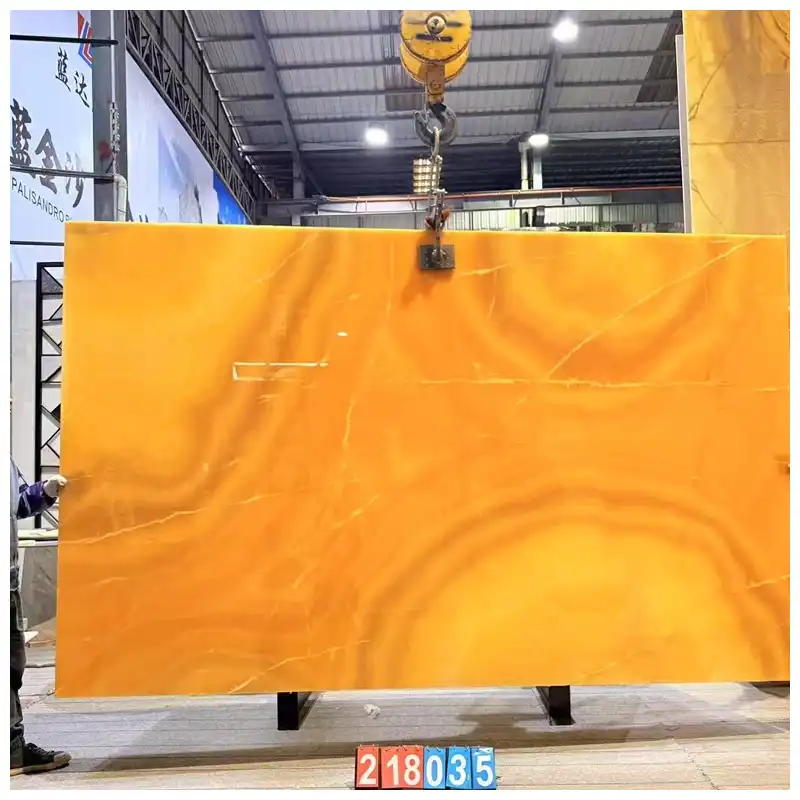
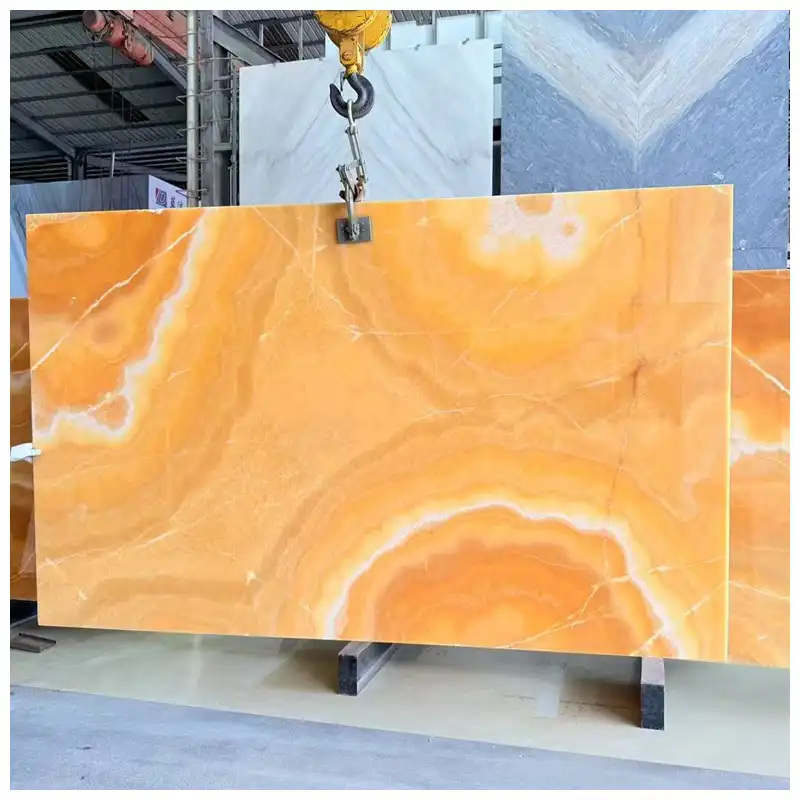
Yellow Honey Onyx natural slab showing honey-orange coloration, broad ivory-white curved bands and layered translucent mineral formations.
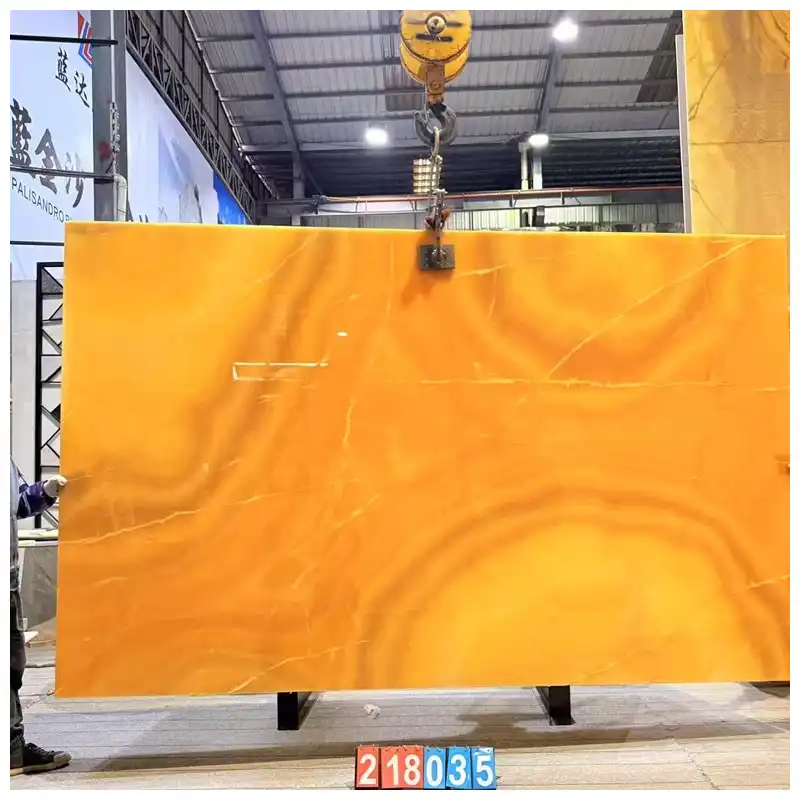
Yellow Honey Onyx Marble Slabs have a distinctive warm mineral palette that ranges from concentrated amber-orange to lighter golden yellow and pale apricot. White calcite-rich bands cross the surface in flowing curves, creating a composition that differs from conventional linearly veined marble.
The photographed slab contains broad orange fields broken by irregular milky-white boundaries. A particularly prominent curved formation rises from the lower section, where successive bands create a layered, almost concentric pattern.
This natural arrangement gives designers two different ways to use the stone. Under ordinary lighting, the surface reads as a richly colored architectural material. When illuminated from behind, sufficiently translucent areas can transmit light and reveal additional depth within the mineral layers.
The resulting appearance depends on the actual stone and lighting assembly. Dense orange areas, pale bands, fissures and any filled sections may transmit different amounts of light. A uniformly bright glow should not be assumed from an unlit slab photograph.
For villa entrance walls, hotel reception features and decorative columns, the main selection priority is the relationship between the slab's natural pattern and the intended illuminated architectural surface.
Yellow Honey Onyx Slab Sizes, Thickness Options and Natural Stone Specifications
| Product Name | Yellow Honey Onyx Marble |
| Commercial Material Category | Natural Honey Yellow Onyx Marble / Banded Calcite Onyx |
| Origin Reference | China; supplying quarry and individual batch provenance subject to confirmation |
| Slab Size A | 198 × 131 cm / 1980 × 1310 mm |
| Slab Size B | 200 × 192 cm / 2000 × 1920 mm |
| Slab Size C | 129 × 107 cm / 1290 × 1070 mm |
| Nominal Thickness | 16 mm / 18 mm / 20 mm |
| Reference Surface Finish | Polished; alternative finishes subject to project and batch confirmation |
| Primary Color Range | Honey orange, golden amber, apricot yellow, ivory white and pale cream |
| Natural Pattern | Flowing white calcite bands, curved mineral layers, irregular amber clouds and locally concentric formations |
| Light Transmission | Naturally variable translucency; backlit appearance must be verified on actual stone |
| Cut-to-Size Processing | Backlit wall panels, column cladding, reception fronts, decorative tiles, selected vanity surfaces and custom interior components |
| Pattern Layout | Single-slab composition, sequential panel layouts and bookmatching where suitable consecutive slabs are available |
| Project Quantity Reference | 3000 SQM; current slab allocation and production availability require confirmation |
| Main Applications | Interior illuminated walls, decorative columns, hotel lobby panels, villa entrance walls, reception counters and custom architectural features |
| Supplier | KA UNITED |
All dimensions refer to supplied slab size references, not guaranteed finished cutting dimensions. Usable area depends on edge trimming, natural fissures, reinforcement, mineral pattern placement and the intended fabrication drawing. Thickness selection must also account for the approved mounting and lighting system.
Honey-Orange Calcite Bands and Concentric White Formations in Yellow Onyx Marble
The most recognizable feature of the supplied Honey Yellow Onyx Slabs is the contrast between broad amber-orange fields and flowing ivory-white mineral bands.
The photographed slab shows several types of natural movement. At the left edge, irregular white boundaries surround rounded orange formations. Across the center, soft apricot and golden layers transition gradually rather than forming sharply divided blocks.
Near the lower portion, a large curved formation is outlined by successive pale mineral bands. These concentric layers create a strong focal area that would be particularly noticeable on a large architectural panel.
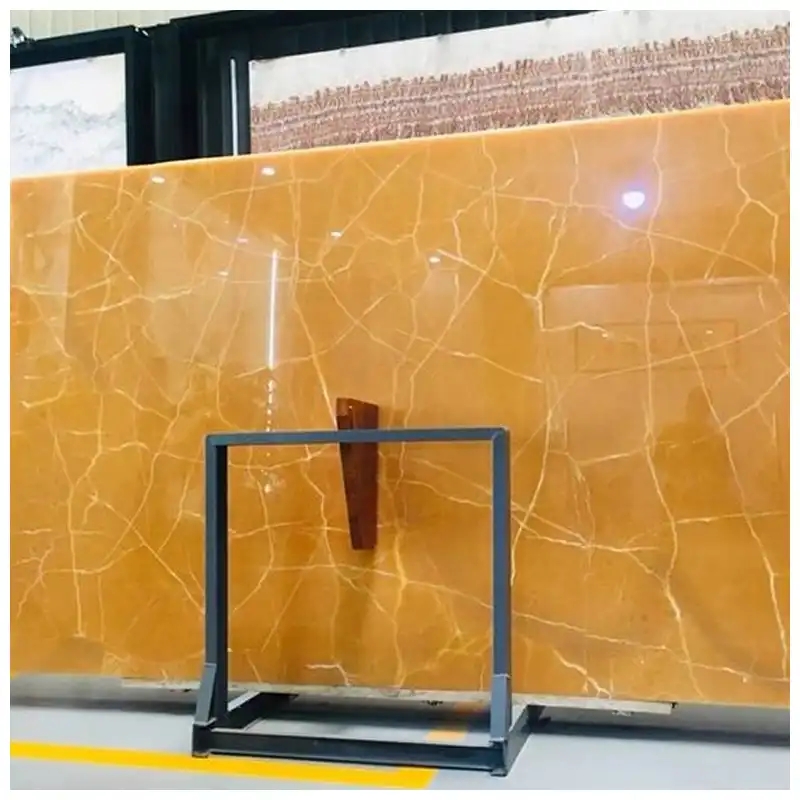
Fine pale lines also cross the broader orange zones. Some may follow mineral boundaries, while others intersect the larger bands. Their structural condition must be assessed separately because appearance alone cannot establish whether a line represents a sound mineral feature, a filled fissure or an opening requiring reinforcement.
From a distance, the stone appears predominantly golden-orange. At close range, its layered calcite structure becomes much more visible. This difference is important when choosing between a full-height wall panel and smaller decorative pieces.
Buyers should review the entire slab under consistent lighting rather than selecting material from small photographs focused only on the brightest honey-colored area.
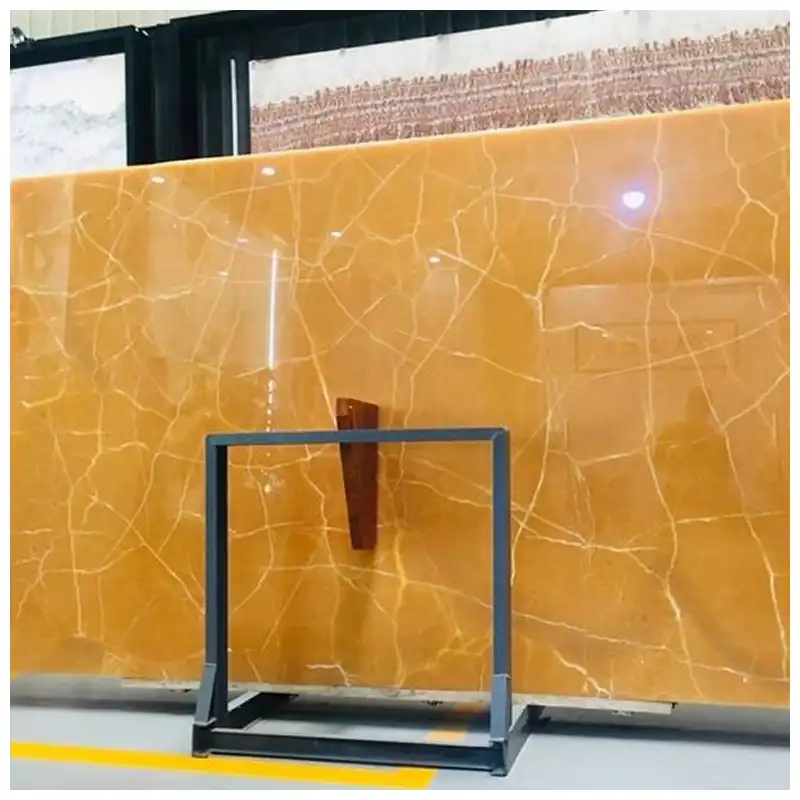
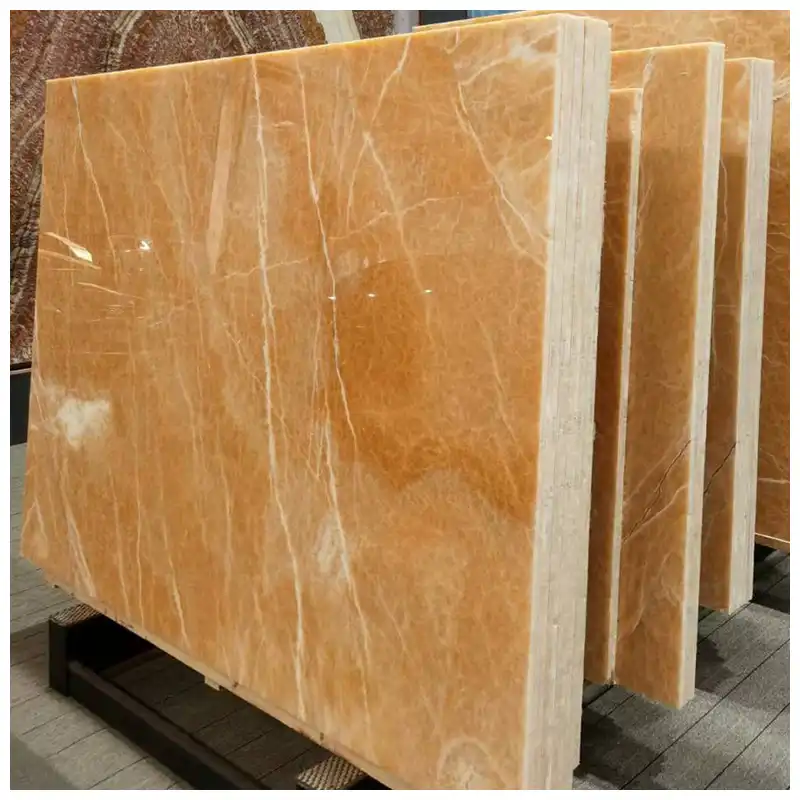
Close-up of Yellow Honey Onyx showing orange calcite layers, ivory-white curved bands and detailed natural mineral transitions.
Choosing 198x131cm, 200x192cm and 129x107cm Onyx Slabs for Architectural Panels
The three available slab references provide different opportunities for preserving the natural pattern within a finished architectural surface. Their dimensions should be evaluated against the panel elevation before a cutting schedule is approved.
| Slab Size | Potential Fabrication Direction | Approval Priority |
|---|---|---|
| 198 × 131 cm | Reception panels, feature-wall sections and large decorative inserts | Determine panel orientation and preserve the most important curved mineral formations. |
| 200 × 192 cm | Broader wall compositions, large illuminated panels and selected bookmatch layouts | Confirm usable cutting area, support arrangement and actual transmitted-light appearance. |
| 129 × 107 cm | Smaller illuminated features, column cladding sections, niches and decorative panels | Review joint positions, pattern scale and panel grouping with adjacent stone. |
The 200 × 192 cm reference provides the broadest nominal cutting area among the supplied sizes. It may reduce the number of visible joints in a large wall design, although natural fissures, slab edges and structural requirements can still limit the dimensions of an individual finished panel.
The smaller 129 × 107 cm reference can be useful where the design consists of separate illuminated modules or several coordinated column panels. A smaller format does not necessarily produce less visual impact if the selected cutting area contains a strong curved honey-white formation.
A cutting overlay should identify the finished dimensions, visible panel face and intended mineral orientation. This is particularly important when the natural bands need to continue visually around a corner or across neighboring wall sections.
How Backlit Yellow Honey Onyx Marble Slabs Create Warm Golden Architectural Lighting
Backlit Onyx Slabs can form illuminated architectural surfaces because portions of their calcite-rich structure transmit light. Honey-colored material is especially suited to warm interior lighting, where orange and golden mineral bands can appear more luminous than they do under ordinary front lighting.
Light transmission is not identical across the full slab. Pale calcite bands may transmit light differently from denser orange mineral areas, and some natural boundaries or filled sections may appear darker when illuminated.
The objective is to create a controlled glowing stone surface rather than expose the individual lighting components behind it. Bright LED points, visible strip patterns and dark support shadows can interrupt the natural appearance.
For a successful installation, the stone, light source, diffusion material, support system and available cavity depth need to be designed together.
| Backlighting Component | Purpose | Project Requirement |
|---|---|---|
| LED Lighting | Illuminates translucent mineral areas | Test light distribution, color temperature, controls and electrical compatibility. |
| Diffusion Layer | Reduces visible individual light sources | Confirm compatibility with the lighting arrangement and available cavity. |
| Lighting Cavity | Provides space for illumination, support and servicing | Determine actual depth, thermal conditions and maintenance access. |
| Stone Backing | Supports the natural onyx panel where required | Check reinforcement strength, translucency and compatibility with the installation system. |
| Fixing System | Secures the stone to the supporting structure | Assess load transfer, fixing locations and visible shadows when illuminated. |
| Service Access | Allows lighting equipment to be inspected or replaced | Provide access without unnecessarily dismantling fragile stone panels. |
Warm-white lighting may strengthen the amber and honey appearance, while a more neutral light can reveal different aspects of the pale mineral bands. The final color temperature should be approved with the actual stone, not selected solely from a generic lighting specification.
Backlit Onyx Marble Slabs should be tested in a representative assembly that includes the intended lighting, diffuser, backing and panel spacing. The accepted reference should show both the illuminated and unilluminated appearance.
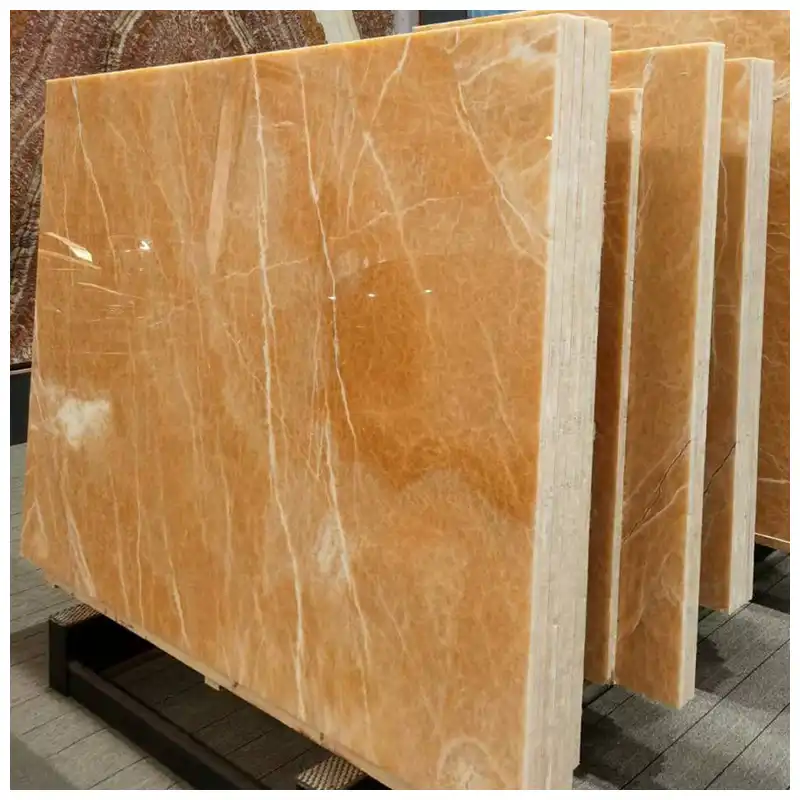
Actual Yellow Honey Onyx backlighting test showing differences in transmitted light across amber and ivory mineral bands.
16mm, 18mm and 20mm Onyx: Thickness Selection for Backlit Wall Panels
Thickness affects both light transmission and fabrication requirements. In general, a thinner onyx section may allow more light to pass through, but the actual result depends on mineral density, natural banding, surface treatment and reinforcement.
The 16 mm option may be considered where transmitted light is a major design priority and the installation includes a suitable supporting system. Its handling and fixing requirements must be evaluated carefully because the reduced thickness alone does not provide sufficient evidence of structural performance.
At 18 mm, the designer can assess a different balance between material thickness and the intended backlighting effect. It should not be assumed that an 18 mm slab automatically produces an evenly illuminated surface.
The 20 mm option provides a thicker stone section, although greater thickness may reduce transmitted light in some mineral areas. The final appearance depends on the selected slab and lighting system rather than thickness alone.
Where a translucent reinforcement or laminated backing is necessary, its thickness and optical properties must be included in the complete panel specification. Conventional opaque mesh, adhesives or reinforcing materials may create visible shadows when placed behind backlit stone.
The correct thickness is the one approved for the stone's actual condition, panel dimensions, supporting structure and lighting design. The three nominal options should be compared using representative illuminated samples before production.
Backlit Honey Onyx Feature Walls: Slab Matching, Visible Joints and Bookmatch Planning
Large honey onyx walls require deliberate panel composition. Broad orange areas and curved white mineral bands can shift dramatically between neighboring slabs, making the approved arrangement an important part of the finished architecture.
A single large slab can preserve a prominent ring-shaped formation without interruptions. When the wall requires several pieces, the panels should be arranged according to the complete elevation rather than installed in an arbitrary sequence.
Bookmatching can be considered when suitable consecutive slabs are available and their cutting orientation produces a useful mirrored composition. The actual matched pair must be reviewed before fabrication; a symmetrical pattern cannot be guaranteed by the commercial material name.
For illuminated walls, matching natural color is only part of the approval process. Two slabs with similar orange tones may transmit light differently. Their appearance should therefore be checked under the proposed lighting conditions.
Panel joints may become more noticeable when the lighting is switched on. Frames, adhesive lines, opaque backing and fixing details can create dark boundaries that are less apparent under ordinary room lighting.
The final elevation drawing should identify the slab sequence, visible joints, returns, corners, electrical components and maintenance access. This gives fabricators and installers a common reference for the completed wall.
Yellow Honey Onyx Column Cladding, Reception Fronts and Decorative Architectural Details
Yellow Onyx Marble Slabs can be processed into smaller decorative components where their translucent mineral structure provides a distinctive alternative to conventional opaque wall stone.
For decorative columns, honey onyx may be fabricated as curved or faceted cladding around a separately designed supporting structure. A complete solid-stone column should not be assumed from a column-cladding specification.
The orientation of the mineral bands is important around corners and curved surfaces. Broad orange formations may appear interrupted if narrow panels are cut without considering the original slab layout.
Reception counters and decorative bar fronts can use illuminated stone faces to introduce a warm focal point at eye level. In these applications, the stone should be protected from direct impact and separated from the functional support system where appropriate.
For recessed wall niches and decorative inserts, smaller onyx pieces can retain prominent mineral details without requiring a complete large-format slab. The surrounding framing should accommodate stone movement, installation tolerances and service access.
Where illuminated onyx is incorporated into commercial interiors, electrical equipment, fire-safety requirements, structural support and any wet-area exposure must be assessed as part of the complete installation system.
Where Yellow Honey Onyx Performs Best: Decorative Walls versus Working Surfaces
The primary commercial value of Yellow Onyx Slabs is their natural color and translucency. Although onyx can be fabricated into several architectural forms, not every application makes equal use of these characteristics or provides the same protection against wear.
| Application | Design Value | Practical Limitation |
|---|---|---|
| Backlit Feature Walls | Displays amber layers and ivory calcite bands with transmitted light | Requires a tested lighting, backing and fixing assembly. |
| Decorative Columns | Creates warm vertical surfaces with coordinated mineral movement | Column curvature, framing and stone-panel connections require review. |
| Reception and Bar Fronts | Illuminated fronts become architectural focal points | Protect vulnerable edges and plan impact exposure. |
| Decorative Wall Niches | Uses smaller stone areas with prominent honey-white formations | Coordinate joints, lighting access and surrounding finishes. |
| Bathroom Vanity Tops | Provides a decorative amber-colored surface | Calcite-rich onyx can etch and needs suitable moisture and cleaning management. |
| Kitchen Countertops | Distinctive natural pattern and optional decorative lighting | Not a preferred heavy-use worktop because of acid sensitivity and vulnerability to impact or scratching. |
| Stairs and Flooring | Possible decorative use subject to specialized design | Wear, breakage, structural capacity and slip performance require project-specific verification. |
Exterior cladding and outdoor paving should not be approved from the commercial onyx name alone. Exposure conditions, fixing systems and material performance need separate technical assessment, and protected interior decorative installations remain the primary design direction.
Yellow Honey Onyx Fabrication, Fissure Inspection and Translucent Panel Quality Control
Honey onyx can contain natural mineral boundaries, fissures, repaired sections and locally different levels of translucency. These characteristics should be inspected before deciding how a slab will be divided into finished panels.
For large decorative walls, the cutting layout should preserve important amber and white bands while avoiding structurally unsuitable areas. Narrow strips around openings and unsupported corners may require reinforcement or a different panel arrangement.
For backlit construction, resin filling, backing mesh and bonding materials need particular attention. Some treatments may be compatible with ordinary wall cladding but produce unwanted dark shadows when illuminated from behind.
Finished panels should be checked for dimensions, actual thickness, edge quality, flatness, surface condition, filled areas and visible processing damage. Natural color variation should be evaluated against the approved slab selection rather than treated as a machining defect.
Where panels form one complete architectural elevation, slab identification and cutting schedules should remain linked to the finished components. This helps retain the selected mineral pattern through packing and installation.
The material should be inspected in both ordinary light and representative transmitted light when the order is intended for illumination. A polished surface alone does not establish the quality of the backlit result.
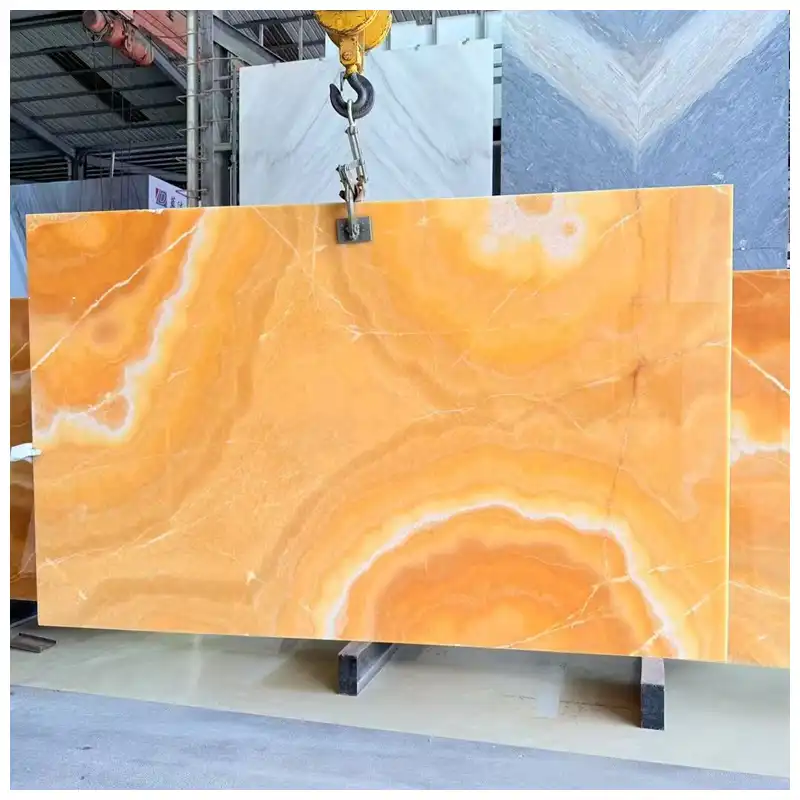
Yellow Honey Onyx fabrication and inspection reference showing panel edges, natural banding, reinforcement and finished surface quality.
3000 SQM Chinese Honey Onyx Supply: Batch Selection and Project Acceptance
Chinese Onyx Marble is an established commercial category that includes honey-colored decorative stone with naturally varied calcite banding. For this Yellow Honey Onyx selection, the supplied quantity reference is 3000 SQM, subject to confirmation of actual available material.
At this scale, buyers need to distinguish visual consistency from identical natural patterning. The production may contain lighter golden slabs, stronger orange material and different proportions of ivory-white mineral bands.
A suitable project approval process should define the acceptable color range and organize slabs according to the intended areas. Prominent entrance walls may require the most carefully coordinated mineral compositions, while smaller decorative components can use compatible offcuts or separate slab groups.
Where illumination is involved, batch approval should also account for differences in light transmission. A visually similar group of unlit slabs may not produce identical brightness when installed over the same lighting system.
Slab numbers, selected elevations, cutting drawings and finished-panel references should remain consistent through production. Each shipment should follow the agreed inspection and packing specifications, particularly for fragile stone edges and translucent surfaces.
The 3000 SQM figure is a purchasing reference and should not be interpreted as verified ready stock or an unconditional monthly supply capacity.
Cleaning and Maintenance of Polished Yellow Honey Onyx Marble Surfaces
Yellow Honey Onyx belongs to a calcite-rich natural stone category and should be treated as sensitive to acidic cleaning products and certain food or drink spills.
Lemon juice, vinegar, acidic descalers and aggressive cleaners may dull or etch the surface. For routine maintenance, use a soft cloth and a suitable pH-neutral natural-stone cleaner.
A penetrating sealer may reduce liquid absorption where appropriate, but it cannot make the stone completely stain-resistant, scratch-proof, waterproof or resistant to acid etching.
For illuminated installations, maintenance also includes the lighting system. Drivers, electrical connections, ventilation and service access should be planned so future servicing does not require unnecessary removal of fragile stone panels.
Any cleaning method should remain compatible with the polished stone, resin treatments, backing materials and surrounding architectural finishes.
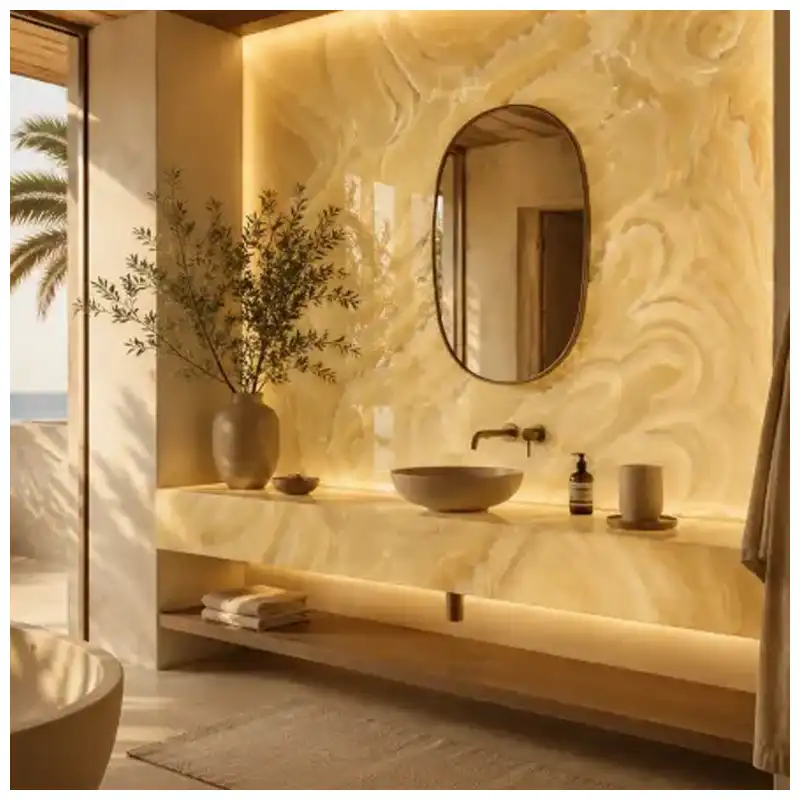
Yellow Honey Onyx used as an illuminated architectural feature wall or decorative interior column in a luxury residential or hospitality setting.
Yellow Honey Onyx in Villa Entrances, Hotel Reception Areas and Illuminated Interior Features
Yellow Honey Onyx has a naturally warm color composition that can become the principal focal surface in an otherwise restrained interior. Its amber-orange fields work well against cream stone, quiet plaster walls, warm timber and darker architectural accents.
In a villa entrance hall, an illuminated onyx wall can establish a clear visual destination. Broad natural mineral bands are especially effective when the stone occupies a large, relatively uninterrupted surface.
Hotel reception areas may use honey onyx behind a service desk or as a selected vertical panel. In these locations, an illuminated feature can remain prominent under lower ambient lighting without requiring highly decorative surrounding surfaces.
For private clubs and boutique commercial interiors, curved or faceted onyx column cladding can introduce a warm vertical accent. The visual effect depends on panel orientation and the relationship between the mineral bands and the proposed lighting.
Designers should also consider the appearance when the lighting is switched off. During daylight or normal operating hours, the stone may read as predominantly orange and cream rather than a glowing architectural surface.
Both states should be approved before fabrication, with the lighting arrangement assessed as part of the completed interior rather than as a separate decorative accessory.
Compare Yellow Honey Onyx with Four Decorative Onyx Slab Alternatives
Yellow Honey Onyx emphasizes saturated amber-orange color and flowing pale bands. The four related KA UNITED onyx selections provide different color directions and visual patterns for decorative stone walls, illuminated features and architectural interiors.
| Selection Factor | Yellow Honey Onyx | Pink Onyx | Ivory Onyx | Tiger Onyx | White Onyx |
|---|---|---|---|---|---|
| Natural Color | Honey orange, golden amber and ivory white | Soft pink and rose-colored mineral areas | Ivory cream and pale neutral mineral tones | Brown, amber and cream with darker contrasting bands | White and pale mineral variations |
| Pattern Direction | Broad curved bands and concentric formations | Variable pink clouds and natural veining | Soft pale banding and crystalline transitions | Strong layered brown and cream movement | Subtle light-colored clouds and mineral bands |
| Design Positioning | Warm golden statement walls and columns | Soft-colored decorative interiors | Neutral illuminated wall features | High-contrast warm decorative panels | Light-toned architectural features |
| Panel Selection Priority | Orange intensity, curved band placement and transmitted light | Pink color range and natural pattern balance | Cream tone and mineral consistency | Dark-light band distribution and slab layout | Pale mineral features and lighting uniformity |
| Backlit Approval | Test actual amber and pale-white mineral zones | Verify color change under the selected light | Check pale-area brightness and visible hotspots | Assess transmission through darker bands | Evaluate light diffusion and support shadows |
This comparison addresses material appearance and design selection. None of these onyx types should be assumed to have identical translucency, strength, absorption or installation requirements without material-specific testing.
Popular Natural Onyx Slabs from KA UNITED

Pink Onyx Slabs
Natural rose-pink onyx with delicate mineral movement for decorative walls, illuminated panels and residential interiors.
View Product
Ivory Onyx Slab
Soft ivory and cream-colored onyx slabs for neutral architectural panels and carefully planned backlit installations.
View Product
Tiger Onyx Slab
Brown and amber onyx with strong contrasting bands for distinctive reception walls and decorative cladding.
View Product
White Onyx Slabs
Light-colored natural onyx with subtle mineral variation for bright feature walls and translucent decorative panels.
View ProductYellow Honey Onyx Backlit Wall and Column Project Specification Checklist
For illuminated architectural stonework, the material approval should establish the actual onyx panels together with the lighting and installation requirements.
- Approved honey-orange color range, white mineral banding and actual slab photographs
- Selected 198 × 131 cm, 200 × 192 cm or 129 × 107 cm slab references
- Confirmed 16 mm, 18 mm or 20 mm nominal stone thickness
- Actual backlit samples under the proposed lighting color and intensity
- Panel elevation, cutting layout, mineral orientation and visible joints
- Natural fissure inspection, resin treatment and reinforcement compatibility
- Lighting cavity, diffuser arrangement, drivers, controls and service access
- Wall or column framing, load transfer and approved fixing system
- Electrical, fire-safety and installation requirements applicable to the project
- Production quantity, panel identification, export protection and delivery schedule
Frequently Asked Questions About Yellow Honey Onyx Marble
Can all Yellow Honey Onyx Marble slabs be illuminated from behind?
Yellow Honey Onyx is a translucent calcite-rich decorative stone, but light transmission varies within and between slabs. Some mineral bands may transmit considerably less light than others. The actual selected material should be tested with the proposed lighting, diffuser and backing system before a backlit installation is approved.
What sizes and thicknesses are available for Yellow Honey Onyx Marble?
The supplied slab references are 198 × 131 cm, 200 × 192 cm and 129 × 107 cm, with nominal thickness options of 16 mm, 18 mm and 20 mm. Actual availability, usable cutting area and suitability for the intended support and lighting system must be confirmed for the selected batch.
Why do some areas of backlit Honey Onyx appear brighter than others?
Natural differences in calcite density, mineral banding, thickness, fissures and resin treatment can change light transmission. Lighting geometry, diffusion materials, backing and fixing shadows can also affect the finished appearance. Both the stone and the complete lighting assembly should be evaluated when investigating uneven brightness.
Can Yellow Honey Onyx Marble be used for kitchen countertops or flooring?
Yellow Honey Onyx can be fabricated into different decorative components, but calcite-rich onyx is sensitive to acidic substances and can be vulnerable to scratching, impact and wear. Protected interior walls and decorative panels are generally more appropriate uses. Kitchen worktops, flooring and stairs require separate assessment of performance, support and maintenance expectations.
What should buyers confirm before ordering 3000 SQM of Yellow Honey Onyx slabs?
Buyers should confirm available slab groups, color variation, sizes, thicknesses, actual translucency, natural fissures, repairs, panel drawings, reinforcement, inspection criteria and export packing. For backlit projects, the lighting and mounting system must also be approved. The 3000 SQM quantity is a project reference and does not independently establish ready stock.
Select Yellow Honey Onyx for Its Curved Amber Bands and Verified Backlit Performance
The principal value of this Yellow Honey Onyx selection lies in its richly colored orange calcite layers and prominent ivory-white curved formations. These features give the stone a distinct identity even before artificial illumination is introduced.
For backlit architectural projects, the final material decision should be based on both visual selection and a representative illuminated assembly. Confirm the usable slab area, 16–20 mm thickness, panel arrangement and compatibility of the lighting and supporting structure before releasing the cutting schedule.

Request Yellow Honey Onyx Marble Slabs for Backlit Walls and Decorative Columns
KA UNITED can review available Yellow Honey Onyx Marble selections for illuminated villa feature walls, hotel reception panels, decorative columns and custom architectural interiors. The supplied slab references include 198 × 131 cm, 200 × 192 cm and 129 × 107 cm, with 16 mm, 18 mm and 20 mm nominal thickness options.
For a quotation, provide the required quantity, slab dimensions, thickness, intended application and delivery destination. If the design includes backlighting, bookmatched panels, curved column cladding or a large multi-panel elevation, include the architectural drawings and lighting requirements so the selected stone, fabrication layout and installation approach can be reviewed together.
| Request Quote | WhatsApp Inquiry |
Hot Tags: yellow honey onyx marble, China yellow honey onyx marble suppliers, factory, Cipollino Ondulato Marble, Colinas Quartzite Slab, Kamarica Green Granite, Les Quatre Saisons Marble, luxury stone craft, Opera D Arte Green Marble
You Might Also Like


Send Inquiry
