

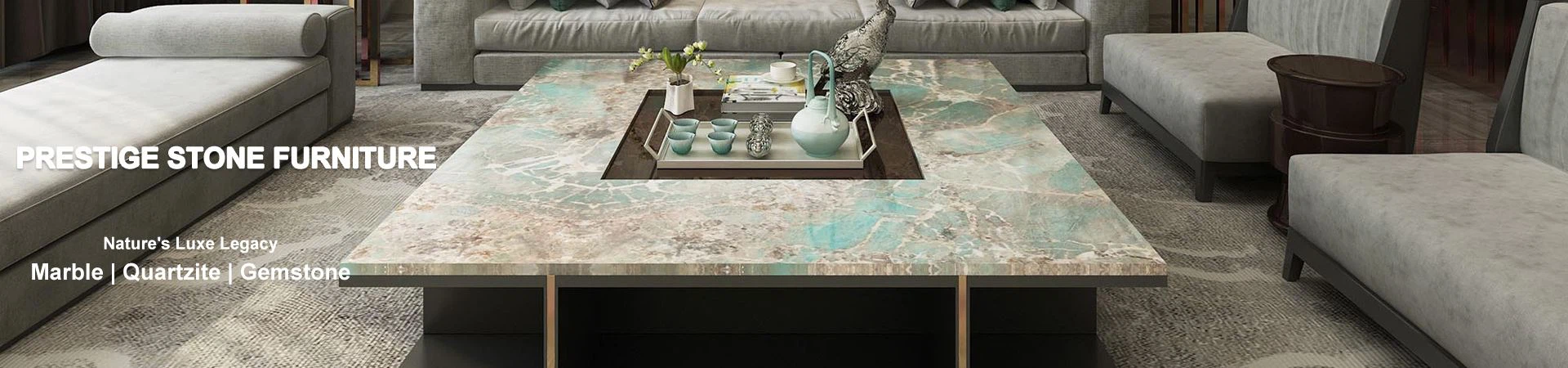

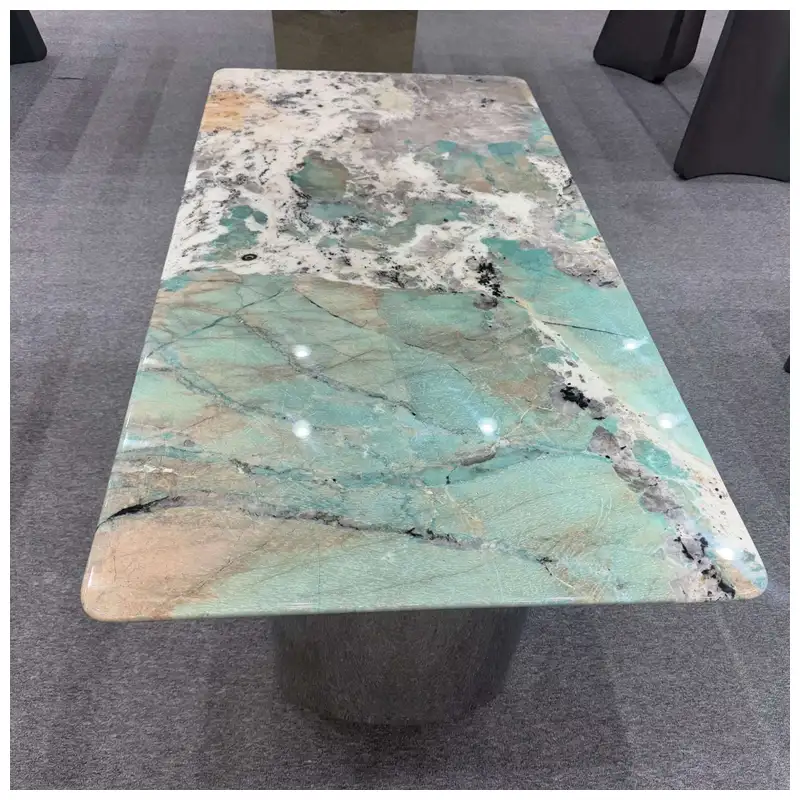
Amazonite Turquoise Quartzite Tables
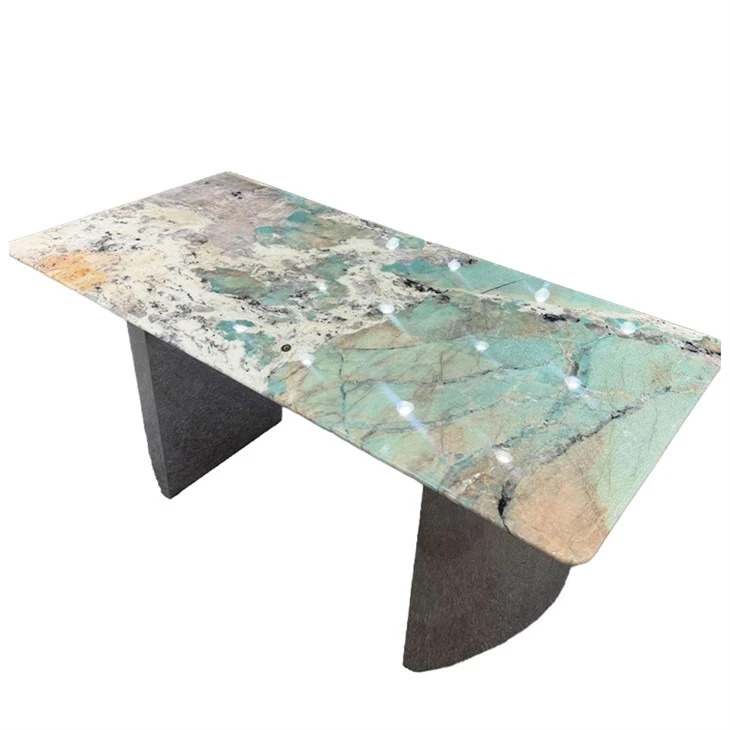
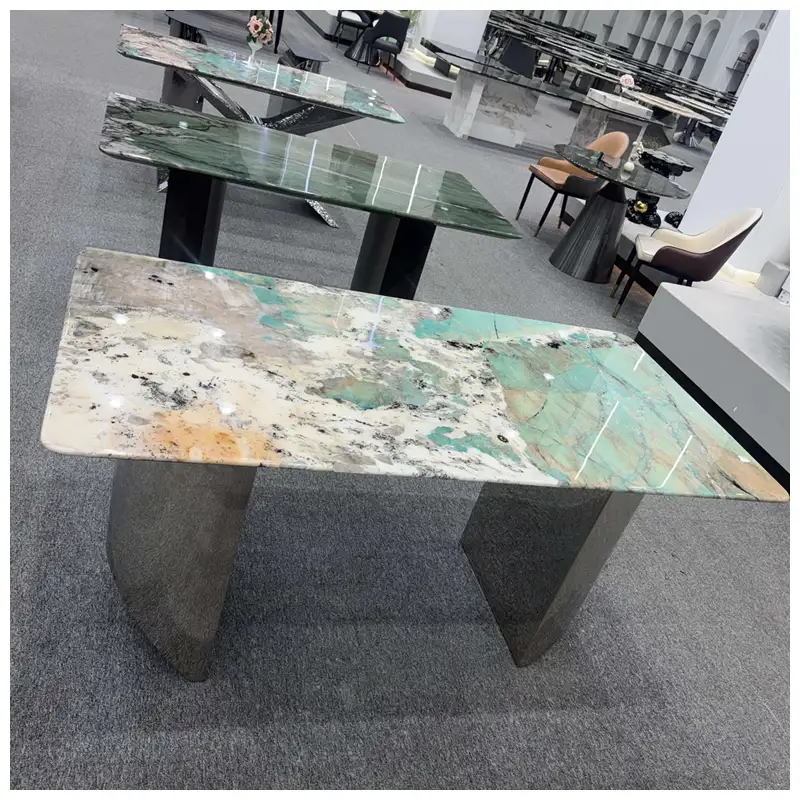
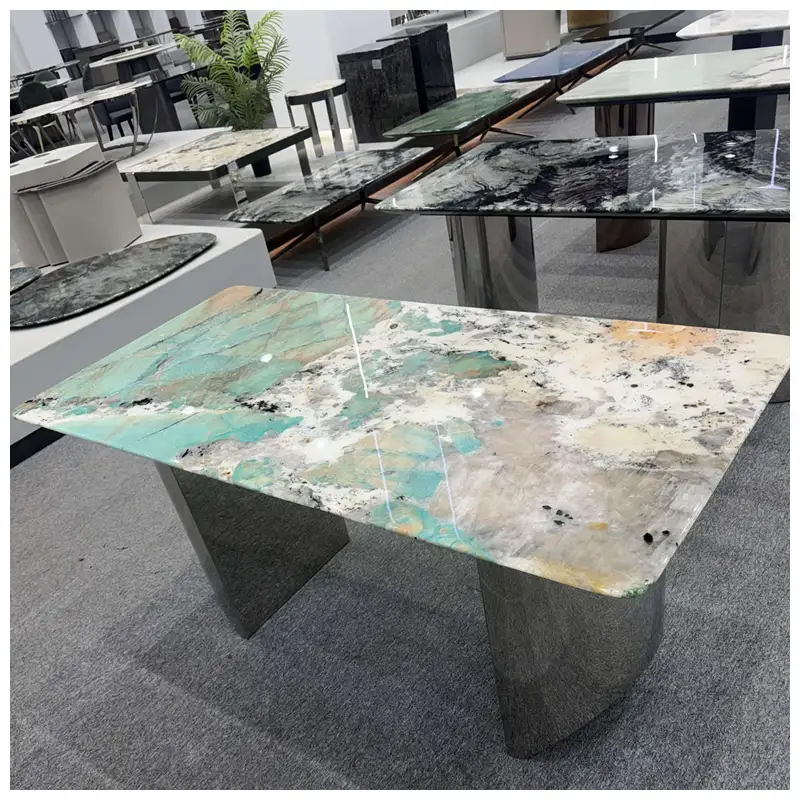
Rectangle Amazonite Turquoise Quartzite tables feature striking turquoise‑green mixed with cream, golden and black mineral veins. Polished glossy quartzite top paired with solid stone legs. Standard rectangle sizes: 160‑240×80‑120cm. Hard‑wearing, stain‑resistant Brazilian natural quartzite. Custom dimensions and edge profiles available. Perfect for villa dining rooms, luxury residences, show home projects for interior designers and private homeowners.
Stone Furniture Item: Rectangle Amazonite Turquoise Quartzite Tables Polished Natural Stone Dining Table for Villa Home Interior
Table Material: Amazonite Green Quartzite, Luxury Quartzite
Dimensions: 180 x 90 x 75 cm,200 x 90 x 75 cm,220 x 100 x 75 cm,240 x 110 x 75 cm. Or Customized
Table Thickness: 18mm, 20mm
Surface: high polished, Crystallized Polished, High Glossy
MOQ: 5 sets
Luxury Stone Table Factory: KA UNITED
Table Usages: Luxury Exotic Quartzite Table Sets are suitable for any interior display in Hotels, VIP room, Villas, Office, Mansion, Coffee Shops, restaurants, and Boutique Stores.
Product Introduction
Quick Summary
Amazonite Turquoise Quartzite Tables are custom natural-stone dining tables developed for luxury villas, apartments, display residences, and statement residential dining spaces. The supplied table references measure 180 × 90cm and 160 × 90cm with a 16–30mm tabletop thickness range, while the reference image shows a rectangular polished top with softly rounded corners, turquoise-green, cream, beige-gold, grey, and dark mineral movement supported by two stone panel-style bases. This custom Amazonite quartzite dining table can be coordinated by size, tabletop thickness, edge profile, stone layout, base geometry, support method, finish, packing, and installation requirements.
|
|
Luxury Natural Quartzite Dining Furniture Luxury Amazonite Turquoise Quartzite Rectangle Dining Table with Custom Stone BaseAmazonite Quartzite Dining Tables are selected when the dining table itself needs to function as a major decorative element. The broad rectangular tabletop allows large turquoise-green and creamy mineral areas to remain visible rather than being fragmented into small decorative pieces. For custom residential projects, final fabrication should be based on the approved tabletop dimensions, actual stone selection, finished thickness, edge profile, base spacing, seating clearance, structural support, finished weight, access route, and installation method.
|

What Defines This Amazonite Quartzite Dining Table?
This table is defined by a large rectangular natural-stone top, softly rounded outer corners, polished surface, and paired stone supports positioned below the tabletop. In the supplied reference image, the support elements read as substantial stone panels rather than conventional narrow metal or timber legs.
Amazonite Green Quartzite Tables are visually distinctive because the stone can combine turquoise-green and pale aqua areas with cream, off-white, grey, beige-gold, and darker mineral markings. The exact balance changes from one natural slab to another.
The polished reference surface increases color depth and makes green and cream mineral areas appear more luminous under interior lighting. Reflection from spotlights and ceiling lights can also become visually prominent on a broad polished tabletop.
Amazonite Quartzite Rectangle Tables work especially well where the interior layout uses a long dining axis, because the elongated tabletop allows natural mineral movement to become part of the room composition.
Green Quartzite Rectangle Dining Tables can be coordinated with neutral upholstery, dark timber, black or bronze metalwork, pale stone floors, warm beige interiors, and contemporary residential furniture without requiring additional ornamental detailing on the table itself.
Natural stone variation is a core part of the product. The actual dining table will not duplicate the reference photograph exactly, so slab selection and tabletop cutting-layout approval are recommended before fabrication.
What Sizes and Thicknesses Are Available of Amazonite Quartzite Dining Tables?
The supplied standard references are 180 × 90cm and 160 × 90cm, with a tabletop thickness reference of 16–30mm. These dimensions can be customized, but the final table size should be coordinated with dining-chair clearance, room dimensions, tabletop span, support geometry, finished stone weight, access route, and installation conditions.
| Reference | Approximate Inches | Project Use | What Must Be Confirmed |
|---|---|---|---|
| 180 × 90cm | Approx. 70.9 × 35.4 inches | Primary dining table for villas, apartments, display homes, private dining rooms, and larger residential layouts | Chair quantity, end clearance, base position, tabletop span, stone selection, weight, transport, and installation access |
| 160 × 90cm | Approx. 63.0 × 35.4 inches | Compact luxury dining spaces, apartments, villas, show residences, and secondary dining rooms | Seating layout, tabletop overhang, base spacing, circulation, door width, lift access, and final table height |
| Thickness | 16–30mm reference | Selected according to design, span, edge treatment, support construction, handling, and finished visual proportion | Actual stone condition, support method, reinforcement if required, underside preparation, edge profile, and safe handling |
| Custom Size | Project specific | Long dining tables, compact dining tables, console-style furniture, private dining rooms, and bespoke residential interiors | Room dimensions, seating plan, stone availability, fabrication yield, support spacing, delivery route, and site installation |
Tabletop Thickness Must Be Coordinated with the Support System
A 16mm, 20mm, or 30mm natural-stone tabletop should not be selected only for appearance. The usable span between stone supports, tabletop length, natural fissures, underside reinforcement, edge construction, finished weight, lifting points, seating overhang, and installation method all affect the final engineering decision. The approved fabrication drawing should show the complete tabletop and base relationship before production.
Verified Product Specifications of Luxury Quartzite Tables
| Product Type | Custom rectangular natural-quartzite dining table |
| Material | Natural Amazonite Turquoise Quartzite |
| Reference Origin | Brazil, according to the supplied product specification |
| Reference Sizes | 180 × 90cm and 160 × 90cm |
| Tabletop Thickness Reference | 16–30mm; final specification subject to stone selection, span, support, edge detail, and fabrication drawing |
| Tabletop Shape | Rectangular with softly rounded corners in the supplied reference image |
| Color Character | Turquoise-green, aqua, cream, off-white, beige-gold, grey, and darker natural mineral movement |
| Reference Finish | High-gloss polished tabletop; alternative finish can be discussed after physical sample approval |
| Base Form | Paired substantial stone panel or slab-style supports as shown in the reference image; final construction method to be confirmed from fabrication drawing |
| Customization | Length, width, tabletop thickness, corner radius, edge profile, stone layout, base dimensions, base spacing, surface finish, support preparation, and packing |
| Primary Applications | Villa dining rooms, luxury apartments, display residences, private dining rooms, high-end residential interiors, and selected hospitality dining spaces |
| View Category | KA UNITED Stone Furniture |
|
Show turquoise-green areas, cream and beige-gold mineral movement, dark flecks, polished reflection, natural fissures, repaired features, edge finish, corner radius, and actual stone variation. |
How Should the Amazonite Green Quartzite Stone Pattern Be Selected?The tabletop should be selected as one complete visual composition rather than by choosing only a small material sample. The reference image shows both pale cream-grey zones and stronger turquoise-green areas across the same top. For a dining table, the visual center can be assigned to the most dramatic turquoise or beige-gold movement, while quieter stone areas may be positioned near table edges or seating positions according to the preferred design. Natural fissures, repaired areas, mineral boundaries, and darker inclusions should be reviewed before finalizing corners, edge profiles, base fixing positions, or other structurally sensitive areas. Full-tabletop photographs or a marked cutting layout provide a more reliable approval basis than a small physical sample alone. |

How Does Tabletop Layout Affect the Finished Dining Table?
Amazonite quartzite can contain strong changes in color over relatively short distances. One end of a slab may be turquoise dominant while another contains more cream, grey, or amber-colored mineral areas.
For a 160–180cm dining top, the factory cutting layout should identify the exact tabletop outline, corner radius, finished edge, base positions, underside fixing zones, and any area that should be avoided because of natural fissures or repairs.
If more than one table is ordered for the same project, the buyer should decide whether the tables should be visually similar or intentionally different. Natural stone cannot provide identical pattern reproduction between separate pieces.
For multiple-unit residential or hospitality projects, numbered tabletop photographs can be approved before packing so each finished table is associated with its selected stone pattern.
This selection process turns natural variation into a design decision rather than an uncontrolled difference discovered after delivery.
How Should the Stone Base and Tabletop Be Engineered Together?The table base is not only decorative; it establishes the support span, seating clearance, stability, and load path of the finished furniture. The reference image shows two broad stone supports positioned inward from the tabletop ends. Final base width, thickness, height, spacing, stone orientation, underside connection, pads, reinforcement if required, and floor contact should be resolved on the fabrication drawing. Moving the bases too far inward can increase tabletop cantilever at the ends, while moving them too far outward may interfere with dining-chair positions. The final location should balance structural support and seating ergonomics. The image visually suggests substantial stone supports, but the exact internal construction, reinforcement, adhesive, concealed hardware, or fabricated assembly method cannot be confirmed from the photograph alone. For this reason, the production drawing should identify the actual base construction and all connection details before manufacturing. |
Show tabletop thickness, rounded corners, edge polishing, underside preparation, stone support geometry, base spacing, concealed connection, floor contact, and fabrication details. |

What Can Be Customized for Residential Dining Projects?
| Custom Item | Available Direction | Buyer Decision Factors |
|---|---|---|
| Table Length and Width | 160 × 90cm, 180 × 90cm, or project-specific rectangular dimensions | Room size, seating capacity, circulation, stone availability, support span, and delivery access |
| Tabletop Thickness | Within the supplied 16–30mm reference range where structurally suitable | Span, base spacing, stone condition, reinforcement, edge profile, finished visual weight, and handling |
| Corner Geometry | Soft rounded corners, larger radius, smaller radius, or sharper rectangular geometry | Interior style, safety, edge durability, chair circulation, polishing method, and tabletop pattern |
| Edge Profile | Straight polished edge, eased edge, rounded edge, bevel, or project-specific profile | Stone thickness, design language, tactile comfort, fabrication, natural fissures, and maintenance |
| Stone Base | Paired stone supports, wider panel bases, narrower supports, alternative stone geometry, or approved custom design | Stability, seating clearance, support span, finished weight, floor loading, fixing, and installation |
| Stone Layout | Turquoise-dominant, cream-green balance, dramatic mineral composition, or project-selected tabletop area | Actual slab, table outline, natural fissures, edge position, base location, visual center, and cutting yield |
| Surface Finish | Polished reference finish or alternative finish after sample confirmation | Color depth, reflection, cleaning, fingerprints, repair visibility, room lighting, and maintenance preference |
Where Are Amazonite Quartzite Dining Tables Best Used?
The table is best suited to interiors where natural stone furniture is intentionally used as a focal point rather than as a neutral background item. Residential dining rooms provide the clearest use case because the full rectangular surface remains visible around place settings and seating.
Luxury Villa Dining RoomsA broad polished Amazonite top can become the primary color feature in dining spaces using neutral upholstery, timber, bronze, black metal, or pale stone flooring. |
Luxury ApartmentsThe 160 × 90cm reference can fit more compact dining zones where a visually strong stone table is required without using an oversized furniture footprint. |
Display ResidencesDistinct turquoise-green stone can create an immediate visual focal point in model homes, show residences, sales galleries, and curated interior presentations. |
Private Dining and Lounge ProjectsCustom dimensions and base geometry can support private dining rooms, residential lounges, premium suites, and selected hospitality dining environments. |
How Does Amazonite Compare with Four Other KA UNITED Quartzite Tables?
Amazonite should be selected primarily for its turquoise-green visual identity and large mineral transitions. The four recommended alternatives below provide different stone-table directions, so the final decision should be based on actual product photographs, current stone selection, table geometry, dimensions, finish, base construction, and the color palette required by the interior project.
| Selection Factor | Amazonite Turquoise Quartzite Table | Fuchsite Crystal Quartzite Table | Avocatus Quartzite Table | Palladium Smeraldo Quartzite Dining Table | Roma Imperiale Quartzite Table |
|---|---|---|---|---|---|
| Primary Selection Identity | Turquoise-green natural stone with cream, beige-gold, grey, and dark mineral movement. | Alternative green crystal quartzite table for buyers comparing another green luxury-stone direction. | Alternative quartzite furniture option for projects comparing different natural slab compositions and color balance. | Alternative Smeraldo quartzite dining-table direction for buyers seeking another statement green-toned table concept. | Alternative quartzite table for projects prioritizing a different natural-stone palette and decorative character. |
| Reference Product Form | Rectangular polished tabletop with softly rounded corners and paired stone panel-style supports in the supplied reference image. | Dining-table product; confirm current tabletop shape, base style, dimensions, and finish from the related product specification. | Quartzite table product; confirm current tabletop geometry, support form, dimensions, and surface finish before comparison. | Dining-table product; confirm current shape, size, support design, and fabrication specification for the project. | Quartzite table product; confirm current tabletop design, dimensions, base construction, and finish before order. |
| Customization Focus | Turquoise stone layout, rectangular dimensions, corner radius, thickness, edge profile, stone supports, base spacing, and polished finish. | Actual Fuchsite slab selection, table dimensions, tabletop layout, base design, edge treatment, and finish. | Actual Avocatus slab selection, tabletop shape, dimensions, support design, stone layout, and edge details. | Actual Smeraldo quartzite selection, dining-table dimensions, tabletop composition, base geometry, and finish. | Actual Roma Imperiale slab selection, dimensions, stone composition, base design, edge profile, and project positioning. |
| Buyer Approval Priority | Approve the exact turquoise-green tabletop area, natural fissures, edge condition, base spacing, support method, weight, and room access. | Approve the actual material, finished dimensions, stone pattern, base structure, fabrication drawing, and packing. | Approve the actual material, table design, dimensions, structural support, natural variation, and installation plan. | Approve the exact tabletop selection, dining dimensions, base construction, finished weight, and site installation conditions. | Approve the actual slab, shape, edge, base geometry, overall dimensions, weight, and transport route. |
| Project Positioning | Best where turquoise-green natural stone should become the dining room's dominant visual feature. | Best for buyers evaluating another distinctive green quartzite furniture direction. | Best where the design requires an alternative exotic quartzite character rather than Amazonite turquoise coloration. | Best where a different green statement quartzite is required for the dining environment. | Best where another quartzite color and pattern direction better matches the project's interior palette. |
What Should Buyers Approve Before Fabrication?
A custom natural-stone dining table should not enter production from only a product photograph and nominal size. The complete order should close the material, furniture geometry, structural interface, delivery route, and installation requirements before cutting begins.
- Approve the actual Amazonite quartzite slab or marked tabletop area before cutting.
- Confirm the final table length, width, overall height, tabletop thickness, and corner radius.
- Confirm the acceptable turquoise-green, cream, beige-gold, grey, and dark mineral range.
- Review natural fissures, resin-treated areas, repairs, mineral boundaries, and edge locations before fabrication.
- Confirm the tabletop edge profile and whether the finished thickness is the actual slab thickness or includes fabricated edge construction.
- Approve base dimensions, base spacing, support geometry, underside connection, floor contact, and any concealed reinforcement or hardware.
- Confirm chair positions and seating clearance so the stone supports do not conflict with normal dining use.
- Confirm the finished table weight or lifting plan when required for delivery, site handling, or floor-loading review.
- Measure doors, corridors, staircases, lifts, turning spaces, and final room access before approving oversized one-piece components.
- Approve the polished reference finish or alternative finish using a representative physical sample.
- Complete factory trial assembly where the tabletop and stone supports use project-specific connections.
- Use separate component codes for tabletop, left support, right support, hardware, pads, and installation accessories.
- Do not promise identical natural patterns between several tables or future material batches.
How Should Factory QC and Packing Be Managed?The finished tabletop should be checked against the approved drawing for overall size, corner radius, thickness, edge profile, surface finish, stone pattern, natural fissures, repaired areas, and base connection preparation. The two stone supports should be checked for height, width, thickness, squareness, floor contact, orientation, finish, and compatibility with the tabletop connection system. A factory trial assembly is useful for custom furniture because it verifies base spacing, tabletop level, component fit, visual proportion, and the intended finished appearance before shipment. Packing should isolate the tabletop from the stone supports and protect polished faces, corners, rounded edges, connection areas, and vulnerable natural stone features from direct impact. Pre-shipment records can document finished dimensions, tabletop pattern, component codes, trial assembly, surface condition, packing arrangement, and crate condition. |
Show table dry assembly, dimension checking, base spacing, surface inspection, edge QC, component coding, foam protection, wooden crates, or loading preparation. |

How Should an Amazonite Quartzite Dining Table Be Maintained?
Use a soft cloth and a pH-neutral cleaner formulated for natural stone for routine cleaning. Loose grit should be removed before wiping the polished tabletop because abrasive particles can produce fine surface marks.
Natural quartzite is commonly selected for comparatively hard stone surfaces, but the actual table should not be described as scratch-proof, stain-proof, or heat-proof without verified test data for the specific material and finish.
Use trivets or protective pads under very hot cookware, and avoid dragging metal, ceramic, or rough-bottomed objects directly across the polished top.
Wine, oil, sauces, coffee, pigments, cosmetics, and cleaning chemicals should be removed promptly. Their effect can depend on the exact stone, surface treatment, resin, sealer, exposure time, and maintenance history.
A compatible penetrating sealer may reduce absorption and provide additional time for cleaning. It does not make the table waterproof, stain-proof, scratch-proof, heat-proof, or maintenance-free.
Cleaning products and sealers should be tested on a discreet area or representative sample before being applied across the complete tabletop.
What Does the Table Look Like in a Finished Residential Dining Room?This image position should show the complete Amazonite quartzite table inside a finished villa, luxury apartment, display residence, dining room, or private residential interior. A useful project photograph should include the full tabletop, stone supports, dining chairs, floor finish, pendant lighting, surrounding furniture, wall colors, artwork, and circulation around the table. The objective is to show how the turquoise-green natural stone performs at room scale and how the stone base works with actual seating rather than presenting only an isolated furniture product. |
Use a completed villa dining room, luxury apartment, display residence, private dining space, or premium residential interior showing the entire table in context. |

Recommended Quartzite Tables from KA UNITED
KA UNITED offers four related quartzite-table options for projects comparing Amazonite with other natural-stone furniture directions. Fuchsite Crystal Quartzite Tables provide another green luxury-stone choice for buyers who want a strong mineral character in dining furniture. Avocatus Quartzite Tables offer an alternative exotic quartzite option where the actual slab composition and room palette should drive selection. Palladium Smeraldo Quartzite Dining Tables provide another statement green-toned direction for residential and hospitality dining spaces. Roma Imperiale Quartzite Tables expand the comparison toward a different quartzite color and pattern language. Together with Amazonite, these products allow designers, contractors, and homeowners to compare actual stone selection, table proportions, tabletop geometry, base design, finish, natural variation, delivery requirements, and project positioning before approving custom furniture.
Fuchsite Crystal Quartzite TablesA related green quartzite furniture direction for villas, apartments, residential dining rooms, and other luxury stone-table projects. View More |
Avocatus Quartzite TablesAn alternative exotic quartzite table option for custom residential interiors where natural slab selection and furniture design are both important. View More |
Palladium Smeraldo Quartzite Dining TablesA statement quartzite dining-table alternative for designers comparing different green stone palettes, tabletop proportions, and custom furniture concepts. View More |
Roma Imperiale Quartzite TableA related natural-quartzite furniture option for projects requiring a different stone pattern and color direction from Amazonite turquoise quartzite. View More |


FAQ About Amazonite Turquoise Quartzite Tables
1. What sizes are available for Amazonite Turquoise Quartzite dining tables?
The supplied reference sizes are 180 × 90cm and 160 × 90cm, with a 16–30mm tabletop thickness reference. Custom dimensions can also be discussed according to the dining-room layout, seating capacity, stone selection, base spacing, support requirements, delivery access, and approved fabrication drawing.
2. Will every Amazonite quartzite tabletop have the same turquoise-green pattern?
No. Natural Amazonite quartzite varies in turquoise-green, aqua, cream, beige-gold, grey, dark mineral markings, fissures, and repaired features. Buyers should approve the actual slab or marked tabletop area when color distribution and pattern placement are important.
3. Can the tabletop thickness and edge profile be customized?
Yes. The supplied thickness reference is 16–30mm, and edge profiles can be customized according to the design. Final thickness and edge construction should remain compatible with the tabletop span, stone condition, base spacing, underside support, reinforcement if required, handling, and installation method.
4. Can the stone base design and spacing be customized?
Yes. Base width, height, thickness, geometry, spacing, stone orientation, and connection method can be developed according to the approved table design. The final base arrangement should provide suitable tabletop support while preserving chair clearance, stability, floor contact, and practical installation access.
5. Is Amazonite quartzite scratch-proof and stain-proof for daily dining use?
No natural-stone table should be described as completely scratch-proof or stain-proof without verified testing for the specific material and finish. Use pH-neutral stone cleaners, remove spills promptly, avoid dragging rough objects across the polished surface, use protection under very hot cookware, and follow the selected sealer and maintenance recommendations.
6. What should be approved before custom table production begins?
Approve the actual Amazonite quartzite, tabletop cutting area, final length, width, height and thickness, corner radius, edge profile, stone base dimensions, base spacing, support and connection method, surface finish, natural variation range, trial-assembly requirement, finished component coding, packing plan, delivery route, destination, and installation method.
Final Product Overview
Amazonite Turquoise Quartzite dining tables combine large-scale turquoise-green natural stone with a simple rectangular furniture form, allowing the mineral pattern to remain the principal decorative feature. Successful execution depends on actual stone approval, correct tabletop span and thickness, coordinated stone-base geometry, controlled edge fabrication, suitable support, trial assembly, protected packing, verified site access, and professional installation.

Request a Custom Amazonite Quartzite Dining Table ProposalSend KA UNITED the required table length, width and height, tabletop thickness, preferred edge profile, stone pattern preference, base dimensions, seating plan, quantity, delivery access information, destination, and project schedule.
|
Inquiry Checklist1. Confirm table length, width, and height. 2. Confirm tabletop thickness. 3. Select the Amazonite stone range. 4. Confirm corner and edge design. 5. Confirm base dimensions and spacing. 6. Confirm delivery and installation access. 7. Provide destination and schedule. |
Hot Tags: amazonite turquoise quartzite tables, China amazonite turquoise quartzite tables suppliers, factory
You Might Also Like




Send Inquiry
