



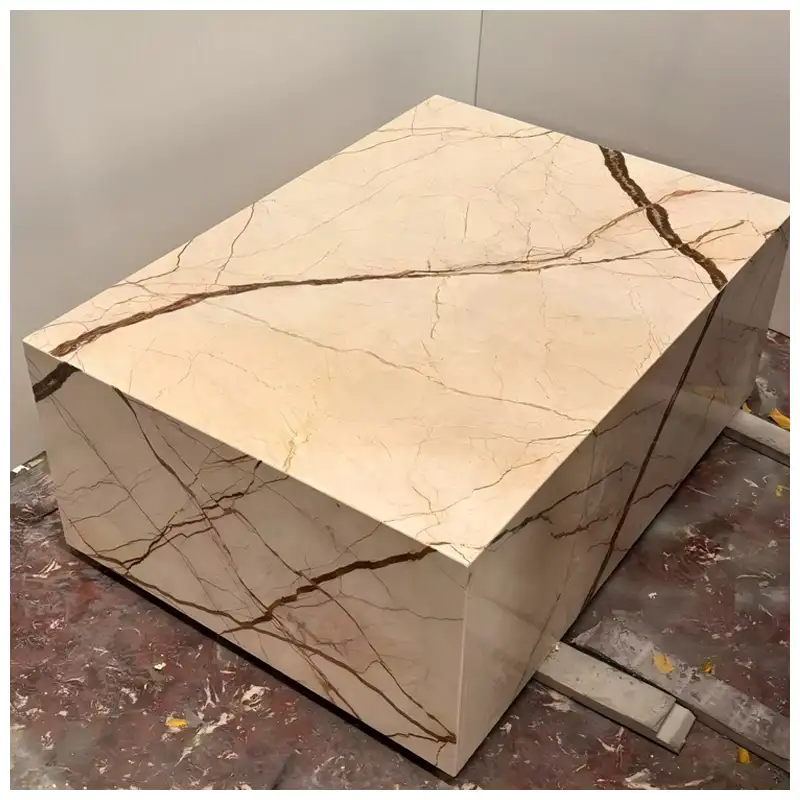
Travertine Plinth Table
This low rectangular beige travertine plinth table is carved from a solid natural travertine block. It retains the classic porous texture and warm beige natural veins of travertine, presenting minimalist rustic-luxury aesthetics. The all-in-one solid stone structure offers outstanding stability and durability. Ideal as coffee tables, display plinths or side tables in villas, boutique hotels and residential lounges. Custom dimensions, polished / honed surface finishes are available to match diverse interior design styles.
Stone Furniture Item: Luxury Low Rectangular Beige Travertine Plinth Table, Natural Travertine Solid Block Side Table for Hotel & Mansion Projects
Table Material:Beige Travertine, 100% Natural Travertine
Dimensions: 11.81'' H X 39.4'' L X 23.6'' W. Or Customized
Table Thickness: 18mm, 20mm
Surface: high polished, Crystallized Polished, High Glossy
MOQ: 5 sets
Luxury Stone Table Factory: KA UNITED
Table Usages: Luxury Exotic Quartzite, Onyx, and Natural Marble Table Sets are suitable for any interior display in Hotels, VIP room, Villas, Office, Mansion, Coffee Shops, restaurants, and Boutique Stores.
Product Introduction
Quick Summary
Travertine Plinth Table is a low-profile natural-stone furniture design developed for villa living rooms, hotel lobbies, boutique hospitality interiors, private lounges, reception areas, galleries, and luxury residential projects. Beige travertine provides a warm cream-to-sand color range with linear mineral movement, open pores, cavities, and subtle tonal transitions. The supplied references include a 1000 × 600 × 350mm rectangular coffee table and several compact square plinth formats ranging from approximately 201 × 201 × 500mm to 300 × 300 × 600mm. KA UNITED can customize the length, width, height, surface finish, pore treatment, edge profile, internal construction, underside protection, and packing method according to the approved furniture drawing.
|
|
Low Rectangular Natural Stone Furniture Low Rectangle Beige Travertine Plinth Tables for Villa and Lobby InteriorsBeige Travertine Plinth Tables combine a simple geometric silhouette with the visible pores, layered bands, and warm mineral tones of natural travertine. The restrained block form works as a coffee table, low display pedestal, side table, sculpture base, or architectural furniture element. The reference design is described as a solid-block construction. Final production drawings should confirm whether each model is carved from one complete block or fabricated using coordinated stone sections, depending on the selected size, weight, transport method, and project requirements.
|

Product Overview of Travertine Plinth Side Tables
Beige travertine is a natural calcite-based stone characterized by warm ivory, cream, sand, pale beige, and light taupe tones. Linear bedding, cloudy mineral layers, open pores, narrow cavities, and occasional darker markings create the material's architectural character.
The low rectangular format emphasizes horizontal proportion and material mass. Instead of relying on decorative legs or a complex base, the design uses a simple stone volume that can sit comfortably within modern, minimalist, Mediterranean, wabi-sabi, organic-modern, and quiet-luxury interiors.
Travertine Low Plinth Tables work particularly well with boucle seating, linen upholstery, leather, pale timber, walnut, bronze, blackened metal, textured plaster, limewash walls, natural rugs, and neutral stone flooring.
Every travertine block or slab varies in tone, pore distribution, bedding direction, cavity size, mineral concentration, and repaired areas. An approved sample establishes the general color and finish, but it cannot guarantee that every table will have an identical pattern.
For multi-piece villa or hotel orders, material can be grouped within an approved tonal range. Project teams should still expect natural differences between coffee tables, side tables, display plinths, and replacement pieces.
Dimensions and Weight References of Travertine Stone Plinth Tables
| Reference Model | Dimensions | Approximate Imperial Size | Reference Weight |
|---|---|---|---|
| Low Rectangular Coffee Table | 1000 × 600 × 350mm | 39.4 × 23.6 × 13.8 inches | Confirm from final construction |
| Tall Square Reference | 300 × 300 × 525mm | Approximately 11.8 × 11.8 × 20.7 inches | Not supplied |
| Small Square Plinth | Approximately 201 × 201 × 500mm | 7.9 × 7.9 × 19.7 inches | Approximately 57lb / 25.9kg |
| Medium Square Plinth | Approximately 300 × 300 × 500mm | 11.8 × 11.8 × 19.7 inches | Approximately 82lb / 37.2kg |
| Large Square Plinth | Approximately 300 × 300 × 600mm | 11.8 × 11.8 × 23.6 inches | Approximately 97lb / 44kg |
Reference Weights Must Not Be Applied to Every Construction
The supplied weights relate to specific compact plinth references. The final weight of a 1000 × 600 × 350mm coffee table can vary substantially according to whether the table is a true solid block, partially hollowed, assembled from stone panels, reinforced internally, or fabricated with another approved method. Packing, floor loading, lifting equipment, and installation planning must use the confirmed production weight.
Specifications at a Glance of Beige Travertine Low Rectangle Plinth Tables
| Product Type | Natural travertine coffee table, plinth table, side table, or display pedestal |
| Material | Natural beige travertine |
| Color Character | Ivory, cream, sand, pale beige, and light taupe with linear bedding and natural pores |
| Primary Reference Size | 1000 × 600 × 350mm / 39.4 × 23.6 × 13.8 inches |
| Additional Formats | Square side-table and display-plinth formats from approximately 201 × 201 × 500mm to 300 × 300 × 600mm |
| Custom Dimensions | Custom length, width, height, wall thickness, internal construction, and floor-contact detail |
| Shape Options | Low rectangle, square block, tall plinth, side table, pedestal, or project-specific geometric form |
| Construction Options | Confirmed solid-block carving, hollowed block, mitred stone-panel construction, or engineered furniture assembly |
| Surface Options | Honed, polished, brushed, or approved project-specific finish |
| Pore Treatment | Natural open pores, partially filled pores, fully filled surface, or approved mixed treatment |
| Edge Options | Straight eased, lightly chamfered, softened, radiused, mitred, or drawing-specific edges |
| Underside Options | Stone base, recessed plinth, protective pads, concealed levellers, or project-specific floor interface |
| Applications | Villa lounges, living rooms, hotel lobbies, suites, reception spaces, galleries, boutiques, and private clubs |
| View Category | KA UNITED Stone Furniture |
|
Show warm beige coloration, linear bedding, open or filled pores, honed texture, edge finish, and approved natural variation. |
Warm Beige Color and Natural Pore StructureTravertine's open cavities and layered mineral bands distinguish it from uniform manufactured furniture surfaces. These natural features create shadow, depth, and tactile variation across the top and vertical faces. Vein-cut material produces stronger linear banding, while cross-cut material can show softer cloudy formations. The selected cutting direction should be confirmed according to the desired visual effect. Open pores create a more natural and textured appearance. Filled surfaces provide a flatter touch and may simplify routine cleaning, although the filler color, sheen, and long-term compatibility must be approved. A physical sample should show the accepted background range, pore size, cavity distribution, filling method, surface finish, and edge treatment before bulk production. |

Furniture Form and Construction Method of Travertine Low Plinth Tables
Beige Travertine Rectangle Block Plinth Tables use a disciplined geometric form that makes the stone mass, surface texture, and proportions the primary design elements. The 1000 × 600 × 350mm reference provides a broad, low surface suitable for living-room seating groups and lounge arrangements.
A genuine one-block table offers continuous material through the body but may create substantial weight, reduced internal flexibility, and greater handling requirements. Availability also depends on obtaining a block with sufficient usable dimensions and acceptable internal structure.
An assembled stone-panel table can reproduce the same block-like appearance with reduced weight and greater control over dimensions. Mitred corners, internal reinforcement, backing panels, and concealed junctions must be fabricated carefully so the piece retains a clean monolithic visual effect.
A hollowed block is another possible construction direction. It retains more continuous natural stone around the visible exterior while removing selected internal mass. The remaining wall thickness and lifting points require engineering review.
The quotation, fabrication drawing, product description, weight calculation, and installation instructions should all identify the actual approved construction rather than using "solid block" as a general visual description.
Low Coffee Table and Compact Side-Table FormatsBeige Travertine Plinth Coffee Tables provide a broad surface for books, trays, decorative objects, flowers, and living-room accessories. The low 350mm height is suited to contemporary lounge seating but should be checked against the actual sofa seat height. Travertine Plinth Side Tables use a narrower square format for placement beside armchairs, sofas, beds, reception seating, or sculptural displays. The supplied compact models have greater height relative to width and therefore require stable floor contact. A collection can combine one low rectangular centerpiece with matching square side plinths. Color range, bedding direction, finish, pore treatment, and edge detail should be coordinated without expecting exact duplication. Table dimensions should remain compatible with circulation routes, seating clearances, door openings, elevator access, and the intended visual proportion of the room. Tall narrow plinths used for sculpture or display pieces require a separate stability review based on the top load, center of gravity, floor level, and public access. |
Show the low rectangular proportions, square plinth formats, edge geometry, top dimensions, height relationship, and floor-contact profile. |

Surface Finish and Pore Treatment of Travertine Tables
| Finish Direction | Visual Effect | Project Considerations |
|---|---|---|
| Honed | Low-reflection matte surface with soft beige color and quiet natural texture | Suitable for wabi-sabi and organic-modern interiors; physical sample should confirm smoothness and color depth |
| Polished | Higher reflection with deeper color and stronger definition of mineral bands | May show fingerprints, water marks, surface wear, and etching more visibly |
| Brushed | Tactile low-gloss texture with softened edges around pores and mineral layers | Cleaning response and pore treatment should be tested before approval |
| Open-Pore | Most natural appearance with visible cavities and deeper texture | Small items, liquid, dust, and food residue can collect in cavities; best suited to approved decorative use |
| Filled | Flatter surface with reduced cavity depth and more controlled daily cleaning | Filler color, shrinkage, repair visibility, finish compatibility, and long-term maintenance must be approved |
Custom Plinth Table Options
| Custom Item | Available Direction | Details to Confirm |
|---|---|---|
| Overall Dimensions | Custom length, width, and height for coffee, side, pedestal, or display use | Room scale, sofa height, circulation, top load, floor condition, access route, and installation method |
| Construction | Solid block, hollowed block, mitred panels, reinforced shell, or project-specific furniture structure | Stone availability, finished weight, wall thickness, reinforcement, joints, packing, lifting, and visual requirements |
| Stone Orientation | Vein-cut linear direction, cross-cut cloudy pattern, horizontal banding, or coordinated face allocation | Actual material, usable dimensions, top orientation, vertical faces, corners, pores, and approved layout |
| Surface Finish | Honed, polished, brushed, or approved custom texture | Lighting, reflection, tactile feel, pore appearance, cleaning, repair visibility, and physical sample |
| Pore Treatment | Open, partially filled, fully filled, or mixed natural treatment | Furniture use, cleaning expectations, filler color, cavity size, surface level, and accepted natural texture |
| Edge Profile | Eased, chamfered, softened, radiused, sharp architectural edge, or drawing-specific profile | User contact, circulation, stone structure, surface finish, corner protection, and fabrication tolerance |
| Underside Detail | Flat stone base, recessed shadow gap, concealed plinth, felt pads, rubber pads, or adjustable feet | Floor material, levelling, moisture, furniture movement, weight distribution, and visible base line |
| Coordinated Collection | Coffee table, side tables, display plinths, consoles, benches, and matching stone furniture | Material allocation, color range, cutting direction, finish, dimensions, room schedule, and delivery sequence |
Factory Fabrication and Underside PlanningThe production method begins with selecting a block or slab group that can provide the required usable dimensions, color range, bedding direction, and natural-feature distribution. For a solid or hollowed block, the factory must inspect the material for internal fissures, weak cavities, repaired sections, and sufficient wall thickness. For panel construction, mitred corners, backing, internal reinforcement, and concealed joints require separate control. The underside should protect the finished floor and distribute weight evenly. Felt or rubber pads may suit some residential interiors, while concealed levellers can assist on floors with limited variation. The final unit should be inspected for dimensions, level, corner alignment, visible joints, pore treatment, finish consistency, underside protection, stability, and packing readiness. Confirmed weight, lifting orientation, safe support points, and unpacking instructions should be recorded before shipment. |
Show block cutting, internal hollowing, mitred-panel assembly, pore filling, edge finishing, underside pads, levellers, or dimensional inspection. |

Interior Applications of Low Rectangle Travertine Plinth Coffee Tables
Villa Living RoomsA low rectangular travertine table anchors sofas, lounge chairs, rugs, and neutral residential furniture without requiring a visually complex base. |
Hotel Lobbies and LoungesCoffee tables, side plinths, and decorative pedestals can be coordinated across reception areas, seating groups, suites, and public lounges. |
Boutiques and GalleriesSquare or rectangular stone blocks can support product displays, sculpture, floral arrangements, books, or curated decorative objects. |
Private Clubs and HospitalityCustom plinth furniture supports private lounges, reception areas, club rooms, resort interiors, and premium waiting spaces. |
Beige Travertine Tables can be coordinated with matching consoles, dining tables, benches, side tables, fireplace surrounds, wall panels, and architectural stone details. Matching should be treated as a controlled natural range rather than exact duplication across every furniture piece.
Travertine Plinth Table and Recommended Stone Table Comparison
| Selection Factor | Beige Travertine Plinth Table | Cosmic Gold Granite Block Table | Rosso Levanto Marble Plinth Table | Sofitel Gold Marble Low Table | Verde Patagonia Quartzite Plinth Table |
|---|---|---|---|---|---|
| Appearance | Warm cream and beige travertine with pores, linear bands, and quiet natural variation. | Dark granite with gold, brown, bronze, and pale mineral movement. | Deep burgundy-red marble with contrasting white vein networks. | Warm gold-toned marble with layered beige, brown, and pale mineral movement. | Green quartzite with dramatic pale crystal areas and expressive landscape-like patterning. |
| Visual Intensity | Low-to-medium intensity for calm, warm, and organic interiors. | Medium-to-high intensity with darker contrast and metallic-looking mineral movement. | High intensity due to the saturated red background and bright white veins. | Medium intensity with warm golden movement and decorative stone character. | Very high intensity with green and pale crystal contrasts. |
| Best-Fit Interior | Wabi-sabi, Mediterranean, minimalist, organic-modern, resort, and neutral villa interiors. | Dark luxury villas, hotel lounges, executive interiors, and warm metallic schemes. | Boutique hotels, dramatic residential lounges, wine-colored interiors, and statement spaces. | Warm hotel lobbies, luxury residences, lounges, and gold-accented interiors. | Collectible interiors, artistic villas, designer hotels, and nature-led statement rooms. |
| Surface Character | Naturally porous with open or filled cavities and soft linear mineral layering. | Dense crystalline granite surface with strong dark mineral structure. | Smooth decorative marble surface with visible veining and acid sensitivity. | Decorative marble surface with warm layered coloration and natural variation. | Crystalline quartzite surface with irregular large-scale green and pale formations. |
| Selection Priority | Pore treatment, beige range, bedding direction, construction method, weight, and floor protection. | Dark pattern placement, block quality, gold movement, construction, and polished finish. | Red tone, white-vein layout, fissures, repairs, edge placement, and marble care. | Gold tone, mineral movement, surface finish, visible face allocation, and room coordination. | Crystal distribution, structural fissures, slab or block yield, reinforcement, and feature placement. |
| Project Positioning | Best for understated natural texture and warm architectural furniture. | Best for darker furniture with gold-toned mineral drama. | Best where burgundy marble should become the primary accent. | Best for warm gold-toned luxury and decorative lobby furniture. | Best where dramatic green natural stone should function as collectible furniture. |
Material Selection and Project Risk Control
- Approve current stone photographs showing the beige range, bedding direction, pores, cavities, fissures, repaired areas, and usable dimensions.
- Confirm whether the selected table is a true solid block, hollowed block, stone-panel assembly, or another engineered construction.
- Issue final millimetre drawings showing the length, width, height, wall thickness, internal structure, edges, underside, and floor-contact detail.
- Confirm the actual finished weight before approving floor loading, packing, lifting, delivery, and installation methods.
- Review whether vein-cut or cross-cut travertine is required and identify the intended direction on the top and vertical faces.
- Approve open, partially filled, or fully filled pores with the selected honed, polished, or brushed finish.
- Confirm the edge profile and corner softness according to circulation, user contact, stone structure, and furniture placement.
- Provide protective pads, levellers, or a recessed underside compatible with the finished floor material.
- Check doorway, elevator, corridor, stair, crane, and final-room access before approving a large solid or assembled unit.
- Complete dimensional, level, stability, finish, pore-treatment, edge, underside, and packing inspection before shipment.
- Retain installation photographs and final weight records for replacement, future movement, or coordinated furniture orders.
- Do not drag the finished table across timber, marble, tile, terrazzo, or other sensitive flooring.
Packing, Delivery, and Placement
A solid or heavy travertine plinth requires reinforced packing with full base support, protected corners, surface separators, lifting instructions, confirmed weight, and clearly marked support points.
Panel-built furniture must also be protected from twisting or concentrated impact around mitred corners and concealed internal joints. Crate restraints should support the unit without placing excessive pressure on finished edges.
The table should remain upright in the approved transport orientation unless the production team specifies another handling method. Open pores and finished faces must be protected from dirty packing materials, water, metal, adhesive, and construction debris.
Before delivery, confirm the crate size, forklift or crane requirements, doorway clearance, elevator capacity, corridor turns, floor protection, installation team, and final furniture position.
Once placed, the unit should sit level with even floor contact. Protective pads or levellers must remain correctly positioned so the furniture weight is not concentrated on one corner.
Care and Maintenance
Clean the travertine with a soft non-abrasive cloth, clean water, and a pH-neutral cleaner formulated for natural stone. Remove dust, grit, and hard particles before wiping the surface.
Use coasters, trays, placemats, and protective pads beneath drinks, decorative objects, ceramics, metal accessories, planters, candles, and other items that may scratch, stain, heat, or discolor the stone.
Blot wine, coffee, oils, fruit juice, sauces, cosmetics, and colored liquids promptly. Open pores and natural cavities can retain residue if spills are not removed quickly.
Avoid vinegar, citrus cleaners, aggressive descalers, abrasive powders, rough pads, concentrated alkaline chemicals, and unapproved solvents. Travertine is calcium-based and can etch when exposed to acids.
A compatible penetrating sealer may reduce absorption and provide more response time for cleaning. It does not make the stone waterproof, stain-proof, acid-proof, scratch-proof, or maintenance-free.
Inspect pore filler, corners, edges, underside pads, levellers, internal support, and floor contact periodically. Heavy furniture should be moved only by trained handlers using an approved lifting method.
Villa and Hotel Interior Project ReferenceThis image position can show the low rectangular plinth table in a villa lounge, hotel lobby, boutique suite, reception space, gallery, private club, or contemporary living room. A useful project photograph should show the table's scale relative to the sofa, chairs, rug, flooring, lighting, decorative objects, circulation area, and surrounding interior materials. The completed setting should demonstrate how the warm beige stone supports the room composition without relying on exaggerated decoration or visually complex furniture construction. |
Use a completed villa, hotel, lobby, lounge, gallery, or residential installation showing the table scale and surrounding furniture. |

Recommended Luxury Stone Plinth Tables from KA UNITED
KA UNITED offers four related stone-plinth directions for villas, hotel lobbies, private clubs, lounges, galleries, and luxury residential interiors. Cosmic Gold Granite Block Coffee Table introduces a dark surface with bronze and gold mineral movement. Rosso Levanto Marble Plinth Coffee Tables use deep burgundy stone with dramatic white veins. Sofitel Gold Marble Low Plinth Tables provide a warmer gold-beige decorative palette. Verde Patagonia Quartzite Plinth Tables feature expressive green and pale crystal formations for statement furniture. Together with beige travertine, these options allow designers and project buyers to compare color intensity, pore structure, natural pattern, surface finish, construction method, finished weight, maintenance, and the visual role of each table within the complete interior scheme.
Cosmic Gold Granite Block Coffee TableDark granite block furniture with gold, bronze, and pale mineral movement for luxury lounges and contemporary interiors. View More |
Rosso Levanto Marble Plinth Coffee TablesBurgundy-red marble plinth tables with bold white veins for boutique hotels, villas, and dramatic living spaces. View More |
Sofitel Gold Marble Low Plinth TablesWarm gold-toned marble low tables for hotel lobbies, villa lounges, receptions, and decorative luxury interiors. View More |
Verde Patagonia Quartzite Plinth TablesGreen quartzite block tables with pale crystal formations for artistic villas, designer hotels, and statement interiors. View More |



FAQ About Beige Travertine Plinth Tables
1. Is every beige travertine plinth table carved from one solid block?
Not necessarily. A table may be carved from a complete block, hollowed from a block, or fabricated from coordinated stone panels with mitred corners and internal reinforcement. The approved production drawing should identify the actual construction because it affects weight, handling, visible joints, packing, and installation.
2. Can the natural pores be filled for easier cleaning?
Yes. Travertine can be supplied with open, partially filled, or more fully filled pores. Filling creates a flatter surface, while open pores retain a more natural texture. The filler color, cavity depth, finish, repair visibility, and intended furniture use should be approved from a physical sample.
3. Can the 100 × 60 × 35cm coffee table be customized?
Yes. Length, width, height, edge profile, finish, pore treatment, internal construction, underside detail, and floor protection can be customized. The final dimensions should consider sofa height, room scale, circulation, stone availability, finished weight, access restrictions, and installation method.
4. Are the listed 57lb, 82lb, and 97lb weights valid for all models?
No. These figures relate to specific compact square plinth references. The weight of a rectangular coffee table or customized model depends on dimensions, wall thickness, construction method, internal hollowing, reinforcement, pore structure, and stone density. Final handling plans should use the confirmed production weight.
5. Does sealing make a travertine coffee table stain-proof?
No. A compatible penetrating sealer may reduce absorption and provide more time to remove spills, but it cannot make travertine stain-proof, acid-proof, scratch-proof, or maintenance-free. Coasters, trays, prompt cleaning, and pH-neutral stone-care products are still required.
6. What should be approved before production begins?
Approve the final dimensions, actual travertine range, cutting direction, construction method, finished weight, surface finish, pore treatment, edge profile, underside protection, lifting points, access route, inspection requirements, packing plan, destination, and placement method.
Final Product Overview
The beige travertine plinth table combines a restrained block form with warm natural color, visible pores, and architectural mineral layering. Successful production depends on confirming the actual construction, finished weight, pore treatment, edge detailing, floor protection, and delivery method before fabrication.

Request a Custom Beige Travertine Plinth Table ProposalSend KA UNITED the required dimensions, room layout, furniture use, construction preference, surface finish, pore treatment, edge profile, floor material, quantity, access restrictions, destination, and project schedule.
|
Inquiry Checklist1. Confirm table dimensions. 2. Select construction method. 3. Approve travertine range. 4. Confirm finish and pore treatment. 5. Define edge and underside details. 6. Confirm access and lifting method. 7. Provide destination and schedule. |
Hot Tags: travertine plinth table, China travertine plinth table suppliers, factory
You Might Also Like


Send Inquiry
