


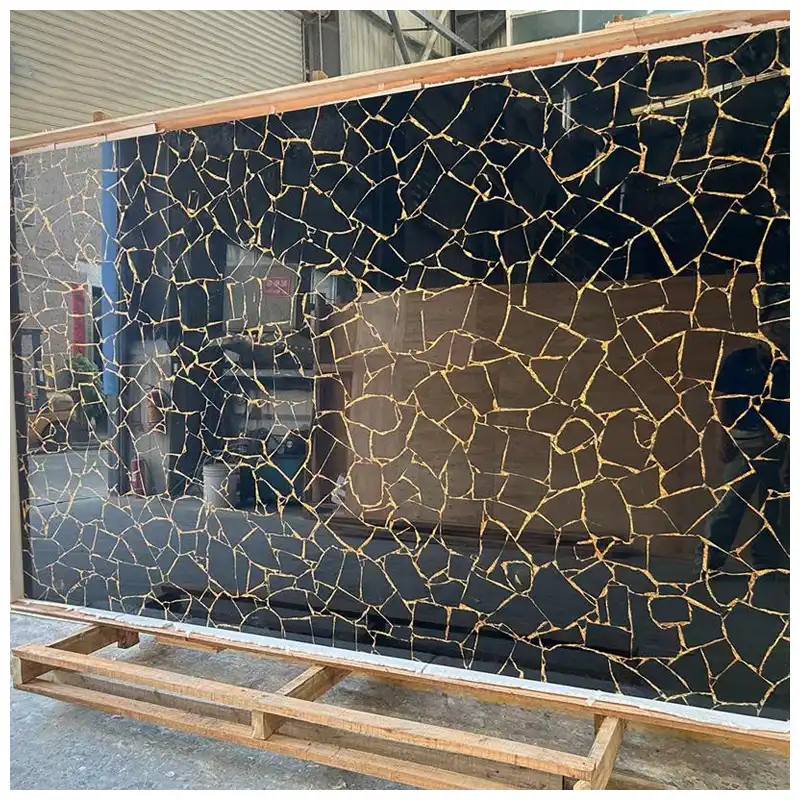


Black Obsidian Slab
Handcrafted semi-precious black obsidian gemstone slabs with high-gloss polished finish. Resin-bonded solid structure, optional gold resin inlay for premium look. Custom sizes and thicknesses available. Ideal for feature walls, countertops and high-end commercial & residential projects. Factory direct supply for designers and contractors.
Quartzite Item: Semi-Precious Black Obsidian Gemstone Slabs Custom Cut for Luxury Villa and Hotel Interior Projects
Quartzite Stone: Black Obsidian, Obsidian Black Gemstone
Slab Size: 2300x1900, 3180x1890mm, etc.
Thickness: 20, 30 mm
Surface: Polished, Honed, and brushed
MOQ: 300 SQM
Quartzite Slabs And Countertop Factory: KA UNITED
Application: 60+ luxury exotic Quartzite/Quartz Stones in KA UNITED Factory For Private Home, hotels, villas, apartments, and other commercial estate properties
Product Introduction
Quick Summary
Black Obsidian Slab is a polished semi-precious decorative surface assembled from selected dark obsidian pieces, with an optional gold-toned resin inlay that draws a fine network between the irregular black fragments. Supplied formats range from 12″ × 12″ sample or tile scale up to approximately 140″ × 70″ / 355 × 180cm panels, with cut-to-size processing for feature walls, counters, bar fronts and luxury interior surfaces. For Black and Gold Gemstone Slabs, the main approval points are fragment scale, gold-joint distribution, gloss level, final cutting layout and-where illumination is specified-the actual response of the finished panel under the proposed lighting system.
|
|
Semi-Precious Obsidian · Polished Surface · Gold-Tone Inlay Option · Custom Cut-to-Size Black Obsidian Gemstone Slabs with Gold Inlay for Feature Walls, Counters and Luxury InteriorsThe supplied factory slab shows an almost jet-black field built from hundreds of irregular obsidian pieces. Narrow warm-gold joints define every fragment, producing a fractured mosaic pattern that remains graphic from a distance while revealing much finer variation at close range. Black Obsidian Gemstone Slabs are particularly useful when a project needs a dark architectural surface with more depth than plain black stone. The panel can be fabricated around wall dimensions, countertop geometry, furniture components or bar-front elevations, but the final cutting position should be approved before the most attractive fragment composition is committed to production. View Luxury Stone Collection |

The Gold Joint Network Turns a Black Obsidian Panel into a Large-Scale Graphic Surface
The design value of this material comes from the contrast between two elements: large dark fragments and the fine gold-colored network around them. Unlike conventional veined stone, there is no single directional vein running through the slab. Instead, the pattern behaves more like an irregular mineral mosaic.
Fragment sizes vary across the panel. Some areas contain broad black shapes, while others are filled with smaller angular pieces. This prevents the slab from looking mechanically repetitive and gives each fabricated panel a different balance.
The gold-toned joints become more noticeable under direct lighting and reflected light from the polished surface. In a darker interior they create a restrained metallic outline; under brighter lighting they can become a stronger decorative feature.
For a large feature wall, designers should approve not only the black tone but also the density and distribution of the gold lines, because those joints control how busy or restrained the installed elevation will appear.
|
Show polished black fragments, joint width, gold-tone inlay, edge detail and reflected surface gloss. |
What Should Be Approved in the Black-and-Gold Pattern?Start with fragment scale. A slab dominated by larger black pieces looks calmer, while smaller fragments create a denser, more decorative field. Next, review the gold-colored infill. Narrower lines keep black visually dominant; broader or more frequent joints increase the metallic character. For adjoining panels, compare the overall pattern density rather than trying to force an artificial vein match. This surface is based on irregular fragments, so natural-looking coordination is more realistic than perfect mirror continuity. The polished sample should also be viewed under the intended interior lighting because strong reflections can make the gold network appear brighter than it does under normal factory light. |

Black Obsidian Slab Sizes, Tile Formats and Custom Fabrication
| Specification | Supplied Reference | What the Buyer Should Confirm |
|---|---|---|
| Product Form | Bonded semi-precious obsidian gemstone panel | Confirm intended use as full slab, cut-to-size panel, tile, counter or furniture component. |
| Minimum Reference Size | 12″ × 12″ / approximately 30 × 30cm | Useful for samples, smaller tiles and decorative inserts. |
| Maximum Supplied Reference | Up to approximately 140″ × 70″ / 355 × 180cm | Final achievable panel size should be confirmed against current production stock, handling and project geometry. |
| Tile References | 12″ × 12″, 12″ × 24″, 24″ × 24″, 24″ × 48″ and custom sizes | Select tile module according to wall elevation, joint layout and handling requirements. |
| Surface | Polished | Approve gloss, reflection level and the appearance of the bonded joints. |
| Thickness | Project-specific | Confirm thickness together with backing, application, panel size, support and edge treatment. |
| Lighting Option | Project-specific illuminated or backlit construction where suitable | Do not assume the black fragments will glow uniformly; test the actual panel and joint construction. |
| MOQ | 10 sets | For repeated panels, establish an approved black/gold visual range before bulk fabrication. |
Construction note: this product should be treated as a fabricated semi-precious gemstone surface made from obsidian fragments and bonding/inlay material, not as one monolithic block of black obsidian. Final performance depends on the complete panel construction, backing, support, cutout geometry, edge treatment and installation method.
Large Feature Walls Need the Slab Layout Approved Before Final Panel Cutting
On a feature wall, several panels are normally read together as one architectural composition. That makes the cutting plan more important than the appearance of any one slab.
The factory can first establish the wall elevation, panel widths, joint locations and openings for doors, niches, switches or other architectural elements. The obsidian slabs are then allocated against that drawing so major gold-joint clusters are not accidentally lost in cutouts.
For very large elevations, it is useful to avoid placing every strong gold area in the same corner. A more balanced distribution creates a calmer installation without trying to make the irregular pattern artificially symmetrical.
Panel numbering should follow the installation drawing. This prevents individually attractive pieces from being installed in the wrong position after shipment.
With Obsidian Black Slabs, the most successful wall projects usually come from planning the full elevation first and cutting the gemstone second.
Countertops Require More Structural Planning Than Decorative Wall Panels
Horizontal use introduces concentrated loads, cutouts and exposed edges that a wall panel does not experience in the same way. Sink openings, cooktops, faucet drilling and unsupported overhangs therefore need to be resolved before fabrication.
Where the surface is used for a bar or vanity counter, the supporting cabinet or frame should carry the panel evenly. Large unsupported spans and small point connections should not be assumed suitable simply because the finished slab appears rigid.
Cutouts should be positioned against the actual black-and-gold layout so visually important fragment groups are not removed unnecessarily. Inside-corner geometry should follow the approved fixture template and fabrication method rather than an arbitrary sharp square corner.
For kitchen use, the material should be handled as a premium bonded gemstone surface. Use boards for cutting, trivets below hot cookware and suitable support around appliances and sink openings.
Edge Design Should Match the Panel Construction, Not Just the Interior Style```A simple polished edge keeps the dark fragment pattern visually direct, while a built-up edge can give counters or furniture a heavier architectural profile. However, edge selection should be made after confirming the actual panel thickness and backing construction. Decorative geometry cannot be separated from how the bonded surface is supported. On exposed waterfall returns or bar fronts, the relationship between top edge, vertical panel and gold-joint pattern becomes particularly noticeable. Any laminated build-up should be reviewed in a sample or fabrication drawing so the seam does not create an unexpected dark or resin line. The finished detail should look intentional from normal viewing distance while remaining practical for transport and installation. |
Show polished edge, bonded panel construction, backing, cutout finishing and support detail. |

Backlighting Black Obsidian Should Be Tested as a Contrast Effect, Not Assumed to Produce an Even Glow
The black fragments in the supplied slab are visually dense. A lighting concept should therefore begin with a real mock-up rather than expecting the full black surface to illuminate like pale agate or translucent onyx.
Depending on the selected panel construction, lighter joints, resin areas or thinner translucent zones may respond differently from the black obsidian pieces. The result can be a dark surface with illuminated accents rather than a uniformly glowing slab.
That contrast can work especially well for reception walls, bar fronts and luxury retail installations where the objective is atmospheric lighting instead of task illumination.
LED spacing, diffuser choice, cavity depth and supporting frame all affect the outcome. Structural members placed directly behind brighter zones can become visible as dark shadows once the panel is powered.
For backlit Luxury Black Gemstone Slabs, the approved mock-up should use the actual obsidian/resin construction planned for the project, not a different translucent gemstone sample.
|
Show black fragment opacity, any illuminated resin or joint zones, LED spacing, diffuser and support-frame shadows. |
Where Does Illuminated Black Obsidian Work Best?Bar fronts are a natural application because the panel can be read from a distance while electrical components remain accessible from behind the counter. Reception desks can use the same concept selectively on the guest-facing surface rather than lighting every horizontal worktop. Feature walls are suitable where a shallow service cavity can accommodate LEDs, wiring and replaceable drivers without interfering with the architectural finish. Furniture panels can also use accent illumination, but heat management, wiring access and attachment points need to be integrated into the furniture structure. The illumination strategy should always follow the actual transparency test of the production panel. |

Black Obsidian Creates Different Interior Effects with Gold, Brass, Timber and Pale Stone
Warm brass and champagne metal reinforce the gold inlay and make the slab more decorative. Matte black hardware produces a quieter effect because fittings visually disappear into the dark fragments.
Walnut and smoked oak soften the hard black-and-gold contrast and work well in bars, studies and residential entertainment spaces. Light oak moves the same slab toward a more contemporary interior.
Ivory limestone, cream travertine and restrained off-white wall finishes provide strong contrast without introducing another complicated pattern. Highly veined marble can work, but two dominant stone patterns should be coordinated carefully.
This is why Black Obsidian Slab often works best as the visual anchor of a room rather than one of several equally strong decorative surfaces.
Where Black Obsidian Slabs Add the Most Design Value
Hotel Lobby Feature WallsLarge dark elevations use the gold-joint pattern to create detail without relying on conventional marble veining. |
Luxury Bar FrontsGuest-facing vertical panels make the black-and-gold pattern visible while allowing optional lighting equipment to remain accessible behind. |
Retail Display InteriorsThe deep black background works well behind jewelry, cosmetics and premium products that require a high-contrast setting. |
Custom Counters & FurnitureCut-to-size obsidian can be developed for reception counters, console fronts, table surfaces and bespoke interior furniture. |
Full Slab, Cut-to-Size Panel or Tile: Which Format Fits the Project?
| Order Form | Best Use | Approval Priority |
|---|---|---|
| Full Slab | Local fabrication, slab inventory or projects that need flexible cutting after material approval. | Overall pattern density, actual slab size, surface finish, backing and packing method. |
| Cut-to-Size Wall Panel | Feature walls, lobby cladding, reception fronts and decorative architectural elevations. | Panel numbering, elevation layout, joints, openings, edge exposure and fixing system. |
| Counter / Furniture Component | Bar tops, vanities, counters, table surfaces and custom furniture. | Support, cutouts, edge profile, connection points, overhangs and handling. |
| Tile | Smaller wall modules, decorative bands and projects that prefer repeatable installation units. | Tile calibration, joint width, pattern mix and installation layout. |
"Semi-Precious Obsidian Slab" Describes the Finished Composite Surface More Accurately Than a Solid Stone Block
The finished panel uses individual dark obsidian fragments assembled into a larger decorative slab. Buyers should therefore distinguish the fabricated architectural product from a single naturally occurring block.
This distinction matters for cutting, support, backlighting and care. A bonded gemstone panel behaves as a system: obsidian pieces, resin or inlay, backing where used, edge treatment and installation support all contribute to the final result.
Procurement teams may encounter naming variants such as Smei-Precious Obsidian Slabs in sourcing lists; the intended product category is semi-precious obsidian architectural slabs.
The most useful specification is therefore not the marketing name alone, but the actual approved construction drawing and production sample.
Black Obsidian vs. Four KA UNITED Gemstone Slab Directions
These alternatives move from bright translucent agate to crystalline amethyst and darker banded gemstone surfaces.
| Selection Factor | Black Obsidian Slab | Yellow Agate Slab | Amethyst Gemstone Slabs | Pink Agate Slab | Black Agate Slab |
|---|---|---|---|---|---|
| Pattern | Irregular fractured black pieces with optional gold-tone joint network. | Golden-yellow and cream concentric agate sections. | Purple crystalline fragments with natural tonal variation. | Pink concentric agate slices with softer warm color. | Dark agate rings with more visible concentric banding than fractured obsidian. |
| Visual Mood | Dark architectural, graphic and contemporary. | Warm, bright and decorative. | Jewel-like purple statement surface. | Soft decorative luxury with pink tonal character. | Dark gemstone look with recognizable agate rings. |
| Lighting Direction | Best treated as a contrast-lighting project; actual black fragments may remain visually dense. | Strong candidate for luminous backlit feature applications. | Illumination emphasizes crystalline purple areas. | Backlighting creates a softer pink-gold effect. | Lighting response varies between dark rings and more translucent sections. |
| Strongest Application | Feature walls, bar fronts, reception counters and dark luxury interiors. | Backlit walls, counters and decorative panels. | Luxury counters, vanity tops and statement walls. | Residential feature panels and warm hospitality interiors. | Dark decorative walls, counters and gemstone furniture. |
| Buyer Approval Priority | Fragment scale, gold-joint distribution, cut layout, backing and lighting mock-up. | Agate color distribution, ring scale and light transmission. | Crystal composition, purple range and translucency. | Pink range, ring balance and illuminated appearance. | Ring pattern, dark-tone consistency and panel construction. |
Factory QC Should Separate Natural Pattern Variation from Fabrication Defects
Irregular fragment size is part of the intended aesthetic. It should not be treated as a defect simply because one area contains larger pieces than another.
QC should instead focus on issues that affect the finished component: incorrect dimensions, damaged edges, unintended chips, poor polish, visible fabrication scratches, incorrect drilling and panel warping outside the approved requirement.
Gold-inlay appearance should also be compared with the approved sample, especially for multiple slabs used in one room. A major change in gold tone can make adjoining pieces feel unrelated even when the black fragments are similar.
Where lighting is part of the project, the illuminated test becomes a separate QC stage. The panel may look acceptable unlit but reveal structural shadows or unexpected bright areas after LEDs are switched on.
For cut-to-size orders, every component should be coded to the approved drawing before protective packing begins.
|
Show slab inspection, cut-to-size checking, panel coding, edge protection and export packing. |
Large Obsidian Panels Need Packing Designed Around the Finished ComponentA full slab and a narrow fabricated wall panel do not have the same transport risk, so one packing method should not automatically be applied to every order. Polished faces need separation from adjacent panels, and exposed edges should not be allowed to contact metal straps or hard crate components directly. Cutouts increase handling sensitivity. Countertops with sink or appliance openings should be supported so the narrow material beside those openings is not carrying unnecessary transport load. Numbered components should remain visible or traceable after packing so installation crews can identify panel sequence without unpacking an entire shipment. The packing plan should be reviewed together with panel dimensions and destination handling conditions. |

Risk-Control Checklist for Black Obsidian Slab Orders
- Approve the overall black tone and acceptable fragment-size range.
- Confirm whether the project requires monochrome black joints or gold-tone inlay.
- Approve the gold color and acceptable variation before bulk production.
- Confirm actual slab or panel dimensions rather than relying only on maximum production size.
- Specify full slab, cut-to-size wall panel, tile, countertop or furniture component before material allocation.
- Provide architectural elevations for large feature-wall orders.
- Mark doors, niches, electrical points and other openings before panel cutting.
- Provide sink, faucet and appliance templates for fabricated counters.
- Review support requirements around cutouts, overhangs and long horizontal spans.
- Confirm edge profile and any laminated build-up from an approved drawing or sample.
- For illuminated projects, test the actual obsidian panel rather than assuming full-face translucency.
- Coordinate LED spacing, diffuser, cavity and structural frame before fabrication.
- Keep drivers and serviceable electrical components accessible.
- Number finished panels according to the installation sequence.
- Inspect dimensions, polish, exposed edges, cutouts and inlay appearance before packing.
- Protect polished faces and fragile fabricated geometry according to the finished component rather than only the raw slab size.
Cleaning and Maintenance for Polished Obsidian Gemstone Panels
Use a soft cloth or non-abrasive sponge with a mild cleaner confirmed for the complete obsidian-and-resin construction. Harsh solvents and aggressive abrasive products should not be assumed compatible with the bonded joints.
On horizontal surfaces, wipe spills promptly and avoid dragging rough metal, ceramic or decorative objects across the polished face.
Use cutting boards for food preparation and trivets below hot cookware or countertop appliances. A polished gemstone panel should not be marketed or treated as indestructible.
For wall applications, routine dust removal and gentle cleaning are normally more important than aggressive treatment. Check sealant joints and mechanical support independently from the decorative slab surface.
Project maintenance guidance should follow the actual panel construction supplied, especially where special resin, backing or illuminated assemblies are incorporated.
Recommended Luxury Gemstone Slabs from KA UNITED
Compare yellow, purple, pink and black gemstone slab directions for different interior palettes.
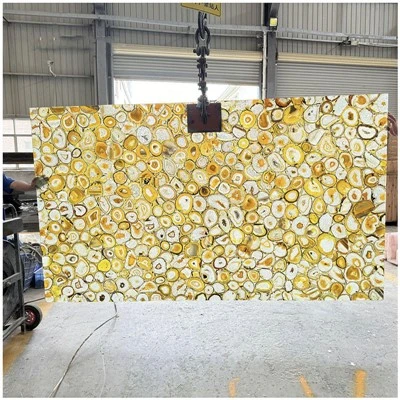
Yellow Agate SlabGolden translucent agate panels for illuminated feature walls, counters and decorative hospitality interiors. |
Amethyst Gemstone SlabsPurple crystalline gemstone slabs for dramatic walls, counters and bespoke luxury interior surfaces. |
Pink Agate SlabSoft pink agate surfaces for backlit residential features, hospitality panels and custom decorative counters. |
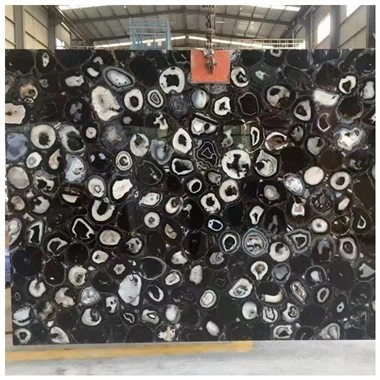
Black Agate SlabDark concentric agate patterns for luxury walls, counters, furniture and gemstone interior accents. |


FAQ About Black Obsidian Slabs
1. What is a Black Obsidian Slab made from?
The architectural slab is a fabricated semi-precious surface made from selected dark obsidian fragments arranged and bonded into a larger panel. Gold-toned resin or inlay can be introduced between the fragments to create the black-and-gold version shown in the supplied product reference.
2. What sizes are available for Black Obsidian Gemstone Slabs?
The supplied references range from approximately 12″ × 12″ / 30 × 30cm up to approximately 140″ × 70″ / 355 × 180cm, with cut-to-size fabrication available. Final slab and panel dimensions should be confirmed for the actual production lot and application.
3. Are tile sizes available as well as full slabs?
Yes. Supplied tile references include 12″ × 12″, 12″ × 24″, 24″ × 24″ and 24″ × 48″, with custom sizes available for project layouts.
4. Can Black Obsidian Slabs be used for feature walls?
Yes. Feature walls, lobby cladding, bar fronts, reception areas and luxury retail interiors are suitable design directions. Large wall projects should be developed from an elevation drawing so panel sizes, joints, openings and installation sequence can be coordinated before cutting.
5. Can black obsidian gemstone panels be used for countertops?
They can be fabricated for selected counters, bar tops, vanity tops and furniture surfaces where the finished panel construction, support, edge design and cutout geometry are suitable. The material should be treated as a bonded gemstone surface rather than assumed to perform like monolithic granite or quartzite.
6. Can a Black Obsidian Slab be backlit?
A project-specific illuminated construction can be tested, but the dark obsidian fragments should not be assumed to transmit light evenly. The actual panel should be tested with the proposed LEDs, diffuser, cavity and backing so the final contrast effect is understood before production.
7. Will every black-and-gold slab have the same fragment pattern?
No. Fragment size, shape and distribution vary across fabricated panels. Project orders can be sorted to an approved overall pattern range, but identical fragment placement should not be expected.
8. How should polished obsidian gemstone panels be cleaned?
Use a soft non-abrasive cloth or sponge with a mild cleaner confirmed for the supplied obsidian-and-resin construction. Avoid aggressive solvents, abrasive pads and cleaners that have not been approved for the finished bonded surface.
9. What should be approved before a large Black Obsidian feature wall enters production?
Approve the black and gold visual range, slab allocation, panel dimensions, elevation layout, joint locations, openings, edge exposure, backing or fixing method, any lighting construction, component numbering, QC requirements and packing sequence before cutting begins.
10. What information should be supplied for a custom obsidian countertop or bar project?
Provide finished dimensions, quantity, cabinet or support drawings, sink or appliance templates where applicable, edge profile, seam positions, exposed ends, required gold-inlay direction, lighting requirement, installation method, destination and packing sequence before fabrication is released.
Black Obsidian Works Best When the Gold Pattern Is Planned at Architectural Scale
The strength of Black Obsidian Slab is not only its deep black color. The visual identity comes from how hundreds of irregular fragments are divided by the gold-toned joint network. On a large wall or counter, the cutting position, panel divisions and surrounding materials can change that balance significantly. Approving the full layout before fabrication allows the strongest black-and-gold areas to remain visible, prevents important pattern zones from disappearing into openings, and gives installers a numbered panel sequence that follows the intended architectural composition.

Selecting Black Obsidian Slabs for Feature Walls, Bar Fronts and Custom Counters
Choose the application before choosing the cutting position. A full-height feature wall needs balanced fragment density across several adjoining panels; a bar front benefits from a strong guest-facing black-and-gold composition; a horizontal counter requires more attention to support, exposed edges and cutouts. Those uses may come from the same material, but they should not use the same fabrication logic.
After the architectural dimensions are fixed, review the actual slab layout and mark the required components directly against the drawing. Confirm which edges remain visible, where joints will fall, whether gold inlay should be restrained or more prominent, and whether lighting is part of the installation. This turns the gemstone slab from a decorative raw panel into a controlled project material ready for cutting, coding, packing and installation.
Hot Tags: black obsidian slab, China black obsidian slab suppliers, factory, Backlit Patagonia Quartzite, Blue Macaubas Quartzite Stone, Blue Mare Quartzite Stone, Dover White Quartzite Slab, Iron Red Quartzite, Turtle Illusion Quartzite Slabs
You Might Also Like


Send Inquiry
