



Yellow Agate Slab
Yellow agate slab is assembled from premium natural yellow agate slices, translucent for backlighting effect. Polished glossy surface with rich golden‑yellow circular agate patterns. Custom thickness and dimension available. Ideal for feature walls, bar countertops, reception desks and vanity tops. For interior designers, building contractors and luxury stone buyers. Export fumigated wooden crate packing, OEM custom processing supported.
Semiprecious Stone Products: 1. Custom Size Yellow Agate Slab Semi‑Precious Stone Slab For High‑end Residential & Commercial Interior Renovation
Material: Yellow Agate, Backlit Semi Precious Agate Stone
Slab Size: 1200*2400mm or customized.
Tiles: 24''x24'', 12''x24'',12''x12'', 18''x18''
Thickness: 20,30mm
Surface: Polished, Honed, With Backlit Effects
MOQ: 100 SQM
Semi Precious Stone Factory: KA UNITED
Application: KA UNITED Supplies A full Range of Semiprecious backlit Agate Stone For Floor, Wall Tiles, Kitchen and Bathroom Countertops, and other Commercial Projects
Product Introduction
Quick Summary
Yellow Agate Slab is a polished semi-precious decorative surface assembled from selected natural agate sections in golden yellow, amber, cream, white and occasional brown mineral tones. Large slab references are 2400–3000 × 1200–1800mm with 18–30mm thickness, while the supplied minimum slab reference is 120 × 60cm. Its semi-translucent structure is particularly useful for illuminated feature walls, reception desks, bar fronts and custom countertops, but the final result depends on agate-slice distribution, backing construction, cut-out position, lighting depth and the approved backlit mock-up.
|
|
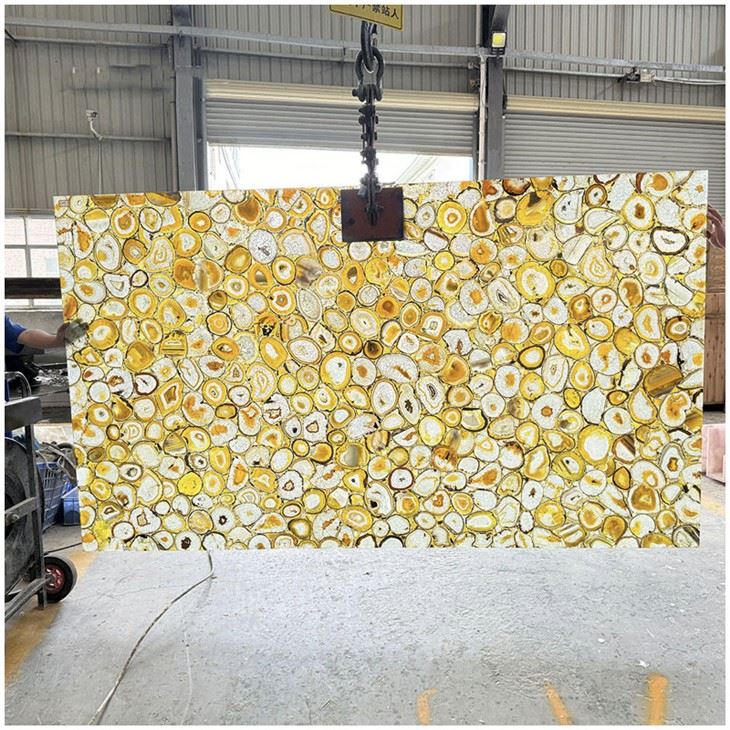
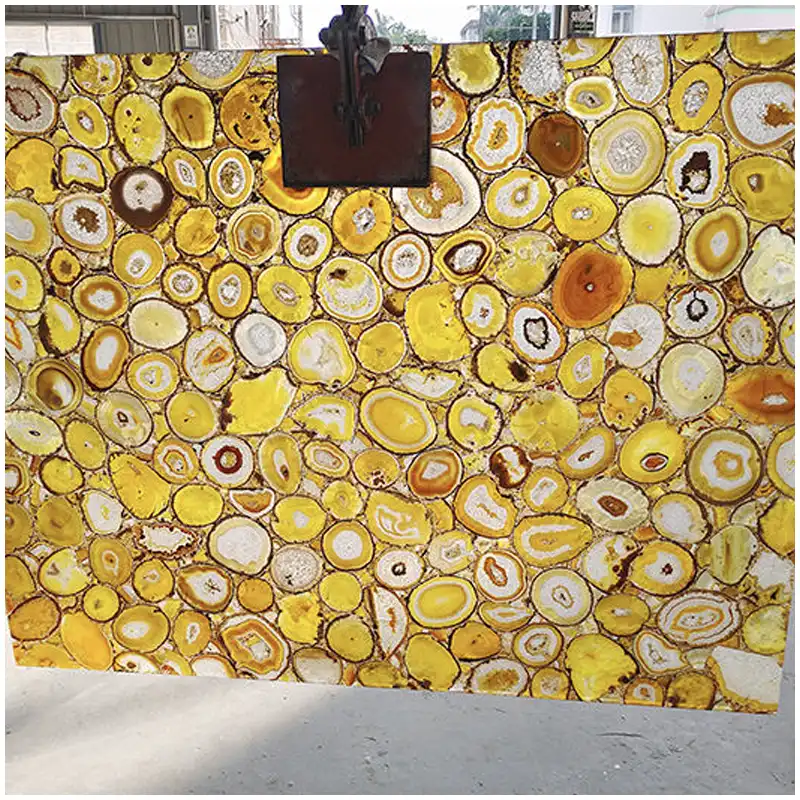
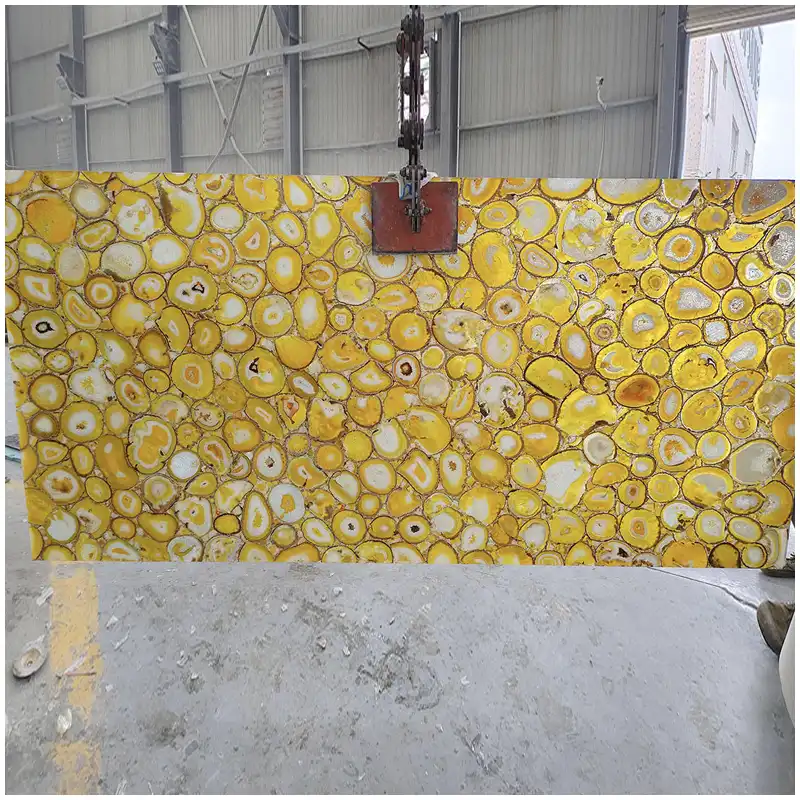
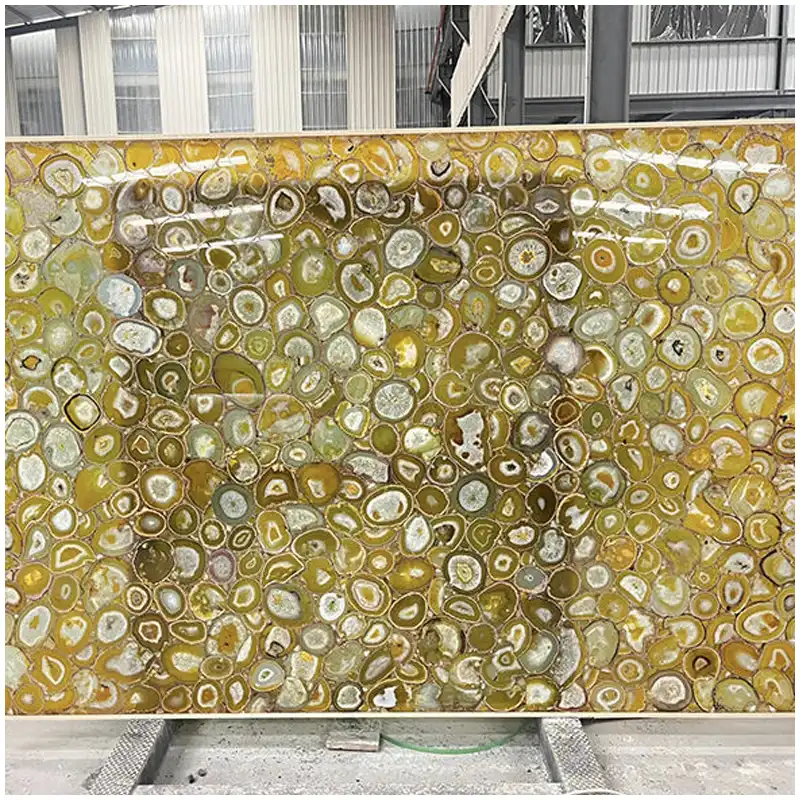
Golden Agate Gemstone Surface for Backlit Walls, Counters and Custom Interior Panels Yellow Agate Gemstone Slabs with Golden Rings, Crystal Centers and Translucent Backlit CharacterYellow Agate Gemstone Slabs are visually built from hundreds of individual agate sections rather than one continuous geological vein. The supplied factory slab shows small and large circular pieces mixed across the face, with bright yellow rims, amber centers, creamy-white crystalline zones and occasional darker brown outlines. That structure gives architects more control over the overall color rhythm than a conventional marble slab, but it also means the actual full-slab layout should be approved before wall panels, vanity tops or countertops are cut from it. View Luxury Stone Collection |

What Does the Supplied Yellow Agate Slab Show Before Fabrication?
The factory image shows a full polished rectangular gemstone panel being handled vertically in the workshop. Its composition is dominated by warm yellow, golden-orange and cream-white agate sections, with the individual pieces varying considerably in diameter and shape.
Some agate slices have distinct concentric yellow bands around pale crystalline centers. Others are more solid amber, while a smaller number contain translucent grey-brown or darker mineral cores. The result is intentionally varied rather than mechanically repetitive.
The distribution is also relatively balanced across the photographed slab. Large yellow sections do not occupy only one corner, and pale pieces are spread through the field. For an architectural surface, this type of balance matters more than requiring each natural slice to have the same ring pattern.
Because the photographed panel is viewed under ordinary workshop lighting, it does not show the final transmitted-light effect. Sections that appear pale or almost white in the image can become much more luminous once an appropriate lighting system is placed behind the slab.
Available Yellow Agate Slab Sizes, Thicknesses and Cut-to-Size Options
The supplied specification includes both large architectural slab references and a smaller minimum slab format. Final usable dimensions should still be checked against current production material before a project cutting schedule is released.
| Specification | Supplied Reference | Project Significance |
|---|---|---|
| Large Slab Size | 2400–3000 × 1200–1800mm | Suitable as a planning range for feature walls, reception counters, bar fronts and larger furniture surfaces. |
| Minimum Slab Reference | 120 × 60cm / 4 × 2ft | Useful for smaller furniture, vanity, inset-panel or decorative fabrication requirements. |
| Thickness | 18–30mm | Final thickness should coordinate with backing, support, panel size, edge construction and backlighting requirements. |
| Surface Finish | Polished | Polishing gives the agate rings greater optical depth and stronger reflected color before illumination. |
| Cut-to-Size | Custom dimensions available | Wall panels, countertop components and furniture pieces should follow approved cutting drawings. |
| Primary Interior Forms | Wall panels, bar tops, reception counters, vanity tops and tabletops | Each form requires a different combination of support, edge detail, cut-outs and lighting access. |
Large Semi-Precious Agate Slabs Are Fabricated Architectural Panels
Semi-Precious Yellow Agate Slabs are created by arranging selected natural agate pieces into a much larger architectural surface. Individual agate formations are not naturally quarried as 2.4–3.0m rectangular slabs, so the finished panel depends on both the gemstone face and its bonding or backing construction.
That fabrication route is an advantage for design because the color composition can be balanced across a larger surface. It also changes how the product should be detailed compared with one homogeneous granite or quartzite slab.
Exposed edges can reveal the construction behind the decorative face. Large vertical panels may also need reinforcement or a project-specific backing depending on size, mounting and lighting design.
Before cutting Semi-Precious Agate Slabs, the shop drawing should therefore identify the actual finished thickness, backing type, support zones, illuminated areas and exposed-edge treatment rather than specifying only length and width.
How Does Yellow Agate Change When It Is Backlit?
|
Photograph the same production panel under ordinary light and the proposed backlighting system. |
Yellow Agate Backlit Slabs reveal substantially more internal structure than the same surface under ordinary room lighting. Pale crystalline centers become brighter, translucent amber bands deepen and individual agate rings become easier to distinguish. Not every slice transmits the same amount of light. Some dense golden sections stay comparatively dark, while white or lightly colored crystal zones can glow much more strongly. That natural difference should remain visible rather than being treated automatically as a lighting defect. LED color temperature changes the overall impression as well. Warmer light strengthens the honey-gold character; cooler light makes the white crystal areas look cleaner and can reduce the apparent orange tone. For a large wall or counter, approve a representative illuminated mock-up with the actual agate, backing, diffuser and proposed light-source spacing before the entire project is fabricated. |

Why Lightbox Depth and Diffusion Matter Behind an Agate Feature Wall
A translucent gemstone panel does not create even light by itself. The wall cavity needs sufficient distance between the light source and the agate, or an appropriate diffusion system, so individual LEDs do not appear as bright points through pale sections.
Support rails and brackets can create the opposite problem. An opaque member directly behind a translucent part of the slab may appear as a dark line once the wall is switched on.
The structural and lighting drawings should therefore use the same panel elevations. Lighting modules, diffusers, rails, wiring and fixing points can then be positioned around the actual joint and support layout rather than added independently.
Drivers and electrical connections also need maintainable access. On a hotel lobby wall or retail feature, replacing a driver should not require removing a large gemstone slab simply because no service location was reserved.
For reception counters and bar fronts, service access can often be kept on the concealed working side while the public-facing yellow agate elevation remains visually uninterrupted.
How Should the Yellow, Amber and White Agate Distribution Be Selected?
The full slab should be reviewed as one composition rather than as a collection of individually attractive agate slices. The balance between yellow rings, white crystal centers and darker amber pieces determines whether the surface feels light, saturated or highly contrasted.
For a large wall, very pale zones can be spread through the panel group so one elevation does not become noticeably brighter than the others when illuminated. If the design intentionally wants a gradient, the factory can instead organize panels from lighter cream-yellow into deeper amber sections.
Countertops require another decision. A sink or equipment opening can remove several visually strong agate sections, so the cutting outline should be drawn over the actual slab image before fabrication.
Adjacent slabs do not need identical agate eyes, but the project should establish an acceptable overall yellow-to-white ratio and general pattern density. This is particularly useful when multiple lobby panels or several reception counters need to read as one material family.
Natural slice size, internal rings and crystalline centers remain intentionally variable and should not be edited or sorted into an artificial repeated pattern.
What Changes When Yellow Agate Is Cut for Countertops or Vanities?A full slab displays the complete agate composition, but a countertop or vanity removes sections for sinks, faucets, corners and appliance openings. The remaining pattern can look very different from the original slab if cutting positions are not reviewed beforehand. The strongest circular agate pieces can be retained on prominent areas such as a bar overhang or vanity front, while less important zones can accommodate cut-outs. This does not mean every opening should be moved for appearance; plumbing and equipment dimensions still control the final drawing. Exposed edges need their own construction detail because the backing system may be visible through a conventional straight cut. A laminated, mitred or otherwise fabricated edge can be developed where a deeper visual profile is required. Overhang and span should be reviewed structurally. An assembled gemstone panel should not be given the same unsupported cantilever simply because another stone countertop uses that dimension. Final support should follow the selected panel construction, finished thickness, span, cut-outs and project-specific frame design. |
Show slab backing, countertop cut-out, edge build-up, underside support and agate pattern remaining after fabrication. |

Where Does Yellow Agate Deliver the Most Value in an Interior?
Yellow agate performs best where both its gemstone pattern and translucency remain visible. Using the material as a hidden utility surface wastes much of what distinguishes it from conventional stone.
Backlit Hotel Feature WallsLarge illuminated panels turn yellow and white agate rings into a warm architectural focal point for lobby and lounge areas. |
Reception DesksGuest-facing fronts can carry the translucent gemstone while storage, wiring and service access remain behind the counter. |
Bar and Vanity SurfacesCut-to-size panels can combine a polished working surface with coordinated illuminated fronts or backsplash elements. |
Custom Furniture PanelsTabletops and decorative furniture inserts use the gemstone at a smaller scale where individual agate rings can be viewed closely. |
Yellow Agate Slab vs. Four KA UNITED Agate Color Alternatives
Yellow Agate is the warmest and most luminous color direction in this group, with golden rings and pale crystal centers creating a sunlit appearance even before illumination. Pink Agate shifts the mood toward blush and rose; Black Agate creates stronger dark-light contrast; White Agate is quieter and more dependent on illumination for visual depth; Green Agate introduces a cooler botanical palette. Because all four alternatives rely on the arrangement of individual agate sections, the final decision should compare actual slab layouts and backlit samples rather than color names alone.
| Selection Factor | Yellow Agate | Pink Agate | Black Agate | White Agate | Green Agate |
|---|---|---|---|---|---|
| Color Direction | Golden yellow, amber, cream and white crystalline agate rings. | Blush, rose and pale translucent agate for warmer decorative interiors. | Dark agate sections with stronger contrast between dense and translucent areas. | White and pale crystalline agate with a cleaner neutral palette. | Green natural agate for cooler, botanical and saturated interior schemes. |
| Backlit Character | Warm luminous effect with bright white centers and deeper honey-gold rings. | Soft rose illumination with stronger pink color in translucent sections. | More dramatic dark-light contrast because dense black areas transmit less light. | Clean luminous field where internal crystal structure becomes more apparent. | Green translucent glow for bars, walls and decorative feature surfaces. |
| Best Interior Role | Warm hotel lobbies, reception desks, home bars and statement furniture. | Boutique hospitality, powder rooms and softer luxury decorative schemes. | High-contrast bars, feature walls and darker contemporary interiors. | Minimal interiors where light and texture should dominate over strong color. | Spa, lounge, bar and villa interiors requiring a stronger green focal material. |
| Primary Approval Point | Balance amber, yellow and pale crystalline slices across the finished panel. | Control blush intensity and distribution between adjacent slabs. | Review dark-zone concentration under both ordinary and transmitted light. | Review pale-tone consistency and lighting uniformity. | Control green saturation and differing translucency between agate sections. |
| Selection Priority | Choose when the project needs a warm golden gemstone surface with strong illuminated impact. | Choose for softer rose-colored decorative interiors. | Choose for dramatic contrast and a darker luxury palette. | Choose when the lighting concept should remain visually clean and neutral. | Choose when green color is intended to become a principal interior feature. |
Production-Release Checks for Yellow Agate Walls, Counters and Furniture Panels
The largest risks are not hidden in the gemstone itself. They appear where the agate slab meets lighting, support, cut-outs and adjacent panels. These interfaces should be resolved before the project is released for cutting.
- Confirm current usable slab dimensions against the required architectural panel schedule.
- Approve the actual yellow, amber, cream and white agate distribution across each production slab.
- Confirm finished slab thickness and the actual backing or reinforcement construction.
- Mark wall panels, countertop components and furniture pieces on the approved slab layout before cutting.
- Define all sink, faucet, electrical, equipment and other openings before machining.
- Specify which edges remain visible and how their construction should be finished.
- For backlit work, issue the lighting cavity, LED positions, diffuser and structural support on the same elevation.
- Approve an illuminated mock-up using representative production material before releasing a large backlit wall.
- Provide accessible locations for LED drivers and future electrical maintenance.
- Number adjacent wall or counter panels according to installation sequence.
- Confirm support and span separately for horizontal countertop applications.
- Check crate dimensions, lifting orientation and site access before packing large finished panels.
Factory QC for Agate Distribution, Panel Dimensions and Backlit AppearanceQC should begin with the full slab under ordinary light. The project-approved balance of yellow, white and amber pieces should be checked before individual components are separated from the larger panel. After cutting, finished dimensions, squareness, openings, edges and adjoining joints need to match the current fabrication drawing. Large vertical pieces should also be checked against their installation codes. Backlit projects need a second visual inspection with the light system operating. That stage can reveal frame shadows, bright LED points or inconsistent diffuser coverage that are invisible during ordinary surface QC. The polished face should be examined for scratches, edge chips and fabrication damage separately from natural crystalline features and the visible joints between individual agate pieces. The supplied packing requirement is reinforced fumigated wooden crates. Large slabs should be immobilized, separated with protective material and supported so polished faces, corners and fabricated edges cannot contact neighboring pieces during ocean freight. |
Show slab measurement, polish inspection, illuminated QC, panel coding, edge protection and reinforced export packing. |

Care Guidance for Polished Yellow Agate Architectural Surfaces
Clean the polished gemstone surface with a soft cloth and a mild pH-neutral cleaner compatible with the complete fabricated panel. The architectural slab may contain natural agate, bonding materials and backing, so cleaner compatibility should not be judged from the agate mineral alone.
Avoid abrasive pads and harsh polishing powders during routine cleaning. They can reduce surface clarity and make a high-gloss gemstone panel look uneven under reflected or transmitted light.
Countertop applications should be protected from concentrated impact, particularly around cut-outs and exposed corners. The agate mineral is hard, but a fabricated semi-precious panel can still chip when a vulnerable edge is struck.
Very hot appliances or vessels should use suitable protection unless the finished panel system has specifically been reviewed for direct heat exposure. Supporting structures and backing materials are part of that assessment.
For illuminated installations, the maintenance plan should also include LED drivers, wiring, diffuser panels and access zones behind the gemstone.
How Should a Finished Yellow Agate Installation Be Documented?A completed-project image should show the full wall, counter or furniture piece rather than only a close-up of individual agate rings. The wider view explains scale, panel joints and the relationship between the gemstone and surrounding finishes. For illuminated surfaces, photograph the same installation with the light switched on and off. That comparison shows both the polished golden surface and the additional crystalline depth created by transmitted light. An angled photograph is useful for counters because it shows edge construction and the transition from horizontal to vertical surfaces. A frontal photograph is better for judging panel alignment across large walls. Warm timber, champagne metal, cream stone and darker bronze details can all work with yellow agate, but the finished project should allow the gemstone pattern to remain the primary decorative element. |
Use a completed hotel lobby wall, reception desk, villa bar, vanity, tabletop or retail feature showing the full installation. |

Recommended Agate Gemstone Slabs from KA UNITED
Compare four related agate colors for different illuminated interior palettes and project focal surfaces.
Pink Agate SlabRose-toned translucent agate for boutique walls, counters and decorative illuminated interiors. |
Black Agate SlabDark translucent agate for dramatic backlit walls, bars and contemporary luxury interiors. |
White Agate SlabPale crystalline agate for clean backlit walls, counters and light-toned interiors. |
Green Agate SlabsGreen translucent agate for illuminated bars, luxury walls and statement interior surfaces. |


FAQ About Yellow Agate Slabs
1. What sizes are available for Yellow Agate slabs?
The supplied large-slab reference is 2400–3000 × 1200–1800mm with 18–30mm thickness, while the supplied minimum slab reference is 120 × 60cm / 4 × 2ft. Custom cutting is available for project-specific wall panels, counters, vanity tops and furniture components. Current usable slab size should be confirmed before the final cutting schedule is released.
2. Is a large Yellow Agate slab one solid natural piece of agate?
No. Large architectural agate slabs are fabricated by arranging selected natural agate sections into a larger decorative surface and using a suitable bonding, backing or reinforcement system. The finished construction should be confirmed for the specific project because it affects edges, support, cut-outs and backlighting.
3. Can Yellow Agate slabs be backlit?
Yes. The semi-translucent agate sections can create a strong illuminated effect, but different slices transmit different amounts of light. The lighting cavity, LED color temperature, module spacing, diffuser, structural shadows and electrical access should be coordinated with the actual slab before a large backlit installation is produced.
4. Will every Yellow Agate slab have the same yellow and white pattern?
No. Natural agate sections vary in size, shape, banding, crystalline centers, amber intensity, white content and translucency. The assembled slab can also be arranged with different color distributions. Buyers should approve the actual production slab or an agreed visual range instead of expecting identical patterns.
5. Can Yellow Agate be cut for countertops, vanity tops and reception desks?
Yes. Custom cut-to-size fabrication can be developed for countertops, vanity tops, reception desks, bar surfaces and furniture panels. Sink, faucet and equipment openings should be marked on the approved slab layout before cutting so pattern placement, backing and structural support can be coordinated.
6. Is Yellow Agate suitable for exterior wall and floor applications?
This product is positioned primarily for high-end interior architectural and furniture applications. Exterior suitability should not be assumed from the agate appearance alone because the finished panel includes bonding or backing construction. Any exterior proposal requires separate review of the actual panel system, environmental exposure, fixing, weathering and project testing.
7. How should polished Yellow Agate surfaces be cleaned?
Use a soft cloth and a mild pH-neutral cleaner compatible with the complete fabricated gemstone panel. Avoid abrasive pads and unverified aggressive chemicals that may affect the polish, bonding, joints or backing. Countertop edges and cut-outs should also be protected from concentrated impact.
8. What should be approved before a Yellow Agate project enters production?
Approve the actual agate slab layout, final component dimensions, thickness and backing construction, cutting positions, exposed edges, sink or equipment openings, support system, illuminated areas, LED and diffuser arrangement, representative backlit mock-up, panel coding, packing plan and site-access requirements before production release.
Yellow Agate Is Most Effective When the Full Slab Composition Is Designed Before It Is Cut Apart
The value of this material lies in the relationship between hundreds of individual gemstone sections, not in one isolated yellow agate ring. Across a full slab, golden borders, white crystal centers and amber areas create a warm surface that changes again once light passes through it. For a wall, counter or furniture project, the better sequence is to approve the whole panel first, overlay the final cutting geometry, then coordinate backing, support and illumination around that composition. This preserves the strongest parts of the slab instead of discovering after fabrication that the key agate patterns were removed by joints or cut-outs.

Submit Yellow Agate Panel Layout, Cutting Plan and Backlighting Details for Fabrication
Provide the required slab or cut-to-size dimensions, selected agate layout, thickness and backing requirement, wall or countertop drawings, exposed-edge details, cut-outs, support arrangement, illuminated areas, LED and diffuser information, quantity and installation sequence before production begins.
Request Project Quote
Hot Tags: yellow agate slab, China yellow agate slab suppliers, factory
You Might Also Like



Send Inquiry
