


Patagonia Glace Quartzite
Brazil‑origin Polaris Gold Quartzite slabs feature dramatic deep‑green background with striking golden‑orange flowing veins. Polished finish delivers glossy luxury look. Standard slab size: 240‑320×120‑160cm, thickness 20mm /30mm. Perfect for villa feature walls, kitchen countertops, bathroom vanity tops and hotel project applications. Hard, scratch‑resistant natural quartzite, stable for heavy‑use interior spaces. Custom cut‑to‑size service available for builders, designers and residential projects.
Quartzite Item: Custom Size Patagonia Glace Quartzite, Exotic Natural Stone for Bathroom Vanity Tops & Wall Cladding
Quartzite Stone: Patagonia Glace Quartzite; Patagonia Brown Quartzite
Slab Size: 2300x1900, 3180x1890mm, etc.
Thickness: 20, 30 mm
Surface: Polished, Honed, and Leathered
MOQ: 300 SQM
Quartzite Slabs And Countertop Factory: KA UNITED
Application: 60+ luxury exotic Quartzite Stones in KA UNITED Factory For Private Home, hotels, villas, apartments, and other commercial estate properties
Product Introduction
Quick Summary
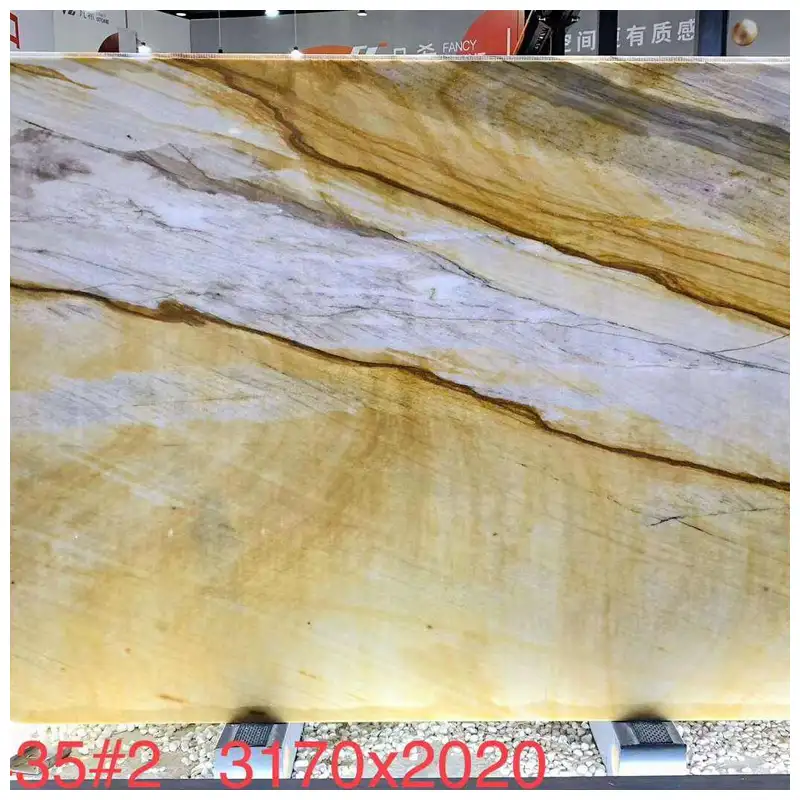
Patagonia Glace Quartzite is an exotic natural stone defined by an irregular composition of warm amber-brown mineral masses, pale grey-white crystalline fields and fine fractured transitions. KA UNITED supplies Patagonia Glace Quartzite Slabs in 305 × 183cm and 320 × 205cm references, with 18mm, 20mm and 30mm thicknesses for statement walls, kitchen islands, countertops, vanity tops and custom interior stonework. Because every slab has a different balance of brown and crystalline areas, slab photography, cutting layout and the intended focal surface should be approved before fabrication.
|
|
Exotic Brown & Crystal Quartzite · Large Slabs · Custom Project Fabrication Patagonia Glace Quartzite Slabs for Statement Walls, Islands and Luxury Interior StoneworkThis stone does not rely on conventional linear veining. Instead, large golden-brown blocks meet cloudy white, silver-grey and crystal-like areas in an irregular geological composition. The supplied image shows especially strong contrast between amber-brown mineral fields and broad pale translucent-looking sections. That makes Patagonia Glace Brown Quartzite particularly suitable for projects where the slab itself is intended to become a visual feature rather than a quiet background surface. View Luxury Quartzite Collection |

Why Patagonia Glace Looks Different from Conventional Brown Quartzite
Many brown quartzites read as a continuous brown, beige or linear-grained field. Patagonia Glace is different. Its visual structure is broken into much larger mineral zones, so a single slab can shift abruptly from warm honey-brown to pale grey-white crystalline material within a short distance.
The brown areas in the supplied reference contain fine crossing lines and lighter mineral traces, while the pale portions have a softer, cloudy crystalline appearance. Smaller cream, beige and grey transitions appear where these larger fields meet.
This makes the stone attractive for feature-driven interiors, but it also means a 10cm sample cannot explain the appearance of a complete slab. Buyers comparing Patagonia Brown Quartzite should review full-slab photographs or current production slabs before deciding whether the brown-to-white balance suits the project.
The overall result is less repetitive and more architectural than a conventional uniformly colored Exotic Brown Quartzite, with each slab functioning almost like an individual natural composition.
Patagonia Glace Quartzite Slab Sizes, Thicknesses and Project Options
| Specification | Supplied Reference | Project Consideration |
|---|---|---|
| Slab Size A | 305 × 183cm | Confirm usable area after perimeter trimming, natural features and required fabrication allowances. |
| Slab Size B | 320 × 205cm | Large-format option for islands, walls and oversized components where available from the selected slab lot. |
| Thickness | 18mm / 20mm / 30mm | Select according to product form, span, support, edge design, weight and installation method. |
| MOQ | 100 SQM | Current slab and bundle availability should be confirmed before order release. |
| Primary Finish | Polished | Highlights the contrast between crystalline pale areas and warmer brown mineral fields. |
| Alternative Finishes | Honed / Leathered | Approve on representative production stone because different mineral zones can respond differently to texturing. |
| Fabrication | Slabs / Countertops / Vanity Tops / Wall Panels / Bar Tops / Custom Pieces | Cutting layout should be approved before machining major openings or dividing the slab. |
| Natural Variation | High | Brown, grey-white, crystal-like areas, fissures and transition zones vary significantly from slab to slab. |
|
Use a close-up showing brown mineral zones, pale crystalline areas, natural transitions, fissures and polished surface detail. |
The Brown and Pale Crystal Zones Should Be Evaluated SeparatelyThe most important visual characteristic of this stone is the scale of its individual mineral fields. The amber-brown sections can occupy a large percentage of a slab, while pale grey-white crystal-like zones may form broad islands between them. Because those areas differ visibly in color, structure and translucency, a polished finish may not produce identical reflection across the entire slab. This variation is part of the stone rather than a reason to expect manufactured uniformity. Natural fissures and mineral boundaries should also be mapped before fabrication. A feature that is acceptable in a decorative wall panel may need different consideration when it falls close to a sink opening, narrow countertop bridge or mitered edge. For Brown Quartzite Slabs with this level of geological contrast, approving the complete slab is more useful than approving only a small color chip. |

Where Should the Strongest Brown Mineral Areas Be Positioned?
A dramatic slab does not have one universally correct cutting layout. Placement should depend on which part of the completed room is intended to attract attention.
For a kitchen island, a large amber-brown section can be placed toward the center or seating side where the full pattern remains visible. If the island includes a sink or cooktop, the opening should be drawn over the slab photograph before cutting so a major mineral formation is not accidentally removed.
For feature walls, pale crystal fields and darker brown blocks can be positioned to create visual movement across the full elevation. Large blank wall surfaces allow the stone to be appreciated at the same scale as the original slab.
For vanity tops or smaller furniture pieces, the slab may need a quieter local section. Cutting a compact component entirely from one visually stable mineral field can sometimes produce a cleaner result than forcing several contrasting zones into a small surface.
This is why cutting-layout approval is a design decision, not simply a production formality.
Feature Walls Need Full-Slab Layout Approval Before the First Panel Is Cut
|
A Patagonia Glace wall is most successful when the stone composition is planned at elevation scale. Panel joints should respond to the material rather than dividing important brown or pale mineral fields randomly. Where consecutive slabs are available, they can be photographed and arranged digitally or dry-laid before cutting. Depending on the block and sawing sequence, some adjoining slabs may offer stronger visual continuity than unrelated slabs from separate lots. Bookmatching should not be promised automatically. The suitability of mirrored layouts depends on the actual consecutive slabs, pattern structure, thickness and required panel dimensions. Joint width, wall backing, fixing method and panel size should also be included in the elevation. A beautiful slab layout can still fail visually if important mineral transitions disappear behind oversized joints or architectural interruptions. For hotel lobbies and villa feature walls, numbering the approved panels before fabrication makes it much easier to reproduce the intended composition during installation. |
Show consecutive slabs, panel joints, finished wall dimensions, cutting lines and installation numbering. |

Can Patagonia Glace Quartzite Be Backlit?
Patagonia-family stones can contain crystalline zones that react differently to transmitted light. The pale areas visible in the supplied slab have a crystal-like appearance, so selected sections may be worth testing when a project includes illuminated stone.
That does not mean the complete slab should be assumed to illuminate evenly. Dense brown mineral masses may transmit little or no light, while clearer crystalline passages can respond more strongly.
For a backlit wall, bar front or decorative panel, place the actual selected slab in front of a test light source before cutting. The test should check which regions transmit light, the required distance between light source and stone, and whether the illuminated appearance matches the daytime design.
Backlighting is therefore best treated as a slab-specific design option rather than a guaranteed property of every Patagonia Glace piece.
Countertop Fabrication Should Protect the Stone's Most Valuable Pattern Areas
Quartzite is generally selected for countertops because it is a hard natural-stone category, but Patagonia Glace deserves additional fabrication planning because the slab contains visibly different mineral regions and natural structural transitions.
Sink and cooktop openings should be marked on a slab photograph before cutting. This helps the designer decide whether to preserve a large brown formation, center a pale crystalline region or move the opening into a less visually important area.
Narrow stone bridges around undermount sinks and cooktops need particular review. Natural fissures, repaired features or abrupt mineral boundaries close to these openings may require a different cutting position or project-specific reinforcement.
Waterfall islands require another layer of planning. The horizontal top and vertical end panel should be allocated together so the transition from brown to grey-white material does not feel accidental at the mitered corner.
No natural quartzite countertop should be marketed as completely scratch-proof, stain-proof or heat-proof. Final performance depends on the specific stone, finish, fabrication, sealing, support and normal use practices.
|
Use a completed application showing how the brown and crystalline stone fields read at architectural scale. |
Where Patagonia Glace Makes the Strongest Design ImpactKitchen Islands: large uninterrupted surfaces give the irregular mineral composition enough space to read as one complete design. Feature Walls: full-height applications preserve broad crystal and amber-brown zones that can be lost when the slab is divided into small pieces. Bar and Reception Counters: the stone can become the focal material where guests see the front elevation and countertop together. Bathroom Vanities: smaller components can be selected from specific slab areas to control how much brown or pale crystalline material appears in the finished surface. Fireplace Surrounds: the patchwork composition can frame a fireplace strongly, but the exact appliance, clearances, support and heat-related requirements must be coordinated with the fireplace system. |

Polished, Honed or Leathered Patagonia Glace: Choose the Finish Around the Intended Visual Effect
Polished finishing gives the strongest reflection and usually creates the sharpest contrast between honey-brown mineral blocks and paler crystalline regions. It is the natural choice when the slab is intended to look rich and luminous.
Honed finishing reduces glare and can make the same material feel calmer and more architectural. It is particularly useful in interiors with matte plaster, timber, brushed metals or indirect lighting.
Leathered finishing adds tactile texture. Because Patagonia Glace contains visibly different mineral fields, texturing should be sampled before a large order is finished; the brown and pale areas may not respond identically to the same mechanical process.
Finish selection should therefore be made on representative production stone rather than from a generic quartzite sample.
Interior Pairings That Work with Patagonia Glace's Amber-Brown and Pale Crystal Palette
Warm walnut, smoked oak and medium-toned timber reinforce the amber areas without trying to match them exactly. These pairings work especially well when the stone is used as a kitchen island or feature wall.
Ivory plaster, warm white cabinetry and pale limestone tones give the grey-white crystalline fields enough contrast to remain visible while keeping the overall room bright.
Bronze, champagne metal and brushed brass pick up the warmer side of the stone. Darkened steel or matte black can create a sharper contemporary contrast against both pale crystal and brown mineral masses.
Because the stone already contains large-scale pattern, surrounding surfaces generally work better when their own grain or veining is restrained.
Patagonia Glace vs. Four KA UNITED Exotic Quartzite Alternatives
Patagonia Glace stands out for the scale of its amber-brown mineral blocks and pale crystalline zones. Polaris Gold shifts toward deep teal-green with stronger gold-orange movement; Black Crystal Patagonia uses a much darker Patagonia direction; Patagonia Extra retains the recognizable fragmented Patagonia family but with a different balance of crystal and warm mineral zones; Giallo Macaubas follows a more linear yellow-beige and brown movement. The best choice depends on whether the project needs block-like geological contrast, dark drama, stronger gold color or more directional veining.
| Selection Factor | Patagonia Glace | Polaris Gold | Black Crystal Patagonia | Patagonia Extra | Giallo Macaubas |
|---|---|---|---|---|---|
| Visual Identity | Large amber-brown blocks interrupted by pale grey-white crystalline fields. | Deep teal-green with gold-orange, cream and darker natural movement. | Darker Patagonia direction with high-contrast crystal and dark mineral composition. | Fragmented Patagonia-family composition with a different warm/crystal balance. | Yellow, beige, white and brown layered movement with more directional flow. |
| Pattern Scale | Very large geological blocks; slab-scale viewing is important. | Large flowing color zones with strong gold accents. | Bold high-contrast fragmentation. | Large irregular fields typical of statement Patagonia selections. | More linear and layered than Patagonia Glace. |
| Best Design Direction | Warm luxury interiors, statement walls and large islands. | Green-gold interiors where strong color becomes part of the architecture. | Dark dramatic interiors requiring stronger contrast. | Highly expressive feature surfaces and dramatic island designs. | Warm gold-beige spaces with more directional natural movement. |
| Critical Approval | Brown-to-crystal ratio, cutting layout, fissures and focal placement. | Green tone, gold distribution and slab-to-slab movement. | Dark/crystal balance and placement of high-contrast sections. | Exact slab composition and intended cutting sequence. | Direction of yellow-brown bands and selected finish. |
| Best Reason to Specify | Choose when warm brown geological blocks and pale crystal fields should become the main visual feature. | Choose when green and gold need to dominate the interior palette. | Choose for a darker and more dramatic Patagonia-family direction. | Choose for another highly fragmented Patagonia statement with different slab composition. | Choose when warmer linear golden movement better suits the project. |
Risk-Control Priorities for Custom Patagonia Glace Orders
- Approve full-slab photographs or the current production slabs before final material release.
- Confirm whether 305 × 183cm, 320 × 205cm or another current slab dimension controls the order.
- Specify 18mm, 20mm or 30mm according to final product form and engineering requirements.
- Map the brown, grey-white and crystalline areas before countertop, wall or furniture cutting begins.
- Identify natural fissures, repaired zones and mineral transitions that intersect narrow fabricated areas.
- Confirm polished, honed or leathered finish on representative production material.
- For feature walls, approve panel dimensions, joints, slab sequence and installation numbering.
- For islands, place sink and cooktop openings on the slab photograph before nesting.
- For waterfall edges, review top-to-side pattern transition and miter construction together.
- Test the selected slab before specifying any backlit application.
- Confirm countertop support, cabinet structure, overhang and finished weight before fabrication.
- Dry-layout multi-piece wall or countertop sets when visual continuity is important.
- Photograph finished pieces after fabrication for comparison with the approved slab layout.
- Match component and crate codes to the installation drawing before shipment.
Factory QC Should Preserve the Approved Stone Composition, Not Only Check DimensionsFinished dimensions, thickness and edge details still need normal fabrication inspection, but Patagonia Glace adds a second layer of quality control: the finished component should also reflect the approved slab layout. A countertop may be dimensionally correct yet visually wrong if an important amber formation was cut away or if a seam separates two unrelated mineral areas. Layout photographs give QC staff a reference for checking this before packing. Polished surfaces should be inspected under reflected light for scratches, dull areas, edge damage and processing marks. Natural fissures and approved repaired features should be distinguished from damage introduced during fabrication. Wall panels should be dry-arranged in their numbered sequence where practical. Countertop sets can be checked together for seam relationship and waterfall alignment. Final packing should protect slab corners, mitered edges, narrow sections around openings and polished surfaces from direct contact during long-distance transportation. |
Show slab inspection, panel numbering, seam check, polished finish, edge protection and export packing. |

Care, Sealing and Everyday Use
Quartzite is generally a hard natural stone, but the finished surface should still be treated as a premium fabricated product rather than an indestructible material.
For countertops, use cutting boards and protect the surface from very hot cookware. This also protects sealers, resins, repaired natural features and finished edges from unnecessary wear.
Clean with a soft cloth and a product suitable for natural stone. Oils, wine, strongly colored liquids and food residue should be removed promptly instead of being allowed to remain on the surface.
A compatible penetrating sealer may be used according to the selected stone and finish. Sealing can help reduce absorption and staining but does not make the stone completely stain-proof or waterproof.
For walls and decorative panels, maintenance is generally lighter, but joints, fixings and any illuminated backing system should remain accessible for inspection when the project design requires it.
Recommended Exotic Quartzite Slabs from KA UNITED
These related stones provide four different directions when Patagonia Glace is not the exact visual fit: green-gold drama, dark Patagonia contrast, another fragmented Patagonia composition or warmer linear golden movement.
Polaris Gold QuartziteDeep teal-green quartzite with dramatic gold-orange movement for luxury feature surfaces. |
Black Crystal Patagonia QuartziteDarker Patagonia-family quartzite for interiors requiring stronger crystal and black contrast. |
Patagonia Extra QuartziteAnother fragmented Patagonia selection for expressive walls, islands and statement interior surfaces. |
Giallo Macaubas QuartziteWarm yellow-beige quartzite with layered brown movement for elegant interior stone projects. |


FAQ About Patagonia Glace Quartzite
1. What slab sizes are available for Patagonia Glace Quartzite?
The supplied reference slab sizes are 305 × 183cm and 320 × 205cm, with 18mm, 20mm and 30mm thickness options. Natural-stone slab dimensions can vary by current lot, so the exact available slab should be confirmed before final cutting layouts are approved.
2. What colors appear in Patagonia Glace Quartzite?
The supplied slab shows large warm amber-brown mineral fields combined with pale grey-white crystalline areas, cream-beige transitions and fine natural lines. The percentage and placement of these colors change significantly from slab to slab.
3. Is every Patagonia Glace slab visually similar?
No. Patagonia Glace is a highly variable natural stone. The size and position of brown mineral blocks, pale crystalline fields, fissures and transition zones differ between slabs. Full-slab approval is recommended when pattern placement is important to the project.
4. Can Patagonia Glace Quartzite be used for kitchen countertops?
Yes. It can be fabricated for kitchen countertops and islands, but sink and cooktop locations, natural fissures, mineral transitions, seam placement, edge construction and support should be reviewed on the actual selected slab before cutting.
5. Can Patagonia Glace be used for feature walls?
Yes. Large feature walls are one of the strongest uses for this stone because they preserve the slab-scale relationship between brown and pale crystalline areas. Panel joints, slab sequence, fixing method and installation numbering should be planned before fabrication.
6. Can Patagonia Glace Quartzite be backlit?
Selected pale crystalline sections may respond to transmitted light, but the complete slab should not be assumed to illuminate uniformly. Dense brown areas can behave differently, so any backlit design should be tested on the actual selected slab before fabrication.
7. Which finishes are available?
The supplied options include polished, honed and leathered finishes. Polishing emphasizes color contrast and reflection, honing creates a softer matte appearance, and leathering adds texture. The finish should be approved on representative production stone because different mineral zones may respond differently.
8. Is Patagonia Glace Quartzite scratch-proof, heat-proof and stain-proof?
No natural quartzite surface should be described as completely scratch-proof, heat-proof or stain-proof. Use cutting boards, protect countertops from very hot cookware, remove spills promptly and follow the maintenance guidance for the selected slab, finish and sealer.
9. Should Patagonia Glace Quartzite be sealed?
A compatible penetrating sealer may be selected according to the actual stone, finish and application. Sealing can help manage absorption and staining, but it does not make the material completely stain-proof or waterproof.
10. What should be approved before a Patagonia Glace project enters fabrication?
Approve the actual slabs, thickness, finish, full cutting layout, brown-to-crystal distribution, natural fissures and repaired areas, panel or countertop dimensions, sink and appliance openings where applicable, seams, edge details, support, dry-layout requirements, component coding, packing sequence and installation drawings before fabrication begins.
Patagonia Glace Turns Brown and Pale Crystalline Quartzite into a Large-Scale Interior Feature
Patagonia Glace is most convincing when the design gives its large mineral composition enough space to remain visible. Instead of treating every slab as interchangeable material, the project can use the individual brown blocks, pale crystal areas and natural transitions to decide where an island, wall panel or custom surface should be cut. That approach preserves the character seen in the original slab while reducing avoidable pattern loss around openings, seams and small components.

Custom Patagonia Glace Quartzite Slabs for Statement Walls, Kitchen Islands and Luxury Stone Projects
Choose the actual slab composition first, then develop the countertop, wall-panel or custom fabrication around the brown and crystalline areas you want to preserve. KA UNITED can coordinate slab selection, cutting layout, polished or textured finishing, panel numbering, countertop fabrication and project-based packing for residential and hospitality interiors.
Request Patagonia Glace Project Quote
Hot Tags: patagonia glace quartzite, China patagonia glace quartzite suppliers, factory, Gaya Quartzite Slabs, Jacaranda Oro Quartzite, Malachite Semiprecious Gemstone, Michelangelo Quartzite Slab, Red Colinas Quartzite, White Macaubas Slab
You Might Also Like



Send Inquiry
