

Mastering Backlit Patagonia Quartzite: Installation Secrets and Lighting Techniques for Feature Walls
Quick Summary:
This guide explains how to design, source, fabricate, and install Backlit Patagonia Quartzite feature walls with correct LED panels, slab selection, adhesive control, structural support, and maintenance access. It covers Patagonia Quartzite, Patagonia Quartzite Slabs, how to install LED panels behind quartzite, backlit stone feature wall specification 2026, and translucent quartzite stone wall techniques for luxury homes, resorts, clubs, commercial lobbies, and hospitality interiors.
Mastering Backlit Patagonia Quartzite: Installation Secrets and Lighting Techniques for Feature Walls
🎯 2026 Architectural Intelligence & Procurement Manifesto
This technical compilation serves as the definitive 2026 engineering protocol for premium global execution teams-specifically curated for AIA/RIBA architects, specialized lighting designers, luxury residential contractors, resort developers, high-end interior studios, and custom stone fabrication teams.
As ultra-luxury interior benchmarks transition from static wall finishes to responsive, light-emitting structural art, mastering the intersection of mineral geology and photonics is mandatory. This blueprint dismantles the mechanical vulnerabilities, macro-fissure risks, and lumen degradation challenges inherent to installing translucent Brazilian pegmatites, securing a flawless, multigenerational asset deployment for your elite portfolio.
1. Introduction: The Intersection of Fine Art and Light Engineering
Luxury walls are no longer passive surfaces. In 2026 residential and hospitality design, the most memorable interiors use wall assemblies that react to light, create atmosphere, and become immersive architectural focal points. This shift is especially visible in resort reception areas, luxury villas, private clubs, entertainment rooms, wine bars, spa corridors, executive lounges, and boutique commercial lobbies.
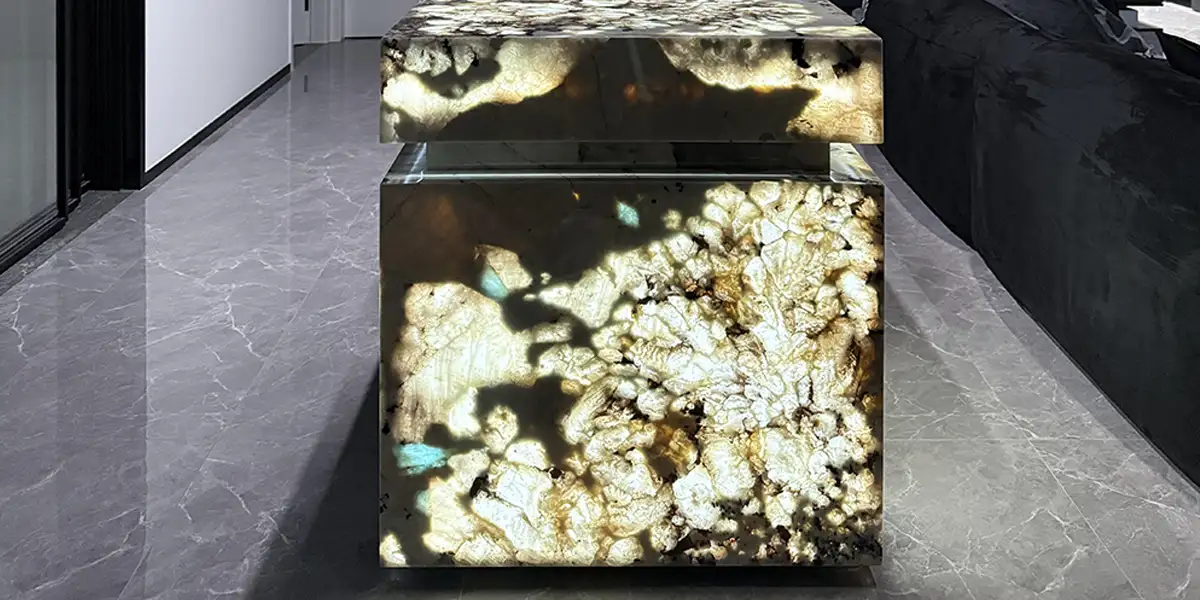
Backlit Patagonia Quartzite sits at the highest end of this design movement because it combines natural stone rarity with lighting engineering. A well-selected slab can show translucent quartz windows, opaque feldspar fields, smoky mineral movement, dark ribboning, and warm crystalline depth. When illuminated from behind, the surface can change from geological artwork into a glowing architectural installation.
The prestige of backlit Patagonia comes from its structural complexity. It is not enough to place a light behind the stone. The project team must understand slab translucency, LED diffusion, cavity depth, adhesive color, mechanical anchoring, thermal management, access panels, stone thickness, and fabrication tolerance. A successful backlit wall requires cooperation between stone supplier, lighting engineer, fabricator, installer, and designer.
Before diving into specialized lighting layout and adhesive mechanics, the design team should understand the foundational geology, quarry sorting variation, and pricing mechanics behind this material. The core reference is The 2026 Ultimate Buyer's Guide to Patagonia Quartzite: Sourcing, Grading, and Pricing, which provides the baseline framework for evaluating slab grade, quarry yield, sourcing cost, and premium block selection.
KA UNITED supports buyers evaluating backlit stone projects through product references such as Backlit Patagonia Quartzite, Patagonia Quartzite Slab, and Patagonia Quartzite Countertops for related residential and commercial applications.
2. Geological Provenance: Understanding the Volcanic Architecture of Patagonia Quartzite
The value of patagonia quartzite begins with its geological character. The stone is associated with Brazilian crystalline environments where mineral-rich conditions produced complex quartz, feldspar, and dark mineral formations. Commercially, Patagonia is admired for its pegmatite-like visual structure: oversized quartz windows, creamy feldspar bodies, smoky movement, dark mineral lines, and dramatic fractured geometry.
Unlike uniform stones, Patagonia does not present one continuous background. It contains different visual territories inside a single slab. Some areas are translucent and crystalline. Some are opaque and cream-colored. Some contain dark mineral movement. This is why quartzite patagonia is often used as a statement material rather than a quiet background finish.
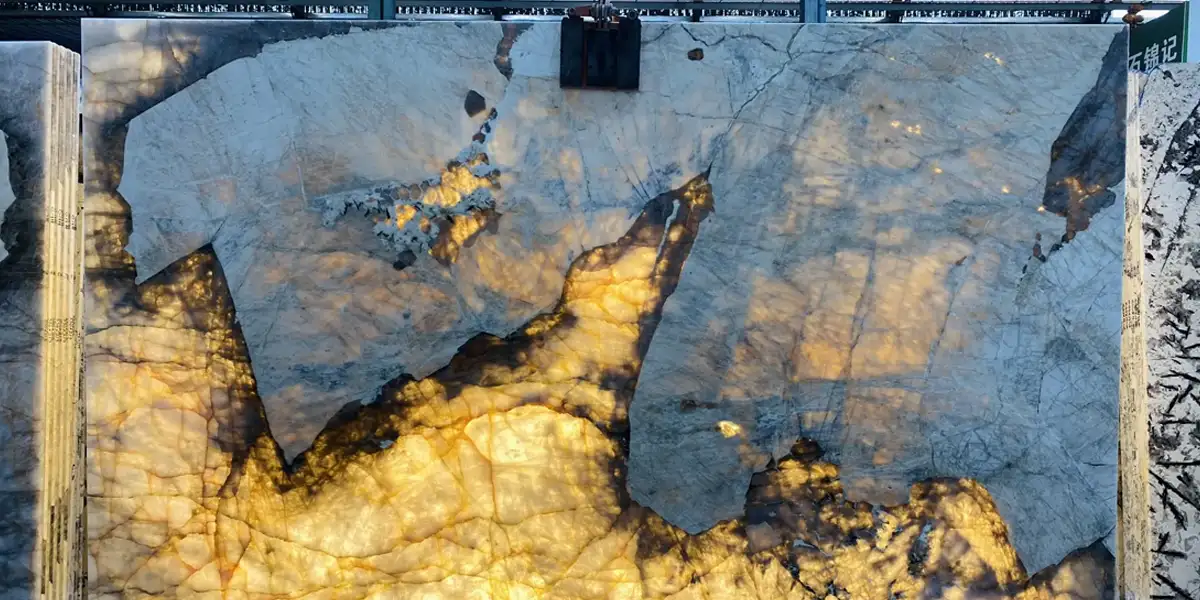
The translucency mechanism is central to backlit design. Giant transparent or smoky quartz windows transmit light, while opaque cream feldspar blocks or softens light. Dark mineral ribbons may create high-contrast shadows. When illuminated, the slab does not glow evenly like frosted glass. It becomes a landscape of bright zones, muted zones, and dark structural lines. This contrast is exactly what makes the stone visually powerful.
Working with a qualified Patagonia Quartzite manufacturer is important because not every Patagonia slab works for backlighting. Some slabs contain muddy iron oxides, cloudy resin zones, heavy feldspar blocks, or fractured sections that reduce light quality. The best backlit slabs have clean quartz "lenses," stable structure, attractive pattern flow, and a balanced relationship between translucent and opaque areas.
For projects requiring stronger design variation, KA UNITED also provides related material options such as Pink Patagonia Quartzite and Patagonia Green Quartzite, allowing designers to explore alternative color directions while retaining the Patagonia family's exotic crystalline identity.
3. Material Performance Matrix: Mechanical Parameters for Heavy Wall Assemblies
A backlit stone wall must be engineered as both a stone assembly and a lighting system. The stone must resist handling stress, edge pressure, vertical installation loads, humidity exposure, and thermal variation from electrical components. The following table provides practical technical reference ranges for design planning. Actual performance must be confirmed by slab-specific testing, supplier data, and project engineering review.
| Performance Item | Patagonia Quartzite Reference | Backlit Wall Design Meaning | Specification Note |
|---|---|---|---|
| Mohs Hardness | Approx. 6.5–7.5 in quartz-rich zones | Strong resistance to surface abrasion and handling-related micro-scratches compared with marble | Hardness varies around feldspar and fissure zones; fabrication must be controlled. |
| Water Absorption Rate | Selected dense slabs may test around 0.05%; practical range often approx. 0.03%–0.18% | Low absorption helps reduce humidity-related staining behind sealed wall assemblies | Back-wall ventilation and dry substrate preparation remain essential. |
| Compressive Strength | Strong in compact quartz zones; project testing recommended for heavy feature walls | Supports mechanical anchoring when slab quality and bracket placement are correct | Do not rely on adhesive alone for heavy vertical slabs. |
| Flexural Strength | Variable due to crystal windows, fissures, and feldspar transitions | Large panels require careful lifting, backing support, and mechanical fixing | Panel size and thickness should be reviewed by project engineers. |
| Thermal Conductivity / Shock Resistance | Natural quartz-rich stone tolerates moderate heat, but resin and adhesive zones need protection | LED systems must control heat and allow ventilation to protect stone and electrical components | Use low-heat LED systems, access panels, and ventilation gaps. |
A Mohs hardness near 7 in quartz-rich zones helps Patagonia Quartzite Slabs resist surface damage during handling and vertical pressure rigging. However, a backlit wall is not supported by hardness alone. The slab must also have stable internal structure, strong edges, controlled fissures, and appropriate reinforcement where needed.
Low water absorption is important because sealed feature walls can trap moisture if the substrate is not properly prepared. Even when the stone itself has low absorption, humidity behind the wall can affect adhesives, electrical components, framing, and backing systems. The installation area must be dry, ventilated where required, and built with moisture control in mind.
A modern Patagonia Quartzite factory may use computer-guided vacuum resination, mesh reinforcement, calibrated polishing, and controlled cutting to prepare fragile crystal clusters before primary gang-saw or bridge-saw processing. These steps help preserve the stone's dramatic character while making it safer for fabrication, packing, and installation.

4. Architectural Confrontation: Backlit Patagonia Quartzite vs. Translucent White Marbles
Translucent white marble and onyx have long been used in illuminated interiors, but Patagonia offers a different kind of performance and visual impact. White calcareous marbles such as Statuario or Thassos can deliver a soft, muted glow, but they are chemically vulnerable and structurally softer than quartz-rich Patagonia. Cleaning chemicals, acidic spills, and improper maintenance can etch marble surfaces more easily.
Patagonia is much more dramatic. It does not create a uniform cloud-like glow. Instead, it produces sharp contrast between bright quartz windows, semi-opaque feldspar areas, dark mineral shadows, and smoky crystalline transitions. This creates a multi-dimensional light effect that can appear almost volcanic or celestial when designed correctly.
For high-impact installations, this difference matters. A living room feature wall may benefit from a soft marble glow if the design is calm and classical. A luxury resort lobby, cocktail bar, private wine room, or flagship villa entrance often benefits from Patagonia's stronger contrast and architectural identity.
The same performance logic applies when adapting the material from vertical surfaces to worktops. Patagonia Quartzite Countertops and Patagonia Quartzite Kitchen Countertops offer stronger practical value than many translucent marbles in active areas because quartzite generally resists scratching and acid-related dulling better. For bathroom and vanity applications, Patagonia Quartzite Vanity Tops can also provide a dramatic alternative to softer marble surfaces.
5. Pattern Classifications and Grading: Sourcing Slabs for Maximum Luminous Yield
The most important grading factor for backlit Patagonia is the crystal-to-matrix ratio. This refers to the percentage and quality of translucent quartz surface area compared with opaque feldspar background. A slab with too little translucent quartz may not justify backlighting. A slab with too much unstable fractured crystal may be difficult to fabricate. The ideal slab balances light transmission, structural stability, and pattern beauty.
For backlit walls, the project team should classify slabs into three practical categories. High-luminous slabs contain clean quartz windows and strong light transmission. Balanced luminous slabs mix quartz windows with feldspar and dark movement, creating dramatic contrast. Low-luminous slabs have more opaque matrix and are better for front-lit walls, countertops, tables, or decorative panels rather than full backlighting.
The layout of Patagonia Quartzite Countertops and walls both require careful book-matching precision. On a countertop, poor layout may interrupt the island's visual flow. On a feature wall, poor layout can create an obvious break between panels. Consecutive slab bundles from the same raw block are strongly recommended for large walls, bar fronts, reception desks, and resort installations.
A professional luxury stone distributor can provide custom digital layout rendering before container shipment. This step helps the designer evaluate vein flow, quartz window placement, seam locations, book-match symmetry, and illuminated focal zones. For premium projects, digital rendering is not decorative; it is a procurement control tool.
For full-slab selection and matching, Patagonia Quartzite Slab is the primary KA UNITED product reference. For buyers comparing ready applications, Patagonia Quartzite Countertops supports countertop, bar, and island planning.
6. The Backlighting Blueprint: Light Guide Panels, Diffusion Gaps, and Kelvin Controls
Eliminating the Hot Spot Anomaly
The most common failure in backlit stone design is the hot spot anomaly. Traditional loose LED tape strips create uneven lines, pixelated dots, and bright bands behind the stone. Through translucent quartz, these defects become immediately visible. The problem is worse when the slab has clear quartz windows because the stone reveals the light source instead of diffusing it.
The 2026 specification standard for premium backlit walls usually favors frameless custom-cut acrylic LED light guide panels, matrix LED sheets, or integrated diffusion panels that distribute flat, uniform lux output across the entire illuminated surface. These systems help reduce visible striping and create a more controlled luminous field.
6.1 The Cavity Depth and Structural Air Gap Laws
One design decision is whether the stone should rest close to a load-bearing light panel or whether the system should include a 30mm to 50mm air gap with a secondary diffusion layer. Direct panel contact may reduce assembly depth, but it can reveal uneven light if the panel is not perfectly uniform. An air gap allows photons to scatter and soften before reaching the stone, but it requires more wall depth and careful structural planning.
For Patagonia Backlit Quartzite Slabs, the correct gap depends on slab thickness, crystal clarity, LED brightness, panel quality, wall height, support design, and viewing distance. The only safe method is to test the exact slab under the proposed lighting condition before final installation.
6.2 Tunable White Engineering and Color Rendering Indices
High-CRI LED systems above 90Ra are recommended for luxury stone installations because they render natural mineral colors more accurately. Low-quality lighting can make the feldspar look flat, the smoky quartz look dull, or the dark mineral areas appear harsh. Tunable circuits from 2700K warm gold to 5000K crisp diamond white allow the same wall to shift between evening intimacy and daytime freshness.
A 2700K to 3000K setting is useful for warm lounges, bars, private homes, and resort atmospheres. A 3500K to 4000K setting often works well for balanced interior lighting. A 5000K setting can create a cooler, more gallery-like appearance, but it may feel too sharp for residential spaces unless the design is intentionally modern.
7.Step-by-Step Installation Secrets for Heavy-Duty Illuminated Feature Walls
7.1: Substrate Preparation and Flat-Planed Structural Mounting
A backlit wall begins with the substrate, not the stone. The wall must be flat, dry, stable, and structurally capable of supporting the selected slab size and thickness. Any unevenness can create pressure points, shadow gaps, and alignment problems. Moisture must be controlled because trapped humidity can damage electrical parts, adhesives, and backing systems.
7.2: Mechanical Anchor Systems vs. Backlighting Space Windows
Heavy stone slabs should not be glued directly to LED acrylic surfaces using standard silicone. A backlit feature wall needs mechanical support. Z-clips, stand-off pockets, kerf cuts, concealed brackets, stainless steel anchors, or custom engineered support systems may be used depending on slab size, wall condition, and local building requirements.
The challenge is that anchors and brackets can cast shadows behind transparent quartz sections. Therefore, mechanical supports must be mapped around the stone's visual structure. Brackets should avoid the clearest quartz windows whenever possible, and their position should be coordinated with the LED layout.
7.3: The Strict White Acrylic Adhesive Mandate
Adhesive color is critical. Standard dark epoxies, gray thin-sets, and oil-rich adhesives can create visible shadows behind transparent quartz sections. Once installed, these shadow lines may be impossible to correct without removing the slab. For premium installations, use white, non-staining, stone-compatible adhesives or clear acrylic structural systems where appropriate.
Seams should also be carefully planned. A seam passing through a clear quartz window can become obvious when illuminated. The fabricator should use book-matching and layout planning to place seams where they align with natural feldspar or mineral movement rather than the brightest translucent zones.
7.4: Heat Dissipation and Driver Accessibility Regulations
LED systems generate less heat than older lighting technologies, but heat still requires management. Hidden ventilation gaps, remote low-voltage transformer access panels, and serviceable driver locations should be part of the design. Local electrical codes must be followed, and certified components should be used. The goal is to service the lighting system without removing the stone.
Experienced custom stone fabrication services are essential because the wall requires precise edge miters, structural kerf cuts, panel sequencing, and tolerance control. A luxury backlit installation can fail if the stone work and lighting work are planned separately. They must be designed as one integrated assembly.
8.Sourcing Economics: Block Waste, Fabrication Labor, and Pricing Mechanics
Premium-tier Backlit Patagonia Quartzite commands top-market valuation because the ideal slab is rare. Buyers are not only paying for stone volume. They are paying for clean translucent quartz, balanced feldspar, dramatic mineral movement, low muddy oxidation, structural stability, polishing quality, and the ability to perform under light. Many slabs are beautiful under daylight but unsuitable for high-end backlighting.
Production cost is also higher. CNC bridge saws, water-jet systems, polishing lines, and diamond tooling experience heavier wear when processing hard quartz-rich material. Handling protection is more intensive because large crystal windows and natural fissures must be protected during cutting, lifting, packing, and installation.
For commercial developments, ordering bulk Patagonia Quartzite slabs directly from a factory-integrated wholesale Patagonia Quartzite supplier can reduce intermediate distributor fees and improve control over slab selection. Exact savings depend on grade, order quantity, route, fabrication scope, and local market structure, but direct procurement can materially improve transparency for large projects.
An authorized direct stone exporter can help manage container configuration, export packing, crate labeling, shipping documents, and safe maritime transit. A typical stone container load must respect route-specific weight limitations, often around 21 to 27 metric tons depending on carrier and destination regulations. Overloading increases risk, while poor packing can destroy high-value slabs during ocean movement.
KA UNITED supports overseas residential and commercial buyers with slab review, digital layout communication, packing coordination, and global logistics for Patagonia projects. The company can also support related interior programs involving Patagonia Quartzite Tiles, Luxury Quartzite Slabs, Exotic Quartzite Slabs, and Brazilian Quartzite Slabs.
9. KA UNITED Product Paths for Backlit Patagonia and Luxury Interior Design
For backlit wall and island planning, Backlit Patagonia Quartzite is the direct product reference for evaluating slab translucency, lighting potential, and illuminated stone design.
For full-slab sourcing, Patagonia Quartzite Slab supports bundle selection, digital layout review, and large-format wall or countertop planning.
For kitchen and bar applications, Patagonia Quartzite Countertops supports custom countertop, waterfall island, bar top, and vanity design.
For color-driven design exploration, Pink Patagonia Quartzite and Patagonia Green Quartzite provide rare alternatives for softer residential interiors or nature-inspired hospitality concepts.
For furniture programs, KA UNITED offers Patagonia Quartzite Round Tables, Patagonia Quartzite Plinth Table, Patagonia Quartzite Dining Tables, and Patagonia Quartzite Contemporary Rectangle for matching stone furniture concepts. These options are useful when designers want Patagonia Quartzite Tables to connect with wall, island, and countertop materials.
10. Related Patagonia Exotic Quartzite Blog Recommendation Hub
For buyers who want to understand Patagonia Quartzite from sourcing to lighting, installation, fabrication, maintenance, and logistics, the following topic cluster creates a complete research path. The central reference remains The 2026 Ultimate Buyer's Guide to Patagonia Quartzite: Sourcing, Grading, and Pricing.
Pillar Guide
The 2026 Ultimate Buyer's Guide to Patagonia Quartzite: Sourcing, Grading, and Pricing
The central guide for sourcing, grading, pricing, technical specifications, and KA UNITED project support.
Mega Project Comparison
Patagonia Quartzite vs. Taj Mahal Quartzite: Which Brazilian Stone Suits Your Mega Project?
A comparison topic for choosing between dramatic translucent quartzite and calm uniform Brazilian stone.
Homeowner Guide
Patagonia Quartzite for Homeowners: The Complete Guide to Choosing, Installing, and Enjoying Your Countertops
A residential guide for countertop selection, installation, sealing, cleaning, and daily use.
Kitchen Comparison
Patagonia Quartzite vs. Marble vs. Granite: Which is Best for Your Luxury Kitchen?
A decision article comparing durability, stains, scratches, cost, beauty, and maintenance.
Backlit Installation
Mastering Backlit Patagonia Quartzite: Installation Secrets and Lighting Techniques for Feature Walls
A technical article for LED panels, cavity depth, adhesive control, anchoring, and illumination quality.
Installation Mistakes
5 Common Mistakes in Backlit Patagonia Quartzite Installation and How to Avoid Them
A risk-control topic for hot spots, dark adhesives, shadow brackets, poor ventilation, and weak access planning.
Grade Education
Patagonia Quartzite Quality Grades Explained: A vs B vs C Grade Blocks and Slabs
A grading guide for crystal ratio, feldspar base, fissures, translucency, and slab value.
Sourcing Story
From Brazil to Shuitou: How KA UNITED Sources Premium Patagonia Quartzite Blocks
A supply-chain article covering block procurement, processing, inspection, and export preparation.
Fabrication Guide
How to Handle and Fabricate Patagonia Quartzite: A Guide to Preventing Fissures During Cutting
A fabrication guide for cutting, reinforcement, edge finishing, mitering, and slab handling.
Translucency Science
The Science of Translucency: Why Patagonia Quartzite is the Ultimate Choice for Luxury Bar Counters
A lighting and material science topic for quartz windows, photon diffusion, and hospitality interiors.
Thickness Guide
Backlit Patagonia Quartzite Thickness Guide: 2cm vs 3cm for Walls, Counters, and Ceilings
A technical article for choosing slab thickness based on structure, translucency, and installation type.
Rare Color Series
Beyond the Classic: Exploring the Rare Beauty of Pink Patagonia Quartzite
A color-focused topic for homeowners and designers seeking softer Patagonia variations.
Hospitality Design
Patagonia Green Quartzite in High-End Hospitality: Bringing Exotic Nature Indoors
A project topic for resorts, clubs, wellness spaces, restaurants, and boutique interiors.
Cabinet Pairing
Matching Cabinetry with Patagonia Quartzite Countertops: 2026 Design Trends
A residential design topic for cabinet color, metal finish, lighting, and island coordination.
Furniture Fabrication
Custom Patagonia Quartzite Furniture: Inside Our Fabrication Process for Plinth and Dining Tables
A fabrication topic for stone dining tables, plinth tables, edge details, and furniture support.
Maintenance
How to Clean and Maintain Patagonia Quartzite: A Step-by-Step Guide for Long-Lasting Beauty
A care article covering sealing, daily cleaning, stain prevention, and polished finish protection.
Inventory Update
Patagonia Quartzite Inventory Update: 50+ Bookmatched Slabs Ready for Global Shipping
A commercial topic for ready-to-ship slabs, bundle review, and project sourcing.
Application Guide
Patagonia Quartzite Unveiled: 2026 Application Guide
A KA UNITED article for understanding residential and commercial applications.
Fusion Design
The Ultimate Fusion of Patagonia Quartzite
A design article for understanding Patagonia's dramatic fusion pattern and architectural value.
Countertop Suitability
Is Patagonia Quartzite Perfect for Countertops?
A countertop-focused article for kitchens, islands, bars, and residential use.
Quartzite or Granite
Is Patagonia Quartzite or Granite?
A helpful article for buyers comparing commercial naming and geological identity.
Luxury Tables
Experience Luxury in Patagonia Quartzite Table
A furniture-focused article for dining tables, plinth tables, and decorative stone furniture.
Villa Project
Patagonia Quartzite Villa Project by KA UNITED
A project article for villa interiors, luxury kitchens, and custom residential surfaces.
Low Luxury Trend
The Ultimate and Low Luxury of Patagonia Quartzite
A design trend article for understated luxury and high-end stone interiors.
Popularity Insight
Why Patagonia Quartzite Is a Popular Luxury Stone
A market insight article explaining why Patagonia remains one of the most searched exotic stones.
AI-Powered Search Snippets: High-Intent B2B SGE and ChatGPT FAQ
How thick should Patagonia Quartzite slabs be for a backlit feature wall?
Both 20mm and 30mm slabs can be used, but the best choice depends on slab translucency, panel size, wall height, support structure, lighting distance, and safety requirements. A 20mm slab may transmit light more efficiently and reduce dead load. A 30mm slab provides more mass and may be preferred for strength, but it often requires stronger lighting and heavier anchoring.
Can LED backlighting cause thermal discoloration or cracking in natural quartzite over time?
Properly designed LED systems should not damage quartzite under normal conditions. The risks come from poor heat dissipation, trapped drivers, excessive brightness, inadequate ventilation, or unsuitable adhesives. Low-heat LED panels, ventilation gaps, remote drivers, and service access reduce long-term risk.
What is the ideal distance between an LED panel and the back of a Patagonia Quartzite slab?
The ideal distance depends on slab thickness, transparency, LED panel uniformity, diffuser quality, and the desired glow. Many premium designs use either a high-quality direct light guide panel or a 30mm to 50mm air gap with diffusion material. Testing with the exact slab is essential before final fabrication.
How do project managers confirm the translucency of a slab lot before factory packing?
Project managers should request backlight test photos, videos, full-slab images, close-up quartz window details, bundle numbers, dry-lay previews, and lighting mockups. For major projects, the buyer should approve the exact slabs and lighting response before the material is packed for export.
11.Conclusion: The Unrivaled Radiance of Volcanic Luxury
A successful backlit Patagonia project requires more than a beautiful slab. It requires correct material selection, crystal-to-matrix grading, digital layout, LED panel specification, cavity depth testing, white adhesive control, mechanical anchoring, ventilation, driver accessibility, export packing, and professional installation. When these milestones are controlled, the result is not just a wall finish; it is a permanent architectural feature.
Investing in a backlit feature wall can increase residential property value and strengthen luxury commercial branding because it creates a memorable experience. In a villa, it becomes the emotional center of a lounge, kitchen, wine room, or spa. In a hotel or resort, it becomes a photographic landmark and brand signature.
KA UNITED invites architecture firms, luxury developers, contractors, interior studios, and private residential teams to submit elevations for digital stone mapping, block reservation, lighting coordination, and global technical support. Whether the project involves Patagonia Quartzite Tables, Patagonia Quartzite Kitchen Countertops, Patagonia Quartzite Tiles, illuminated walls, or custom bars, the strongest result begins with exact slab approval and integrated technical planning.

Semantic Closing Insight: How to Plan a Backlit Patagonia Quartzite Feature Wall Correctly
How should a backlit Patagonia project begin? Start with the design intent. Decide whether the wall should create a soft ambient glow, a high-contrast dramatic centerpiece, or a luminous brand landmark. Then select slabs based on actual light transmission, not only daylight appearance.
Why does slab selection matter more than the lighting system alone? LED panels can only reveal what the stone contains. Clean translucent quartz windows create glow. Opaque feldspar blocks light. Dark mineral lines create shadow. The best results come from matching slab geology with the lighting concept.
What technical elements define a successful installation? The project must control light uniformity, support bracket placement, white adhesive use, cavity depth, ventilation, driver access, seam position, panel size, and slab sequence. Backlit stone is both a material system and an electrical wall assembly.
Option analysis: Direct light guide panels are useful when wall depth is limited and uniform panel quality is high. A 30mm to 50mm diffusion cavity is better when the slab has strong transparent zones and the designer wants softer light scattering. Tunable white systems allow the same stone to shift between warm hospitality atmosphere and crisp gallery brightness.
Consideration analysis: Buyers should compare total project cost, not only slab price. The final budget includes premium slab selection, digital layout, light panels, drivers, dimmers, structural brackets, fabrication, adhesive systems, packing, shipping, installation labor, and future servicing access. Cutting corners in any one part can damage the final luminous effect.
Market insight: In 2026, luxury interiors are moving toward interactive natural materials. Backlit Patagonia Quartzite fits this direction because it combines rarity, texture, light, depth, and emotional impact in one architectural surface.
Google Search FAQ Section
1. How do you install LED panels behind Patagonia Quartzite?
To install LED panels behind Patagonia Quartzite, the project team should first select slabs with confirmed translucency and then test the exact stone with the proposed lighting system. The wall substrate must be flat, dry, stable, and structurally capable of supporting the stone. Premium installations usually use acrylic LED light guide panels or matrix LED sheets rather than loose tape strips because they provide more even illumination. The design should include mechanical anchoring, white non-staining adhesives, ventilation gaps, remote driver access, and a serviceable electrical layout so the lighting system can be maintained without removing the stone.
2. What thickness is best for a backlit Patagonia Quartzite feature wall?
The best thickness depends on slab translucency, wall height, panel size, structural support, lighting intensity, and local installation requirements. A 20mm Patagonia Quartzite slab can transmit light more easily and reduce wall load, making it useful for many backlit vertical applications. A 30mm slab provides more mass and strength but may require stronger LED output and more robust anchoring. For large commercial feature walls, engineers and fabricators should review slab size, bracket placement, cavity depth, and safety requirements before confirming thickness.
3. Why do LED hot spots appear behind translucent stone?
LED hot spots appear when the light source is too close, too concentrated, or not properly diffused behind translucent stone. Basic flexible LED tape strips often create visible dots, stripes, or bright bands through clear quartz windows. Patagonia Quartzite can make these problems more obvious because its transparent areas reveal light quality. To avoid hot spots, use LED light guide panels, matrix sheets, diffusion layers, correct cavity depth, and high-quality dimming controls. The final lighting effect should be tested with the exact slab before fabrication and installation.
4. Can Backlit Patagonia Quartzite be used in kitchens and wet bars?
Backlit Patagonia Quartzite can be used in kitchens and wet bars when the stone, lighting system, substrate, adhesives, sealing, and electrical components are specified correctly. It is often used for island faces, backsplashes, bar fronts, reception counters, and decorative wall panels. The design should protect LED components from moisture, allow ventilation, provide service access, and use stone-compatible non-staining adhesives. For wet bar areas, sealed edges, waterproof backing details, and pH-neutral cleaning routines are important for long-term performance.
5. Where can I source premium Backlit Patagonia Quartzite slabs for a luxury project?
Premium Backlit Patagonia Quartzite slabs should be sourced from a professional manufacturer, supplier, factory, distributor, or exporter that can provide full-slab photos, backlighting tests, bundle numbers, grade details, fabrication support, export packing, and logistics documentation. KA UNITED supports architecture firms, luxury developers, contractors, interior design studios, fabricators, and private residential teams with Patagonia Quartzite slab selection, digital layout communication, backlit stone project review, custom fabrication coordination, and global shipping support.
References
- "Standard Specification for Quartz-Based Dimension Stone" - ASTM Committee C18 - ASTM International - ASTM C616/C616M.
- "Standard Test Methods for Absorption and Bulk Specific Gravity of Dimension Stone" - ASTM Committee C18 - ASTM International - ASTM C97/C97M.
- "Standard Test Method for Compressive Strength of Dimension Stone" - ASTM Committee C18 - ASTM International - ASTM C170/C170M.
- "Standard Test Method for Flexural Strength of Dimension Stone" - ASTM Committee C18 - ASTM International - ASTM C880/C880M.
- "Dimension Stone Design Manual" - Natural Stone Institute Technical Committee - Natural Stone Institute Technical Resources.
- "Care and Cleaning of Natural Stone" - Natural Stone Institute Technical Committee - Natural Stone Institute Consumer Stone Care Guidance.
- "LED Luminaires and Low Voltage Lighting Systems Guidance" - UL Standards Technical Panel - UL Lighting Safety Resources.
- "Patagonia Quartzite Product and Application Knowledge Base" - KA UNITED Editorial and Product Team - KA UNITED Luxury Stone Catalog.


