The Art of Book-matching: Creating Symmetrical Masterpieces with Azul Bahia Granite
The Art of Book-matching: Creating Symmetrical Masterpieces with Azul Bahia Granite
Book-matching is one of the most refined techniques we have in natural stone design. It takes two consecutive slabs cut from the same block and arranges them so the pattern on one mirrors the other across a central seam. When it works, the mineral veins, white ribbons, and deep blue fields open outward like the pages of a rare geological book. When it is applied to Azul Bahia Granite, the result stops being a decorative wall and becomes architectural art.
I have spent years sourcing blue stone for hotel lobbies, villa living rooms, spa suites, and executive offices, and I can tell you the same thing every time: book-matching is not a finishing detail you add at the end. It is a decision you make at the very beginning, because it changes which slabs you buy, how they are cut, how they are packed, and how they are installed. The stone itself does most of the work, but only if we give it the right conditions.
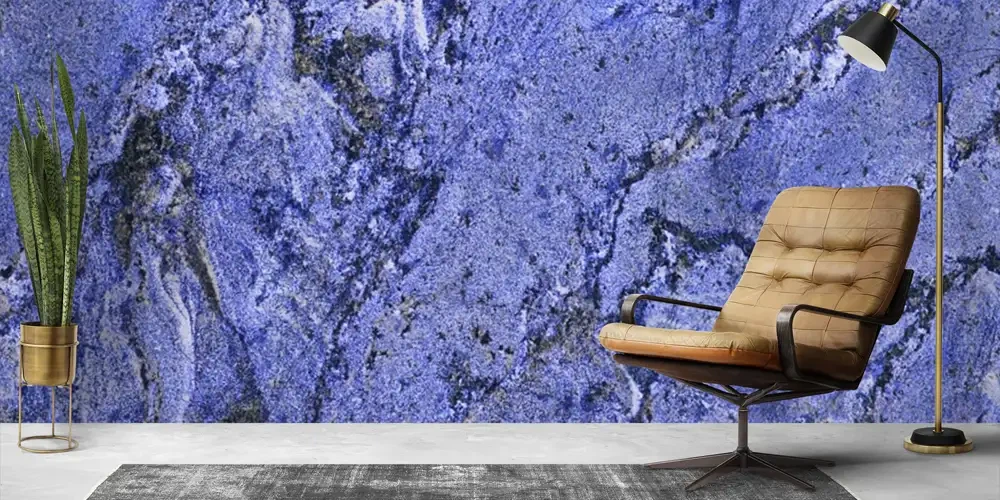
What makes Azul Bahia so effective for this technique is its color. This is not the quiet grey-blue you see in ordinary granite. It is an intense sodalite blue with pale feldspar movement, black mineral contrast, and occasional golden or grey accents. That combination gives the mirrored wall depth, so the symmetry feels intentional rather than mechanical. For anyone planning a luxury feature wall in 2026, that distinction is the whole game.
1. Where the Symmetry Begins: The Geology of Azul Bahia
The visual strength of Azul Bahia starts underground. Commercially it is sold as granite, but geologically it is more accurately described as a sodalite-rich blue decorative stone from Bahia, Brazil. That distinction explains a lot about why it looks the way it does. Instead of the common speckled surface of ordinary granite, you get deep blue mineral fields, crystalline movement, and a gemstone-like appearance that no amount of fabrication can fake.
For book-matching, geological continuity matters more than it does for any other application. Consecutive slabs have to form a believable mirror across the central seam, and that only happens when they come from the same block with a clear, directional pattern. If the original block has strong movement and a consistent direction, the final wall reads as balanced and dramatic. If the block is muddled or interrupted, no amount of polishing will save the composition.
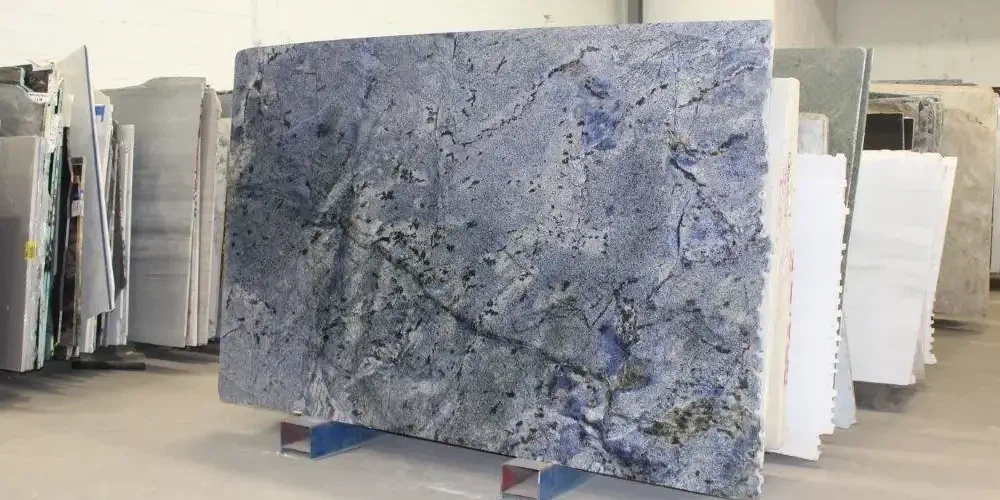
Sodalite concentration is the reason blue intensity varies from slab to slab. Some blocks show deep royal blue fields. Others carry more white feldspar, black mineral zones, grey clouds, or uneven patches. A supplier who understands book-matching does not pick blocks at random. We inspect block direction, slab sequence, fissure behavior, and blue saturation before deciding whether a bundle can produce a balanced A-side and B-side composition. That is why I always tell buyers to request slab sequence photos before purchase. If a supplier cannot show you consecutive slabs from the same block, the risk of broken symmetry is already high.
2. The Technical Numbers That Keep a Wall Standing
Book-matching is a visual technique, but it leans heavily on technical performance. Large panels have to survive handling, polishing, transport, installation, and long-term vertical anchoring. That is especially true for double-height walls, elevator lobbies, and reception backdrops, where a failure would be expensive and impossible to hide. The table below compares Azul Bahia Granite with two other blue stones that buyers often consider in the same conversation.
| Metric | Azul Bahia Granite | Sodalite Blue Marble | Blue Macaubas Quartzite |
|---|---|---|---|
| Mohs Hardness | 6.0 to 6.5 | 3.0 to 3.5 | Around 7.0 |
| Absorption Rate | 0.08% to 0.15% | Around 0.25% | Around 0.10% |
| Acid Sensitivity | Extremely low compared with marble | High, with etching risk | Very low |
| Compressive Strength | 170 to 190 MPa | Around 90 MPa | Around 200 MPa |
| Density | Around 2,600 kg/m³ | Around 2,710 kg/m³ | Around 2,650 kg/m³ |
| Best Book-match Use | Feature walls, lobbies, spas, counters | Decorative low-contact walls | High-performance counters and walls |
These are practical industry ranges, not universal guarantees. I always recommend confirming them with project-specific test data from the supplier before final approval, because every quarry and every block behaves a little differently. Still, the pattern is clear. Azul Bahia sits in a strong middle ground: much harder and less acid-sensitive than marble, with a blue identity that quartzite cannot quite match. For a book-matched wall that has to earn its place in a busy building, that balance is exactly what you want.
3. How Book-matching Actually Works
Book-matching starts at the slab stage, not the wall. Consecutive slabs are cut from the same block and processed so the pattern of one mirrors the next. In the factory we refer to these as A and B slabs, and the mirror effect is created by polishing opposite faces of two consecutive pieces so the natural veining opens like a book. For Azul Bahia, the process is demanding precisely because the value sits in the blue movement. If the sequence is interrupted, if the wrong side is polished, or if the cutting plan ignores the central vein direction, the final design loses the rhythm buyers are paying for.
Two-slab book-match
The two-slab book-match is the classic left-right mirror. It is the right choice for fireplace walls, vanity walls, and smaller lobby panels where you want symmetry without committing to the extra material a larger composition demands. It reads calm and deliberate, and it is usually the most affordable entry point into mirrored stone.
Four-slab quad-match
Quad-matching takes the idea further by mirroring four slabs around a central point, creating a diamond, butterfly, or kaleidoscopic effect. This is what I recommend for grand entrance walls, luxury hotel lobbies, and spa backdrops where the wall is meant to be the emotional center of the room. With Azul Bahia, a quad-match can produce a central blue burst that looks closer to mineral art than surface cladding.
The role of digital templating
For premium work, physical dry-laying alone is no longer enough. We now photograph each slab in high resolution and build a digital layout so the architect or buyer can preview the exact mirrored composition on screen before a single blade touches the stone. This removes the guesswork and prevents the expensive mistake of approving a layout that looked fine on paper but failed in reality. A realistic alignment target is achievable when the slabs are consecutive, the seam is correctly located, and the fabrication team controls thickness, trimming, edge squareness, and final polishing together.

4. Choosing the Right Pattern
Pattern classification is how we decide whether a wall feels calm, dramatic, or artistic. Brazilian blue granite varies significantly from block to block, so no one should approve a project from a small hand sample alone. I group Azul Bahia movement into three patterns that each serve a different mood.
The Oceanic Swirl
The Oceanic Swirl carries rolling blue movement, white clouds, grey transitions, and occasional dark punctuation. It is best for grand entrance walls where the movement itself becomes the focal point. In a large living room, hotel lobby, or branded reception, this pattern creates the sensation of a natural blue wave frozen mid-motion.
The Deep Horizon
The Deep Horizon has more solid blue fields and a quieter vein direction. It suits quiet luxury applications - executive lounges, private offices, bathroom walls, and minimalist interiors where the stone should feel expensive without shouting. This is the pattern I steer toward when a client wants restraint.
The Nebula Mirror
The Nebula Mirror combines strong mineral contrast, cloud-like white forms, and dramatic central symmetry. It belongs in gallery-like spaces, premium retail, and hospitality entrances where visitors are expected to stop and look. When the goal is a statement wall, this is the pattern that earns the attention.
One practical warning: when a project uses several book-matched sections in the same building, bundle control matters enormously. Without it, one wall can read royal blue while the next reads grey-blue, and the inconsistency is obvious the moment they are seen together. A wholesale supplier has to hold sequence continuity across the entire order, not just within a single pair.
5. Why Granite Over Blue Marble
Book-matched marble can be beautiful, and I will never argue otherwise. But marble is generally softer and far more acid-sensitive, which makes it vulnerable to etching, dulling, and micro-scratches in high-contact spaces. For the kind of environment where these walls usually live - a lobby, a spa corridor, a showroom, a luxury bathroom - granite-like blue stone with stronger hardness and lower acid sensitivity is often the more honest choice.
Symmetry in granite also tends to last longer simply because the surface resists daily wear better. People touch these walls. Cleaning teams wipe them. Sunlight pours across them through large glass façades. A stone that holds its polish and color depth under that routine is the difference between a feature that still impresses in five years and one that looks tired in two. If you are weighing options, I would compare Azul Bahia against a blue marble the way you would compare marble against granite for any high-traffic surface: one rewards you on day one, the other rewards you every year after.
Color permanence is part of this too. Sodalite-rich stone should still be protected from harsh chemicals and unsuitable cleaning, but it offers a strong balance between visual uniqueness and structural performance. A reliable supplier will tell you plainly whether a given bundle is appropriate for sun-exposed walls, humid spas, wet bathrooms, or heavy commercial lobbies. That conversation is worth having before money changes hands.
6. Installation: Where the Mirror Wins or Fails
Installation is where a book-matched design either becomes a masterpiece or fails in public. The central seam is the most important point on the entire wall. A seam that is too wide, uneven, poorly filled, or misaligned will destroy the mirror effect no matter how good the slabs were. An invisible joint depends on three controls: accurate cutting, a dry layout inspection before anything is fixed, and color-matched resin that reduces contrast at the seam rather than creating a visible line.
The invisible joint and the zipper effect
The most common failure I see is the zipper effect - a thick, highly visible resin line that runs down the center and breaks the symmetry. Azul Bahia makes this harder than most stones because it mixes deep blue sodalite, white quartz, and dark minerals in a single slab. A single uniform epoxy color cannot cross all three and disappear. The fix is multi-tone resin mixing, where the fabricator matches the epoxy dye to the specific mineral zone it crosses, blue where it crosses sodalite and clear or white where it crosses feldspar. Combined with precise edge milling to keep the gap level, this is what produces a genuinely seamless joint.
Structural reinforcement matters just as much. Large 3cm slabs on a vertical surface need a stable substrate and an anchoring or adhesive system chosen for the specific site. The heavier the panel, the more professional the planning has to be. I also insist on non-staining adhesives where light mineral zones are involved, because a dark adhesive can bleed through and permanently alter the stone's appearance. For any luxury wall, require pre-installation dry layout photos, seam position approval, adhesive confirmation, and a tolerance discussion. These steps cost a fraction of what a failed wall costs to replace.
7. What Symmetry Actually Costs
Azul Bahia book-matching is more expensive than standard slab installation, and the reasons are practical rather than mysterious. You are not paying only for stone. You are paying for sequence, waste, fabrication risk, inspection, polishing accuracy, packing, and installation coordination. Understanding where that money goes helps you spend it in the right places.
The first cost driver is yield loss. A book-matched design often requires buying more square footage than the visible wall area, because vein alignment forces the fabricator to cut away usable stone to preserve the pattern. With a rare blue slab, that waste is real and unavoidable. The second driver is the premium-grade surcharge. Not every extracted block is suitable for mirror work; many have broken movement, excessive dark mineral concentration, irregular fissures, low blue saturation, or slabs too small for the composition. Only a smaller portion of available material is visually strong enough, and that scarcity carries a price.
Sourcing directly from a manufacturer can reduce middleman markup, but the bigger benefit is communication. Direct contact improves slab selection, sequence control, packing accuracy, and pre-shipment inspection. For a hotel lobby or a branded commercial project, those controls matter more than a minor difference in unit price. If the budget is tight, I suggest a smaller book-matched center panel with standard slabs around it. If the goal is maximum impact, buy premium consecutive slabs and accept the higher yield loss.
8. Maintenance That Keeps the Blue Alive
A book-matched wall should look as good in year five as it does on installation day, and that only happens when maintenance is treated as part of the design investment. I recommend a premium penetrating sealer or a modern nano-sealant for high-value panels. The goal is not to coat the stone in a plastic film; it is to reduce staining, oil marks, and fingerprints while preserving the deep wet-look polish that makes the blue feel alive.
The biggest threat to a polished blue surface is the wrong cleaner. Strong acids, harsh detergents, and abrasive pads will dull the polish over time. pH-neutral cleaners and soft cloths are the safe daily routine. In hospitality spaces where walls are touched and wiped constantly, a professional polish may be needed every few years, but prevention is always cheaper than restoration. A trained stone specialist can refresh a polished wall, yet the best strategy is to never let it get to that point.
Frequently Asked Questions
How is book-matched Azul Bahia Granite made?
It is made by cutting consecutive slabs from the same block and polishing opposite faces so the blue, white, grey, and dark mineral movement mirrors across a central seam. The process requires slab sequence control, digital layout planning, accurate cutting, and a dry assembly before final installation. For premium walls, I recommend asking for photos of the full slab bundle and approving the mirror layout before production begins.
Why is Blue Bahia Granite perfect for symmetrical feature walls?
Its vivid sodalite blue and dramatic mineral movement create a natural mirror when consecutive slabs are book-matched. It has stronger visual impact than common blue-grey granite and better practical durability than many blue marbles, which makes it suitable for luxury lobbies, villa living rooms, spa walls, and branded commercial interiors.
What does book-matching exotic granite cost in 2026?
The cost depends on slab grade, blue saturation, block rarity, slab size, thickness, fabrication difficulty, yield loss, packing, and destination. Book-matching usually costs more than standard installation because you must buy consecutive slabs and accept cutting waste to preserve symmetry. Premium Azul Bahia with strong blue color will carry a higher price than commercial mixed-grade blue slabs.
Can Azul Bahia Granite be used for bathrooms and spa walls?
Yes, it works well in luxury bathrooms and spas when it is properly sealed, installed, and maintained. The blue creates a calm but dramatic environment behind vanities, bathtubs, and showers. For wet areas, confirm adhesive compatibility, substrate preparation, sealing method, ventilation, and cleaning protocol before installation.
Where can contractors buy wholesale blue granite slabs for book-matching?
Contractors should look for a verified manufacturer, factory, or direct exporter with access to sequential slab bundles. The supplier should provide slab photos, bundle numbers, thickness confirmation, surface finish details, export packing support, and fabrication guidance. That level of transparency is the best indicator that the symmetry will hold.
Final Conclusion
Book-matching is the clearest expression of what natural stone can do, because it reveals exactly what nature created inside the block. With Azul Bahia Granite, that revelation is especially powerful: the blue sodalite, the crystalline movement, and the rare Brazilian origin give every mirrored panel a sense of permanence and prestige that no painted surface can imitate. The real decision is not choosing a beautiful slab. It is choosing the right sequence, the right grade, the right fabrication method, the right installation standard, and the right supplier, and holding all five together from the first drawing to the final polish. When those pieces line up, a book-matched wall stops being decoration and becomes the reason the room exists. That is the standard I hold every blue stone project to, and it is the standard you should expect from KA UNITED.