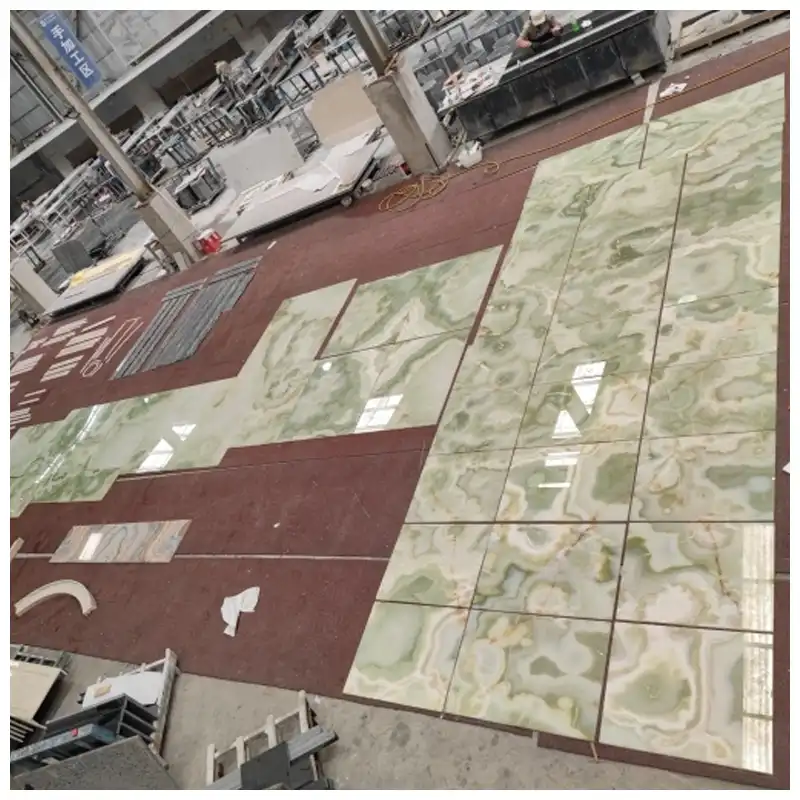
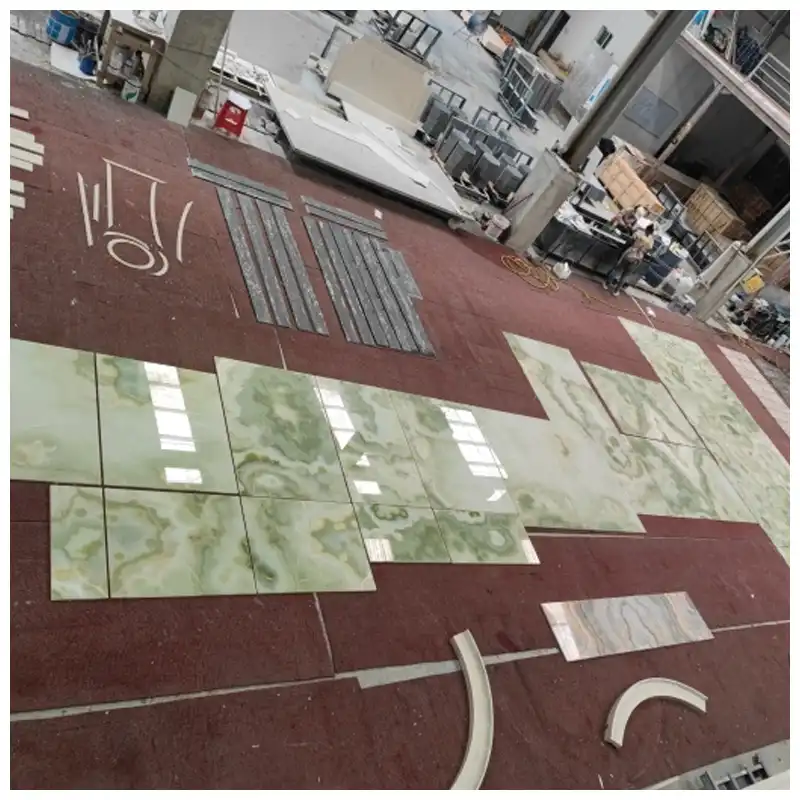
Quick Summary: Light Green Onyx Tiles are polished natural onyx pieces with mint-green, ivory and honey-amber mineral bands arranged in rounded, sometimes concentric formations. KA UNITED lists 300 × 300, 600 × 300, 600 × 600 and 900 × 600 mm formats, with nominal 18, 20 and 30 mm thicknesses. The tiles are intended primarily for decorative interior walls, coordinated stone features and selected residential floors, with potential for specially engineered backlit installations. The supplied factory photograph shows a pre-arranged tile layout, making pattern position and joint alignment central purchasing considerations. Illumination and floor performance require separate technical approval.
Light Green Onyx Tiles for Pattern-Matched Walls, Decorative Floors and Illuminated Interior Features

Light green onyx tile material reference for inspecting the overall color balance and natural banded pattern.
The appeal of this light green onyx lies in its pattern scale. Instead of a uniform green surface, the stone forms rounded bands, soft mineral pools and irregular layers of white, sage and warm amber. Different portions of the stone may contain broad pale fields or closely grouped green outlines.
On an interior wall, these forms can be arranged across neighboring tiles to create an extended decorative composition. The design depends on which sections of the original material are selected and how each piece is rotated before installation.
For Green Onyx Wall Tiles, the main advantages are the manageable tile formats and the opportunity to develop a coordinated arrangement without using one oversized slab. An architectural wall can incorporate the stone as a defined panel, a vanity backdrop or a localized decorative surface within a larger interior.
Flooring is a more restricted application. Onyx requires careful assessment of expected wear, the polished surface and the supporting construction. Decorative residential floor sections may be considered where the technical requirements are met, but the material should not be treated as an automatic substitute for durable everyday floor tile.
Pattern-Matched Walls
Organized mineral-band compositions for reception backdrops, living-room features and private interior panels.
Illuminated Stone Sections
Selected translucent pieces for engineered light-panel assemblies with approved support and diffusion.
Residential Floor Accents
Limited floor areas where wear, wet traction, bedding and maintenance conditions have been assessed.
Concentric Mint-Green Bands and Honey-Colored Outlines: Reading the Actual Onyx Pattern
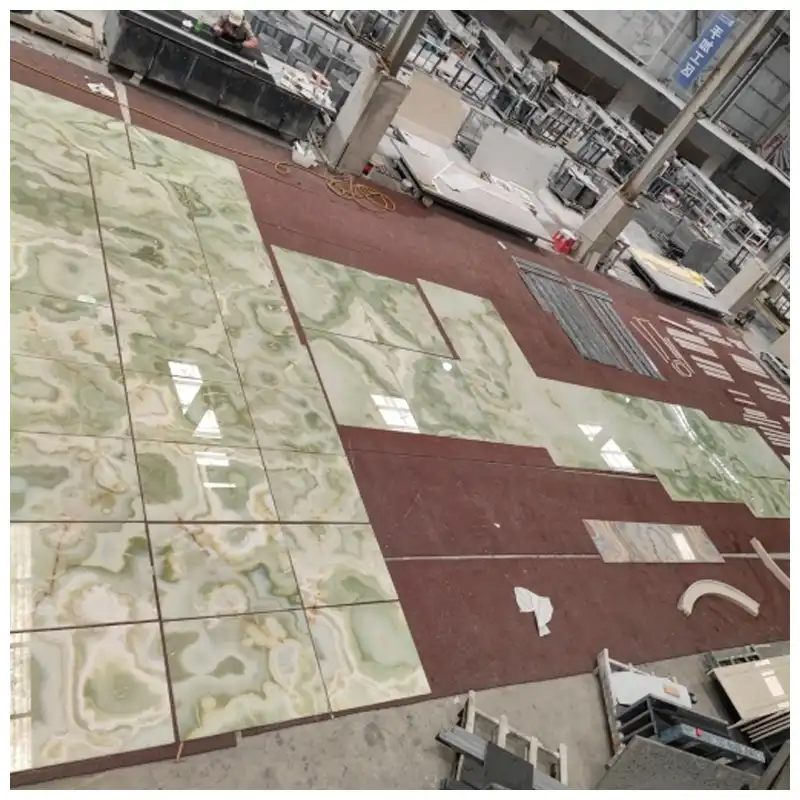
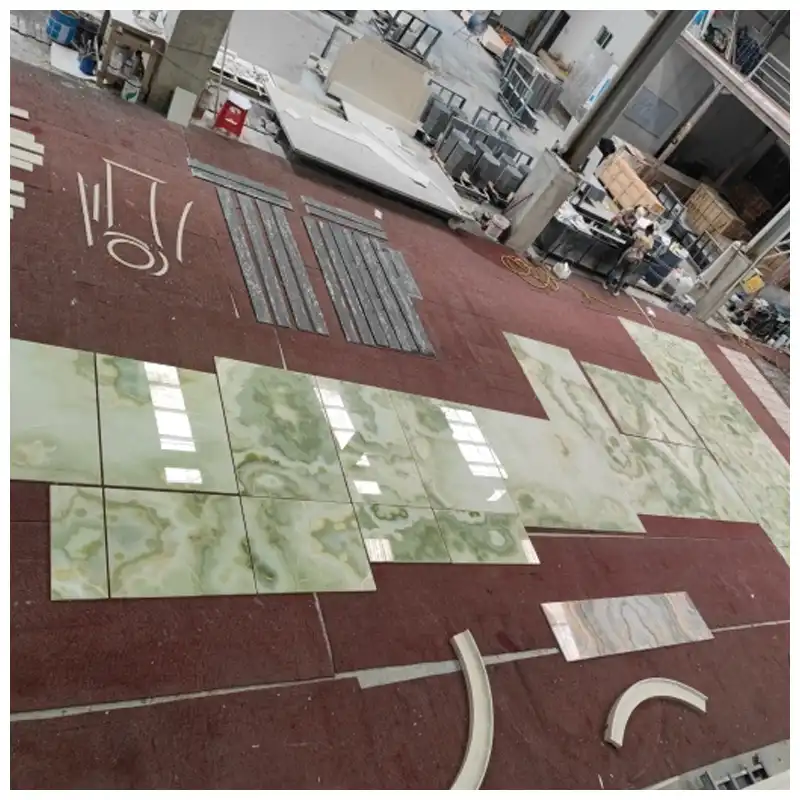
The factory layout photograph reveals a material with several distinct pattern zones. Pale green and ivory sections sit beside rounded mineral formations, some resembling irregular rings. Fine amber and beige outlines separate portions of the green background, while a few areas contain more concentrated swirling structures.
These bands are not evenly distributed. Some pieces contain wide areas of translucent-looking cream color, while others show a denser network of narrow green outlines. The apparent scale of the pattern also changes when a section is cut into a smaller tile.
For Green Onyx Stone Tiles, the position of a rounded formation can be more important than its overall color. A complete ring near the center of one panel may become a partial arc when divided by a joint. Placing a related section next to it can restore some visual movement, but the transition must be checked rather than assumed.
The photographed Light Green Onyx Marble Tiles have a gentler color range than dark jade-green onyx. This distinction matters when ordering additions to an existing installation. A supplier's general label of green onyx is not enough to establish that a new batch will match the pale mint and amber arrangement of the approved selection.
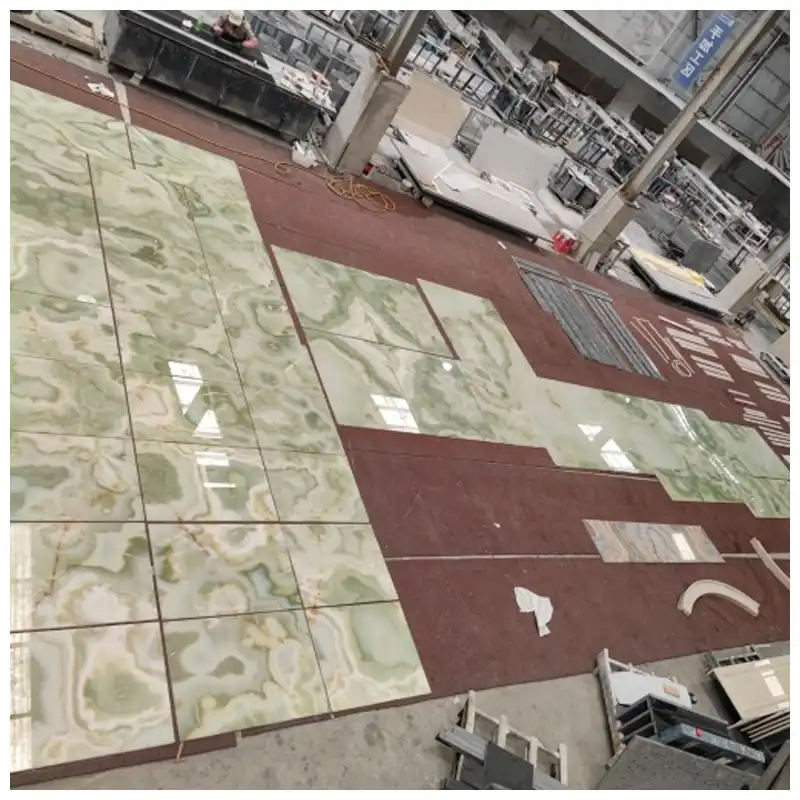
Mineral-pattern detail position for evaluating the scale of concentric bands and transitions across tile faces.
Pattern Continuity Is Different from Identical Color
Two tiles can share a mint-green background yet produce a visible interruption when their mineral bands meet at different angles. Conversely, pieces with moderately different green intensity may create a convincing continuous arrangement if their band positions are compatible.
The project should define whether its priority is a relatively uniform green field, a series of preserved circular formations or a deliberate combination of contrasting patterns. That decision affects which tiles are accepted for prominent areas and which are better allocated to perimeter cuts.
Four Light Green Onyx Tile Formats and Their Effect on the Finished Pattern
The listed dimensions are 300 × 300, 600 × 300, 600 × 600 and 900 × 600 mm. These formats should not be regarded as visually interchangeable. The longer the tile, the more opportunity there is to preserve an extended band; smaller squares divide the same formation into more individual pieces and joints.
| Tile Format | Pattern and Cutting Consideration | Potential Design Use |
|---|---|---|
| 300 × 300 mm | More joints across the same decorated area; circular bands may be divided into smaller segments. | Compact accent areas, decorative surrounds and modular compositions |
| 600 × 300 mm | Rectangular shape can follow a dominant mineral direction; rotation changes the perceived movement. | Horizontal or vertical wall courses and linear accents |
| 600 × 600 mm | Square composition can retain larger round formations within individual pieces. | Decorative wall fields and approved low-wear floor sections |
| 900 × 600 mm | Larger uninterrupted stone face; requires particular attention to handling, backing and installation support. | Large feature panels and selected continuous-pattern wall layouts |
Nominal Thickness and Surface Finish
The supplied thickness references are 18 mm, 20 mm and 30 mm, with a polished finish. Their availability should be confirmed for the particular tile format and selected material. The final section must suit the panel size, substrate, fixing method and any backing treatment.
The term Onyx Marble Polished Tiles describes the commercial decorative-stone finish, not proof of a particular surface hardness or moisture resistance. A polished surface increases reflected light, while actual transmission of light through the stone depends on its mineral structure, thickness and backing.
For any non-standard tile dimensions, finished sizes and dimensional tolerances should be stated on the approved cutting drawing. A reference dimension alone does not confirm that every piece has been machined and inspected to an identical tolerance.
What the Factory Dry-Lay Photograph Shows About Green Onyx Tile Sequencing
The supplied photograph shows several groups of polished green onyx pieces spread across a factory work area. Individual tile boundaries are visible, and portions of the green, white and amber bands appear positioned to form larger decorative arrangements. Additional cut stone parts are visible nearby.
This is useful evidence of a pre-installation layout stage. It is not, by itself, proof that every tile forms a true mirrored pair, has been permanently installed or has passed a specified dimensional inspection. The photograph also does not establish the final building location or room dimensions.
Three Layout Decisions Visible in a Dry-Lay
Band alignment: The green rings and honey-colored lines must be assessed where they meet along neighboring tile edges. A seam that interrupts a major circular formation may require the pieces to be repositioned.
Pattern grouping: Dense green areas can be grouped or distributed according to the design. The layout may use a prominent formation as a central feature, leaving lighter pieces for margins or secondary zones.
Boundary cuts: A wall or floor layout rarely ends exactly on full tile dimensions. Perimeter pieces should be identified before cutting so that the remaining visible pattern is intentional rather than a collection of arbitrary offcuts.
Pattern-Matched Versus Bookmatched
Pattern-matched pieces may be arranged with related layers following across adjacent edges. True bookmatching requires stone faces with a suitable mirrored relationship. Sequential or adjacent-looking tiles are not automatically bookmatched.
For this product, the approved layout should indicate tile position and rotation, identify any verified mirrored pairs and record the intended joint arrangement. If a symmetrical design is required, the actual matching faces should be reviewed before the order is released for cutting.
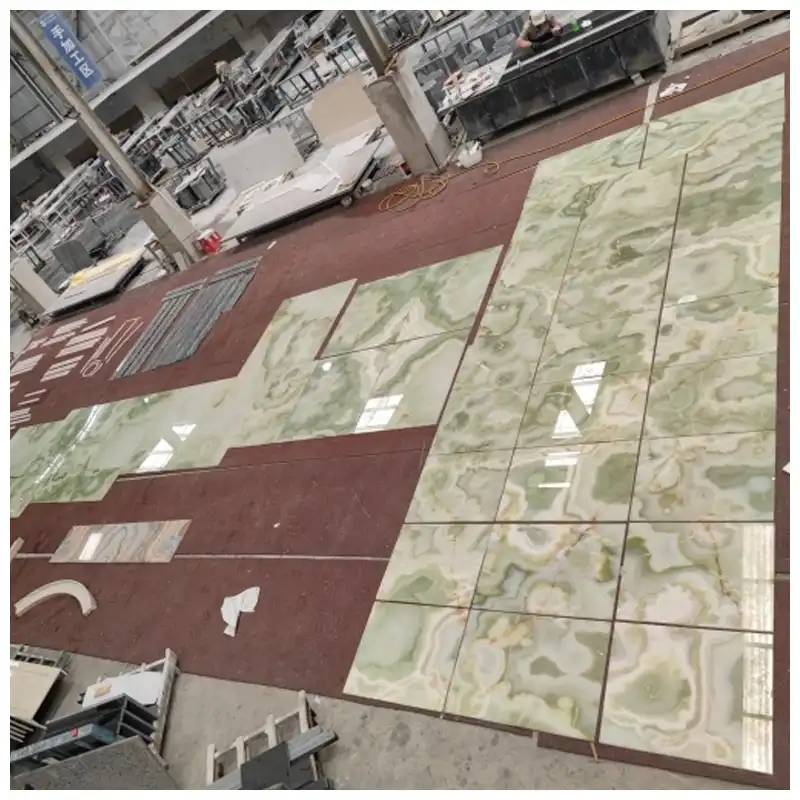
Factory dry-lay photograph: arranged onyx tiles before packing or installation. This is the intended position for the supplied image.
Backlit Light Green Onyx Tiles: Separating Natural Translucency from the Lighting System
Architectural onyx can transmit light through selected parts of its mineral structure. The effect is not identical across the stone. Pale cream areas, green bands, honey-colored layers and darker mineral zones may transmit or diffuse light differently, which means an illuminated wall may show greater contrast than the same tiles under ordinary room lighting.
When specifying Backlit Onyx Tiles, the stone selection and electrical lighting assembly must be developed together. A polished finish does not make an opaque section transparent, and an attractive daylight photograph cannot establish the final illuminated appearance.
Light-Transmission Mock-Up
Illuminate actual project tiles to inspect bright and dark mineral areas at the intended viewing distance.
Backing and Diffuser
Review whether reinforcement, adhesive and diffusing materials alter the visible color or block transmitted light.
Lighting Access
Allow for LED maintenance, heat management and electrical access without disturbing fragile stone pieces.
What Must Be Tested Before an Illuminated Wall Is Approved?
The mock-up should use the intended stone thickness, support assembly, proposed LED lighting and any diffuser or backing treatment. Incomplete coordination can create visible bright spots, shadow lines or a different color balance from the approved unlit sample.
Tile joints can also become noticeable under illumination. Some seams may appear darker, while inconsistent backing materials can produce abrupt light boundaries. The lighting designer and stone installer should approve a representative multi-tile section rather than testing only one small piece.
Illuminated flooring requires additional structural, electrical and surface-safety design. The presence of translucent onyx does not establish that the proposed floor can accept underlighting or that such an assembly is practical for ordinary residential traffic.
Green Onyx Floor Tiles: Where Decorative Use Ends and Technical Approval Begins
Green Onyx Floor Tiles can be considered for carefully controlled interior applications, but calcareous decorative onyx is generally more vulnerable to abrasion and impact than harder flooring stones. A polished sample that looks sound in a factory does not demonstrate long-term wear performance under regular foot traffic.
For a selected residential accent floor, the required assessment should cover pedestrian loading, cleaning frequency, abrasive grit, moisture exposure and the supporting floor system. A small private decorative zone may have substantially different requirements from a hotel entrance or frequently used hallway.
Traction and Surface Wear
Polished onyx should not be assumed to meet wet-floor slip-resistance requirements. If the selected finish does not satisfy the project criteria, the product may be more appropriate on a wall than on the proposed floor. The finished surface also requires realistic expectations concerning scratching, loss of gloss and localized surface damage.
Bedding and Stone Support
Natural onyx is sensitive to unsuitable handling and incomplete support. The installer should establish a stable substrate, compatible natural-stone setting materials, adequate bedding contact and the relevant movement joints. Large pieces require careful handling to avoid concentrating stress at corners or vulnerable mineral boundaries.
Because the stone is light-colored and may be translucent, the choice of bedding material also affects appearance. A dark or uneven adhesive bed may become visible through selected areas. The installation system should therefore be tested with the actual tiles and any existing resin or backing.
Bathroom Floors and Wet Locations
Waterproofing belongs to the supporting bathroom construction, not the decorative onyx tile itself. Shower floors, wet entries and other exposed locations require both suitable waterproofing and verified traction. Where the proposed onyx selection cannot satisfy these conditions, decorative wall placement is the safer application direction.
Light Green Onyx Material Verification, Cleaning and Surface Protection
Natural decorative onyx is commonly calcareous and can include calcite or aragonite-based mineral formations. It should not be confused with the harder siliceous gemstone material also called onyx in other markets. The exact composition and any reinforcement of the supplied batch require material-specific verification where the specification depends on them.
No traceable batch-specific strength, absorption, abrasion or slip-resistance report was included in the supplied product information. The table below focuses on the checks relevant to this tile selection without assigning unsupported numerical properties.
| Acceptance Item | What Must Be Confirmed | Why It Matters |
|---|---|---|
| Stone Soundness | Natural fissures, resin-filled areas and any existing reinforcement | Cutting, lifting, edge condition and installed panel integrity |
| Color and Translucency | Front-lit and transmitted-light appearance of approved pieces | Visual consistency of the intended illuminated composition |
| Surface and Edges | Polish quality, chipped corners and dimensional acceptance | Visible joints, handling and long-term appearance |
| Floor-Use Performance | Relevant traction, wear and support criteria for the actual application | Whether the polished tile can be approved for pedestrian use |
Cleaning the Polished Surface
Use soft cleaning materials and a pH-neutral product compatible with calcareous natural stone. Avoid acidic descalers, vinegar, abrasive pads and aggressive cleaning treatments. Acid-sensitive mineral surfaces can lose their polish through chemical etching even when an impregnating sealer has been applied.
Sealing may reduce certain liquid absorption risks but does not make onyx non-porous or scratch-proof. Cleaning requirements should be considered before selecting the material for a regularly splashed bathroom surface or a floor that requires frequent intensive maintenance.
From Approved Dry-Lay to Identified and Protected Onyx Tile Sets
Once the tile arrangement has been approved, the relationship between individual pieces needs to be preserved during handling and delivery. A polished tile with a curved mineral band may be visually recognizable, but relying on pattern recognition alone is an unreliable way to reconstruct a complex wall composition.
A project-specific layout reference should link each finished piece to its location and orientation. For example, the drawing may identify wall zones, course positions, the visible face and rotation direction. Those identifiers should remain consistent with the packing information, rather than changing between factory layout and site receipt.
Inspection of the finished pieces should cover the approved natural appearance, any relevant repaired areas, surface finish, dimensions and exposed edges. Translucent panels should be examined for unwanted backing marks or treatments that could alter their appearance under the intended lighting arrangement.
Onyx can be vulnerable to edge damage during transport. Packing should separate polished faces and protect corners against direct impact. Where the order includes a numbered composition, the identification system should make it possible to locate each tile without repeatedly unpacking unrelated pieces.
Interior Application Reference: A Coordinated Light Green Onyx Feature Surface
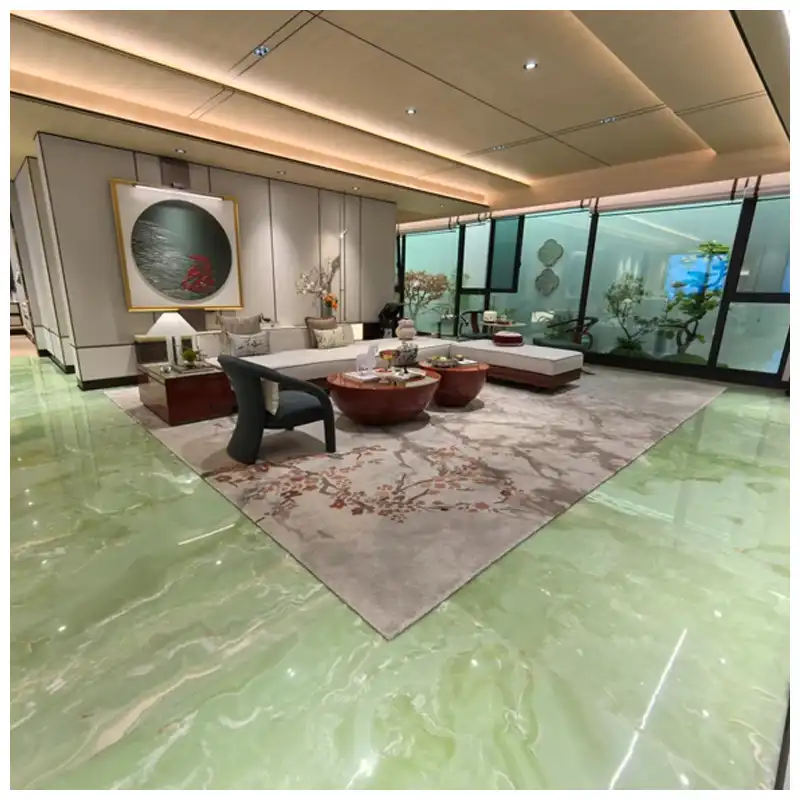
A pale green onyx composition can be used as a defined feature within an otherwise restrained room. Light-colored plaster, warm timber and neutral surrounding stone allow the mint-green circles and amber outlines to remain visible without competing with another heavily patterned material.
For a vertically mounted arrangement, the wall can be composed around one or more prominent rounded formations. A front-lit surface emphasizes the polish and mineral outlines; a properly tested illuminated version may reveal additional internal contrast.
The application image is reserved for an actual project reference or clearly identified design illustration. The provided factory dry-lay photograph is not an installed room photograph and should not be presented as a completed residence or hotel project.
Light Green Onyx Tiles Compared with Four Other KA UNITED Onyx Tile Colors
The choice between onyx tile colors is not only about matching the surrounding interior palette. The dominant color, mineral-band geometry and proportions of light and dark areas affect how a tiled composition reads in daylight and how it may respond to a proposed lighting system. The following comparison is for visual selection; technical properties must be confirmed for each material.
| Onyx Tile Selection | Appearance | Design Use to Evaluate | Principal Buyer Check |
|---|---|---|---|
| Light Green Onyx Tiles | Pale mint, ivory and honey-colored concentric banding | Pattern-led feature walls and selected decorative tile fields | Alignment of circular bands and compatibility of actual selected pieces |
| Blue Onyx Tile | Blue and ivory mineral areas with warmer contrasting accents | Cool-colored decorative wall and feature compositions | Blue saturation and balance of light and warm bands |
| Pink Onyx Tiles | Pink-toned and pale mineral formations | Warm-toned decorative walls and selected vanity backgrounds | Pink color range, veining distribution and actual finish |
| Brown Onyx Tiles | Ocher, brown, cream and tiger-like contrasting bands | Earth-toned wall panels and decorative interiors | Dark band distribution and intended panel sequence |
| Yellow Honey Onyx Marble Tiles | Honey-yellow, amber and cream mineral movement | Warm architectural accents and illuminated wall concepts | Amber intensity and actual response to proposed illumination |
Recommended Natural Onyx Tiles from KA UNITED

Blue Onyx Tile
Blue-toned natural onyx for decorative wall compositions where cooler mineral colors are preferred over mint green.
View Product
Pink Onyx Tiles
Pink natural onyx tiles for interior schemes requiring warmer colored stone and individually selected pattern arrangements.
View Product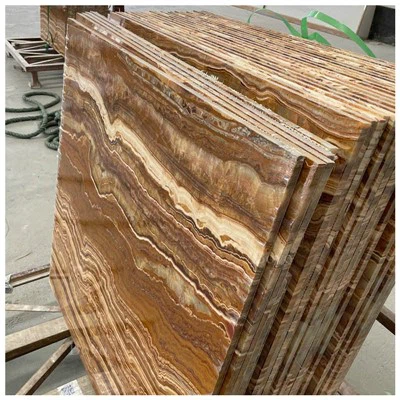
Brown Onyx Tiles
Earth-toned onyx with strong brown and cream banding for warm decorative stone walls and interior accents.
View Product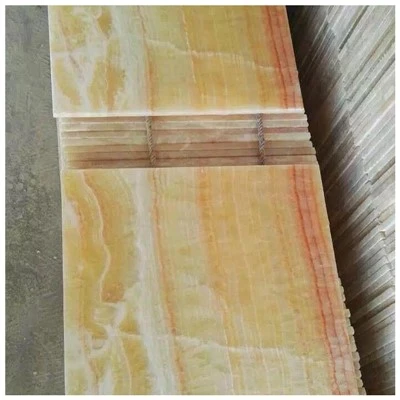
Yellow Honey Onyx Marble Tiles
Amber-yellow onyx tiles for projects choosing a warmer mineral palette and potentially illuminated decorative panels.
View ProductFrequently Asked Questions About Light Green Onyx Tiles
1. Does the factory dry-lay photograph prove these onyx tiles are bookmatched?
No. It shows pieces arranged for pattern review, but the photograph alone cannot prove that all neighboring tiles are mirrored pairs. Bookmatching requires suitably related stone faces with a verified symmetrical relationship. A numbered layout and actual paired-piece photographs should be approved when a true bookmatch is specified.
2. Which tile format preserves the larger circular patterns most effectively?
A larger format such as 900 × 600 mm or 600 × 600 mm may retain more of a rounded mineral formation within one piece, depending on the actual stone. Smaller formats create more joints and divide the pattern into shorter sections. The best choice requires reviewing the selected stone and proposed cutting map.
3. Will all Light Green Onyx Tiles glow evenly when backlit?
No. Light transmission varies across the mineral bands and may also be affected by thickness, resin, reinforcement, adhesives and lighting components. The intended tile selection should be tested in a representative lighting mock-up using the proposed backing and diffuser before approving an illuminated wall.
4. Can polished light green onyx be installed across an entire residential floor?
It should not be specified for whole-house flooring without a separate assessment of wear, slip resistance, support, moisture and maintenance. Onyx is a relatively delicate decorative stone, and polished surfaces may be unsuitable for demanding or wet pedestrian areas. Approved low-wear accents and interior walls are more conservative applications.
5. What information should accompany a multi-tile green onyx pattern order?
Provide the required tile formats, thickness, selected stone photographs, intended wall or floor drawing, joint layout and preferred mineral-band arrangement. If illumination is planned, include the lighting mock-up requirements, backing details and support design. The approved tile sequence should be maintained through piece identification and packing.
Release the Light Green Onyx Tile Layout Only After the Pattern Boundaries Are Resolved
For this specific material, the drawing that matters most is the complete tile arrangement. It should establish the position of the prominent rounded mineral formations and show where the layout meets the wall edges, corners, openings or adjoining materials.
If a circular band is interrupted at a joint, the buyer must decide whether that transition is acceptable or whether a related tile should be substituted. Any approved mirror arrangement should be identified separately from an ordinary pattern-oriented layout. These decisions belong in the final cutting map, not in a general color approval.
The release conditions will differ by application. A decorative wall needs an approved fixing arrangement. A backlit panel must also resolve its lighting assembly. A floor requires a separate surface-performance and construction acceptance. The fact that the same stone is available in several tile formats does not make those installations technically interchangeable.
Final Note: The principal selection decision for this light green onyx is where its mint-green rings and amber outlines will appear after the tiles are joined. Approve the pattern as a complete composition and treat illuminated wall construction and floor suitability as independent technical decisions. A visually convincing factory dry-lay is a useful reference, but it is not an installation or performance certificate.

Request Light Green Onyx Tile Selection and Pattern Layout from KA UNITED
KA UNITED can review the available light green onyx tile formats against a proposed wall composition, decorative floor plan or custom illuminated panel. A useful inquiry includes the area drawing and the preferred natural mineral-band arrangement rather than only a tile size.
Send the selected tile format, thickness, intended finish, installation location and any existing pattern reference. For backlit work, include the proposed lighting arrangement, diffuser, backing and access requirements. Where the project involves a coordinated multi-piece surface, provide the wall elevation or floor setting-out plan so actual tile positions and cutting boundaries can be evaluated.