


Quick Summary: Blue Fusion Quartzite Tiles are polished natural Brazilian stone tiles recognized for their dark blue-grey, charcoal and silver-grey mineral formations. Unlike uniform-colored tiles, the stone contains folded bands, irregular dark patches and fine pale veins that change direction from piece to piece. KA UNITED lists 300 × 300, 600 × 600, 600 × 900 and 600 × 300 mm formats, with nominal thicknesses of 16, 18 and 20 mm. The supplied workshop photograph shows cut stone pieces arranged for pre-installation review, including narrow components alongside larger panels. Purchasers should evaluate the actual mineral distribution, finished-piece geometry and floor or wall installation requirements before approving production.
Blue Fusion Quartzite Tiles for Mansion Interior Floors and Hotel Architectural Wall Surfaces

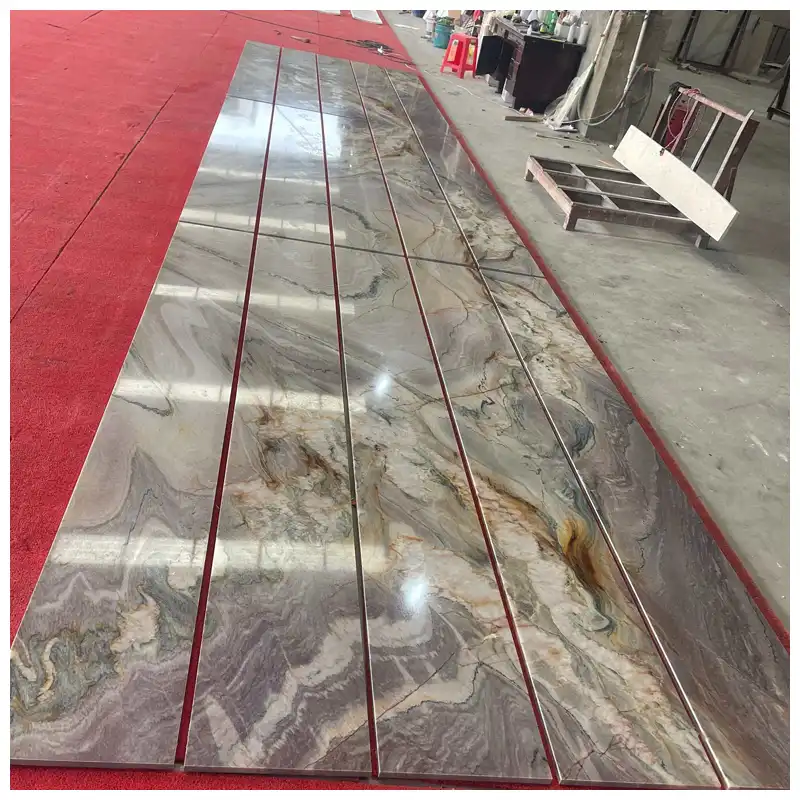
Main stone reference showing smoky blue-grey mineral movement and naturally variable polished surfaces.
Blue Fusion is a strongly patterned natural stone in which the apparent color changes with the direction and concentration of its mineral bands. The photographed tiles have a predominantly smoky charcoal-grey appearance, with muted blue-grey and darker greenish sections. Fine pale lines cross the folded mineral areas, creating a complex surface that cannot be reproduced through an identical printed pattern.
For a large mansion interior, the stone can form a distinct architectural floor rather than a neutral background. The natural movement becomes more visible as several pieces are assembled, particularly where darker bands and lighter mineral concentrations occupy adjoining tiles.
Hotel interiors present another design direction. A reception wall, elevator lobby or interior feature panel can use the stone's irregular mineral movement to create depth behind furniture, lighting or architectural fittings. Tile sizes and joint locations should be selected according to the wall elevation rather than copied from a flooring schedule.
The product is supplied as finished square and rectangular stone tiles. Its commercial value for contractors lies in receiving defined components that can be assigned to a specific floor or wall layout, rather than treating every piece as an interchangeable section of a uniform grey material.
Distinct Mineral Movement
Folded charcoal and silver-grey bands create changing patterns across neighboring polished stone pieces.
Four Finished Tile Formats
Square and rectangular modules can be allocated to different architectural surface dimensions.
Coordinated Stone Components
Narrow cut pieces and larger tiles can be reviewed together for borders, thresholds and wall terminations.
Blue-Grey Mineral Currents, Folded Charcoal Bands and Natural Color Variation
The supplied image shows an unusually intricate natural pattern. Broad dark areas fold through the stone, sometimes appearing as parallel waves and sometimes separating into irregular patches. Lighter silver-grey formations run beside them, while fine mineral lines introduce additional movement within each section.
The surface is not consistently navy blue. Under the workshop lighting shown in the photograph, the prevailing colors appear smoky grey, charcoal, slate blue-grey and muted green-grey. Other commercially marketed Blue Fusion selections may contain stronger blue, cream, rusty gold or brown areas, but those variations should not be assumed to occur in every production tile.
Folded Bands Rather Than Straight Veins
Many mineral formations in the pictured stone bend and change direction. Some resemble compressed waves; others form overlapping, irregular dark fields. This is quite different from a marble or quartzite with straight parallel lines extending across a largely uniform background.
The pattern can change considerably when the original material is divided into smaller tiles. A 300 × 300 mm section may show only one part of a broad mineral fold, while a larger rectangular piece can preserve a more complete transition between several mineral zones.
Differences Between Adjacent Stone Pieces
Within the factory arrangement, some tiles are dominated by heavy dark movement. Other pieces contain larger smoky grey areas or pale mineral streaks. These variations should be considered part of the selected material's visual range, not treated as defects solely because neighboring tiles differ.
When purchasing Exotic Quartzite Tiles, it is useful to distinguish the desired overall appearance from the particular pattern of a single tile. A small sample cannot represent all the combinations of grey, dark green and pale mineral structures visible across a larger area.
For a design requiring a certain proportion of dark and light areas, approval should be based on representative completed tiles from the intended material selection. An exact repetition of one sample image is not a realistic acceptance criterion for natural stone.

Close-up material reference for distinguishing dark folds, silver-grey streaks and local changes in mineral direction.
Brazilian Material Identity and Commercial Naming
Blue Fusion is marketed internationally as a Brazilian exotic quartzite. The reversed name Fusion Blue Quartzite Tiles is also used in stone catalogs for related commercial selections. Other Fusion-family stones may have similar flowing patterns but noticeably different color distributions.
For Brazilian Quartzite Tiles ordered to a project specification, the actual stone source and approved production batch should determine acceptance. A commercial name identifies the requested material family, but it does not establish identical mineral composition, strength or appearance across every seller's selection.
Blue Fusion Quartzite Tile Sizes, Thicknesses and Finished Stone Specifications
Four tile dimensions are listed for this product: 300 × 300 mm, 600 × 600 mm, 600 × 900 mm and 600 × 300 mm. Nominal thickness options are 16, 18 and 20 mm. These formats are intended for different architectural layouts, with final size-and-thickness combinations subject to confirmation against the selected stone and installation design.
| Specification | Product Details and Approval Notes |
|---|---|
| Product Name | Blue Fusion Quartzite Tiles |
| Stone Material | Natural Brazilian Blue Fusion Quartzite |
| Alternative Trade Name | Fusion Blue Quartzite |
| Primary Colors | Smoky Blue-Grey, Charcoal, Dark Grey and Muted Green-Grey |
| Natural Pattern | Folded Mineral Currents, Irregular Dark Bands and Pale Intersecting Veins |
| Tile Size A | 300 × 300 mm / 11.81 × 11.81 inches |
| Tile Size B | 600 × 600 mm / 23.62 × 23.62 inches |
| Tile Size C | 600 × 900 mm / 23.62 × 35.43 inches |
| Tile Size D | 600 × 300 mm / 23.62 × 11.81 inches |
| Nominal Thickness | 16 mm / 18 mm / 20 mm |
| Surface Finish | Polished |
| Edge Processing | Straight-Cut Tile Edges; Alternative Profiles by Approved Fabrication Drawing |
| Finished Product Forms | Square Tiles, Rectangular Tiles, Borders and Drawing-Based Cut-to-Size Pieces |
| Applications | Interior Flooring, Decorative Wall Cladding, Hotel Features and Residential Architectural Surfaces |
How the Four Tile Formats Change the Visible Pattern
A 300 × 300 mm tile contains a relatively small area of the original stone. Its folded veins may appear as isolated fragments, while the completed installation develops a more intricate pattern through the relationship between many individual pieces.
The 600 × 600 mm format preserves a larger portion of the mineral movement within each square. It can form a regular floor grid while allowing broader dark and pale areas to remain visible. Because the dimensions are equal, individual tiles can be rotated during design review without changing the module size.
The 600 × 900 mm tile has the longest uninterrupted face among the listed options. It allows more of a flowing mineral formation to remain within one finished component. The longer dimension also influences handling, setting-out, substrate flatness and the position of perimeter cuts.
The 600 × 300 mm format can establish a more pronounced laying direction. Its rectangular proportions are relevant to parallel floor courses, selected corridor layouts and vertical or horizontal wall cladding. The required vein orientation should be established separately from the direction of the tile joints.
Choosing 16, 18 or 20 mm Thickness
Thickness selection must account for the finished tile size, material condition, substrate and installation method. A particular thickness should not automatically be assumed suitable for every format or expected floor load. The approved cutting schedule needs to distinguish any differences between principal floor pieces and supplementary architectural components.
Larger rectangular pieces require attention to support and handling. For walls, the completed component weight and fixing arrangement also need to be evaluated. Structural acceptance must be based on the actual material and relevant project criteria rather than on a generic claim that all quartzite has identical strength.

Tile dimension and edge-detail image position for the selected thickness and finished geometry.
Cutting Drawings for Finished Components
Blue Fusion Quartzite Cut-to-Size Tiles should be ordered against a finished component schedule identifying actual dimensions, thickness, edge processing and any required orientation of the visible mineral pattern.
The approved tolerances should cover the geometry relevant to the installation, including length, width, squareness and finished edge condition. No particular tolerance or machining accuracy can be verified from the supplied photograph alone.
Where the order includes both larger panels and narrow strips, their separate dimensions and intended locations should be recorded. These pieces may share the same stone selection but require different handling and installation details.
Reading the Factory Dry-Lay: Large Tiles, Narrow Strips and Separated Project Zones
The supplied photograph shows a substantial group of polished Blue Fusion pieces arranged on a red protective workshop surface. Large rectangular sections occupy the principal areas, while smaller pieces and long narrow strips are positioned nearby. Dark mineral patterns remain visible across the stone faces despite strong reflections from overhead lights.
This arrangement provides more information than a single full-slab photograph. The viewer can see how the natural pattern looks after cutting and can examine the different proportions of large panels and supplementary components. However, the photograph alone does not verify the final architectural drawing, installed positions or the exact dimensions of every visible piece.
Separate Visual Groups Before Final Installation
The pieces are not shown as one uninterrupted completed floor. Several groups are separated by areas of protective red material, and not every edge is intended to meet its photographed neighbor. This distinction matters when interpreting the image as a factory layout reference.
For a project using material with pronounced dark mineral folds, a planned arrangement should identify the placement of the larger visual features. Some sections may have concentrated dark bands; others may contain more open grey fields. Their distribution influences the finished interior.
Why Narrow Pieces Deserve Separate Review
Long narrow stone sections are visible alongside the larger pieces. Depending on the approved project drawings, similarly shaped components might be specified as borders, skirting, thresholds or architectural trims. The image does not establish their final function, so those uses must be confirmed through the cutting schedule.
Such components may require more careful handling than a full tile because their long edges and small cross-sections can be vulnerable to local impact or bending. Stone soundness, edge condition and support should be evaluated in relation to the actual finished geometry.
Natural Alignment Versus True Bookmatching
Related tiles may be arranged so that their mineral movement follows a preferred direction. This is a layout decision, not proof that every piece is bookmatched. True mirrored compositions require suitable corresponding stone faces and an approved pairing arrangement.
If a feature wall calls for a symmetrical mineral composition, the selected material must demonstrate the proposed relationship before fabrication. Randomly pairing tiles with similar dark waves will not automatically produce a mirrored pattern.

Factory Dry-Lay: use the supplied photograph showing polished Blue Fusion tiles and supplementary pieces arranged on red protective flooring.
Polished Blue Fusion Quartzite in Interior Floors: Wear, Traction and Material Verification
Quartzite is commonly specified where a quartz-rich natural stone is desired. However, the commercial term quartzite does not establish identical mineral composition or mechanical behavior for every stone selection. Individual mineral bands, natural discontinuities and any processing treatments can affect the finished product.
Blue Fusion Quartzite Floor Tiles should therefore be evaluated as finished architectural components, with the actual stone and polished surface considered together. The appearance of a dense, glossy tile does not independently confirm a particular abrasion rating, absorption result or resistance to slipping.
Polished Surface and Slip Resistance
Polishing increases reflectivity and makes the contrast between dark and pale mineral areas more visible. On a hotel lobby or residential entrance floor, that visual effect must be considered separately from pedestrian traction.
Wet shoes, cleaning water and other surface contaminants can influence slip conditions. A polished finish should not automatically be approved for wet entrances, stairs or high-traffic public areas. Relevant surface testing and the applicable project requirements should determine the permitted use.
Abrasion and Maintenance Expectations
Quartz-rich stone is generally associated with relatively good resistance to common mineral scratching. Nevertheless, an actual floor also experiences abrasive grit, furniture movement, cleaning equipment and possible localized impact. These service conditions are not fully characterized by a Mohs hardness description.
Use cleaning equipment and chemicals appropriate to the actual stone and any surface treatments. Remove abrasive debris before wet cleaning. Sealing requirements should be established according to the material's measured behavior and the sealer manufacturer's guidance rather than assuming that every Blue Fusion tile requires the same treatment.
Technical Properties Requiring Evidence
No verified laboratory report for the photographed production batch was provided. The following table identifies the performance information relevant to a floor or wall specification without introducing unsupported numerical test results.
| Technical Property | Verification Requirement | Practical Relevance |
|---|---|---|
| Stone Classification | Material-specific identification when required by the specification | Mineral composition and suitable treatment selection |
| Abrasion Resistance | Representative test evidence appropriate to expected traffic | Preservation of polished flooring under repeated use |
| Slip Resistance | Finish-specific testing under relevant use conditions | Floor and pedestrian-area suitability |
| Water Absorption | Material-specific result where the installation requires it | Moisture behavior, sealing and setting-material selection |
| Flexural Performance | Relevant material evidence and component-support review | Larger tiles, narrow pieces and wall-panel support |
Mechanical properties published for another quartzite material should not be represented as certified results for this Blue Fusion selection. Final acceptance should use project-relevant evidence and the condition of the actual supplied stone.
Wall Cladding and Floor Interfaces: Where the Blue Fusion Cutting Plan Meets Construction
The geometry of the finished pieces becomes especially important where Blue Fusion meets other architectural materials. A large stone floor may terminate against a lift entrance or a staircase. A decorative wall may include lighting recesses, outlets or exposed returns. Each condition affects how the available tile formats can be used.
Blue Fusion Feature Wall Panels
Blue Fusion Quartzite Wall Tiles can be arranged vertically or horizontally depending on the selected panel dimensions and the preferred appearance of the natural mineral folds. The apparent direction of the stone's movement can change when a rectangular tile is rotated.
For interior cladding, the wall elevation should identify openings, visible edges, corners and the position of any architectural fixtures. The substrate and fixing method must suit the actual component weight and applicable project requirements.
Floor Thresholds and Perimeter Strips
A flooring design should establish the finished elevation at doors, corridors and changes to neighboring materials. Where narrow quartzite strips form part of a border or transition detail, their geometry should be included in the cutting plan rather than treated as an unspecified site adjustment.
A border can change the apparent direction of the natural pattern, particularly if the strips are cut from different parts of the original stone. For an installation requiring a coordinated color range, those components should be included in the visual approval.
Installation Joint and Substrate Requirements
The installation system must provide suitable support to the stone and accommodate the expected movement of the supporting construction. Joint widths, substrate conditions and relevant movement joints should be established through the project design.
A decorative desire to align dark mineral bands across several tiles cannot override necessary movement joints or suitable fixing details. Visual continuity and construction performance are separate acceptance requirements.
Finished-Piece Inspection and Export Protection for Blue Fusion Quartzite Tile Orders
Finished Blue Fusion pieces need to be assessed against the approved drawing and actual selected stone. Relevant checks include the required dimensions, thickness, polished finish, edge condition and any natural discontinuities affecting the intended components.
Inspection of this material should pay attention to the distinction between natural dark mineral lines and open fractures or processing damage. A heavily patterned area may contain several intersecting visual features. Their appearance alone cannot establish whether a line is structurally significant.
For an installation that has an approved stone arrangement, each component or grouped set should be identifiable through the cutting and packing documentation. The aim is to preserve the intended allocation of pieces without requiring the site installer to reconstruct the entire design from unmarked material.
The larger 600 × 900 mm components and the narrow pieces visible in the factory photograph may have different handling needs. Stable support, separation between polished faces and protection of exposed edges are important during loading and transportation.
Packing should keep the finished pieces protected and identifiable. It cannot eliminate the need to inspect site dimensions, substrate conditions or installation tolerances before fixing the stone.
Interior Application Reference: Blue Fusion Quartzite in a Dark-Toned Architectural Setting

Independent application image position. Use an actual installed project or a clearly identified architectural rendering.
A dark Blue Fusion stone field can be contrasted with pale wall finishes, brushed metal fittings and restrained timber elements. The contrast allows the natural silver-grey and charcoal patterns to remain visible without surrounding the stone with other strongly patterned surfaces.
For a mansion entrance, the tile field can define a principal circulation area. In a hotel interior, selected wall panels may be used behind reception furniture or within a lobby feature. The choice depends on the actual material available and the required installation details.
Lighting should be considered during material selection. Strong overhead reflections can emphasize the polished finish while making some mineral details less visible from certain viewpoints. A sample inspected only under workshop lighting may look different in a room with warmer or more directional lighting.
The provided factory photograph documents finished stone pieces before installation. It should not be described as a completed mansion or hotel project. A separate application photograph or explicitly labeled design rendering belongs in this position.
Blue Fusion Quartzite Compared with Four KA UNITED Natural Quartzite Tile Collections
Blue Fusion's distinctive feature is its dense dark mineral movement. Some related quartzite tiles have much lighter crystalline surfaces, while others emphasize watercolor-like color transitions or restrained grey patterns. These differences affect the intended design composition rather than establishing a ranking of strength or durability.
| Quartzite Selection | Natural Appearance | Design Direction | Buyer Selection Priority |
|---|---|---|---|
| Blue Fusion Quartzite Tiles | Dark smoky blue-grey and charcoal mineral currents with pale irregular veins | Dark-toned architectural floors and distinctive interior feature walls | Distribution of folded mineral bands and relationship between large and narrow cut pieces |
| Aquarella Quartzite Tiles | Lavender-grey, muted green, cream and warm brown-gold watercolor-like movement | Multicolored decorative floors, stair components and interior walls | Distribution of contrasting lavender and cream mineral areas |
| Calacatta Grey Quartzite Tiles | Pale grey-white stone with cloudy charcoal-grey movement | Light neutral interior floors and contemporary wall fields | Balance between pale background areas and darker mineral concentrations |
| Cristallo Quartzite Tiles | Light white-grey crystalline appearance with contrasting mineral details | Bright decorative wall surfaces and selected architectural stone features | Crystal distribution, visual transparency where relevant and actual piece construction |
| Atlantic Quartzite Tiles | Neutral grey and charcoal-grey stone with restrained silver mineral lines | Subdued architectural flooring and coordinated interior walls | Consistency of the selected grey tone, surface finish and tile calibration |
These selections represent different design approaches within the KA UNITED natural stone collection. Their geological properties, finished dimensions and installation suitability must be reviewed independently.
Recommended Natural Quartzite Tiles from KA UNITED
Aquarella Quartzite Tiles
Multicolored quartzite with watercolor-like lavender, cream and grey movement for expressive interior stone compositions.
View Product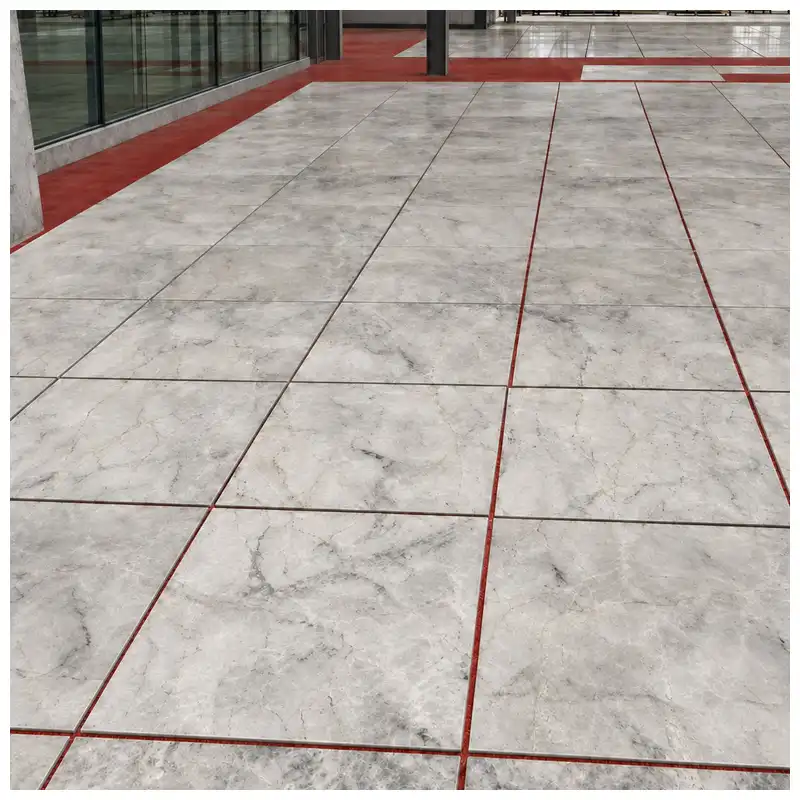
Calacatta Grey Quartzite Tiles
Pale grey-white natural stone with cloudy darker movement for understated architectural flooring and walls.
View Product
Cristallo Quartzite Tiles
Light crystalline quartzite tiles for decorative walls and selected interiors requiring a brighter mineral appearance.
View Product
Atlantic Quartzite Tiles
Neutral grey architectural quartzite tiles with restrained mineral movement for coordinated floor and wall surfaces.
View ProductFrequently Asked Questions About Blue Fusion Quartzite Tiles
1. Why does the Blue Fusion tile photograph show more grey than blue?
Blue Fusion is a commercial stone name covering material with naturally variable blue-grey, charcoal and other mineral colors. In the supplied factory photograph, smoky grey and dark mineral formations dominate. The approved production tiles should determine the accepted color range rather than an expectation that every piece will be bright blue.
2. Which tile sizes and thicknesses are available for Blue Fusion Quartzite?
The listed formats are 300 × 300 mm, 600 × 600 mm, 600 × 900 mm and 600 × 300 mm, with nominal thicknesses of 16 mm, 18 mm and 20 mm. Each requested size-and-thickness combination should be confirmed against the selected material and installation requirements before production.
3. Are the narrow strips in the factory photograph skirting and floor borders?
The photograph shows long narrow stone components beside larger polished tiles, but it does not identify their final construction function. They may be considered for borders, skirting or other details when supported by approved drawings. Their actual dimensions, edges and installation positions require separate confirmation.
4. Can polished Blue Fusion Quartzite be used in a high-traffic hotel lobby?
The material can be evaluated for hotel interior flooring, but suitability depends on the selected stone, finished surface, support system and expected service conditions. Slip resistance, abrasion performance and moisture exposure must be assessed. A polished appearance does not independently confirm compliance with public-floor requirements.
5. Can Blue Fusion tiles be arranged to create a continuous or mirrored mineral pattern?
Related tiles may be oriented to follow a preferred mineral direction, but natural variation prevents an automatic guarantee of continuous veins. True bookmatching requires suitable corresponding stone faces. An intended matching or mirrored arrangement must be approved from the actual available material before fabrication.
Approve the Blue Fusion Cutting Map Around the Major Dark Mineral Formations
For a strongly patterned stone such as Blue Fusion, the purchasing decision should distinguish the required finished tile geometry from the desired visual arrangement. A 600 × 900 mm piece may preserve more of the natural mineral movement, but the cutting plan must still satisfy the architectural dimensions and the condition of the selected stone.
Where the design includes large panels and narrow stone components, the drawing should identify their intended positions and any required relationship between visible mineral patterns. It should also establish the acceptance conditions for exposed edges and natural discontinuities relevant to the finished pieces.
The supplied factory photograph supports a visual review of the cut stone and grouped material. Before approving fabrication, the final schedule should establish which pieces are included in the order and how their sizes and positions relate to the actual project.
Final Note: Blue Fusion's folded mineral structure is its main visual distinction. Selecting the correct tile format is only one part of the decision; the finished cutting map must also account for the natural dark and pale areas, supplementary components and the intended architectural surface.

Request Blue Fusion Quartzite Tile Selection and Custom Cutting from KA UNITED
KA UNITED can review Blue Fusion quartzite selections for residential flooring, hotel interior walls and drawing-based architectural stone components. The material's irregular dark mineral movement makes finished-tile photographs and the proposed cutting arrangement important parts of product approval.
For a quotation, provide the required tile sizes, thickness, polished finish and intended installation location. Where the design includes matching panels, supplementary strips or special edge details, include the floor plan or wall elevation with the preferred stone orientation. Project-specific performance and installation requirements should also be identified before the material is released for fabrication.


