


Patagonia Quartzite Integrated Sinks
Patagonia Quartzite integrated sinks, one‑piece whole slab fabrication. Natural mixed‑tone grey‑gold veined quartzite, polished finish. Pre‑cut drain hole, faucet hole reserved. Custom length, width, thickness available. Ideal for villa, hotel and apartment bathroom renovation. Pre‑inspected in workshop for vein matching. For interior designers, bathroom contractors and stone importers. Export fumigated wooden crate packaging. OEM custom processing supported.
Products:Natural Patagonia Quartzite Integrated Sink Polished One‑Piece Quartzite Vanity Countertop For High‑end Residential Bathrooms
Material: Patagonia Quartzite, Brazil Quartzite
Quartzite Factory/Brand: KA UNITED STONE
Quartzite Slab Size: 2400upx600, 2400upx800, 2500upx1200up, etc.
Quartzite Countertops: 96"x26", 108"x26", 96"x36", 72"x36", 72"x36", 96"x16
Thickness: 20,30mm
Surface: Polished, Honed, Brushed
MOQ: 300 SQM
Application: KA UNITED Supplies A full Range of Natural Quartzite Stone For Floor, Wall Tiles, Kitchen and Bathroom Countertops, and other Commercial Projects
Product Introduction
Quick Summary
Patagonia Quartzite Integrated Sinks are pre-fabricated natural-stone bathroom vanity units in which the countertop and recessed wash cavity are developed as one coordinated quartzite fixture. The supplied factory image shows two compact polished basins cut from pale Patagonia material with white, cream, grey and occasional warm amber-brown mineral areas rather than the extreme black-gold contrast seen in some Patagonia slabs. Reference sizes include 21.5″ × 17.5″ × 4.75″ and 26″ × 15″ × 5″; basin geometry, drain position, faucet preparation, edge profile, support and the actual stone cutting area should all be fixed before fabrication.
|
|
Pre-Fabricated Natural Quartzite Basin for Custom Bathroom Vanities Patagonia Quartzite Vanity Sink with Integrated Basin, Drain Machining and Custom Faucet LayoutPatagonia Quartzite Vanity Sinks are not visually uniform bathroom fixtures. Patagonia can contain large quartz-rich zones, cream or white areas, grey mineral boundaries, darker fragments and warmer gold-brown movement, so the finished basin depends heavily on which portion of the stone is allocated to the countertop and cavity. The supplied units show a comparatively restrained Patagonia selection. That makes them easier to combine with timber, cream cabinetry, pale wall finishes and warm metal fittings while still retaining the irregular mineral structure that separates natural quartzite from a plain engineered surface. View Luxury Stone Collection |

What Do the Supplied Patagonia Quartzite Sink Samples Actually Show?
The factory photograph shows two rectangular vanity pieces laid out before installation. Both have recessed rectangular wash cavities and visible drain openings, while one piece also has several circular components positioned on the deck area for fabrication or fixture checking.
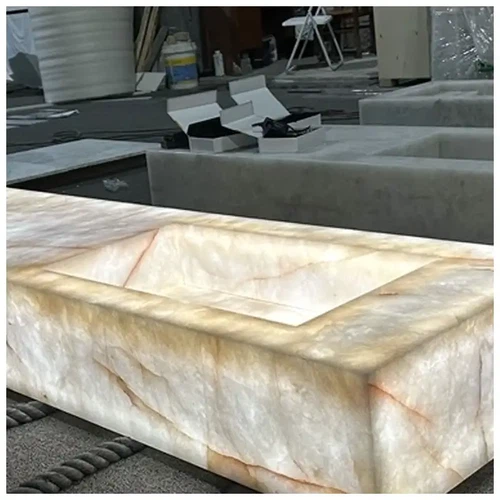
The stone in these samples is substantially lighter than many dramatic Patagonia slabs used for feature walls or backlit counters. Broad ivory-white and cloudy grey zones dominate, with smaller warm beige, honey or brown mineral areas. That distinction should be preserved in the page rather than describing every Patagonia product as heavily black, gold and translucent.
The supplied specification describes the unit as a one-piece solid quartzite vanity top with an integrated basin. The image confirms the integrated visual form, but the exact machining, bonding, reinforcement or internal construction cannot be verified from the photograph alone. Those details should remain controlled by the approved shop drawing.
For a project buyer, this is important because the stone allocation, basin shape and visible front edge are inseparable. A large mineral patch that looks attractive on an uncut slab may partly disappear once the wash cavity has been machined.
Patagonia Quartzite Sink Sizes and Custom Fabrication References
| Specification | Supplied Reference | Production Control |
|---|---|---|
| Reference Size A | 21.5″ L × 17.5″ D × 4.75″ H | Confirm whether the stated height represents the complete vanity body, visible apron or another finished section on the shop drawing. |
| Reference Size B | 26″ W × 15″ D × 5″ H | Compact reference for custom vanity or washbasin layouts; actual sink cavity remains project-specific. |
| Material | Natural Patagonia Quartzite | Approve the actual slab or fabrication area because color distribution varies considerably between pieces. |
| Basin Format | Integrated recessed rectangular basin | Final length, width, depth, bottom fall, corner geometry and drain center should follow the approved basin section. |
| Surface Finish | Polished standard; honed optional | Approve the actual finish on representative Patagonia material before production. |
| Drain Machining | Factory pre-cut drain opening | Coordinate drain diameter, waste fitting and service access with the specified plumbing hardware. |
| Faucet Preparation | Custom faucet cutouts available | Use confirmed faucet model, hole diameter, spacing and spout reach instead of a generic drilling template. |
| Edge and Vanity Geometry | Custom | Coordinate visible edge, front apron, backsplash, wall return and installation support as one drawing package. |
Why Patagonia Stone Selection Matters More on an Integrated Sink Than on a Flat Vanity Top
|
Show the sink outline, cavity position, drain center and visible front face marked on the selected Patagonia stone before cutting. |
On a flat countertop almost the entire selected stone face remains visible. An integrated sink removes a substantial section from the center, so the cutting layout has a larger influence on the final composition. Patagonia makes that decision more noticeable because its mineral scale can be large. One pale quartz zone may occupy most of a basin deck, while an adjacent grey or warm-brown area can fall directly into the cavity. The selected cutting area should be reviewed with the basin outline already drawn on it. This allows the project team to see what will remain on the deck, inside the wash cavity and along the visible front edge. Natural fissures, crystalline transitions and repaired features should also be mapped before heavy machining begins, especially where the design leaves narrow sections beside the basin or around faucet holes. |

Patagonia Quartzite Can Vary from Quiet Cream-Grey to Much More Dramatic Mineral Patterns
Patagonia is sold in a wide visual range. Some slabs carry large white or cream crystal zones with relatively restrained grey movement; others contain heavier black, brown, gold and translucent mineral areas. Commercial photographs of the stone can therefore look dramatically different from the basin samples shown here.
That range is useful for design but requires disciplined approval. A hotel project seeking quiet pale vanities should not release an order based only on the word "Patagonia," while a statement villa bathroom may deliberately choose stronger contrasting areas.
The actual basin samples shown in the supplied image sit toward the lighter end of that spectrum. White, cloudy grey and pale cream dominate, with limited warm brown or amber mineral movement.
For repeated orders, a practical approval method is to establish an acceptable visual range for the bathroom package-background tone, maximum dark concentration, warm mineral content and overall pattern scale-then allocate individual units inside that range.
That approach is more realistic than requiring every Patagonia Quartzite Wash Basins unit to duplicate one photograph of a natural stone.
How Should the Basin Floor, Drain and Internal Corners Be Detailed?
The basin cavity needs a controlled route for water, not just an attractive rectangular opening. Bottom levels should direct water toward the drain without leaving unnecessary standing-water zones.
The drain center must coordinate with the waste fitting below. Moving the drain after the quartzite has been machined is not a simple site adjustment, particularly on a compact unit where the surrounding stone sections are limited.
Internal corners also affect both appearance and fabrication. Very sharp corners can be difficult to machine and finish consistently, while a larger corner radius changes the basin character. The shop drawing should state the intended radius rather than leaving it to CNC defaults.
Where a concealed or stone-covered drain detail is requested, the removable element, water path and cleaning access should all be shown in section. Decorative drain covers should not make routine waste servicing unnecessarily difficult.
Factory water testing is useful after final polishing because it checks the finished basin rather than only the theoretical dimensions on the drawing.
How Should Faucet Holes Be Positioned on a Compact Patagonia Vanity?Compact basins leave less deck space between the sink cavity, wall edge and exposed front. Faucet drilling should therefore begin with the actual fixture, not with a default hole position. A single-hole mixer needs a different stone zone from a widespread three-hole set. Deck-mounted accessories such as soap dispensers or separate controls may require additional clearance that is easy to overlook on a small top. Spout reach should land comfortably inside the basin rather than too close to the front wall or directly over an internal corner. The faucet body also needs enough deck width for its fixing hardware below the stone. Wall-mounted faucets are possible without deck drilling, but the finished wall build-up and spout projection must be known before installation so the water stream aligns with the cavity. Faucet holes should avoid visually or structurally sensitive stone features identified during the cutting-layout review wherever the design allows. |
Show basin depth, floor slope, drain fitting, internal corner radius, faucet center and underside fixing clearance. |

Wall-Hung Patagonia Vanity Sinks Need a Separate Structural Support Detail
Patagonia Quartzite Wall Hung Vanity Sinks create a cleaner bathroom elevation because the floor remains open below the stone. That visual simplicity depends on the hidden support being resolved correctly.
The wall finish itself should not be assumed to carry the sink. The support system needs to transfer the finished stone weight and normal service loads back to suitable wall structure or a dedicated concealed frame.
Bracket positions should avoid conflict with the basin cavity, drain and water connections. They also need suitable bearing zones against the stone rather than concentrating force beside a machined opening.
A compact Patagonia basin can be installed on cabinetry instead, in which case cabinet-top support, plumbing access and the exposed stone edge become the main coordination issues. The product form should not be described as wall-hung unless that mounting arrangement is actually specified for the order.
For either installation route, the finished support condition belongs on the fabrication drawing before the vanity is packed.
Where Do Patagonia Quartzite Integrated Basins Fit Best?
Patagonia Quartzite Vanity Tops with integrated wash cavities make sense where the bathroom needs a natural-stone focal point but the project also wants most sink machining completed before the unit reaches site.
Villa Ensuite BathroomsA selected Patagonia cutting area can create a one-off vanity feature without requiring a highly ornamental cabinet below. |
Boutique Hotel GuestroomsCompact prefabricated units can be coded by room type while maintaining an agreed natural-stone variation range. |
Luxury Apartment BathroomsSmaller vanity dimensions can bring exotic quartzite into tighter layouts without requiring oversized slab-format furniture. |
Designer Powder RoomsA pale Patagonia selection can introduce mineral depth while leaving stronger wall finishes, mirrors or lighting to carry the room. |
Patagonia Quartzite Sink vs. Four KA UNITED Quartzite Alternatives
Patagonia is the most mineral-fragmented and slab-selection-sensitive option in this group. Scandalous Quartzite pushes further toward black-white contrast; Taj Mahal uses a much calmer cream-beige direction; Cristallo Quartzite introduces a lighter crystalline white-gold appearance; Cristallo Rosa moves into a translucent rose and warm-ivory palette. The right choice depends on how much pattern, color and translucency the bathroom can carry, as well as whether the project needs an integrated sink or is selecting stone for a broader custom vanity concept.
| Selection Factor | Patagonia Quartzite Sink | Scandalous Quartzite Sink | Taj Mahal Quartzite Sink | Cristallo Quartzite Vanity Sink | Cristallo Rosa Quartzite |
|---|---|---|---|---|---|
| Visual Character | White, cream and grey quartzite with irregular warm mineral zones and large-scale natural variation. | Graphic pale quartzite interrupted by broad black and charcoal mineral movement. | Cream-beige quartzite with softer taupe, grey and warm-gold movement. | Light crystalline quartzite with white, ivory and fine grey-gold character. | Rose-pink and warm ivory translucent quartzite with delicate gold-toned movement. |
| Current Product Direction | Compact integrated bathroom sink with custom cavity, drain and faucet fabrication. | Wall-hung integrated statement basin. | Warm-toned integrated quartzite vanity sink. | Floating or wall-hung white Cristallo quartzite vanity-sink direction. | Rose Cristallo slab and custom fabrication direction for vanities and decorative surfaces. |
| Primary Approval Issue | Actual slab allocation after the basin cavity removes part of the selected mineral pattern. | Black-white distribution and concealed wall support. | Cream-tone consistency and basin geometry. | Crystalline pattern, basin fabrication and mounting detail. | Pink tone, translucency and whether the selected slab suits the intended vanity design. |
| Best Interior Direction | Natural, modern and statement bathrooms that can accept visible mineral variation. | High-contrast monochrome interiors. | Warm-neutral villas, hotels and understated luxury bathrooms. | Light crystalline interiors using white, champagne or pale timber finishes. | Soft rose, warm-metal and decorative translucent-stone interiors. |
| Selection Priority | Choose when one-off natural mineral composition is part of the vanity design. | Choose when strong black-white impact is the primary requirement. | Choose when a quieter cream quartzite is easier to coordinate. | Choose for a lighter crystalline white vanity character. | Choose when pink color and translucency should become part of the design language. |
Production-Release Checks for Custom Patagonia Quartzite Vanity Sinks
The expensive mistakes on a compact integrated sink are usually dimensional: a cavity that is too large for the deck, a drain that conflicts with the cabinet, a faucet positioned too close to the basin or a stone feature that ends up in the wrong place after machining. These points should be closed before production, not corrected at installation.
- Confirm which reference size applies: 21.5″ × 17.5″ × 4.75″, 26″ × 15″ × 5″ or a custom project dimension.
- Approve the actual Patagonia stone or marked fabrication area before cutting.
- Issue basin length, width, depth, internal corner radius and finished bottom levels.
- Confirm drain fitting, drain opening diameter and waste connection position.
- Provide the faucet model and drilling layout when deck-mounted fittings are required.
- Define front edge, side edges, backsplash and wall-return details.
- Clarify whether the unit is cabinet-supported, wall-hung or installed on another structure.
- For wall-hung units, issue a concealed support section coordinated with plumbing.
- Check selected mineral features around narrow basin rails and drilled areas before heavy machining.
- Approve polished or honed finish from representative production material.
- Assign room or unit codes for repeated hotel and apartment bathroom packages.
- Confirm crate size, lifting method, site access and protected handling points before shipment.
Factory QC for Basin Drainage, Surface Finish and Patagonia Pattern PlacementFinished dimensions should be checked against the latest approved drawing, including overall size, cavity dimensions, drain center, faucet holes and edge geometry. The wash cavity should then be water-tested. The objective is straightforward: confirm that the finished basin directs water toward the drain without obvious unintended pooling. Surface inspection should distinguish accepted natural mineral boundaries, fissures and repaired features from new machining damage, edge chips, scratches or inconsistent polish. Pattern review should compare the completed unit with the approved cutting layout. This matters with Patagonia because machining can remove a large proportion of the stone face that was visible before production. The supplied packing requirement is reinforced fumigated wooden crates. Drain openings, basin corners and projecting edges should be protected so the finished vanity cannot move against the crate or loose hardware during ocean freight. |
Show basin water testing, drain checking, edge inspection, finish QC, project coding and reinforced wooden-crate packing. |

Care Guidance for Polished Patagonia Quartzite Bathroom Sinks
Use a soft cloth or sponge and a pH-neutral cleaner suitable for natural stone. Soap film, cosmetics, toothpaste and colored bathroom products should be removed regularly instead of being left around the drain or deck.
Patagonia is commercially sold as quartzite, but natural stone can vary between lots and mineral zones. The basin should not be described as completely stain-proof or scratch-proof without relevant testing of the supplied material.
A compatible penetrating sealer may be specified according to the selected Patagonia and finish. Sealing can help manage absorption; it does not create an impermeable or maintenance-free surface.
Abrasive pads and unverified aggressive chemicals should be avoided on the polished finish. Where a honed surface is selected, the maintenance plan should be based on that finish rather than copied from the polished sample.
Drain fittings, sealant interfaces, wall support and plumbing connections remain service items even when the quartzite itself is in good condition.
How Should a Finished Patagonia Quartzite Sink Be Shown in the Bathroom?A completed-project photograph should show the basin together with the faucet, mirror, wall finish, cabinet or floating support and surrounding lighting. That tells a designer much more than another factory close-up. For a pale Patagonia selection like the supplied samples, warm timber and champagne-toned metal can bring out beige and honey mineral areas that appear relatively subtle under workshop light. Darker faucets or black architectural accents can instead pick up grey and charcoal features without forcing the bathroom into a completely monochrome scheme. Where several hotel bathrooms use different natural Patagonia pieces, project photography should show the controlled variation rather than suggesting that every sink has one identical pattern. |
Use a completed villa, boutique hotel, luxury apartment or powder-room installation showing the full vanity context. |

Recommended Quartzite Vanity Sinks from KA UNITED
Compare four related quartzite directions by pattern intensity, color and vanity fabrication format.
Scandalous Quartzite Wall Hung SinksHigh-contrast black-white quartzite floating basins for graphic villa and hotel bathrooms. |
Taj Mahal Quartzite Integrated SinkWarm cream quartzite integrated sink for understated hotel, villa and residential bathrooms. |
Cristallo Quartzite Vanity SinksCrystalline white-gold quartzite floating vanities for luminous contemporary bathroom interiors. |
Cristallo Rosa QuartziteRose-pink translucent quartzite for custom vanities, countertops and decorative luxury interiors. |



FAQ About Patagonia Quartzite Integrated Sinks
1. What sizes are supplied for the Patagonia Quartzite integrated sink?
Two reference sizes were supplied: 21.5″ long × 17.5″ deep × 4.75″ high and 26″ wide × 15″ deep × 5″ high. Custom dimensions are also supported. The basin cavity, drain position and finished edge details should be approved separately because the outer size alone does not define the complete sink geometry.
2. Will every Patagonia Quartzite vanity sink have the same white, grey and gold pattern?
No. Patagonia Quartzite can vary substantially in white, cream, grey, brown, gold, darker mineral areas and crystalline zones. The supplied samples are comparatively pale. Buyers should approve the actual stone or an agreed visual range before fabrication rather than expect identical natural patterns.
3. Can the drain and faucet holes be fabricated before shipment?
Yes. Drain machining and faucet cutouts can be completed in the factory according to the approved project drawings. Final drain fittings, faucet models, hole diameters, spacing and spout reach should be supplied before processing so the stone is not drilled from assumed dimensions.
4. Can a Patagonia Quartzite integrated sink be wall mounted?
Yes, a wall-hung configuration can be developed when the vanity geometry and wall construction allow it. The concealed support should be designed around the finished sink weight, structural wall, basin cavity, drain and supply lines rather than relying on decorative wall finishes to carry the load.
5. Can Patagonia Quartzite sinks be made in a honed finish?
Yes. The supplied specification lists polished as the standard reference and honed as an optional finish. The actual appearance should be reviewed on representative Patagonia material because gloss level changes how strongly the crystal zones, grey movement and warm mineral areas are perceived.
6. Is Patagonia Quartzite completely stain-proof and scratch-proof in a bathroom?
No natural-stone sink should be described as completely stain-proof or scratch-proof without verified testing for the actual supplied material. Clean spills promptly, use a suitable pH-neutral natural-stone cleaner and follow the sealing recommendations established for the selected Patagonia Quartzite and finish.
7. What should be approved before Patagonia sink production begins?
Approve the actual Patagonia Quartzite or visual range, outer vanity dimensions, basin length, width and depth, drain center, internal corner radius, faucet drilling, edge and backsplash details, polished or honed finish, installation support, component codes, packing method and site-access requirements before production release.
Patagonia Quartzite Gives Compact Integrated Basins More Natural Mineral Depth
The appeal of a Patagonia integrated basin comes from how much natural variation can be concentrated into a relatively small bathroom fixture. The supplied samples use a restrained white-grey selection rather than an aggressively contrasted slab, so the sink remains easy to coordinate while still showing mineral areas that cannot be replicated by a uniform manufactured surface. The fabrication succeeds when that stone character is planned around the cavity instead of being left to chance after cutting.

Submit Patagonia Quartzite Sink Geometry, Stone Layout and Plumbing Details for Fabrication
Provide the finished vanity size, selected Patagonia Quartzite reference, basin section, drain fitting, faucet layout, edge and backsplash detail, surface finish, installation support, quantity and project-access information before the integrated sink enters production.
Request Project Quote
Hot Tags: patagonia quartzite integrated sinks, China patagonia quartzite integrated sinks suppliers, factory, Azul Cielo Marble Slab, brittanicca luxury series quartz, Kamarica Green Granite, Macaubas Gold Quartzite, Royal Sodalite Exotic Quartzite, Super White Quartzite Slab
You Might Also Like




Send Inquiry
