



Smoky Quartz Countertops
Premium backlit smoky quartz countertops, hand-fabricated from hand-selected natural smoky quartz pieces bonded with high-strength transparent resin. Features warm amber crystalline texture, inherent translucency for LED backlighting, and high-gloss mirror finish. Fully customizable in dimensions, slab thickness, edge profile and cutouts. Ideal statement fixture for luxury mansions, private villas, high-end hotels and premium hospitality projects.
Semi-precious Stone Item: Custom Smoky Quartz Stone Countertop | Polished Resin-Bonded Quartz Vanity Top for High-End Projects
Agate Gemstone: Smoky Quartz, Grey Quartz Gemstone
Slab Size: 2300x1900, 3180x1890mm, etc.
Thickness: 20, 30 mm
Surface: Polished, Honed, and brushed
MOQ: 300 SQM
Quartzite Slabs And Countertop Factory: KA UNITED
Application: 60+ luxury exotic Quartzite/Quartz Stones in KA UNITED Factory For Private Home, hotels, villas, apartments, and other commercial estate properties
Product Introduction
Quick Summary
Smoky Quartz Countertops are semi-precious architectural surfaces assembled from selected natural smoky-quartz crystal pieces, then polished and fabricated into kitchen worktops, islands, waterfall ends, bar counters, vanities and illuminated feature surfaces. Their main visual advantage is the mix of smoky grey, taupe, champagne, pale brown and translucent crystalline areas, which becomes more pronounced under backlighting. Typical project planning references include 20mm and 30mm thicknesses, 25–25.5″ finished kitchen depths and custom island dimensions. For a successful installation, crystal layout, sink or appliance cutouts, waterfall returns, structural support and any LED system should be resolved together before fabrication.
|
|
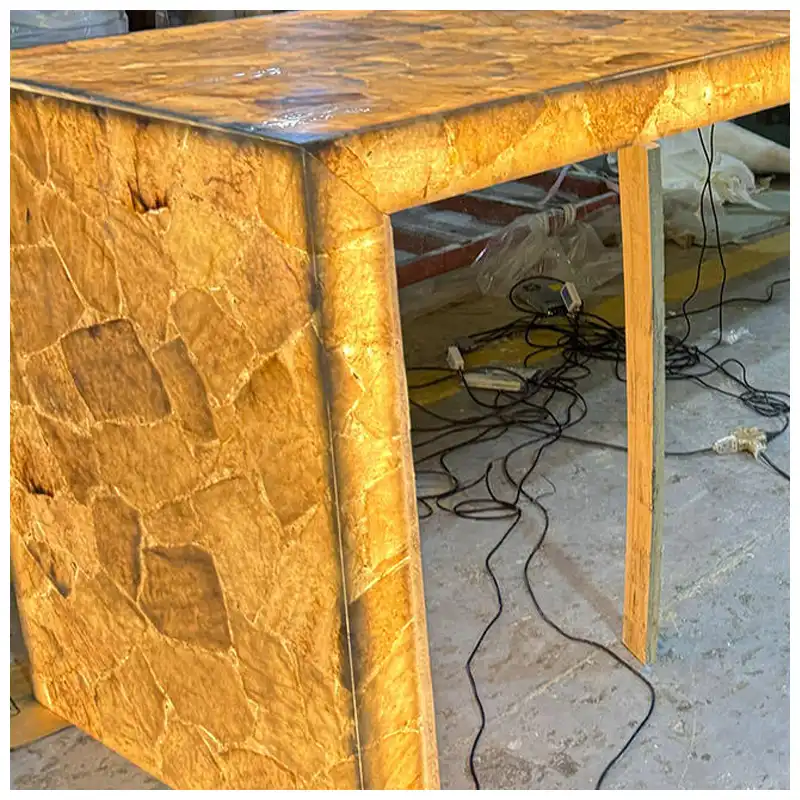
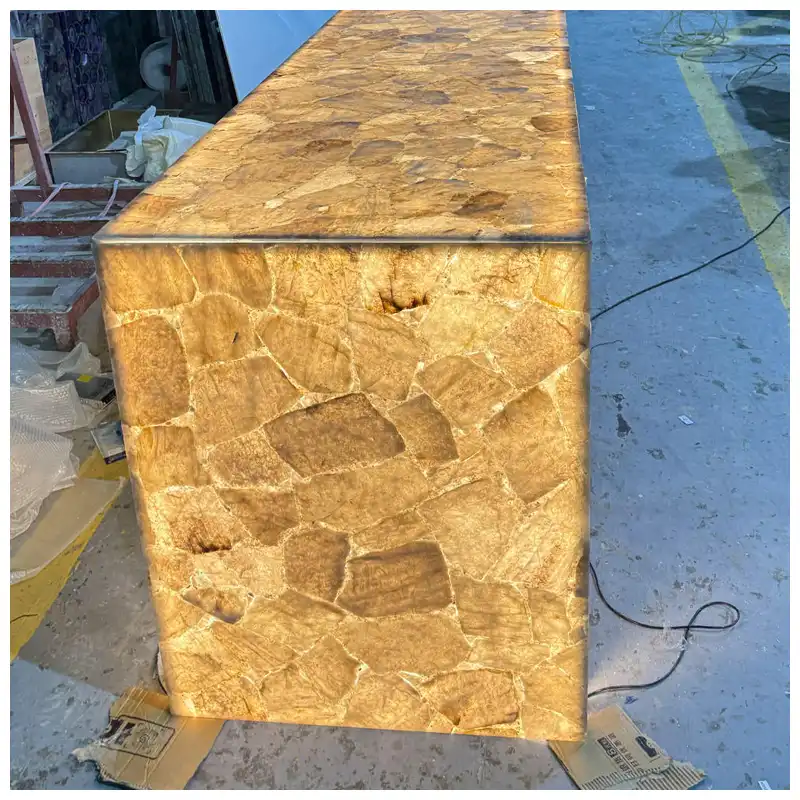
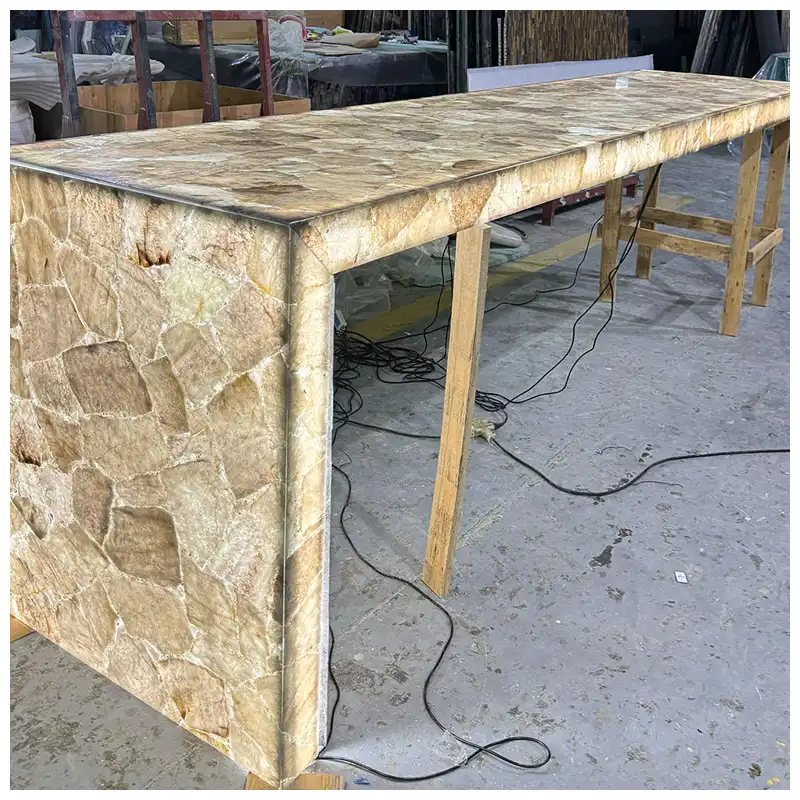
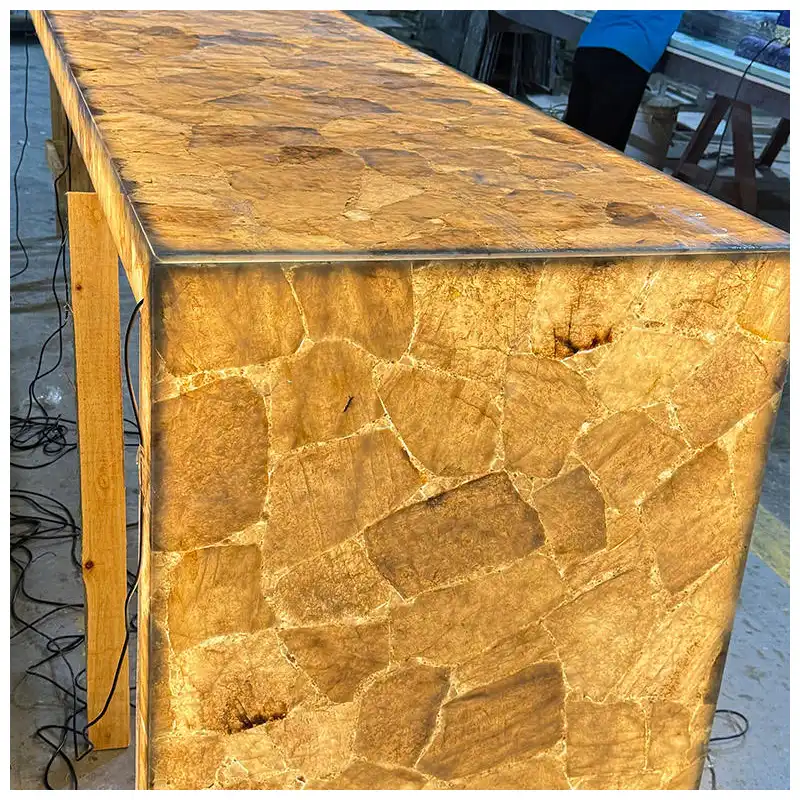
Semi-Precious Smoky Quartz · Backlit Countertops · Waterfall Island Fabrication Backlit Smoky Quartz Countertops for Luxury Mansion Kitchens, Bars and Waterfall IslandsThe factory reference shows a long polished gemstone counter with illuminated horizontal surfaces, thick visible edges and a full-height waterfall end. Under warm backlighting, the smoky crystal changes from restrained taupe-grey to a richer champagne-brown glow, while denser mineral areas remain darker and give the surface depth. For designers comparing Smoky Grey Quartz Countertops with conventional grey engineered quartz, the difference is substantial: this product is selected for natural crystal structure, variable translucency and the possibility of using light as part of the finished countertop design. View Luxury Gemstone Surfaces |
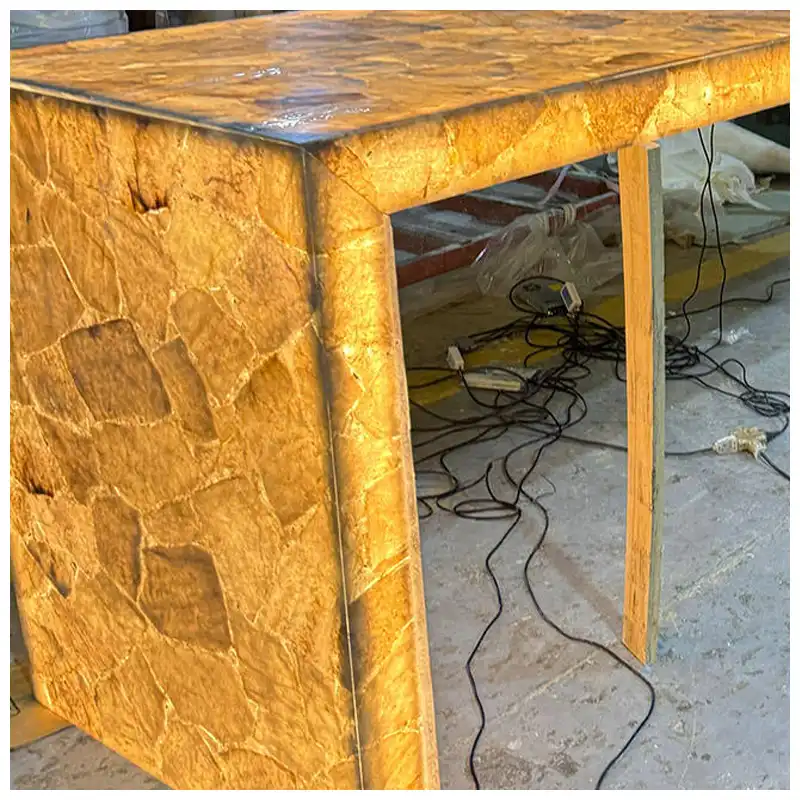
Smoky Quartz Gemstone Has a Warmer, More Crystalline Look Than Standard Grey Quartz
Smoky quartz is naturally associated with grey, brown and smoke-toned quartz crystal. In architectural gemstone panels, selected crystal pieces are arranged and bonded into a larger surface so they can be fabricated at countertop scale.
The supplied production image shows that the result is not a uniform grey. Broad areas move through soft taupe, beige-grey, champagne brown and pale translucent mineral zones. The individual crystal boundaries remain visible, creating a large-scale fragmented pattern rather than printed veining.
That distinction is important for buyers sourcing Semi-Precious Quartz Gemstone Countertops. A small sample can show the general color, but it cannot represent the complete distribution of darker pieces, clearer crystals and illuminated zones across a long island.
For prominent projects, approval should be based on the actual panel or full production photograph so the designer understands the overall crystal balance before cutting begins.
|
Show smoky-grey, taupe and champagne crystal areas under both ordinary lighting and warm backlighting. |
Why One Smoky Quartz Countertop Can Contain Several Shades of Grey and BrownEach natural crystal piece differs slightly in opacity, internal structure and color. Some sections appear cooler grey, others warmer brown, while clearer pieces transmit noticeably more light. The assembled panel can be visually balanced during production, but the individual crystals are not repeated like a printed pattern. This makes every large countertop different. For one villa island, that variation creates a bespoke character. For a multi-unit development, it is better to approve a practical color range and general crystal density than to demand identical piece placement. Backlighting increases these differences, so illuminated projects should also be reviewed with the light switched on before final approval. |

What Countertop Dimensions Should Be Confirmed for a Smoky Quartz Kitchen Project?
| Planning Item | Reference Range | Project Decision |
|---|---|---|
| Typical Finished Counter Depth | 25–25.5″ / 63.50–64.77cm | Useful for many 24″ cabinet layouts, but final depth should follow cabinetry, wall conditions and required front overhang. |
| Typical Finished Counter Height | Around 36″ / 91.44cm including countertop | Confirm cabinet height, finished floor level, countertop build-up and user requirements. |
| Straight Counter Runs | Often approximately 72–120″ / 182.88–304.80cm per section | Longer runs may require seams depending on available panel size, transport access and fabrication layout. |
| Typical Island Width | Approximately 36–60″ / 91.44–152.40cm | Coordinate seating overhang, sink or appliance zones, structural support and circulation clearance. |
| Typical Island Length | Approximately 72–120″ / 182.88–304.80cm | Use the actual gemstone panel and final kitchen plan to determine whether one-piece fabrication is practical. |
| Common Thickness References | 20mm / 30mm | Final thickness and any built-up edge should suit span, support, cutouts, appearance and lighting design. |
| Custom Processing | Sink, faucet, cooktop, waterfall, bar and service openings | Final fixture and appliance templates should be approved before CNC fabrication. |
| Lighting Configuration | Standard non-illuminated or project-specific backlighting | Confirm LED layout, diffuser, supports, electrical access and illuminated zones before cutting. |
Size note: the dimensions above are useful countertop-planning references rather than fixed stocked sizes for every smoky quartz gemstone panel. Final production dimensions should always be checked against the actual selected material and approved shop drawing.
Waterfall Ends Should Be Laid Out Before the Main Countertop Is Cut
The factory image illustrates one of the strongest applications for this material: an illuminated countertop continuing into a full-height vertical end. The waterfall transforms a flat worktop into an architectural furniture element and gives the translucent crystal another visible surface.
For Smoky Quartz Gemstone Waterfall Countertops, the top and vertical return should be allocated at the same time. The goal is not conventional marble vein matching; instead, the fabricator is balancing crystal size, grey-brown tone and translucency across the corner.
The corner detail also affects fabrication. A miter, bonded return or other edge construction needs sufficient support and careful polishing, particularly when the edge will glow under lighting and small workmanship differences become easier to see.
Before production, confirm finished waterfall height, cabinet geometry, floor level, joint position, edge build-up and whether the lighting system continues down the vertical face.
Map the Sink, Cooktop and Waterfall Return onto the Actual Gemstone PanelA cutting layout should show more than finished dimensions. Place every visible component over the selected panel photograph before machining begins. This lets the designer see whether an unusually clear crystal zone is about to disappear into the sink opening or whether a darker area would fall directly across the most visible waterfall face. Large openings also leave narrow countertop bridges. Their width and underside support should be checked before the final nesting is released. Where transport or site access requires a seam, decide its position during this stage rather than allowing the installer to select it after arrival. A strong cutting plan protects the material visually while reducing avoidable fabrication and installation risk. |
Show top-to-waterfall alignment, sink or cooktop cutouts, polished corner detail and underside preparation. |
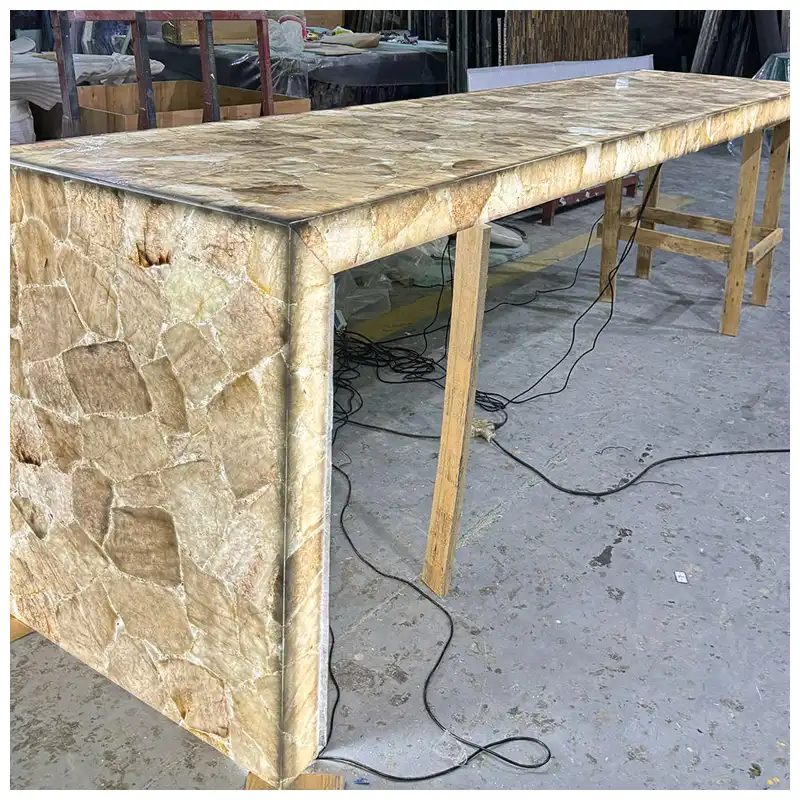
Backlighting Works Only When the Countertop Support Is Designed Around the Light
Backlit Quartz Gemstone Countertops need clear space below or behind the translucent material. LED strips placed too close can produce visible bright points, while solid supports placed behind the clearest crystal zones may appear as dark shadows.
A diffuser can help spread the light, but it does not remove the need for structural support. Large kitchen islands still have to carry their own weight, cutout areas, overhangs and normal service loads.
For that reason, the support system and lighting system should be drawn together. Steel framing, cabinets or brackets may need to be moved into denser crystal zones or arranged to minimize visible shadow lines.
The user-supplied phrase Backlit Grey Quarz Kitchen Tops may appear in sourcing searches, but the production specification should identify the exact smoky quartz gemstone material, finished panel construction and backlighting detail rather than relying on a generic search term.
A lighting test with representative production material is the most reliable way to judge brightness, LED spacing and warm-versus-neutral color temperature before the finished counter is assembled.
|
Show crystal response to lighting, diffuser spacing, concealed structure and accessible LED components. |
Warm or Neutral LEDs Can Change the Character of Smoky QuartzWarm lighting pushes the crystal toward champagne, amber and bronze tones. A more neutral light usually keeps the grey and taupe character clearer. Neither direction is automatically better. The right choice depends on cabinetry, metal finishes, flooring and the atmosphere of the room. Testing is especially useful when an interior designer wants the gemstone to coordinate with bronze hardware or, alternatively, cooler stainless-steel details. For bars or entertainment spaces, dimming can allow a stronger evening glow. Kitchen work zones may need a more restrained setting during normal use. The lighting specification should be selected with the actual gemstone, not from LED data alone. |

Sink and Cooktop Openings Affect Both Structural Support and Crystal Composition
Grey Quartz Gemstone Kitchen Countertops often need undermount sinks, faucets, cooktops, pop-up outlets or other service penetrations. Every opening removes part of the panel and changes the way the countertop is supported.
Final appliance templates are preferable to nominal catalogue dimensions. Flush-fit and tightly integrated appliances leave very little tolerance for site correction.
Sink openings also influence crystal layout. A broad translucent area may be more valuable on the visible front corner of the island than underneath the sink bowl, while darker mineral pieces can sometimes be allocated around structurally necessary supports.
Cooktop areas need additional care because the appliance manufacturer's clearance and installation instructions remain part of the final design. The gemstone surface should not be described as universally heat-proof simply because quartz crystal itself is a hard mineral.
Stone layout, appliance specification and countertop support should therefore be reviewed in the same drawing package.
Smoky Quartz Gemstone Surfaces Need Care Based on the Complete Panel, Not the Crystal Alone
Natural quartz crystal is hard, but the architectural slab contains multiple gemstone pieces and bonded material. Its performance should therefore be judged as a finished fabricated surface rather than as one unbroken quartz crystal.
Use cutting boards instead of preparing food directly on the polished surface. This helps preserve the finish and avoids unnecessary impact around bonded areas, edges and openings.
Use trivets under very hot cookware. Resin-containing semi-precious slabs should not be promoted as universally heat-proof without product-specific testing.
Routine cleaning should use a soft cloth and a mild product compatible with the supplied gemstone system. Strong solvents, harsh abrasives and unapproved chemicals may affect the polish or bonded areas.
Follow the care instructions supplied with the approved finished counter rather than assuming all quartz-branded products share the same maintenance requirements.
Where Smoky Quartz Countertops Deliver the Most Design Value
Mansion Kitchen IslandsLarge surfaces reveal the full smoky crystal composition and allow lighting to become part of the kitchen architecture. |
Villa Waterfall CountersA full-height end displays the gemstone vertically and makes the island read as one substantial furniture element. |
Backlit Bar TopsWarm crystal illumination works particularly well in private entertainment rooms, clubs and boutique hospitality spaces. |
Luxury Vanity CountersSmaller bathroom surfaces concentrate the crystal effect and can coordinate with integrated lighting and custom basins. |
Smoky Quartz Pairs Naturally with Walnut, Bronze, Warm White and Dark Metal
Walnut and dark oak reinforce the brown and champagne side of smoky quartz without repeating its crystalline pattern. Warm-white cabinetry produces a lighter residential composition and lets the counter carry more of the visual weight.
Brushed bronze, champagne metal and aged brass respond well to warm illumination. Black steel creates a sharper outline around a backlit island and can connect visually with denser grey crystal areas.
Cool stainless steel can also work, particularly when the LEDs are kept more neutral and the designer wants the grey side of the material to remain visible.
Because the gemstone already contains strong internal structure, surrounding flooring and splashbacks are usually easier to coordinate when their pattern remains comparatively restrained.
Smoky Quartz vs. Four KA UNITED Luxury Stone Alternatives
The supplied related products cover four different design directions: warm brown agate, soft pink rose quartz, graphic blue agate and natural white Cristallo quartzite. Smoky quartz sits between them as a neutral-to-warm gemstone surface with strong backlighting potential but less saturated color than blue or pink alternatives.
| Selection Factor | Smoky Quartz | Brown Agate Vanity Sink | Pink Rose Quartz Countertop | Blue Agate Bar Countertop | White Cristallo Quartzite |
|---|---|---|---|---|---|
| Color Direction | Smoky grey, taupe, champagne and warm brown crystal. | Amber, honey, cream and brown concentric agate patterns. | Blush pink and milky-white crystalline structure. | Blue, cyan and teal agate circles. | Pale crystalline natural quartzite with grey-white movement. |
| Product Direction | Islands, waterfall counters, bars and vanities. | Decorative integrated bathroom vanity sink. | Pink gemstone islands, waterfall counters and vanities. | Bar, reception and entertainment counters. | Natural-stone countertops and other custom fabricated surfaces. |
| Pattern Character | Large irregular quartz-crystal fragments with variable translucency. | Distinct circular and concentric agate rings. | Cloud-like pink and white crystal areas. | Highly graphic circular agate composition. | Natural geological quartzite movement rather than assembled gemstone fragments. |
| Backlighting Direction | Warm smoky-to-champagne illuminated effect. | Warm amber illumination in a bathroom-focused product. | Soft pink crystalline glow. | Strong cool-blue visual effect. | Selected translucent areas may be considered where the actual material is suitable. |
| Main Approval Priority | Crystal balance, cutout layout, waterfall continuity, support and light distribution. | Agate composition, basin detail, mounting and backlighting. | Pink range, crystal distribution, edge design and lighting. | Agate ring distribution, countertop dimensions and illuminated composition. | Actual slab movement, fabrication layout, thickness and natural variation. |
Factory QC Should Check the Countertop Under Normal Light and Backlighting
A smoky quartz counter can pass a conventional surface inspection and still reveal problems after illumination. For backlit work, quality control should therefore include both lighting conditions.
Under ordinary light, inspect the overall grey-brown balance, polish, bonded transitions, edge finish, visible scratches and dimensional accuracy. Confirm sink, cooktop and faucet openings against the approved drawing.
With the lighting switched on, look for concentrated LED points, unintended dark support lines and strong brightness changes that were not apparent before.
Waterfall ends and other adjacent components should be trial-positioned where practical so corner alignment and color transition can be checked before dismantling.
This separates natural crystal variation from problems caused by fabrication or the lighting system.
What Should Be Verified Before the Smoky Quartz Countertop Is Packed?Check finished length, width, thickness, cutouts, edge profiles and adjoining waterfall pieces against the final production drawing. Inspect polished surfaces under direct light rather than relying only on general factory lighting. Confirm that every component carries a readable piece number that matches the packing and installation plan. For illuminated work, photograph the accepted lighting result before the counter is separated into shipping components. Where electrical accessories, diffusers or templates are supplied, label them to the correct island or countertop zone. |
Show dimension checking, polished surface inspection, illuminated QC, piece numbering and edge protection. |

Risk-Control Checklist for Custom Smoky Quartz Countertop Orders
- Approve the actual smoky-grey, taupe and brown crystal range before releasing production.
- Review a full-panel photograph instead of judging the project only from a small hand sample.
- Confirm the real usable panel dimensions before promising a one-piece island or long countertop run.
- Provide finished countertop and cabinet drawings rather than only nominal room measurements.
- Use final sink, faucet and cooktop templates for CNC cutouts.
- Review narrow bridges around large cutouts and specify adequate underside support.
- Assign waterfall returns before cutting the main countertop so visible crystal tone remains coordinated.
- Fix seam locations before fabrication when the project cannot be installed in one piece.
- Coordinate seating overhangs, cantilever zones and structural support for kitchen islands.
- For backlit work, position opaque framing with the illuminated crystal pattern in mind.
- Test the selected LED color temperature, spacing and diffuser with representative material.
- Keep drivers and replaceable lighting components accessible after installation.
- Use trivets and cutting boards rather than describing the complete gemstone system as heat-proof or scratch-proof.
- Use wet fabrication and appropriate industrial dust-control procedures when cutting or grinding quartz-containing material.
- Review doorway sizes, lift access, turning space and handling equipment before finalizing oversized components.
- Number every top, waterfall return and lighting accessory to preserve the approved installation sequence.
Finished Gemstone Countertops Need Packing Based on Cutouts, Edges and Waterfall Geometry
A fabricated gemstone island is more vulnerable than a flat uncut slab. Sink openings, cooktop cutouts, mitered waterfall edges and long narrow sections all create areas that need additional support in transit.
Polished surfaces should be separated from abrasive contact. Corners and exposed edges need local protection without placing excessive pressure on one crystal area.
Where the project uses several pieces, crate markings should follow the installation plan so the site team knows immediately which return, top and accessory belong together.
Lighting components should be packed separately from the polished gemstone unless they are securely protected, and each electrical or diffuser part should be linked to the relevant countertop zone.
The packing plan should be designed around the finished geometry, not simply around the original panel dimensions.
A Finished Smoky Quartz Island Should Still Look Complete When the Backlight Is OffThe LEDs are an enhancement, not a substitute for material selection and fabrication quality. During daytime use, the countertop is judged by its polished crystal surface, edge details, seams and relationship with the cabinetry. When illuminated, the smoky gemstone takes on a warmer and more dramatic character. Clearer crystals glow while denser pieces stay darker, making the internal structure easier to read. A dimmable system can be valuable in entertainment rooms, private bars and open-plan kitchens where the desired atmosphere changes during the day. Project photography should ideally record both conditions so designers can judge the material as a working countertop and as an illuminated feature. The strongest installation succeeds in both states rather than depending on one dramatic night-time image. |
Use a completed project showing cabinetry, waterfall detail, ambient lighting and the countertop in its architectural context. |

Recommended Luxury Stone Surfaces from KA UNITED
Compare warm agate, pink quartz, blue agate and natural Cristallo quartzite before finalizing the project material direction.
Brown Agate Vanity SinksWarm amber agate basin surfaces for backlit villa and luxury hospitality bathrooms. |
Pink Crystal Rose Quartz CountertopsBlush-pink crystalline surfaces for illuminated islands, waterfall counters and bespoke vanity projects. |
Blue Agate Bar CountertopsGraphic blue agate surfaces for illuminated bars, reception counters and entertainment interiors. |
White Cristallo Quartzite CountertopsPale natural quartzite counters for projects preferring geological slab movement over assembled gemstone crystal. |



FAQ About Smoky Quartz Countertops
1. What are Smoky Quartz Countertops made from?
Smoky Quartz Countertops are architectural semi-precious surfaces made from selected natural smoky-quartz crystal pieces assembled and bonded into a larger panel, then polished and fabricated into countertops, islands, waterfall ends or other project-specific components.
2. What countertop depth is commonly used for kitchen cabinets?
A finished countertop depth of approximately 25–25.5″ (63.50–64.77cm) is a common planning reference for 24″ kitchen cabinets with a front overhang. Final depth should still follow the actual cabinetry, wall condition, appliance layout and project drawing.
3. What thicknesses are commonly specified for smoky quartz gemstone countertops?
20mm and 30mm are common countertop thickness references. The selected thickness and any built-up edge should be reviewed against the finished span, openings, support system, waterfall construction, handling requirements and backlighting design.
4. Can a Smoky Quartz Countertop be backlit?
Yes, suitable smoky-quartz gemstone panels can produce a backlit effect because individual crystal areas transmit light at different levels. Final brightness depends on the actual material, panel construction, LED source, diffuser, cavity depth and support arrangement, so important illuminated projects should be tested before final production.
5. Can Smoky Quartz Gemstone Waterfall Countertops be customized?
Yes. Waterfall height, countertop dimensions, edge construction, cutouts and adjoining components can be customized according to the approved project drawing. The horizontal top and vertical return should be laid out together so their crystal color and scale remain visually coordinated.
6. Will every smoky quartz gemstone countertop have the same color?
No. Natural smoky quartz pieces vary in grey, taupe, brown, champagne tone, opacity and internal crystal structure. Full-panel approval and an agreed color range are more practical than expecting identical crystal placement across multiple countertops.
7. Can sink, faucet and cooktop cutouts be fabricated before shipping?
Yes. Sink openings, faucet holes, cooktop cutouts and other service penetrations can be fabricated according to approved drawings and final equipment templates. Their locations should also be reviewed against structural support and the selected crystal layout before machining.
8. Are smoky quartz gemstone kitchen countertops scratch-proof and heat-proof?
The complete architectural gemstone surface should not be described as fully scratch-proof or heat-proof without product-specific testing. Use cutting boards and trivets, avoid unnecessary edge impact, and follow the care instructions supplied for the approved smoky quartz and bonding system.
9. How should a polished smoky quartz countertop be cleaned?
Use a soft cloth and a mild cleaner compatible with the finished gemstone panel. Avoid strongly abrasive pads, aggressive solvents and chemicals not approved for the supplied surface. Spills should be cleaned promptly, especially around bonded joints and exposed edges.
10. What should be approved before a custom smoky quartz countertop enters production?
Approve the actual gemstone panel, acceptable grey-brown color range, finished dimensions, crystal layout, sink and appliance cutouts, seam positions, edge and waterfall details, structural support, illuminated zones where required, LED and diffuser concept, service access, surface finish, QC photographs, packing sequence and site installation method before fabrication begins.
Smoky Quartz Performs Best as a Countertop When Crystal Layout, Waterfall Edges and Lighting Are Solved Before Fabrication
The value of a smoky quartz counter comes from more than the finished polish. Grey-brown crystal distribution determines where the strongest parts of the surface should appear; sink and appliance openings change the structural layout; waterfall ends extend the crystal composition onto the vertical plane; and backlighting introduces support shadows, electrical access and diffuser requirements. Selecting the actual material first and resolving those details on one coordinated drawing gives the factory a far better basis for cutting, trial fitting, lighting inspection and packing than treating each decision separately after fabrication has started.

Planning a Backlit Smoky Quartz Kitchen Island or Waterfall Countertop
Start with the finished kitchen or bar plan: countertop length and depth, island dimensions, cabinet layout, seating overhang, sink or appliance models, waterfall height and the route through which each finished component must reach the installation area. These details determine whether a one-piece section is practical and where support or seams may be required.
Next, map those components onto the selected Smoky Quartz Countertops panel and identify which crystal zones will remain visible. For illuminated projects, add the support frame, LED layout, diffuser and maintenance access to the same drawing. That gives KA UNITED a clear basis for fabrication and allows the finished gemstone counter to be evaluated as one coordinated architectural element rather than as a flat slab with lighting added afterward.
```
Hot Tags: smoky quartz countertops, China smoky quartz countertops suppliers, factory, Blue Mountain Marble, Delicatus Splendor Granite, Dover Quartzite Slab, Kamarica Granite Stone, luxury green marble, Patagonia Extra Quartzite Slabs
You Might Also Like


Send Inquiry
