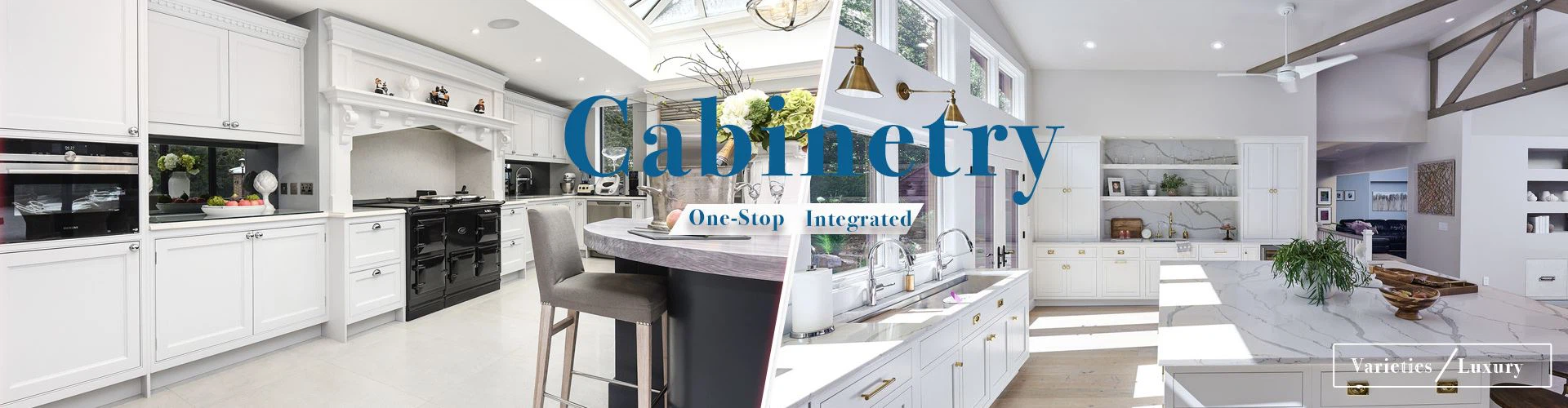
Kitchen Cabinet Layout: Work Zones for Multi-Unit Kitchens
Layout decides whether a repeated kitchen works before any door color or stone finish does. This guide covers kitchen cabinet layout for multi-unit programs: work zones, module sizes, service points, and the appliance and countertop details that belong on one drawing set. I worked the cabinet floor before stone, and these conflicts keep returning. At KA UNITED we draw cabinets, stone tops and appliance openings as one package.
Kitchen Cabinet Layout: Work Zones, Counter Runs, and Appliance Fit in Hotel and Apartment Kitchens
When drawings for a two-hundred-unit apartment program land on my desk, I read them in a fixed order: where the sink sits against the cooktop, whether the dishwasher opening lines up with a base module, and how far the fridge lands from the prep run. The kitchen cabinet layout holds or fails on those first checks.
Guests reheat food, wash a few dishes and store little, while housekeeping opens every door on a schedule. Guidance built around one cook's path stops being the right frame, so zone-based planning takes over. This is the sequence I use for cabinet and stone orders at KA UNITED.
Work Zones Beat a Single-Cook Triangle When a Kitchen Repeats
The work triangle rule was written for one cook in a home kitchen of its era, and NKBA planning guidance still cites those distances for small one-cook rooms. I do not start the kitchen cabinet layout of a repeat program from that triangle. A set of work zones is the better frame, and housekeeping must reach every service point in each one.

The four zones a guest kitchen actually needs
Prep wants a clear counter run between sink and cooktop with drawers below. Cooking wants the hob plus a landing beside it for hot pans. Cleaning centers on the sink and dishwasher. Cold storage sits at the run end nearest the entry.
Distance rules that still carry weight
Old distance rules still matter: sink and cooktop stay close, and appliance doors never fight each other or block a walkway. NKBA-style guidance commonly calls for about 36 in (910 mm) walkways and 42 to 48 in (about 1070 to 1220 mm) between facing work surfaces.
Run Patterns: One-Wall, Galley, L and U Runs
Once the zones are fixed, the run pattern decides how modules fit the floor plan. Most kitchen cabinet layout work on a project comes down to four patterns chosen by room width, door positions and the plumbing stack, and the pattern repeats, mirrored floor to floor, in a repeat program.

One-wall and galley runs in compact units
A single run of base cabinets serves a studio or kitchenette too narrow for two sides. The line runs from cold storage, through prep, sink base and cooktop base, to a landing at the far end. Every zone has to sit on a real module width; a filler of odd width between appliances usually means the plan ignored the widths.
A galley puts base runs on two facing walls, trading floor width for storage. I keep both sides on one module grid so cabinets swap between mirror plans.
L and U runs for apartments and suite kitchens
An L or U run wraps the zones around a corner and suits apartments and hotel residences, because the sink lands on the window wall while cooking sits near the vent and service riser. Grey fronts with white quartz are a common pairing in these plans, and the grey shaker cabinets we build keep the finish approval simple when one finish family repeats.
Islands only where the aisles allow
An island earns its place in larger suites and villas, never in a room without clearance on all sides. Where a pale quartz top runs over darker cabinets, overhang and support are drawn against the carcass before a slab is selected.

Match Standard Cabinet Modules to Each Zone before the Stone Is Drawn
Modules are the grammar of the exercise: a base run built from standard widths closes to the millimeter without filler, which matters more in a bulk program because the same run repeats. When we review the kitchen cabinet layout for a project, I confirm that every appliance and sink lands on a real module width; the table maps each zone to the modules we normally use.
| Work zone | Cabinets that carry it | Common widths | Typical height and depth | Check before ordering |
|---|---|---|---|---|
| Prep | Drawer and door bases | 300 to 600 mm; 12 to 24 in in inch-market sets | Carcass about 720 mm (34.5 in) plus plinth; 560 to 600 mm (21 to 24 in) deep | Keep a clear landing between sink and cooktop |
| Cooking | Cooktop or range base, oven housing | 600 to 900 mm; 600 mm module for built-in ovens and hobs | Same base height and depth; oven cavity follows the model sheet | Cutout sizes come from the model sheet |
| Cleaning | Sink base, integrated dishwasher | Sink base 600 to 900 mm (24 to 36 in); dishwasher module 600 mm | Dishwasher cavity commonly near 600 by 820 by 560 mm | Supply and drain connect in the adjacent cabinet |
| Cold storage | Tall fridge housing, tall pantry | Tall units 300 to 600 mm; built-in fridge widths 30, 36, 42 and 48 in | Tall cabinets commonly 84 to 96 in (about 2100 to 2400 mm) high | Confirm door swing and the vent path at the toe kick |
| Wall storage | Wall cabinets over prep and cleaning | 300 to 900 mm to mirror the base run below | 300 to 350 mm (12 to 14 in) deep; heights 30, 36 or 42 in | Hold the gap above the counter near 450 to 600 mm (18 to 24 in) |
Base modules and appliance widths
Base carcass height drives everything else: roughly 720 mm in metric production, or 34.5 in in inch-market sets, with the plinth and countertop thickness bringing the work surface to about 900 mm or 36 in. Depth near 560 to 600 mm lets a standard countertop overhang the fronts by a consistent amount. The whole kitchen cabinet collection follows that grid.
Wall cabinets, hoods and the gap above the counter
Wall units repeat the module grid of the base run so the vertical lines stay true. The gap between countertop and wall cabinet underside commonly runs 450 to 600 mm (about 18 to 24 in), where the range hood lives with its own duct route.
Tall units, fillers and the runs that repeat
Tall cabinets close the ends of the run and test door swings straight bases never see. Fillers of about 10 to 100 mm absorb wall tolerance, but a run peppered with fillers usually means the modules ignored the wall length. A neutral finish family, like the ivory white run below, serves every floor with one parts list.

Electrical and Plumbing Points on the Same Drawing as the Cabinets
The problems that reach me are rarely finish problems; they are service points roughed in before the layout existed, so a drawer meets a drain or a shutoff hides behind a fixed appliance. Drawing the rough-ins with the cabinet schedule is a gate for the whole kitchen cabinet layout on a project.
Water and drain: sink, dishwasher and the module they sit in
The sink base must be wide enough for the basin plus its plumbing; a large undermount bowl inside a narrow base leaves no room for trap and supplies. Dishwasher planning guides show the same discipline: the cavity is sized to the unit, while supply and drain connect in the adjacent cabinet through a low service hole. I check that the shutoff is reachable and the drawer in front still opens.
Power: cooktop, oven, hood and small appliances
Cooktops, wall ovens and hoods carry electrical demands that vary by model, so circuits belong on the drawing as early as cabinet widths. The cooktop cutout is cut into the stone, the oven sits in a housing with its own cavity clearances, and the hood duct route is marked before the wall cabinets above are fixed.
Panel-ready appliances and the door they wear
Integrated fridges and dishwashers with cabinet fronts change the schedule itself. Built-in refrigerators commonly come in 30, 36, 42 and 48 in widths, stand about 84 in tall, and vent from the front, so the toe kick stays open and the panel stays within about 3/4 in (19 mm).
Counter Runs, Seams, and When the Stone Gets Ordered
The countertop is where the cabinet schedule meets stone, and timing decides whether a project opens smoothly. Slabs commonly run about 2.8 to 3.2 m (roughly 9 to 10.5 ft) long, so any continuous run beyond that carries a seam, and a kitchen cabinet layout that pretends otherwise is drawing fiction. Plan the seams when you place the sink and cooktop cutouts.
Seam placement rules that survive a bulk program
Keep seams away from cutouts. Fabrication guidance commonly allows a seam no closer than about 100 to 150 mm (roughly 4 to 6 in) to a sink or cooktop opening, never through an opening or over an unsupported span. Seam quality follows the recommended practices of the Natural Stone Institute, formerly the Marble Institute of America, with common benchmarks near 1.6 mm (1/16 in) width and 0.8 mm (1/32 in) lippage.
Order the stone only after the module and appliance layout locks
Quartz and quartzite tops are cut from a slab drawing carrying the sink cutout, the cooktop cutout and the seam lines. If the base modules move after that drawing, the openings move with them and the slab is reworked or replaced. The safe sequence is to lock modules and appliance models first, then cut the stone and choose the kitchen countertop finish with the doors so top and fronts share one approved reference.
The Hard-Won Lesson: A Cooktop That Moved One Module after the Slab Was Cut
I have watched this sequence more than once. The countertop was templated from an early layout because the stone window was tight, while the appliance model was still undecided. The cooktop that finally shipped carried a different cutout position, the base module shifted by one width to suit it, and the openings on the cut slab no longer matched the run. The seam now crossed the new cutout, and the fix was a fresh slab for that unit and every identical one.
The Lesson: never release a countertop for cutting until the cabinet modules, sink position and appliance model numbers are frozen on one signed drawing.
Standard Layouts versus Custom Units in a Bulk Program
Every bulk program asks how much of the plan stays standard and how much turns custom, and the honest answer is a split. Standard layouts earn their keep where rooms repeat; custom units earn their keep where they do not. The two paths carry different drawings and inspection records, and mixing them is how identical kitchen cabinet layout ships with the wrong pieces.
When one standard module set wins
If most units share one plan, standardize the module set around it, the way modular white shaker base cabinets anchor many apartment programs we ship, and let minority units borrow from that set rather than invent. Standard parts mean faster production and spares that fit every unit.
Where a custom unit earns its place
Mirrored corners, accessible rooms with knee clearance and lowered work surfaces, and suites with a different appliance package are the honest cases for custom work. Each custom unit carries its own drawing and inspection record, and the supplier must know which boxes belong to which room before packing.
Freeze the layout before production release
The release drawing should carry room dimensions, module schedule, appliance models, rough-in positions and countertop openings in one approved set. When a change arrives after release, I use one sequence: photograph the affected openings and panels, stop work on that unit until the change is confirmed, and send the photos with the approved drawings to the supplier before rework.
Quick-Reference Checklist for Locking a Kitchen Layout in a Multi-Unit Program
- Arrange the four work zones in sequence, each on a standard module width.
- Choose the run pattern from the room width and the plumbing stack, then mirror it.
- Verify aisle widths and check every appliance door swing for conflicts.
- Fix the appliance model numbers before cabinet or countertop openings are drawn.
- Draw the rough-in points and ventilation paths on the cabinet drawing.
- Plan countertop seams away from cutouts and release the stone only after the layout is signed.
Frequently Asked Questions on Kitchen Cabinet Layout for Hotel and Apartment Projects
1. What is the most practical kitchen cabinet layout for a compact hotel or apartment kitchen?
Arrange the zones in a working sequence rather than chasing a style: cold storage near the entry, a clear prep run between sink and cooktop, and a landing beside the cooktop. Every zone sits on a standard module width, with the sink near the water stack.
2. How much aisle space should we plan between base runs in a guest kitchen?
Planning guidance commonly calls for 36 in (910 mm) clear walkways and 42 to 48 in (1070 to 1220 mm) between facing work surfaces. Add the swing of the widest appliance door to that figure, because open doors should never block the passage.
3. Should the cabinets be sized around the appliances, or the appliances chosen to fit the cabinets?
Pick the appliance models first and size the cabinets to their spec sheets. Two units with the same nominal width can still need different openings or clearances, so the model must be fixed before the module drawing is approved. A model change after release can alter a housing width, a cutout position or a countertop opening.
4. Where do countertop seams belong in a long kitchen run?
Place seams where they do not meet cutouts, water or heavy use. Fabrication guidance commonly keeps a seam at least about 100 to 150 mm (roughly 4 to 6 in) from a sink or cooktop opening, never through the opening itself. A run beyond slab length carries a seam by design, and a repeat program should use the same seam plan in every unit.
5. What must be signed off before a multi-unit kitchen layout goes into production?
The release drawing should carry room dimensions, module schedule, appliance models, rough-in positions and countertop openings in one approved set. If a change arrives after release, photograph the affected openings and panels, stop work on that unit until the change is confirmed, and send the photos with the original approved drawings to the supplier before rework.
Final Conclusion
Kitchen cabinet layout for hotels and apartments succeeds when the zones, the modules and the service points are settled on one drawing. Work zones give the plan its sequence, standard modules its repeatable parts, and appliance and countertop timing its honest openings. None of it needs a more expensive cabinet, only an earlier drawing, and that is the standard we build into KA UNITED cabinet and stone orders.
References
- Kitchen & Bath Planning Guidelines with Access Standards, National Kitchen & Bath Association.
- ANSI/KCMA A161.1 Performance and Construction Standard for Kitchen and Vanity Cabinets, Kitchen Cabinet Manufacturers Association.
- Recommended Practices for the Fabrication and Installation of Stone Countertops, Natural Stone Institute (formerly Marble Institute of America).
- Integrated Dishwasher Planning Guide (cavity dimensions and service clearances), Fisher & Paykel Appliances.
- Product Help: Proper Location and Environment for a Refrigerator, KitchenAid.
- Kitchen Cabinet Module and Sizing Reference, major cabinet manufacturers' published dimension guides.
- Kitchen work triangle, Wikipedia.