White Marble Stairs: Slab, Edge, and Safety Planning
White Marble Stairs in Villas and Hotels: Stone Selection, Nosing, and the Safety Details That Get Skipped
Photographs sell a white staircase before anyone reads a line: a curved flight in a villa entrance, glass railing, light bouncing off pale treads. The harder conversation starts later, after a dull band appears mid-step or a chip shows on the nose edge. That gap between photograph and follow-up visit is where stair specifications go wrong.
I am Leo Chen, and I have priced white stair stone for villa halls and hotel lobbies for years. The original version of this page showed Ariston White treads in residential interiors. This rewrite keeps the material story and shifts to the questions that decide whether those stairs still look right after five years: which stone suits a tread, what geometry treads and nosing need, how slip is controlled, and what keeps a flight sound.
Table of Contents
- Why Stairs Test Stone Harder Than Any Floor Does
- What White Marble Stairs Give a Stair Hall, and What They Cost in Care
- Marble, Quartzite, or Granite for White Stair Treads
- Tread Dimensions and Nosing Profiles That Stop Edge Failure
- Slip Resistance on White Stairs: Finish First, Then the Details
- Adhesive, Support, and Keeping the Flight Sound
- Frequently Asked Questions
Why Stairs Test Stone Harder Than Any Floor Does
Stone stairs fail in patterns that floors never show, because a stair concentrates abuse instead of spreading it. Every step lands on a band roughly the width of a foot, so a tread takes several times the load of the same floor area, always at the same spots, and the wear shows within the first year.
The leading edge takes every impact
The nose of a tread, the projecting edge called the nosing, is the thinnest and most exposed part of the stair. Objects drop on it, cleaning equipment strikes it, and every footstep finishes its arc across it. A sharp square edge concentrates impact in one line and chips readily, which makes edge profile a structural detail rather than a cosmetic one.
The consequence of failure is higher than a scratched floor
A slip on level flooring usually ends in a bruised knee. A slip on a stair involves a fall across a height change, which is why stairway falls account for a very large share of fall injuries in the United States each year, commonly cited around a million emergency visits. Codes treat stair geometry, friction, and edge detailing more strictly than floors for that reason.
What White Marble Stairs Give a Stair Hall, and What They Cost in Care
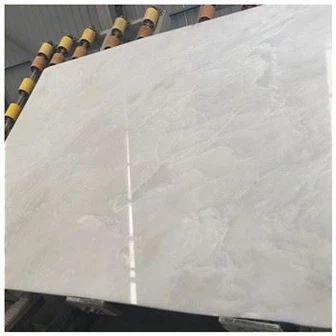
Nothing in the stone yard opens up a stair hall like a pale marble flight. White stone lifts a double-height entrance, reflects whatever light the room gets, and pairs quietly with wood, brass, and glass. The Ariston White stock we carry for stair programs shows the family: an alabaster-white field with silver and pewter ribbons, bright at a distance and softly patterned close up.

Marble is calcite, and calcite is honest about its limits
White marble is mostly calcite, which sits at about 3 on the Mohs hardness scale, well below granite and quartzite. That number predicts most behaviour on stairs: grit scratches the surface, dropped objects chip it, and acids dull the face where they sit. Every mark shows on white stone, and marble absorbs liquids more readily than denser stones, so spills stain unless wiped fast.
A polished walking surface is the wrong tool for the job
The gloss that makes white marble look expensive is its weakest point underfoot. Published wet-friction testing consistently places mirror-polished marble below the commonly used interior wet threshold of 0.42 dynamic coefficient of friction. Polished white flights in socks, after rain, or after cleaning are a real slip consideration, so the finish decision belongs at specification, never at handover.
Where white marble stairs still make the right call
None of this makes marble stairs wrong. It defines where they are right: villa staircases and hotel stairways with modest, controlled traffic, supervised cleaning, mostly dry shoes, and a honed or brushed walking surface. For a busy lobby stair or a family home with children and outdoor shoes, the same white look in a harder stone is usually the better call.
Marble, Quartzite, or Granite for White Stair Treads
Buyers who ask for white marble on a staircase usually only need the look, not calcite specifically, so we open the conversation at the walking surface. Quartzite and granite deliver the bright white aesthetic with hardness marble cannot match, which matters most on the tread. A common compromise is quartzite or granite treads with marble risers and landings.
| Property | White marble (Ariston White, Calacatta family) | White quartzite (Super White type) | Light granite |
|---|---|---|---|
| Typical hardness | About 3 on the Mohs scale | About 7 on the Mohs scale | About 6 to 7 on the Mohs scale |
| Abrasion and scratch resistance | Low; shoe grit dulls the polished band on the tread centre | High; resists grit wear and keeps its finish under traffic | High; the traditional choice for commercial treads |
| Acid and cleaning chemistry | Etches where acids sit; pH-neutral cleaning only | Resistant to household acids, very low etch risk | Resistant to household acids, very low etch risk |
| Water absorption and staining | Most absorbent of the three; light stains show quickly; sealer renewal matters | Very low absorption; resistant to staining | Low absorption; resistant to staining when sealed |
| Typical finishes for stairs | Honed or brushed on the walking surface; polish only on risers or low-traffic formal stairs | Honed, brushed, or leathered; holds texture under wear | Honed, brushed, or flamed for exterior use |
| Maintenance cadence (typical) | Sealer renewal about yearly; professional re-polish within a few years under regular use | Sealer optional or infrequent; routine cleaning only | Sealer infrequent; routine cleaning only |
Quartzite delivers the white look with granite-class wear
White quartzites in the Super White family read as marble from across a lobby: bright ground, grey or soft brown veining, a calm expensive presence. The difference shows on the tread: hardness around 7, very low absorption, and no reaction to acids. For a hotel stair or a villa flight that must stay white after a decade, honed or brushed white quartzite is the tread we recommend most often, once the lot is confirmed as true quartzite rather than a dolomitic marble under a white name.
Granite is the workhorse when pattern matters less
Light-toned granites give the same durability with a busier, speckled face rather than marble-like veining, and they are the traditional material for commercial treads because honed and flamed finishes hold traction under heavy use and weather. Where clean maintenance matters more than a white-vein look, granite is the honest answer.
Tread Dimensions and Nosing Profiles That Stop Edge Failure
Stair geometry is regulated for a reason: bodies calibrate to the rhythm of a flight, and small departures cause missteps. Building codes such as the International Building Code hold risers and treads within tight limits and require every step in a flight to match, so the stone layout starts from verified numbers, not a photograph.
Riser and tread numbers come first, thickness second
For commercial stairways the IBC permits risers from 4 to 7 inches (about 102 to 178 mm) with a minimum tread depth of 11 inches (about 279 mm); dwelling-unit stairs in residential buildings allow a slightly steeper envelope. Within a flight, riser and tread may differ by no more than about 3/8 inch (9.5 mm). Every tread is then cut to one template.
Nosing projection and edge shape decide how long the edge lasts
The nosing is the leading edge of the tread that projects past the riser below. Codes cap that projection, commonly at about 1-1/4 inches (32 mm), keep it uniform across the flight, and expect a rounded or bevelled edge. For stone the translation is simple: a bullnose or pencil-round profile spreads impact over a curve and resists chipping, while a square edge fails first. A radius of roughly 2 to 3 mm is the least that protects an edge.

Thickness follows support, not style
Interior treads on a full supporting bed are commonly cut at about 20 mm, adequate when the whole underside is bonded. Once a tread is unsupported along part of its length, as with open-riser and floating designs, trade guidance typically calls for 30 mm and up plus anchoring designed by an engineer. Glue carries nothing, so thickness and support must match how the tread is held, and a cantilevered stone tread is a structural member, not a styling choice.
Slip Resistance on White Stairs: Finish First, Then the Details
Slip control on a stone stair starts with the finish of the walking surface, then moves to added treatments. The commonly used wet threshold for level interior walking surfaces is 0.42 dynamic coefficient of friction under the ANSI A326.3 test method; published results put mirror-polished marble below that when wet, honed surfaces around it, and brushed or textured surfaces clearly above it.
Specify the walking finish for friction, not for the showroom
A honed tread keeps the pale look while giving the foot meaningfully better wet traction than polish. Brushed and leathered faces go further, adding micro-texture that hides the scuffs a gloss face advertises. Polish belongs on risers, where feet do not land, and on formal low-traffic flights with a strict care routine.
Add mechanical grip where traffic is heaviest
Where stair use is intense or the finish must stay elegant, mechanical aids carry the safety load. Recessed anti-slip strips or pins set into the nosing give the foot a grip point where it lands, and machined grooves across the tread add grip without a contrasting material. Entrance matting and a routine that removes grit before it reaches the stairs do more for long-term safety than any finish, because contamination and wet shoes, not the stone, reduce friction in service.
Hotel realities: socks, slippers, rain shoes, and housekeeping
Public hotel stairs are walked in every state a foot can arrive in: barefoot after a pool, in rain-soaked shoes, in smooth-soled slippers. That spread is why heavy-traffic hotel programs run on honed or textured quartzite and granite, with white marble reserved for light, controlled traffic such as suite-level stairs and villas. Handrails, lighting over each tread, and contrast at the nosing complete the safety system.
Adhesive, Support, and Keeping the Flight Sound
Stone treads fail in two ways: they crack under load because they were not supported, or they loosen because they were not bonded. Both are decisions that reach the factory and site long after the stone is chosen, so the engineering conversation happens with the cutting list.
Adhesive holds a tread in place; support carries it
A tread on a solid concrete or masonry stair bed is set in adhesive mortar with full coverage, commonly a flexible high-bond product with the stone back-buttered so no void sits under the walking line. Spot bonding, dabs of glue under the corners, is the classic failure: the unsupported middle flexes under a heel and cracks, and on white stone the crack is never invisible. The substrate must be sound, dry, and level first.
Open risers and cantilevers change the structural job
Open-riser stairs and floating cantilevered treads, the ones that look weightless in photographs, transfer all load through engineered supports rather than a continuous bed. They need steel or concrete stringers with concealed anchoring sized to the stone thickness and span, plus thicker tread stock. No adhesive specification makes an unsupported cantilever safe.
Ordering, matching, and receiving the flight
A stair flight is a repeating pattern, so tone differences between slabs show at every joint. We cut complete flights from one block lot, template each tread to the verified geometry, number the pieces in order, and photograph the run before crating. White marbles travel with resin fills and fibreglass mesh that are normal when they match the face; the receiving check is verifying numbered pieces against the packing list before installation.

Frequently Asked Questions about White Marble Stairs
1. Can white marble stairs be made slip resistant?
Yes, if the walking surface is specified for friction rather than gloss. Honed or brushed finishes on white marble stairs test meaningfully safer than polished faces, and recessed anti-slip strips or grooves at the nosing add grip where feet land. Polish can stay on risers, where nobody steps.
2. Are white marble stairs durable enough for a hotel lobby?
Only for light, controlled traffic. Calcite marble wears and etches faster than quartzite or granite, so most hotel programs put white quartzite or granite treads on public stairs and reserve white marble stairs for suite levels with a realistic care routine.
3. Do white marble stairs chip easily on the nosing edge?
The exposed front edge is the vulnerable part of any tread, and calcite marble is softer than granite or quartzite. A rounded or bevelled nosing with the projection kept within code limits spreads impact and resists chipping far better than a sharp square edge.
4. How thick should white marble stair treads be?
About 20 mm is the common thickness for interior treads on a full adhesive bed with complete support. Open-riser, floating, or cantilevered treads typically need 30 mm or more plus engineered structural support, because the tread carries load without a continuous bed underneath.
5. How often do white marble stairs need sealing and re-polishing?
An impregnating sealer is typically renewed about once a year on busy stairs, with pH-neutral cleaning in between. Professional re-polishing is scheduled when the tread-centre wear band or etch marks become visible, within a few years on regularly used flights and less often in quiet villas.
Final Conclusion
White marble stairs keep their drama when the tread is treated as an engineered surface rather than a decorative one. Match the stone to the traffic class, give the walking face a honed or brushed finish, hold the nosing geometry to code, support every tread fully, and budget the maintenance calcite honestly needs.
Here is what I would do: order treads, risers, matching floor tiles, and railing coordination as one staircase package, with finish and edge profile approved on the actual stone before cutting. KA UNITED supplies white marble and quartzite stair stock cut to your flight geometry, and one team answers for the finished result.
References
- International Building Code (IBC), Section 1011.5 Stair Treads and Risers, International Code Council.
- ANSI A326.3, Wet Dynamic Coefficient of Friction Test Method for Hard Surface Flooring, ASCMO; Tile Council of North America Handbook.
- Natural Stone Institute, Dimension Stone Design Manual and Care and Maintenance of Natural Stone.
- ASTM C503 Marble Dimension Stone and ASTM C97 Absorption, ASTM International.
- Centers for Disease Control and Prevention, stairway fall injury statistics.
- Mohs scale of mineral hardness and calcite data, standard geology references.
- Trade fabrication literature on stair nosing, finishes, and anti-slip treatments.
- National Floor Safety Institute, flooring slip-resistance recommendations.