Are Melamine Cabinets Better Than Solid wood
Melamine or Solid Wood: A Question I Hear Every Week
As a countertop consultant who spent years designing cabinets before I moved into stone, I get asked this question more than almost any other: are melamine cabinets better than solid wood? The honest answer is that neither material is "better" in a vacuum. Each one solves a different problem, and the right choice comes down to your budget, your kitchen, and how long you plan to live with the result.
At our cabinet factory, we build both melamine and solid wood cabinets, and we ship both to customers around the world. I have walked through enough kitchens and enough production lines to see exactly where each material shines, and where each one lets you down. Let me lay the two options out side by side so you can decide with confidence instead of guessing.
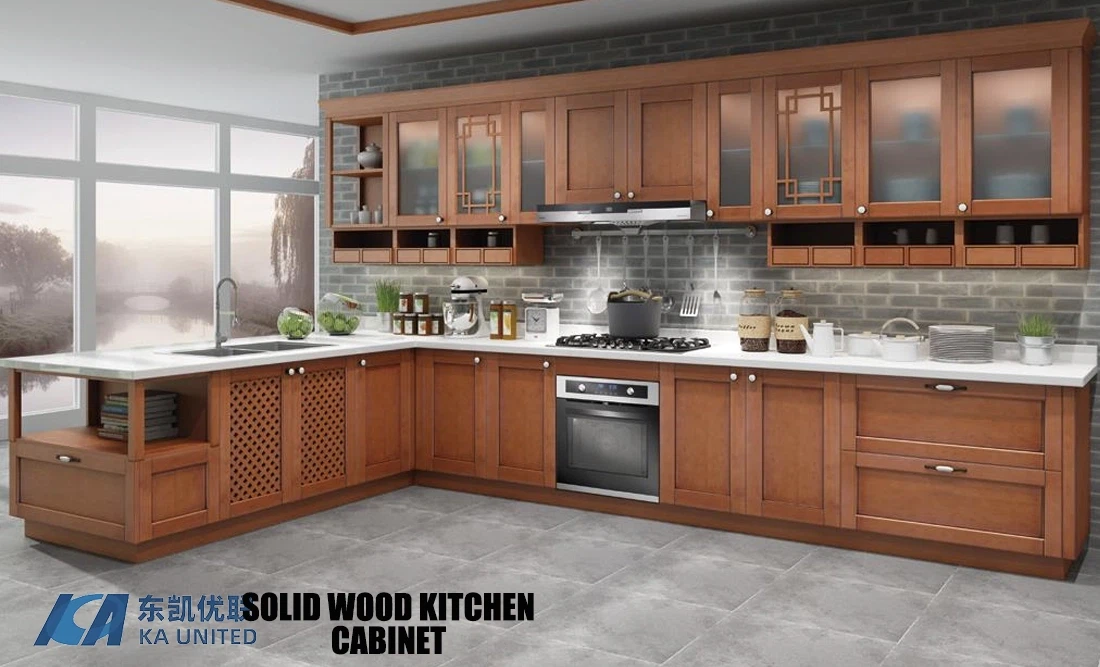
Solid Wood Kitchen Cabinets: What You Are Really Buying
Solid wood is the most popular cabinet material in the world, and it is easy to understand why. With the sheer variety of species and design options available, there is a look for almost every taste. But before you fall in love with a door sample, it helps to know what you are actually paying for.
The Species Behind the Look
The best-known wood species for solid wood kitchen cabinets are maple, birch, cherry, oak, and walnut. In North America, maple, oak, and birch are the most common choices, mostly because they are abundant and easy to source. Walnut and cherry sit at the opposite end of the market. They are considered higher-end species, with rich colors and distinctive grain, and they are generally harder to come by than the everyday hardwoods. From pale maple through warm oak to deep walnut, the range of color, grain, and texture is enormous, and that variety is a large part of solid wood's enduring appeal.
Why Solid Wood Feels Different
Solid wood is prized for its natural beauty. The color, grain, pattern, and texture all come straight from the tree, which means no two doors are ever exactly alike. Doors built from solid wood lean classical and traditional in style, and they tend to carry a higher price because of it. There is also an environmental argument in its favor: because the material is natural wood, it is friendlier to the environment than a manufactured board and does not carry the formaldehyde concerns that can come with engineered panels.

In practice, solid wood cabinets bring a warmth and depth that is difficult to fake. The grain catches the light differently across the day, and over the years the material develops a character that many homeowners genuinely enjoy. If you are designing kitchen cabinets that are meant to anchor the room for a decade or more, that kind of presence is worth weighing seriously.
The Honest Drawbacks of Solid Wood
None of that beauty is free. Solid wood is expensive, and it reacts to its environment. It is vulnerable to moisture, deformation, and rot, and it expands and contracts as humidity rises and falls. Over time wood can warp, cut, or swell, and it may fade or darken when it sits in direct light for years. Maintenance costs also run higher than they do for a sealed melamine panel. I tell clients that solid wood rewards care and punishes neglect, especially in a humid kitchen or a coastal home.
There is a number behind that sensitivity. Solid wood for interior cabinets should be kiln-dried to a moisture content of roughly 6 to 8 percent before machining and finishing. Once the cabinet is in a working kitchen, the wood settles toward the room's humidity, which can sit between 8 and 12 percent depending on the season. That gap drives the movement I described, and it is why solid wood needs a little room to work at the joints.
Melamine Cabinets: What the Name Actually Means
The word "melamine" gets thrown around loosely, so let me clear up what we are actually talking about. A melamine cabinet is not a plastic box. It is an engineered panel with a very specific construction, and once you understand how it is built, the performance claims start to make sense.
How a Melamine Panel Is Built
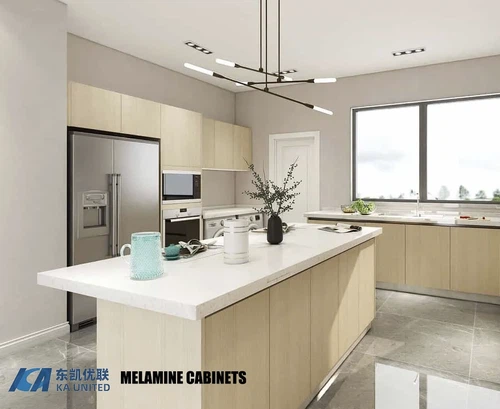
A melamine board starts with a particleboard core. Decorative paper impregnated with resin is then permanently fused to both faces under heat and pressure, sealing the core and forming the door panel. The technical term for this is thermally fused laminate, or TFL. Melamine panels are manufactured to reproduce the look of paint, wood grain, concrete, metal, and even fabric, and the doors usually come in 5/8" or 3/4" thicknesses.
Because the resin-filled paper is fused directly to the substrate rather than glued on as a separate layer, the surface is genuinely part of the panel. That is a key difference from older laminates, and it matters a lot for how the door behaves around water and heat.
Panel thickness matters more than it sounds. The two most common melamine door thicknesses are 16 mm and 18 mm in metric markets, alongside the 5/8" and 3/4" sizes familiar in North America. The particleboard core is pressed to a density of roughly 600 to 700 kilograms per cubic metre, which is why a melamine door feels lighter than a solid hardwood door of the same size. For humid rooms, manufacturers also offer a moisture-resistant grade of particleboard, sometimes marked MR or V313, with a water-resistant resin for the core.
The Look: Wood Grain, Solid Colors, and Texture
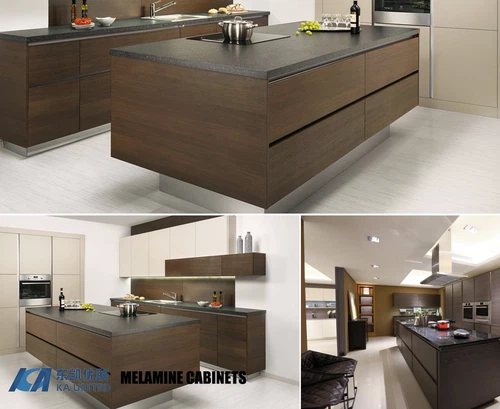
Melamine is most often used to imitate wood grain, but it also comes in solid colors and in textured finishes. Most manufacturers carry hundreds of options. Solid-color melamine is less common than wood grain, and it mostly appears in blacks, greys, beiges, and whites, with a handful of manufacturers adding deeper tones like blue or green.

Textured melamine is the most popular style, because it can reproduce deep, convincing wood grain on an artificial board. Since the grain is printed, a melamine door can mirror a wide range of species quite accurately, and it delivers a more uniform, consistent grain than natural wood ever will. Hardwood, by contrast, is a natural material, so no two doors share an identical pattern. If you prefer a clean, repeatable look across every door in the room, melamine actually has an edge.
Melamine vs. Solid Wood, Side by Side
Now let me get to the comparisons that actually drive decisions: appearance, durability, moisture, and how far you can push the design.
Appearance and Finish
Solid wood offers far more finishing options. It can be painted, stained, glazed, or distressed in ways that let a designer shape the final look. Melamine cannot be refinished at all. It can imitate a finish, but the product will always be the same decorative paper fused to a substrate. This is where solid wood shows its real versatility, and where melamine hits its first meaningful limit.
Melamine has its own surface range - matte, satin, and gloss sheens plus embossed wood-grain textures - but every one is locked in at the factory, so the door will never accept a new color or sheen later.
Durability and Moisture
Melamine is one of the most durable cabinet materials on the market today, known for strong resistance to moisture, heat, and stains. Because the resin-filled paper is permanently fused to the particleboard, it will not peel, and it does not delaminate the way some older fused products do. The weak point is the corners, which can chip. A chip exposes the particleboard underneath, and once water finds its way into that exposed core, it spreads quickly. As long as the surface stays intact, melamine handles water very well.
Solid wood behaves differently. It breathes: it expands and contracts with changes in temperature and humidity, and over time that movement can lead to warping, especially in a damp kitchen. Warping can also be triggered by spills or prolonged moisture. It may take significant moisture or years of seasonal change, but it is a real risk to plan around. Strength also varies by species, with maple being a notably harder hardwood than birch, for example.
Hardness is measurable, and it swings a lot between species. On the Janka scale, which measures dent resistance, hard maple scores around 1,450 pounds-force, white oak about 1,360, and yellow birch about 1,260; black cherry and black walnut sit lower, at roughly 950 and 1,010. A maple door shrugs off dents far better than a cherry door, so species changes the cabinet's day-to-day durability as much as the finish does.
Cost and How Far Your Budget Goes
Melamine is almost always the cheaper option, and the gap widens as the project grows. The panel is engineered with a printed surface, so it costs less to produce than a door milled from solid hardwood, and that saving compounds across every door and drawer front. Within solid wood, the species sets the price - maple and birch sit at the lower end, cherry costs more, and walnut is usually the most expensive of the common species. That premium is not automatic value, though: if you want a painted, stained, or glazed finish, you pay for wood regardless, because melamine cannot be refinished.
Weight, Hinges, and What It Means on Site
Weight is the variable that shows up after the boxes are hung. A melamine door on a particleboard core of roughly 600 to 700 kilograms per cubic metre is lighter than a solid hardwood door, which runs from about 560 kilograms per cubic metre for cherry up to roughly 755 for white oak. The difference lands in two places: wall cabinets and hardware. Heavy solid wood uppers put more load on the wall brackets and hinge screws, while a lighter melamine panel is easier to lift and level. The trade runs the other way too - solid wood's density gives it stiffness and a heft many people like when they open a door.
Design Flexibility
Melamine has genuine limits here. It almost always comes as a flat slab door, which means crown molding and decorative trim are difficult to work in. If you want to adjust or customize the design, solid wood is the better bet. At our factory we keep more than one hundred door patterns in the catalog, plus dozens of custom trims and moldings, and that range is something a slab-only melamine door simply cannot match. When a client wants to flex their creative muscles, I point them toward wood.

Where Each Material Fits Best
After enough kitchens, the pattern is clear. Melamine earns its place in rental properties, quick renovations, laundry rooms, and any job where the budget and timeline are tight and the cabinet has to shrug off spills, heat, and cleaning products. Its slab-only styling is a limit, but in a modern kitchen a flat door is often exactly what the client wanted. Solid wood earns its place where the cabinet is the room: a traditional kitchen with raised panels and crown molding, or an island meant to anchor the space for decades. Solid wood also makes more sense in drier climates, while melamine tends to be the safer bet in humid or coastal homes.
The Comparison at a Glance
| Feature | Melamine Cabinets | Solid Wood Cabinets |
|---|---|---|
| Cost | Lower upfront cost; budget-friendly for quick renovations | Higher; premium pricing, especially for walnut and cherry |
| Durability | Tough surface that resists heat and stains; corners can chip | Strong overall, but expands and contracts; can warp over time |
| Moisture resistance | Good while the surface stays intact; core vulnerable if chipped | Weaker; prone to deformation and rot in humid conditions |
| Appearance | Uniform printed grain; limited to slab door styles | Natural, one-of-a-kind grain; can be painted, stained, or glazed |
| Weight | Lighter engineered panel | Heavier, denser material |
| Panel thickness | Typically 16 mm or 18 mm (about 5/8" or 3/4") | Varies with the door design; commonly 3/4" frames |
| Density | Particleboard core around 600–700 kg/m³ | About 560–755 kg/m³ depending on species |
Which One Is Right for You?
Some people simply prefer natural wood and do not want a manufactured product, and I understand that completely. Others love the idea of a perfectly uniform wood-grain look, which textured melamine delivers very well. In my experience, the decision usually comes down to two practical questions: how much you want to spend, and how custom you want the room to be.
If you are on a tight budget or doing a fast renovation, melamine is a very solid choice. It is clean, consistent, and easy to live with. If you want a striking, colorful painted finish, go with natural paint-grade woods like birch or maple. And whichever cabinet you choose, think about the countertop at the same time, because the two materials sit next to each other every day. A quartz countertop pairs well with both, giving a busy kitchen a durable, easy-to-clean surface that does not compete with the cabinet for attention.
Frequently Asked Questions
Are melamine cabinets cheaper than solid wood cabinets?
Yes, generally. Melamine uses an engineered particleboard core with a fused decorative surface, so it costs less to produce than solid hardwood. Solid wood, especially higher-end species like walnut and cherry, carries a noticeably higher price. If upfront cost is your main concern, melamine is usually the more affordable path.
Do melamine cabinets hold up in a humid kitchen?
They hold up well as long as the surface stays intact. The resin-fused paper resists moisture, heat, and stains, and it will not peel or delaminate under normal kitchen conditions. The risk is at the corners and edges: if a door chips and the particleboard core is exposed, water can reach the substrate and spread. Keep the edges protected and melamine handles humidity better than many people expect.
Can melamine cabinets be painted or refinished?
No. The surface of a melamine door is decorative paper permanently fused to the substrate, so it cannot be painted, stained, glazed, or distressed the way solid wood can. If you want the option to change the finish later, or a custom painted color, solid wood is the more flexible choice.
Is melamine the same as MDF?
No, they are different materials. Melamine typically uses a particleboard core with resin-infused decorative paper fused to both faces. MDF is a denser fiberboard made from fine wood fibers. Both are engineered panels, but they are built differently and perform differently, so it is worth confirming exactly which one you are buying.
Which is better for resale value, melamine or solid wood?
It depends on the market and the home, but solid wood generally reads as a more traditional, higher-end material and is often viewed favorably in resale. Melamine is practical and durable, but it is commonly associated with budget or fast renovations. If resale is a priority, solid wood is usually the safer bet for perceived value.
Final Conclusion
Melamine and solid wood are not really competitors so much as two answers to two different questions. Solid wood gives you natural grain, custom door styles, and a traditional, long-lasting character, at a higher price and with more sensitivity to moisture. Melamine gives you a consistent, budget-friendly, easy-to-maintain surface that resists water and stains, as long as you accept slab doors and protect the edges. Decide what matters more for your kitchen, your budget, and your timeline, and the right material tends to choose itself. If you are still torn, reach out and we will help you work through it, because after years of building both, the team at KA UNITED is just as happy sending you the cabinets that fit your life as the ones that fit your floor plan.