From Brazil to Shuitou: How KA UNITED Sources Premium Patagonia Quartzite Blocks
From Brazil to Shuitou: How KA UNITED Sources Premium Patagonia Quartzite Blocks
I am Leo Chen, and my job sits between two places that could not look more different: the red-earth quarry regions of Brazil and the dense, humming stone-processing clusters of Shuitou. Between those two points travels one of the most misunderstood materials in the trade, Patagonia Quartzite. People ask me constantly why a stone that starts in Espirito Santo or Minas Gerais has to go halfway around the world before it becomes a kitchen island or a backlit wall. The honest answer is that the distance is not wasted movement. It is where the risk gets managed, one decision at a time.
When you look at a finished Patagonia Quartzite Slab, what you are seeing is the end of a long line of choices. Someone inspected the raw block before the first cut. Someone decided whether its quartz windows were clear enough for backlighting or muddy enough to reject. Someone set the saw speed, the resin type, the polish, and the way the bundle would be split. None of those choices are visible in a photograph, but all of them show up in the price, the yield, and the final installation.

This is a supply-chain article, not a catalog page. I am going to walk you through the journey the way I actually see it in my work, from the quarry floor to the container. I will keep the numbers concrete and the claims modest, because a stone this variable does not reward exaggeration. It rewards people who understand exactly where the money and the risk are.
Why the Journey Matters More Than the Slab
Patagonia is not a uniform material. Inside a single block you can find smoky quartz lenses, ivory feldspar masses, dark tourmaline-like ribbons, and natural fissure networks all pressed together. A beautiful photo cannot tell you whether the block is stable, whether the quartz will transmit light cleanly, whether the feldspar is balanced, or whether the slab will survive being cut into a waterfall island. Those answers come from the process, not the picture.
That is the core of what I want to get across. The value of a supplier like KA UNITED is not that we own a warehouse full of pretty stone. It is that we control the handoff between raw extraction and industrial processing. Brazil supplies the geological drama. Shuitou supplies the sawing, the resination, the polishing, the grading, and the export readiness. The two halves only work when someone is watching the seam between them.
For buyers, this matters in a very practical way. A block that looks cheap at the quarry can turn expensive the moment it cracks on the saw or fails grading. A block that costs more up front can reduce project risk if it yields stable, large-format slabs with strong pattern continuity. Understanding the journey is how you stop paying for surprises you could have seen coming.
Where the Stone Begins: Brazilian Quarry Country
Patagonia Quartzite is tied to the crystalline stone regions of Brazil, the kind of geology where complex mineral growth produces dramatic, pegmatite-like structures. Commercial supply is often linked to quarrying areas around Espirito Santo and Minas Gerais, where exotic quartzite, pegmatite, granite, and other high-value dimension stones are extracted, inspected, and prepared for export.
I want to be careful here, because exact quarry sources vary by supplier, by block lot, and by market channel. What does not vary is the discipline required. Before any block is bought, someone has to walk it and read it. The inspector checks for visible fissures, quartz-lens clarity, feldspar balance, oxidation, probable slab size, expected yield, and block soundness. The question is not whether the stone is pretty. It is whether it can be processed into the product you actually need.
Reading a Block Before the First Cut
Block tagging is where high-end applications are decided. A raw block with clear quartz windows and low muddy oxidation might be reserved for Backlit Patagonia Quartzite. A block with balanced feldspar and moderate pattern movement might be better suited for Patagonia Quartzite Countertops. A block with heavier contrast gets steered toward wall panels, custom tabletops, or hospitality statement surfaces.
This is the stage where cost control really begins. A block that looks inexpensive can generate serious waste if it is hiding fractures. A higher-priced block can actually lower total project cost if it yields stable, consistent slabs. Sourcing quartzite blocks from Brazil is therefore a blend of geological judgment and application planning. You are not buying stone yet. You are buying the probability of a good slab.

What a Raw Block Is Actually Made Of
Instead of a single calm matrix, a raw Patagonia block can contain enormous smoky quartz lenses, creamy feldspar masses, dark tourmaline-like ribbons, biotite-style mineral movement, golden fracture lines, and natural crystal boundaries. That combination is what creates the look people pay for, but it is also what creates the technical risk.
Different mineral zones respond differently to sawing pressure, polishing, resin absorption, light transmission, and fabrication stress. A quartz-rich zone is very hard and dense. A feldspar-dominant zone behaves differently during cutting and finishing. Natural fissures, resin response, and mineral boundaries all create localized stress that a uniform stone simply does not have.
Why Mineral Zones Create Technical Risk
This is why a professional Patagonia Quartzite factory processes the material with controlled sawing, vacuum resination, mesh support where needed, and slab-by-slab inspection. You cannot treat Patagonia like ordinary granite and expect it to come out clean. The internal mineral structure is less uniform, so the process has to be more deliberate at every step.
For international procurement teams, the quarry stage is where the discipline gets tested. A block that looks fine in daylight can show cloudy resin, iron specks, or internal fractures the moment you light it from behind. That is why premium luminous slabs are inspected under both daylight and backlight before they are ever graded for sale.
Technical Benchmarks: What the Numbers Tell Us
I keep a simple reference table in my head for Patagonia, and I want to share it here because it frames almost every sourcing conversation I have. These are practical reference ranges, not guarantees. Actual values shift with quarry layer, block, slab, resin treatment, finish, testing method, and mineral composition. For a major project, ask for project-specific test data before you commit.
| Performance Item | Patagonia Quartzite, Crystal Zone | Patagonia Quartzite, Feldspar Zone | Statuario White Marble | Blue Pearl Granite |
|---|---|---|---|---|
| Mohs Hardness | Approx. 6.5–7.5 in quartz-rich areas | Approx. 6–6.5, depending on feldspar density | Approx. 3–4 for calcite-based stone | Approx. 6–7 |
| Water Absorption | Dense zones can test near or below 0.05% | Slightly higher, depending on crystal boundaries | Higher and more variable | Generally low in dense material |
| Compressive Strength | Strong in compact quartz structure | Strong but variable near fissures | Lower than dense quartzite and granite | High and stable |
| Flexural Strength | Good when boundaries are stable and reinforced | Depends on resin treatment and fissure control | More vulnerable to bending stress | Predictable for normal fabrication |
| Thermal Expansion | Low to moderate | Variable by mineral mix | Sensitive to thermal and chemical change | Stable in normal residential use |
What I want you to take from that table is not a set of exact numbers. It is the direction of the differences. Quartzite sits well above marble on hardness, which is why it holds up better in an active kitchen. It sits near granite on strength, which is why it can carry an island or a bar top without the edge chipping you would expect from a softer stone. The variable is always the feldspar zone and the fissure network, and that is where processing quality decides the outcome.
What Hardness Actually Buys You
A quartz-rich Patagonia zone can reach Mohs 7 territory, which is roughly where you start resisting knife scratches and day-to-day wear. The feldspar areas are softer, more like 6, which is still far above the 3–4 range of a calcite-based marble. That gap is why Patagonia behaves differently from marble on a countertop: it dulls acids and resists scratching in ways marble simply cannot.
Why Water Absorption Matters More Than You Think
Porosity and subsurface fluid resistance decide how a finished worktop behaves with coffee, wine, olive oil, and water. Dense quartzite with very low absorption can resist deep staining when the surface is properly sealed. But no natural stone should ever be described as impossible to stain. Edges, fissures, cutouts, and unsealed zones still create risk. The goal with Patagonia Quartzite Kitchen Countertops is to combine low absorption, a strong polish, stable seams, the right sealer, and professional installation. The stone gives you a strong foundation. The factory and the installer decide whether that performance reaches your kitchen.
The Three Pattern Families We Sort For
After processing, we sort Patagonia into pattern families, because the look of the slab decides where it belongs. This is not marketing. It is a practical way to match the right stone to the right room, and it saves buyers from falling in love with a slab that is wrong for their application.
Crystal-Dominant Slabs
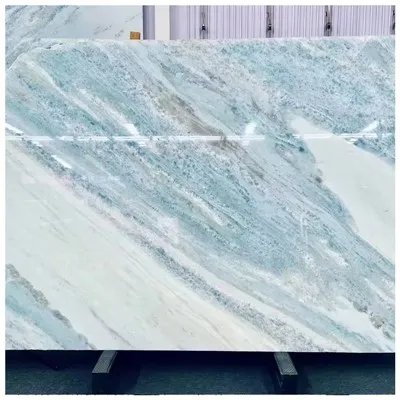
Crystal-dominant slabs are defined by expansive, unbroken windows of smoky quartz. These areas transmit light, which makes them the material of choice for Backlit Patagonia Quartzite installations, luminous bar counters, reception desks, and statement walls. Because clean crystal windows are rare, this sorting category usually commands a premium. The catch is that a slab that looks clear in normal light can show cloudy resin, iron specks, or internal fractures under illumination. A true luminous slab has to be checked both ways.
Feldspar-Balanced Matrix
Feldspar-balanced slabs carry more creamy, porcelain-like structural zones, interrupted by crystal lenses and dark mineral movement. This family works well for large kitchens, waterfall islands, vanity tops, wall cladding, and custom stone furniture, because it gives visual strength without the visual chaos. It is the category I most often recommend for a residential interior where the stone needs to feel rich but still livable, pairing comfortably with warm wood cabinetry, brushed metal fixtures, and soft neutral finishes.
Tourmaline-Ribboned Slabs
Tourmaline-ribboned slabs feature deep charcoal, black, or dark biotite-style movement sweeping across the surface. These make a more aggressive, modern statement, and they fit large open spaces, high-contrast interiors, wine rooms, club lounges, and hospitality reception areas. Designers should use them with care. Too much dark movement can overwhelm a kitchen, but the right slab creates genuine depth. For custom tables, bar counters, or statement walls, dark-ribboned Patagonia carries an unmistakable architectural identity.
The Shuitou Transformation
This is the part of the story that surprises people who have never visited. Shuitou has become one of the world's most important stone-processing centers because it concentrates machinery, skilled operators, slab markets, fabrication knowledge, export logistics, and a dense chain of related services in one place. That concentration is exactly why raw Brazilian blocks travel there. It is simply the most efficient point to turn rough geology into finished product.
Maritime Freight and Documentation
Raw blocks weigh many tons, and some reach the 25 to 30 metric ton range depending on size and density. Moving them internationally means heavy-lift handling, accurate customs declarations, safe block stabilization, and compliance with destination rules. Shipping raw stone is not like shipping finished tiles. Every block has to be handled as a high-value industrial load.
Documentation matters as much as the material. For container exports, packing lists, commercial invoices, shipping marks, crate photos, and loading records all reduce customs delays and claims. When wood packaging is used, ISPM-15 phytosanitary rules can apply depending on the route and destination. A disciplined exporter manages the paperwork with the same care as the stone itself, because a single missing document can stall a container for days.
The Gang-Saw Cutting Protocol
Once the block lands, the transformation begins. Cutting a hyper-hard, Mohs 7, pegmatite-like quartzite block requires specialized diamond gang saws, controlled feed rates, proper water cooling, and operators who know the material. If the blade speed is too aggressive, the block can suffer stress cracking. If the pressure is too low, production slows and tool wear climbs. Patagonia demands a more careful sawing protocol than ordinary granite because its internal mineral structure is uneven.
Vacuum Resination and Mesh Backing
Natural micro-fissures are common in exotic stone, and that is where vacuum resination comes in. A high-end facility injects low-viscosity, UV-stable resin into the fissures and crystal boundaries under vacuum. This stabilizes the slab, improves polish quality, reduces water entry, and prepares the material for fabrication. Mesh backing is added when the slab needs extra reinforcement during handling, especially for crystal-window materials or large panels.
Resination does not make the stone artificial. It makes a volatile raw block usable for premium architecture. When buyers ask me how raw stone blocks become luxury countertops, the answer is a controlled sequence: quarry inspection, block selection, maritime shipping, Shuitou sawing, drying, resin treatment, curing, polishing, grading, photo documentation, digital slab selection, cutting, edge finishing, packing, and final export. Skip any one of those steps and the risk moves downstream, where it costs more to fix.
Bookmatch Mapping and Block Orientation
One of the hardest variables in Shuitou is bookmatching. Patagonia is geologically chaotic, so getting a clean mirror effect across a feature wall or waterfall island has to be engineered before the block meets the diamond wire. When a block enters our processing matrix, our engineers map the internal mineral clusters, crystalline focal points, and fissure trajectories. The block is then positioned on the gang-saw platform with laser alignment.
Rotating or tilting a block by even 2 to 3 degrees before sawing can be the difference between a disconnected, fragmented pattern and a symmetric, museum-grade mirror across consecutive bundles. Our factory also works to keep wastage and yield loss down. Lower-tier processors commonly lose 25% to 35% of a block; we calibrate feed speeds and diamond grit composition dynamically as the saw moves from hard quartz windows into softer feldspar matrices. That kind of control is what lets every slab in a bundle keep graphical continuity and lets an architect get the most design out of a single raw asset.
Patagonia Quartzite vs. Italian Calacatta Marble
Italian Calacatta marble is still one of the most recognized luxury stones in the world, and for good reason. But Patagonia and marble serve different performance expectations, and it helps to be blunt about the difference. Calcareous marbles sit around Mohs 3 to 4. They can etch on contact with lemon juice, vinegar, wine, coffee, and some cleaners, and they scratch more easily under daily domestic wear.
Patagonia Quartzite Slabs provide a stronger technical foundation because the quartz-rich zones are significantly harder and generally more resistant to acid-related surface dulling. That makes Patagonia the better call for active kitchens, wet bars, vanities, restaurant counters, and hospitality interiors where beauty and performance have to coexist. The visual effect is different too. Marble reflects light from the surface. Processed quartzite can capture, distort, and transmit light through its crystal pockets, which is why translucent Patagonia reads as more dimensional than opaque marble, and why backlit Patagonia can create a glowing field of quartz that marble cannot easily reproduce.

For residential work, Patagonia Quartzite Countertops support luxury kitchens, bars, and vanities where the client wants stone drama without the high-maintenance expectations that come with marble. That single difference, maintenance, drives more material swaps than any aesthetic argument I have ever heard.
Engineering and Installation Notes
A beautiful slab can still be ruined by a bad installation. Patagonia has dramatic crystal and mineral movement, which means seams, edges, and supports have to be planned with the pattern in mind, not bolted on as an afterthought.
Mitered Edges on Floating Islands
For luxury kitchens, mitered edges let Patagonia read as a solid sculptural block. Advanced custom stone fabrication uses CNC water-jets, bridge saws, and careful 45-degree edge preparation to align the pattern from the countertop deck down through the waterfall panels. The result is a continuous visual flow across the island. A poorly placed miter seam interrupts the design; a well-planned one makes the stone appear to fold naturally from horizontal to vertical.
Backlit Wall Structure
Backlit walls need a different technical system entirely. Heavy stone panels must be carried by Z-clips, stainless steel anchors, aluminum sub-frames, or custom engineered brackets, while the design leaves uniform space for LED light-guide panels. The structure cannot block the clearest quartz windows or it will cast visible shadows. For Backlit Patagonia Quartzite, lighting and stone layout are planned together, and the slab map shows quartz-window locations, support positions, panel seams, driver access, and ventilation paths before fabrication starts.
Seams and Expansion Joints
Color-matched, non-yellowing acrylic adhesives are essential for light feldspar and translucent sections. Dark epoxies create visible shadow lines, especially under backlighting. Expansion joints should be planned by application, climate, substrate, local building requirements, and slab size. For countertops, seams should avoid the major focal quartz windows where possible. For vanity tops, moisture protection and edge sealing around sinks matter most. For tiles, installers have to manage joint consistency, substrate flatness, and movement control.
Sourcing Economics: Why Yield Drives Price
Patagonia is expensive for a reason, and the reason is yield. A raw block can contain spectacular quartz windows alongside internal fissures, oxidized patches, irregular mineral movement, and sections that will never make a premium slab. Compared with standard granite, the waste factor runs higher because the material is less uniform and harder to process. That waste lands directly on the final cost per square meter.
Premium slabs are not priced by tonnage or thickness alone. They are priced by usable yield, crystal clarity, pattern quality, slab size, resin quality, polish, backlighting potential, and bundle consistency. A cheaper block can become an expensive one the moment several slabs crack or fail grading after cutting. Corporate buyers, developers, and general contractors can reduce acquisition premiums by ordering bulk slabs directly from an integrated wholesale supplier or direct exporter, which improves visibility into slab selection and removes unnecessary distribution layers.

The lowest raw-block price almost never produces the lowest final project cost. Hidden fissures, low yield, breakage, excess resin, replacement delays, and mismatched slabs all add up. Sourcing quality should be judged by project result, not by the initial quotation.
Frequently Asked Questions
Where is Patagonia Quartzite quarried in Brazil?
Patagonia Quartzite is associated with Brazilian exotic-stone quarry regions where crystalline quartz, feldspar, and dark mineral formations occur in pegmatite-like structures. Commercial supply is often connected with stone-producing areas such as Espirito Santo and Minas Gerais, though exact quarry sources vary by supplier, block lot, and market channel. Before confirming a major order, ask for origin documentation, block photos, bundle numbers, and supplier verification, especially for premium backlit or bookmatched projects.
How are raw stone blocks transported internationally?
Raw blocks move through heavy-lift logistics that include quarry handling, truck transport to port, ocean freight, customs clearance, and inland delivery to the processing factory. Because blocks can weigh 25 to 30 metric tons, professional loading, stabilization, documentation, and weight control are essential. Finished slabs and fabricated stone require export-grade packing, shipping marks, commercial invoices, and packing lists, plus wood-packaging compliance where ISPM-15 rules apply. A reliable exporter provides loading photos and shipping documentation to reduce transit risk.
Why are quartzite blocks processed in Shuitou?
Shuitou has one of the world's most developed stone-processing ecosystems, with experienced sawing facilities, resin-treatment lines, polishing workshops, fabrication teams, inspection services, and export logistics all concentrated in one place. Complex materials like Patagonia need careful cutting, vacuum resination, polishing, grading, and slab selection. That industrial concentration lets suppliers like KA UNITED turn raw Brazilian blocks into finished slabs, countertops, panels, backlit surfaces, and custom furniture for international projects.
How do raw stone blocks become luxury countertops?
The block is first inspected and cut into slabs with diamond saws. The slabs are then dried, vacuum-resined, cured, polished, graded, photographed, and selected for specific projects. After approval, the slab is digitally templated, cut by bridge saw or water-jet, edged, reinforced where needed, sealed, packed, and shipped for installation. For Patagonia Quartzite countertops, slab selection is especially important because crystal windows, feldspar zones, fissures, and pattern movement all have to be matched to the kitchen layout.
Where can I source premium Patagonia Quartzite blocks and slabs?
Source through a professional manufacturer, supplier, factory, distributor, or exporter that can provide quarry-level selection, full-slab photos, grade details, resin information, backlighting tests when needed, export packing, and logistics support. KA UNITED supports architecture firms, developers, contractors, distributors, fabricators, and luxury residential teams with Brazil block-sourcing communication, Shuitou slab processing, digital inspection, custom fabrication coordination, and container-level international logistics.
Final Conclusion
The journey from raw Brazilian geology to a finished interior is long and technical. Patagonia begins in remote quarry environments, where blocks are inspected for crystal clarity, feldspar balance, fissure risk, oxidation, and probable yield. It moves through international logistics, Shuitou sawing, vacuum resination, polishing, grading, digital inspection, fabrication, packing, and export, and every one of those stages shapes the final surface. If the wrong block is selected, no later process can fully correct poor structure, muddy quartz, or unstable fissures. If the right block is selected and processed properly, it becomes a dramatic kitchen island, a backlit wall, a reception desk, or a dining table that lasts for decades. That is why the sourcing journey matters as much as the stone itself, and why I would rather walk a buyer through this whole chain than sell them a slab they have not seen through to its source. The discipline of following the material from Brazil to Shuitou is exactly the kind of hands-on control that defines KA UNITED.