Taj Mahal Quartzite vs. Granite/Marble: Why Quartzite Wins in 2026?
Quick Summary
Taj Mahal Quartzite vs. Granite/Marble: Why Quartzite Wins in 2026?
The 2026 debate around KA UNITED's Exotic Taj Mahal Quartzite is not really about beauty alone. It is about performance, long-term value, and whether a stone can satisfy the modern luxury buyer who wants sophistication without fragility. In kitchens, bathrooms, feature walls, and hospitality projects, the comparison between Taj Mahal Quartzite vs. Granite/Marble has become a practical sourcing question rather than a style debate.
Taj Mahal Quartzite occupies a rare position in the market. It looks soft and elegant like a marble, yet it behaves like a hard natural stone that is far better suited to daily use. That combination is why architects, contractors, and homeowners keep asking whether quartzite has finally become the best natural stone for luxury kitchen islands. KA UNITED sees the material as more than a countertop option. It is a project-grade asset with strong design and resale logic.
For buyers who need a direct view into product formats, the catalog routes include Taj Mahal Quartzite, Taj Mahal Quartzite Slab, and Taj Mahal Quartzite Tiles. These references matter because the same stone performs differently when it is specified as a slab, a tile, or a finished furniture piece.
1. Geological Origins: The Brazilian Shield and Mineralogical Transformation
1.1 From sandstone to quartzite
Taj Mahal Quartzite begins its life as sandstone that undergoes extreme heat and pressure in Brazil's geological systems. Over millions of years, the quartz-rich sediment compacts and recrystallizes into a stone that is much harder and more stable than the original rock. This metamorphic transformation is what gives quartzite its performance advantage over marble and helps explain why it is valued in high-end applications.
The Brazilian Shield provides the conditions needed for this process, and the specific geology behind the Taj Mahal variety produces a stone that is chemically distinct from ordinary quartzite. Its creamy tone, restrained movement, and soft tonal shadows make it visually unique. Buyers who want Exotic Quartzite with a calm, premium character often choose this stone because it avoids the busier look that some blue or highly linear quartzites can have.
1.2 Why "Taj Mahal" is different from typical quartzite
Not every quartzite looks or behaves the same. The Taj Mahal variety is prized for its neutral elegance, but it also offers excellent technical performance. That means it can be used where marble would be too soft and granite would feel too dated or too granular. In procurement language, this is one reason a premium exotic stone supplier may highlight the material for upscale kitchens, hospitality bars, and luxury residences.
The role of a direct quartzite exporter matters here because block authenticity and grade-A quality must be protected from the quarry stage onward. When the exporter is disciplined, the project receives slab families with more consistent background tone and better use efficiency. That is especially important for wholesale Taj Mahal Quartzite slabs ordered for large developments.
1.3 Brazilian sourcing and block traceability
The best Brazilian quarries do not simply produce material. They produce choice. The quarry, factory, and exporter must work together to separate clean, attractive faces from weaker or more fractured outputs. A serious Taj Mahal Quartzite manufacturer understands that the value of the block is not just in what comes out of the mountain. It is in how accurately the slab is read, cut, and preserved.
Buyers who want to understand product format at source level can also review Taj Mahal Quartzite Countertops and Taj Mahal Quartzite Wash Basin, because the same stone family can be deployed in multiple architectural and furniture contexts.

2. Technical Performance Matrix: Taj Mahal vs. the Competition
Technical comparison is where quartzite starts to separate itself from marble. The table below gives the 2026 performance profile that buyers most often use when comparing Taj Mahal Quartzite vs. Granite/Marble.
| Physical Property | Taj Mahal Quartzite | Premium Granite | Calacatta Marble |
|---|---|---|---|
| Mohs Hardness | 7.0 – 7.5 | 6.0 – 6.5 | 3.0 – 3.5 |
| Water Absorption | 0.02% – 0.08% | 0.10% – 0.15% | 0.20% – 0.50% |
| Acid Resistance | No Etching | High Resistance | High Sensitivity |
| Density | 2,640 – 2,680 kg/m³ | 2,630 – 2,700 kg/m³ | 2,710 kg/m³ |
| Stain Resistance | Superior | High | Moderate-Low |
| Heat Stability | Excellent | High | Moderate |
The table explains why the 0.02% absorption rate is such a strong selling point for a Brazilian quartzite factory serving gourmet kitchens. A low absorption rate means less risk of deep staining, less moisture migration, and a much easier maintenance burden over time. It also means the material is better suited to family use, hospitality kitchens, and luxury settings where the surface must perform without constant worry.
When developers compare marble and granite to quartzite, they often discover that quartzite delivers the best balance of performance and elegance. Granite is durable but increasingly seen as visually dated in many luxury settings. Marble is prestigious but chemically vulnerable. Quartzite sits between them and often outperforms both in real-world kitchen and interior use.
2.1 Technical verdict for heavy-use kitchens
The strongest argument for Taj Mahal Quartzite is its mix of hardness, absorption resistance, and visual restraint. For heavy-use islands, perimeter counters, and family kitchens, it provides the confidence that marble cannot offer and the warmer visual language that granite often lacks. That is why a wholesale quartzite tiles program or a slab-based kitchen package increasingly centers on this material.
Buyers who want to compare format types can also review Taj Mahal Quartzite Vanity Top and Taj Mahal Quartzite Low Plinth Tables, both of which show how the stone moves beyond the kitchen into full interior specification.
2026 Technical Benchmark: Why Taj Mahal Quartzite Outperforms
Based on KA UNITED Laboratory Testing and ASTM Standards
| Feature | Taj Mahal Quartzite | Natural Marble | Granite |
|---|---|---|---|
| Mohs Hardness | 7 - 7.5 (Superior) | 3 - 4 (Soft) | 6 - 7 (Strong) |
| Acid Sensitivity | Inert (No Etching) | High (Etches easily) | Inert |
| Porosity Rate | < 0.1% (Ultra-Dense) | Moderate | Low |
| Visual Style | Soft, Marble-like | Classic Veining | Granular/Speckled |
3. Aesthetic Classification: Decoding the Tones of Taj Mahal
3.1 The cream spectrum
Taj Mahal Quartzite is popular because it lives in the cream spectrum rather than the stark-white spectrum. That gives the stone a soft, expensive look with pearl, champagne, and gold-veined variations. It feels warmer than a bright white quartzite, but cleaner and more contemporary than many beiges.
Designers often choose it when they want a surface that can sit beside oak, walnut, matte black fixtures, brushed brass, or pale plaster walls without becoming visually cold. This is one reason the stone is frequently described as a Beige Exotic Quartzite that still feels elevated enough for luxury projects.
3.2 Finish impact in 2026
Finish selection changes the emotional reading of the stone. Polished finish gives the strongest light bounce and a more formal appearance. Leathered finish softens the look and adds tactile depth, which can be ideal for contemporary kitchens. Silk finish is increasingly used in 2026 because it sits between the two, delivering a refined surface that feels controlled without becoming overly reflective.
A premium stone supplier should grade slabs based on background clarity versus vein density because those factors determine whether a slab is more suitable for a kitchen island, wall cladding, or furniture. A slab with tighter, cleaner background may work better for Taj Mahal Quartzite Countertops, while a slightly more expressive face may be better used in a backsplash or feature wall.
3.3 Why the stone reads as luxurious
The stone's beauty lies in restraint. It does not try to dominate a room. It quietly supports it. That is why it is often the preferred choice for buyers who want Luxury Quartzite without a highly graphic pattern. It also explains why Taj Mahal Quartzite Countertops have become a standard request in premium homes and boutique hospitality settings.
For product-family reference, buyers can explore Taj Mahal Quartzite Countertops and Taj Mahal Quartzite Tiles to see how finish and format can be matched to a project brief.
4. The Durability Debate: Why Quartzite Wins Over Marble
4.1 Etch factor and chemical sensitivity
The durability case is simple. Marble etches. Quartzite largely does not. In practical terms, that means lemon juice, wine, vinegar, and many household acids are far less threatening to quartzite than to marble. When a luxury kitchen sees real use, that difference becomes very important.
This is why developers increasingly substitute quartzite for marble in high-use kitchens and reduce long-term maintenance liabilities over the 10-year ownership cycle. The buyer gets a more forgiving stone without losing the premium appearance.
4.2 The lemon and wine test
A simple real-world test illustrates the issue. If acidic liquids sit on marble, etching can appear quickly. On quartzite, the same spill is much less likely to leave a visible mark. That is one reason the market has moved toward wholesale Taj Mahal Quartzite slabs for kitchens and hospitality applications. The stone is not invincible, but it is much more forgiving.
The phrase Brazilian quartzite vs. Calacatta marble durability captures the core issue: marble has tradition and prestige, but quartzite has the performance edge. In 2026, many buyers care more about maintaining a beautiful surface than about accepting a surface that needs constant caution.
4.3 Maintenance liability and resale value
Quartzite lowers maintenance liabilities because it needs less emergency response to everyday spills and less fear of common kitchen use. That matters to luxury developers because a low-maintenance stone can better support resale value. Buyers do not just admire a home's stone. They also ask whether living with it will feel easy or stressful.
This is where a Taj Mahal Quartzite wholesaler can become a strategic partner. The best wholesaler helps the project team select the right grade, slab family, and finish so the surface performs well over the long term.
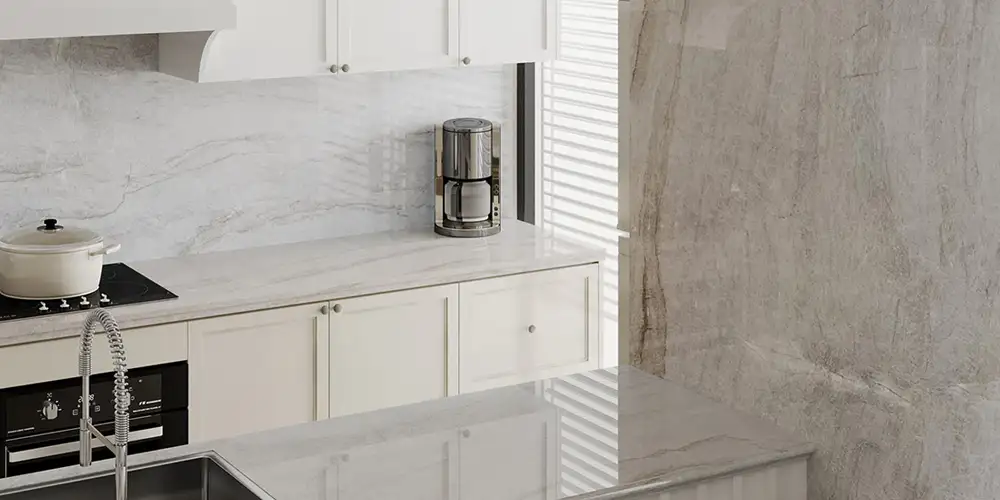
5. Engineering Comparison: Why Quartzite Wins Over Granite
5.1 Visual superiority
Granite is durable, but it can read as granular and visually familiar in many markets. Quartzite, by contrast, often feels more refined and more modern. Taj Mahal Quartzite gives buyers the warm, marble-like depth they want while still offering the technical strength they need. That combination is hard for granite to match in a luxury setting.
In design terms, that is why quartzite has become the material of contemporary luxury. It looks more intentional. It feels less dated. And it supports a cleaner, more high-end aesthetic across kitchens, bathrooms, and feature walls.
5.2 Crystalline depth versus granular look
Granite's granular structure is part of its identity, but the visual effect can be too busy for some minimalist projects. Taj Mahal has a more crystalline depth, which makes it read as calm and expensive rather than speckled or overly patterned. This optical difference is one of the main reasons high-end buyers keep moving toward quartzite.
The same logic applies to furniture. A surface for Taj Mahal Quartzite Tables or Taj Mahal Quartzite Cosole Tables needs to feel sculptural and contemporary. Quartzite delivers that better than most granites because the surface reads as more architectural and less utilitarian.
5.3 Investment value and appraisal impact
A well-sourced quartzite installation can help improve perceived property value because it signals premium taste and practical longevity. That is especially true for Taj Mahal Quartzite Countertops in a luxury kitchen, where buyers often evaluate both the look and the expected upkeep. A stone that feels elegant and durable can strengthen the home's market story.
KA UNITED often positions this material for clients who want the best natural stone for luxury kitchen islands. The reason is not just visual appeal. It is the balance of durability, source credibility, and a finished appearance that feels current rather than dated.
6. 2026 Pricing Intelligence: The Financial Logic of Luxury
6.1 The exotic premium
The market accepts a higher price for Taj Mahal Quartzite because the stone solves several problems at once. It gives buyers the marble-like aesthetic, the quartzite-level durability, and a high-end origin story. That combination creates an exotic premium that standard granite often cannot justify.
Buyers asking about Taj Mahal Quartzite price per square foot 2026 should understand that the rate is shaped by background clarity, slab size, finish quality, block yield, and freight conditions. There is no single universal number because the stone is purchased by grade and by project requirement, not as a commodity with a fixed shelf tag.
6.2 Slab versus fabricated costs
Slab cost is only one part of the equation. Once cutting, polishing, edge treatment, sink cutouts, and packaging are included, the fabricated cost rises. That is why Taj Mahal Quartzite manufacturer and direct quartzite exporter relationships are often more efficient than buying through multiple resellers. The project gets better control over material, timing, and matching.
This also applies to Taj Mahal Quartzite Floor Tiles and Taj Mahal Quartzite Wall Cladding Tiles, where fabrication and packing can change the final budget significantly. The better the factory coordination, the more predictable the outcome.
6.3 Middleman markups and 5-star hotel projects
In large hospitality work, middleman markups can become expensive very quickly. A buyer working directly with a Taj Mahal Quartzite wholesaler often gets better visibility into slab availability, grade, and lead time. This matters because hotel projects frequently need many matching slabs and consistent color across multiple floors.
For source-level reference, buyers can review Taj Mahal Quartzite Slab and Taj Mahal Granite Slab. The latter reflects a legacy catalog naming route, but the quartzite product family remains the most relevant for luxury buyers.

7. Installation and Fabrication Standards for 2026
7.1 The hard stone challenge
Quartzite's hardness is part of its appeal, but it also makes fabrication more demanding. Specialized diamond tools are required at the Brazilian quartzite factory, and poor tooling can damage both edges and finish. The stone should be cut, polished, and handled by teams that understand its structure rather than by generic stone handlers.
This is one reason custom quartzite fabrication has become a serious business category in luxury development. Mitered edges, waterfall islands, integrated sinks, and monolithic counters all depend on accurate fabrication.
7.2 Adhesive science and shadowing
White, moisture-neutral epoxies are recommended to prevent shadowing through the stone or along seams. This matters especially in lighter slabs where any dark line can break the visual continuity. If the project includes a large island or a full-height feature wall, the adhesive system should be chosen as carefully as the slab itself.
The same thinking applies to product formats such as Taj Mahal Quartzite Vanity Top and Taj Mahal Quartzite Wash Basin, where cutouts and edges are highly visible.
7.3 Dry-lay and digital mapping
A premium quartzite factory must provide high-definition digital mapping when the project depends on pattern continuity. This is especially important for waterfall islands and book-matched wall compositions. Without dry-lay planning, the project can lose coherence even if the slabs themselves are beautiful.
Buyers comparing furniture applications can also look at Taj Mahal Quartzite Low Plinth Tables to see how the stone translates into architectural furniture forms.
8. Sustainability and ESG
8.1 Clean quarry mandates
The 2026 market increasingly expects quarry transparency and responsible production. A direct quartzite exporter should be able to explain how the stone is mined, processed, and shipped under ethical and environmental standards. Buyers in premium projects want more than beauty. They want a credible supply narrative.
8.2 LEED and sustainable building certification
Natural quartzite contributes to LEED and WELL goals because of its longevity, low replacement frequency, and authentic material value. A stone that lasts for decades can be more sustainable than a synthetic surface that needs to be replaced sooner. That long service life is part of the sustainability argument for Luxury Quartzite.
8.3 Ethical labor verification
In Brazilian mining, ethical labor verification is now part of the luxury procurement story. Buyers do not want hidden risk in the supply chain. A responsible supplier should be able to speak clearly about labor practices, quarry conditions, and traceability. KA UNITED treats that transparency as part of project professionalism.
9. Maintenance Protocols: Protecting Your 2026 Asset
9.1 The 15-year sealer
A nano-technology sealer can help preserve the low porosity of quartzite for the long term. It does not make the stone invincible, but it can reduce maintenance demands and improve stain resistance. That is especially useful in kitchens, islands, and hospitality bars where daily contact is inevitable.

For buyers asking about What is the maintenance for Taj Mahal Quartzite in 2026?, the answer is that the stone is low-maintenance relative to marble, but not maintenance-free. It still benefits from proper sealing, prompt spill cleanup, and pH-neutral cleaning.
9.2 Cleaning mandates
Abrasive cleaners should be avoided. They can dull the crystalline luster and reduce the stone's visual clarity over time. A soft cloth and a neutral cleaner are the safest daily solution. This is a small habit, but it protects a large investment.
9.3 2026 Real Estate ROI: The Taj Mahal Quartzite Premium
In 2026, natural stone is no longer just a surface; it's a blue-chip asset. High-end real estate data shows that homes featuring Authentic Taj Mahal Quartzite kitchen islands command a 5-8% higher resale value than those with generic granite or engineered surfaces.
The KA UNITED Procurement Advantage: As early pioneers in importing this stone from Brazil, we ensure every slab meets the "Investment Grade" criteria-checking for mineral clarity, structural integrity, and the absence of internal fractures that often plague lower-grade retail batches.
9.4 Long-term lifecycle and ROI
Many buyers consider quartzite a 50-year asset because it can remain attractive for decades with proper care. This is especially true for Taj Mahal Quartzite Floor Tiles and wholesale quartzite tiles used in durable interior programs. The stone's strength helps reduce replacement frequency, which improves life-cycle economics.
10. Sourcing Intelligence: How to Buy for Commercial vs. Residential
10.1 Commercial sourcing
Commercial projects need scale, consistency, and logistics discipline. A direct quartzite exporter becomes essential when the order runs above 1,000 SQM, because the project requires matching across many slabs and reliable freight management. The supplier has to coordinate not just stone, but timing, packing, and approvals.
In a hotel or tower project, wholesale Taj Mahal Quartzite slabs are especially valuable because they preserve consistency across repeated surfaces. A strong Taj Mahal Quartzite wholesaler will also help minimize variation across batches.
10.2 Residential selection
Residential buyers usually need a more curated process. They are selecting a small number of slabs for a kitchen, bath, or feature area, so slab uniqueness matters more. This is where the slab selection protocol becomes important. Buyers should review background clarity, cream tone, vein distribution, and how the stone will look under the home's actual lighting.
For residential buyers, the product family around Taj Mahal Quartzite Countertops and Taj Mahal Quartzite Vanity Top is often the best starting point.
10.3 Cross-border logistics
Coordinating shipping, customs, and packaging is one of the main reasons buyers work through a Taj Mahal Quartzite wholesaler. The right wholesaler keeps the project moving and reduces the chance of delays or mismatched material. That is especially useful when the client is ordering a mix of slabs, tiles, and furniture pieces.
11. Product Context and Applications
The Taj Mahal family extends well beyond the countertop. Buyers can consider Taj Mahal Quartzite Wash Basin, Taj Mahal Quartzite Vanity Top, and Taj Mahal Quartzite Low Plinth Tables when planning a full interior package.
For flooring and wall systems, the dedicated routes Taj Mahal Quartzite Tiles, Taj Mahal Quartzite Floor Tiles, and Taj Mahal Quartzite Wall Cladding Tiles are the right formats to review. These applications often benefit from the stone's calm coloration and strong performance in larger surface areas.
The product family also supports bespoke furniture and statement pieces, including Taj Mahal Quartzite Tables and Taj Mahal Quartzite Cosole Tables. Those pieces work well because the stone gives the furniture a refined, sculptural presence that looks premium in both residential and commercial settings.
Conclusion: Choosing the Standard-Bearer for Taj Mahal Quartzite
The debate over Taj Mahal Quartzite versus Granite and Marble concludes with a clear winner for 2026: Taj Mahal Quartzite provides the only compromise-free solution for luxury living. It captures the ethereal beauty of Greek marble while delivering the iron-clad durability of a gemstone.
However, the quality of your project is only as good as your sourcing partner. KA UNITED takes pride in being one of China's earliest importers of Taj Mahal Quartzite. This decades-long history means we don't just "buy" stone; we have deep-rooted relationships with the premier quarries in Brazil, allowing us to hand-select the "Cream-of-the-Crop" blocks before they hit the open market.
Why Project Managers Source from KA UNITED:
- ✓ Direct Brazilian Quarry Access
- ✓ Expert Grading Mastery
- ✓ 2026 Precision Fabrication
Secure your project's legacy with the industry's most trusted quartzite source.
Contact Our Quartzite Specialists Today
Related Blogs of Taj Mahal Quartzite
2026 The Ultimate Guide To Taj Mahal Quartzite
The main authority page for grading, origin, and material selection.
Is Taj Mahal Quartzite Value to Buy?
Useful for ROI and market-value questions.
Why Choose Taj Mahal Quartzite
Selection logic for designers and procurement teams.
60 Pcs Taj Mahal Quartzite Blocks One the Way
Block-volume and shipment context for large projects.
Art Flow Luxury Stone Taj Mahal Quartzite
Useful for design inspiration and visual strategy.
Top 5 FAQs of Taj Mahal Quartzite
Quick answers for buyers comparing quartzite options.
Taj Mahal Quartzite vs Macaubas Fantasy 2026: Which Brazilian Quartzite is Better?
Direct comparison reading for luxury stone buyers.
Taj Mahal Quartzite vs Granite vs Marble 2026: Why Quartzite Wins for Durability?
Durability-focused comparison with traditional stones.
Taj Mahal Quartzite vs Engineered Quartz 2026: Ultimate Durability Test & Comparison
Useful for comparing natural stone with engineered surfaces.
How to Grade Taj Mahal Quartzite Blocks: A Guide from Direct Brazilian Importers
Helpful for sourcing teams evaluating slab families.
Taj Mahal Quartzite Fabrication Guide 2026: Cutting, Polishing & Edging Solutions
Useful for contractors and fabricators working on custom pieces.
Why Sourcing Taj Mahal Quartzite Slabs from China Delivers the Best ROI in 2026?
Procurement and logistics perspective for project buyers.
Best Kitchen Cabinet Colors to Pair with Taj Mahal Quartzite Countertops 2026
Design support for kitchen planning and color coordination.
Taj Mahal Quartzite Beyond Countertops: Backsplashes, Feature Walls & Floors 2026
Broader application ideas beyond the kitchen island.
Top 2026 Kitchen Design Trends Featuring Taj Mahal Quartzite Countertops
Trend insight for residential and hospitality kitchen planning.
The Complete Guide to Sealing & Cleaning Taj Mahal Quartzite (2026 Expert Tips)
Maintenance guidance for preserving surface performance and appearance.
Semantic Closure Content Block
Why does Taj Mahal Quartzite win in 2026?
It wins because it solves the modern luxury problem better than most stones: it looks refined like a marble, but it behaves like a hard, durable quartzite. That means the owner gets a surface that feels calm, warm, and elegant without taking on marble's higher risk of etching and staining. In real terms, the stone supports daily living, resale value, and a cleaner maintenance routine. For many projects, that combination is the definition of intelligent luxury.
How should buyers think about Taj Mahal Quartzite vs. Granite/Marble?
Buyers should think about it as a performance hierarchy. Granite is durable but can feel visually dated. Marble is prestigious but is softer and more maintenance-heavy. Taj Mahal Quartzite sits between them and often offers the best compromise: natural beauty, modern luxury, and much stronger performance in kitchens, islands, and high-traffic interiors. That is why it has become such a strong 2026 specification choice.
What should a design team consider before choosing slabs or tiles?
The team should consider the visual role of the material, the size of the space, the expected traffic, and the maintenance appetite of the owner. Slabs are best for monolithic islands, waterfall edges, feature walls, and coordinated countertop runs. Tiles are best when the project needs modular coverage, easier replacement, or a more systematic floor pattern. The format choice should always follow the design intent, not the other way around.
Option: when should a project use quartzite instead of marble?
Quartzite should be the option when the project wants marble-like beauty with better daily performance. It is especially strong in kitchen islands, luxury family homes, hospitality bars, and any surface that will see acids, spills, or heavy use. Marble still has a place, but quartzite is the better choice when the buyer wants both refinement and resilience.
Consideration: what makes a reliable supplier or factory valuable?
A reliable supplier or factory does more than quote stone. It explains grade, source, slab behavior, cut direction, finish options, and logistics. It helps the buyer avoid hidden problems such as mismatched batches or poor fabrication outcomes. In premium sourcing, the supplier is part of the quality system. That is why KA UNITED continues to be relevant to buyers who need direct project support, not just inventory.
FAQ
1. Is Taj Mahal Quartzite more expensive than granite in 2026?
In many cases, yes. Taj Mahal Quartzite often costs more than standard granite because it offers a more refined appearance, stronger market demand, and a higher perceived luxury value. The price is also influenced by block quality, slab size, finish, freight, and the amount of usable area each block yields. Granite may be cheaper in raw material terms, but Taj Mahal quartzite often justifies its higher price through a combination of beauty, durability, and resale appeal.
2. Can you put hot pans directly on Taj Mahal Quartzite?
Quartzite has excellent heat resistance, and Taj Mahal Quartzite performs better than many other natural stones in hot-kitchen conditions. Even so, direct contact with very hot cookware is not the best practice because thermal shock can still affect stone over time, especially around seams or cutouts. A trivet remains the safest routine. The material is strong enough for real kitchen use, but sensible care always protects the investment.
3. How do I tell if it's true quartzite or a mislabeled marble?
The simplest field check is the scratch test: true quartzite is much harder and should resist scratching far better than marble. Buyers should also ask for mineral documentation, origin details, and slab photos because some softer stones are sold under quartzite names for marketing reasons. If a supplier cannot explain the stone's source, performance range, or fabrication behavior, caution is warranted. Correct identification matters because the performance difference is substantial.
4. What is the best finish for a Taj Mahal Quartzite countertop in 2026?
The best finish depends on the visual goal. Polished finish gives the strongest color depth and a more formal luxury appearance. Leathered finish softens the stone and can feel more contemporary and tactile. Silk finish is increasingly popular in 2026 because it balances elegance with a softer sheen. For most kitchens, polished or silk delivers the best combination of luxury and ease of maintenance.
5. Who is the best Taj Mahal Quartzite manufacturer for jumbo slabs?
The best Taj Mahal Quartzite manufacturer is the one that can supply real slab photography, grade consistency, careful packing, and export-ready coordination for jumbo formats. Jumbo slabs require more precise extraction, better cutting, and stronger logistics than small-format stock. For large luxury projects, the best manufacturer is not simply the one with the lowest quote. It is the partner that can protect the slab family from quarry to installation and support dry-lay, matching, and fabrication planning.
References
- ASTM International. ASTM C97/C97M Standard Test Methods for Absorption and Bulk Specific Gravity of Dimension Stone. ASTM International.
- ASTM International. ASTM C170/C170M Standard Test Method for Compressive Strength of Dimension Stone. ASTM International.
- Natural Stone Institute. Dimension Stone Design Manual. Natural Stone Institute.
- Natural Stone Institute. Stone Care and Cleaning Guidance. Natural Stone Institute.
- U.S. Geological Survey. Mineral Commodity Summaries: Stone (Dimension Stone). USGS.
- Stone Federation Great Britain. Natural Stone Specification and Maintenance Guidance. Stone Federation GB.
- Tile Council of North America. Installation Guidance for Natural Stone Surfaces. TCNA.
- Stone World Editorial Team. Natural Stone Fabrication and Installation Resources. Stone World.
For the most granular details on grading and origin, visit: 2026 The Ultimate Guide To Taj Mahal Quartzite.