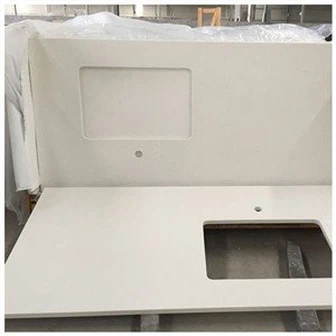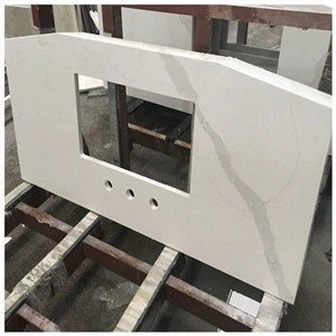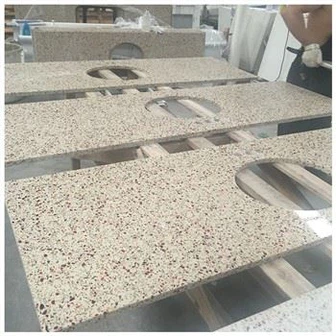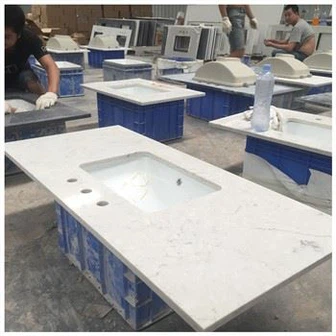
What's Engineered Quartz
What Engineered Quartz Actually Is
When I first started working with stone countertops, I assumed quartz was just another natural slab quarried out of a mountain. It took me a while to understand that engineered quartz is something different, and honestly, that difference is exactly why it has become so common in kitchens, bathrooms, and commercial spaces. Engineered quartz, also called artificial quartz or quartz stone, is a composite material. It is made by mixing crushed natural quartz crystals with resin binders, pigments, and a small amount of additives, then pressing the whole mixture into solid slabs under vacuum and heat.
Think of it this way. A natural granite slab is whatever the earth produced, cracks, color shifts, and all. An engineered quartz slab is assembled with intent. The manufacturer controls the size of the quartz grains, the exact ratio of resin, and the pigment load, so every slab from a given batch comes out consistent. That consistency is the core reason designers and builders reach for it. When a homeowner chooses a color from a sample, they can reasonably expect the installed countertop to look like that sample, not like a distant cousin of it.

The heart of the material is quartz crystal, which is one of the hardest and most abundant minerals on the planet. By weight, engineered quartz is typically more than 90% natural quartz. The remaining portion is resin and additives that bind the stone particles together and give the surface its color. Because the stone content is so high, the finished product behaves in many ways like natural stone, but because the resin fills the gaps between grains, it also behaves like a solid, sealed surface. That combination is the whole story in one sentence.
What Engineered Quartz Is Made Of
To understand why engineered quartz performs the way it does, it helps to break the slab down into its components. There are really three groups of ingredients, and each one has a specific job. I will walk through them one at a time, because once you see what is inside the slab, most of the maintenance advice about quartz suddenly makes sense.
Natural quartz: the structural backbone
Natural quartz is the dominant ingredient, usually making up between 90% and 94% of the slab by weight. This is the same mineral you find in sand and in many rocks, in the form of silicon dioxide. The reason manufacturers lean so heavily on quartz is its hardness. On the Mohs scale, which ranks minerals from 1 for talc to 10 for diamond, quartz sits at about 7. That is harder than a steel kitchen knife, which is why a properly made quartz countertop resists scratching so well. It is also the reason the surface holds its polish over years of daily use.
The quartz used in these slabs is not mined as large beautiful crystals. It is sourced as quartz sand and quartz powder, then sorted, cleaned, and graded by particle size. Different sizes are blended together so the small particles fill the spaces between the large ones. This grading is what lets the slab reach such high density. When the blend is packed correctly, there is very little room left for liquid or air to sneak in.
Resin: the binder that holds it together
The second ingredient is the binder, most commonly an unsaturated polyester resin. Resin typically accounts for somewhere in the range of 5% to 8% of the finished slab, though it can reach around 10% in some formulations. The resin has a simple but critical job: it glues the quartz particles into a single solid mass. During production the resin flows around every grain, and then it cures hard under heat, locking the whole structure in place.
This is the ingredient that makes engineered quartz non-porous in a way natural stone is not. In granite or marble, the space between mineral grains is open, which is why those stones absorb a little liquid and why they are often sealed. In engineered quartz, the resin fills those spaces. The result is a slab that does not need sealing and that shrugs off water, oil, and most kitchen stains.
Pigments and additives: color and process control
The remaining share of the slab, roughly 2% to 3% in many recipes, goes to pigments and processing additives. Pigments are what give engineered quartz its enormous color range. Depending on the look the factory wants, they may use iron oxide, titanium dioxide, natural colorants, or inorganic dyes. These are mixed into the resin before pressing, so the color runs all the way through the slab rather than sitting on the surface like a printed pattern.
Additives play a quieter role. A typical recipe might include a leveling agent, a dispersant, a curing agent, an accelerator, a defoaming agent, and a release agent. None of these change the look of the slab much on their own. Instead, they make the manufacturing process reliable. The defoaming agent removes trapped air, the dispersant keeps pigment evenly spread, and the curing system controls how fast and how completely the resin hardens. Together they explain why a good slab is dense, even, and free of pinholes.
Engineered Quartz Composition at a Glance
I find it easier to keep the recipe straight when it is laid out in a table, so here is a practical breakdown of what goes into a typical engineered quartz slab and why each ingredient matters.
| Ingredient | Typical Share | Role in the Slab | What It Affects |
|---|---|---|---|
| Natural quartz (SiO2) | 90% to 94% | Structural filler and hard surface | Hardness, scratch resistance, density |
| Unsaturated polyester resin | 5% to 8% | Binder that glues grains together | Non-porous surface, stain resistance |
| Pigments (iron oxide, titanium dioxide, dyes) | About 2% | Coloring and veining | Appearance, color consistency |
| Processing additives | About 1% | Curing, leveling, defoaming, release | Manufacturing quality, surface finish |
These numbers shift a little from one manufacturer to the next, but the pattern is consistent across the industry. Quartz dominates, resin follows at a much smaller share, and everything else is measured in single-digit percentages. When you see a slab advertised as "quartz," the real question worth asking is how much of that slab is actually quartz, because the answer drives almost every performance claim the seller makes.
How Engineered Quartz Is Manufactured
Understanding the production process helps explain both the strengths and the occasional limitations of quartz. The basic sequence has not changed much over the years, even though the machinery keeps improving. It starts with raw materials and ends with a polished, project-ready slab.
Mixing and blending
Production begins with the dry materials. Quartz sand and quartz powder are measured by weight, combined with pigments and any other solid additives, and mixed until the batch is uniform. Getting this step right matters more than most people expect. If the pigment is not evenly distributed, the slab will show streaks or blotches. If the particle sizes are poorly graded, the finished surface will be weaker and more porous.
Vacuum pressing
Once the dry blend is ready, it is mixed with the liquid resin and poured into a mold. Then comes the step that separates good quartz from average quartz: vacuum pressing. The mold is sealed, the air is pulled out, and the mixture is compressed under high pressure while it vibrates at high frequency. The vibration settles the particles into a tight pack, and the vacuum removes air bubbles that would otherwise leave tiny voids in the slab.
I have watched this part of the process in person, and it is loud and physical. The slab is not just sitting in a mold while it cures; it is being squeezed and shaken so the grains lock together. The density that makes quartz non-porous is built here, not applied afterward like a coating.
Curing and polishing
After pressing, the slab is heated so the resin cures and hardens into a rigid board. Then it goes through a long polishing sequence, often dozens of steps using progressively finer abrasives. This is what produces the glossy, mirror-like surface people associate with quartz countertops. The polishing also smooths out the tiny irregularities left by pressing, leaving a surface that is easy to clean and pleasant to the touch.
The whole process explains a phrase I often repeat to buyers: engineered quartz is dense and non-porous on the inside and the outside. The density is not a surface treatment. It is built into the material from the first press onward, which is why the performance lasts for the life of the countertop rather than wearing off after a few years.
The Properties That Matter in a Real Kitchen
Spec sheets are full of numbers, but only a handful of them actually matter once the countertop is installed and someone is cooking on it every day. Here are the properties I pay attention to, and what they mean in practice.
Hardness and scratch resistance
Quartz sits at about 7 on the Mohs hardness scale, which puts it above ordinary steel. In everyday terms, that means a knife dragged across the surface is unlikely to leave a mark. It does not mean the surface is indestructible. Items that are harder than quartz, like diamond, sandpaper, or tungsten carbide tools, can still scratch it. I tell every client the same thing: quartz will shrug off normal kitchen use, but it is not a cutting board, and ultra-hard abrasives should never touch it.
Heat resistance and its limits
Quartz has a melting point above 1,300 degrees Celsius, which sounds impressive, and it is why the surface will not scorch or burn under ordinary conditions. But there is a real limit that has nothing to do with melting. The resin that binds the slab together does not handle sudden, extreme heat the way the quartz crystals do. A hot pan placed directly on the surface can cause thermal shock, which may crack or discolor the slab. In practice, I recommend using a trivet or a heat pad for anything taken straight off the stove. It is a small habit that protects a large investment.
Water absorption and stain resistance
This is the property that sells most quartz countertops, and for good reason. Engineered quartz has a very low water absorption rate, often cited around 0.03%. Because the surface has no open micropores, everyday liquids like coffee, wine, oil, and juice do not penetrate the way they can in marble or unsealed granite. A spill that is wiped up reasonably soon leaves no trace. For a busy kitchen, that is a genuinely valuable quality.
Resistance to acids and alkalis
Kitchens are full of mildly corrosive things: lemon juice, vinegar, tomato sauce, and various cleaners. Quartz handles these well because the quartz content is largely inert and the resin seals the surface. The material shows notable resistance to the acids and alkalis found in a normal kitchen. That said, harsh chemical cleaners are still worth avoiding, not because they will instantly destroy the slab, but because repeated exposure to aggressive chemicals is never a good idea for any surface.
Aging and color stability
One concern people raise about any manufactured surface is whether it will fade or yellow over time. At room temperature, engineered quartz is stable and does not show meaningful aging. The color is mixed through the full thickness of the slab, so even light surface wear does not expose a different color underneath. The one caveat is prolonged, direct sunlight over many years, which can cause gradual color change in some resins. For indoor countertops, this is rarely a practical concern.
Main Advantages of Engineered Quartz

If I had to sum up why people keep choosing quartz, I would point to six advantages. None of them is dramatic on its own, but together they make the material very hard to beat for a countertop that has to survive daily life.
Long-lasting, easy-clean surface
The surface is dense and non-porous, so it resists staining and does not absorb water. Daily condiments simply cannot penetrate it. After polishing, the finish is easy to wipe down and holds its luster for years. Most of the time, a cloth and clean water are all the cleaning it needs.
Scratch resistance
Because the surface hardness is higher than ordinary household ironware, most objects used in a kitchen can be placed directly on the countertop without leaving scratches. The main exceptions are ultra-hard materials like diamond, sandpaper, and carbide, which should be kept away from the surface.
Stain resistance
The extremely low water absorption, around 0.03%, means liquids do not soak in. After cooking, a rinse with clean water or a mild neutral detergent restores the surface. There is no hidden reservoir of pores waiting to trap a spill.
Burn resistance
Quartz is one of the more heat-tolerant countertop materials available outside of stainless steel. It withstands the occasional cigarette butt that lands on it and the scorch marks from a pot base far better than many alternatives. It still is not a place for a red-hot pan, but it forgives a lot of everyday accidents.
Anti-aging and colorfastness
At normal room temperature the material does not show visible aging. As long as it is not left in strong, direct sunlight for decades at a stretch, the color stays stable. The pigment is part of the slab itself, so it will not peel or flake off like a coating.
Non-toxic and low-radiation
Engineered quartz is a manufactured product, which means its composition is controlled. It is recognized as a non-toxic, sanitary material that can come into direct contact with food, and it does not carry the radioactivity concerns that some people associate with certain natural stones. For a family kitchen, that peace of mind matters.
Where Engineered Quartz Is Used
Quartz is most famous as a kitchen countertop material, and that is still its biggest market. But the same qualities that make it good on a counter make it useful in plenty of other places. I have seen it specified for bathroom vanities, laboratory worktops, window sills, bar tops, elevator lobbies, floors, and interior wall panels. Anywhere a surface needs to be hard, easy to clean, and consistent, quartz is a reasonable candidate.
In commercial settings, the consistency really pays off. A developer fitting out an office lobby or a hotel wants every floor and every room to match. Natural stone can struggle with that because no two blocks are identical. Quartz, being manufactured, delivers the same color and texture batch after batch. That is why it shows up so often in large commercial plazas and high-end office buildings, where uniformity is a requirement rather than a preference.
For homeowners, the practical appeal is simpler. A quartz countertop looks good on day one and still looks good years later, with almost no upkeep. It does not need sealing, it does not need special cleaners, and it forgives the small spills and accidents that are part of living in a real home. That is the quiet reason it has become the default choice in so many kitchens.
How to Choose a Good Engineered Quartz Slab

Not all quartz is made equal, even though it all sounds the same in a brochure. The difference between a slab that performs for twenty years and one that disappoints usually comes down to a few things you can check before you buy. I want to give you a practical checklist, because this is where a little knowledge saves real money.
Ask about the quartz content
The first question is how much of the slab is actually quartz. High-quality slabs are typically 90% or more quartz by weight. Some cheaper boards cut that percentage and replace it with more resin or with fillers like calcium carbonate. Those substitutions show up as a softer surface that scratches more easily and stains more readily. If a seller cannot tell you the quartz content, that is information worth pursuing.
Check the density and water absorption
A well-made slab is dense and has a water absorption rate around 0.03% or lower. You cannot easily measure this at home, but you can ask for the specification. Low absorption is the practical proof that the vacuum pressing was done properly and that the slab will resist staining the way quartz is supposed to.
Look at the surface closely
Before committing, look at the slab under good light from a few different angles. A quality slab will have an even color, a consistent polish, and no visible pinholes or cloudy patches. The surface should feel smooth and uniform. Small defects at the sample stage are not just cosmetic; they can indicate air was not fully removed during pressing, which affects the whole board.
Ask about color consistency
One of the biggest advantages of quartz is consistency, but that only holds if the manufacturer controls their process well. Ask to see the slab you will actually receive, not just a small sample. A reliable supplier can show you the full slab and confirm that the installed piece will match what you approved. That step removes most of the surprise from the project.
Consider the source and support
Finally, think about who stands behind the slab. At KA UNITED, we run ten production lines and produce tens of thousands of square meters of quartz slabs every day. We also make about 5,000 quartz kitchen countertops each month and offer more than 100 colors, with custom color and texture matching available. Whether you are a homeowner, a fabricator, or a developer, working with a manufacturer who can answer technical questions directly makes the whole process smoother.
Frequently Asked Questions
These are the questions I hear most often from people deciding whether engineered quartz is right for their project. I have kept the answers as direct as I can.
Is engineered quartz the same as natural quartz?
They are related but not the same thing. Natural quartz is a mined mineral. Engineered quartz is a manufactured slab made mostly from that mineral, crushed and bound together with about 7% resin plus pigments and additives. The finished product keeps the hardness of the quartz crystals while gaining a non-porous, consistent surface that raw stone does not have on its own.
Does engineered quartz need to be sealed?
No. Sealing is for porous natural stones like granite and marble. Engineered quartz is non-porous because the resin fills the spaces between the quartz grains during manufacturing. It does not absorb liquids, so there is nothing to seal and nothing to reseal over time.
Can I put a hot pan directly on a quartz countertop?
It is better not to. The quartz crystals themselves have a melting point above 1,300 degrees Celsius, but the resin binder does not handle sudden extreme heat well. A very hot pan can cause thermal shock that cracks or discolors the surface. Use a trivet or heat pad for anything taken straight off the stove, and the countertop will last far longer.
How do I clean and maintain a quartz countertop?
Most of the time, a soft cloth and clean water are enough. For tougher messes, use a mild neutral detergent. Avoid abrasive scrubbers and harsh chemical cleaners. There is no sealing schedule and no special wax or polish required. Wipe up spills when you can, keep ultra-hard objects off the surface, and the countertop will stay bright for years.
Is engineered quartz safe for food contact?
Yes. Engineered quartz is recognized as a non-toxic, sanitary material that can come into direct contact with food. Because the surface is non-porous, bacteria and moisture do not easily find a place to collect, which makes it a practical and hygienic choice for a kitchen countertop.

Final Conclusion
Engineered quartz earns its place in modern kitchens and commercial spaces because it combines the hardness of natural stone with a manufactured consistency that stone alone cannot offer. It is roughly 90% crushed quartz bound with about 7% resin and a small amount of pigment and additives, pressed under vacuum into a dense, non-porous slab that resists stains, scratches, and daily wear with very little upkeep. It is not indestructible, and a hot pan or an ultra-hard abrasive can still damage it, but with basic common sense it will look nearly new for a very long time. When the recipe is right, the pressing is done properly, and the supplier stands behind the product, engineered quartz is one of the most practical surfaces you can put in a home, and that is the standard we work to every day at KA UNITED.