Onyx Marble Countertops: Material Limits to Plan Around
Onyx Marble Countertops and Backlit Walls: Translucency, Strength Limits, and the Setup That Works
Onyx write-ups start with the glow; I read the stone differently. What decides whether an onyx project works is not how the slab looks on a light table, but how it behaves on a countertop at 8 a.m.
If you are weighing an onyx marble countertop for a bar or a feature island, this guide covers the specification side: what the trade name means, the numbers that limit the application, where the stone earns its place, and what a backlit installation needs from slab, light box, and cabinet.
What "Onyx Marble" Is: A Banded Carbonate, Not the Silica Gemstone
Start with terminology, because the countertop trade and the jewelry trade use one word for two minerals. Gemstone onyx is banded chalcedony, a silica stone near Mohs 7 that ignores acid. The architectural material sold as onyx marble is a carbonate rock, mainly calcite, deposited from mineral-rich water in caves and springs and belonging to the banded travertine family.
The trade name is a geological shortcut
The European standard EN 12670 defines onyx marble as a compact, banded stone of colored and transparent calcite and aragonite layers that takes a polish. It is also sold as Mexican onyx, cave onyx, or oriental alabaster depending on the quarry. Buyers sometimes assume the silica and carbonate stones share durability; dilute acid on a sample shows they do not.
How the bands form and why some bands transmit light
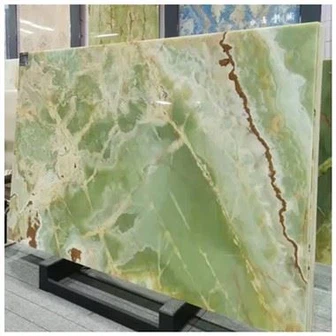
The bands are growth layers deposited by mineral-rich water, each recording different chemistry: iron oxides give honey and amber, chlorite compounds give green, organic matter darkens brown bands. The translucent laminae are elongated calcite crystals in optical continuity, while impurities pack into the opaque bands between them; light travels along the clean layers, so translucency is banded and directional rather than uniform.
Colors and quarries in the countertop trade
Commercial colors run from near-white through cream, honey, amber, green, and brown. Onyx is quarried in Iran, Pakistan, Afghanistan, Turkey, Mexico, Algeria, Italy, and the US Southwest, and block character varies: Pakistani deposits have supplied large architectural blocks for decades, while other districts limit slab width. I ask which quarry feeds the block group, because tone and maximum slab size change with it.

The Physical Limits That Should Shape Your Specification
The honest data sheet reads as a list of constraints. Onyx is translucent in thin sections and polishes to a high gloss, but those strengths come bundled with softness, acid sensitivity, and fragility in thin panels. Table 1 lists the values I plan around and their basis.
| Property | Typical range | What it means on a countertop | Basis |
|---|---|---|---|
| Mohs hardness | About 3 (calcite) | Ceramic bases and gritty dust scratch it | Mohs scale; onyx marble catalogues |
| Mineral composition | Calcite (CaCO3), locally aragonite | Acid spills etch the face; the fizz test separates it from silica onyx | CEN EN 12670 terminology |
| Bulk density | About 2.5 to 2.7 g/cm3 | Feeds support and transport load planning | ASTM C97 per lot; calcite specific gravity |
| Water absorption | Deposit-dependent, often above granite | Staining risk is real; sealer cycles follow the test result | ASTM C97 per block group |
| Slab thickness for backlighting | About 10 to 20 mm; brighter below 15 mm | Thick stock turns dark; thin stock needs rigid backing | Backlit stone fabrication guidance |
| Reinforcement | Resin common; mesh or laminated carrier below 15 mm | Thin panels crack without backing; keep mesh while cutting | Onyx slab fabrication practice |
Mohs 3 changes your scratch expectations
A fingernail sits near 2.5 on the Mohs scale, which is why onyx resists a fingernail but yields to a knife and to anything carrying silica grit. Sand, ceramic mugs, and stoneware dragged across the face leave a scratch each time; granite and quartzite sit at 6 to 7 for comparison. The surprise is usually the scratch map built in a season, so plan an onyx marble countertop knowing the gloss needs professional renewal, not weekly wiping.
Acids etch calcite faster than most owners expect
Lemon juice, vinegar, wine, and soda dissolve the polished calcite face on contact, leaving a dull frosted patch that wiping cannot remove. Removing an etch means re-polishing the area, and a busy kitchen counter can need that several times a year. A sealer slows liquid penetration; it does not stop the surface reaction.
Block size and thin panels set the geometry limits
Onyx supply rarely offers the giant slab sizes common in granite, so large counters carry more seams, and bookmatching keeps the pattern continuous. Thin backlit panels are the other fragility point: below about 15 mm the stone flexes and can crack in transport or cutting unless resin-treated and backed. Both limits are normal, and both belong on the shop drawing before fabrication.
Where an Onyx Marble Countertop Earns Its Place - and Where the Surface Does Not
The placement decision is a maintenance forecast, not a style vote. An onyx marble countertop works when the room can live with its habits: occasional scratches, etching where acids land, and sealing on a schedule.
Four questions that decide whether onyx fits the counter
What touches the surface daily: cut fruit, open bottles, and cleaning sprays all bring acids or abrasives. Who uses it: a staffed hotel bar behaves differently from a family kitchen with children. How visible flaws are: a large polished plane shows every etch, while a busy pattern hides more. Who maintains it: an owner who skips resealing. Two weak answers mean the counter is the wrong job and the wall may be the better one.
Low-acid, low-wear zones are the dependable fit
Feature walls, backlit bar fronts, and powder-room vanities carry the risks well because traffic is light and controlled. In vanity sizes an onyx marble countertop is easier to control: fewer seams, simpler edges, and a use profile that matches the stone. KA UNITED supplies this category as a finished range, from vanilla onyx vanity tops to white onyx vanity tops, with slab thickness, edge, and drain position settled in the factory.
Busy kitchens are workable only with rules
If a client insists on an onyx marble countertop in a working kitchen, the standard I give is: no food prep on the stone, cutting boards and trivets in use, and an immediate-wipe rule for anything acidic. A honed finish hides etch marks better than a mirror polish; if the kitchen proceeds, specify honed. Write the expectations down before installation; a client not told about etching will blame the supplier afterward. This is where you do not cheap out on the handover conversation.
Backlit Installations: What the Stone, the Light Box, and the Joinery Must Agree On
A backlit onyx wall is the application this material exists for, and it is an engineered assembly, not a slab stuck over bulbs. A lit bar top follows the same rules whether the stone stands or lies.

Onyx slab thickness decides brightness before the LEDs do
Translucency is thickness-limited. Backlit panels commonly run 10 to 20 mm, with 12 to 15 mm the usual balance of glow and strength; 18 to 20 mm reads dimmer, and below about 12 mm a panel cannot support itself without lamination to glass or acrylic. My rule is to confirm panel thickness on the actual translucent onyx slab, because a small swing shows as a brightness step once the light is on.
The light box: uniform panels, a set gap, and dimming
Point-source LED strips project their pattern through the stone, so the panel must be uniform or sit behind a diffuser. Keep a consistent air gap between the light face and the stone back, commonly 40 to 60 mm; too little creates hotspots at thin veins, too much wastes brightness. Warm white near 2700 to 3000 K suits honey and amber; 3500 to 4000 K suits white and green; add a dimmer, because full output often bleaches the veining. I insist the mock-up uses the real slab and panel at the working dim level before joinery is built, because on a large backlit onyx wall the eye compares every vein against its neighbor.
Resin, mesh, and backing are part of the product, not a repair
Most onyx slabs arrive resin-impregnated, many with a fiberglass mesh on the back, because the stone is naturally fissured and would crack in transport without it. The backing stays intact through cutting and polishing, and thin backlit panels are usually laminated to glass or aluminum honeycomb before they reach site. Never strip the reinforcement to fit a shallow cavity; deepen the cavity instead. Our factory processing makes that reinforcement decision, as the workshop shot below shows.

Cabinet and cavity planning comes before the mock-up
A backlit wall or bar front needs a recessed cavity roughly 50 to 70 mm deep once panel, gap, and stone are added, plus a service opening for the driver and dimmer. That dimension belongs in the cabinet drawing from the start: a backsplash planned at 20 mm cannot host a backlit assembly. A lit bar top carries the same math, and if the face runs around a corner the cavity continues, so we plan the return before the sheet is cut.
Planning Onyx with Cabinetry, Finishes, and Lighting Together
KA UNITED sells stone and cabinets as one package, so I look at onyx rooms as assemblies: surface, cabinet, and light have to be specified together or the room fails.
Daylight reading vs night glow: design the stone twice
In daylight, honey and amber onyx reads as warm translucent depth; backlit at night it becomes a glowing panel that changes the color of everything beside it. White onyx stays neutral by day and softly luminous at night. The same surface is a different object in those two readings, so choose the variety after deciding which hours matter.
Cabinet colors that let the stone lead
Warm onyx suits deep walnut, charcoal, and matte black cabinetry; white onyx tolerates light oak and pale painted cabinets. Because backlight spills onto adjacent fronts, a high-gloss white door next to an amber panel picks up the glow and shifts color, so we favor matte finishes and dark cavity interiors near lit stone. Tone is matched between counter and basin, which is why units like green onyx wall-mounted sinks and white onyx integrated washbasins come from the same block family for a vanity order.
Edges, seams, and joints under light
Under backlighting every seam and thickness change is visible, so joints sit over structural members and are tested in the mock-up before panels are cut. Thin panels also need a pencil or eased edge that does not expose an opaque core, and mitered bar-front returns concentrate stress where thin stone is weakest. Put the seam map on the shop drawing, not the field.
Cleaning, Sealing, and the Honest Maintenance Boundary
Onyx maintenance is stricter than most owners expect, and the line between routine care and restoration should be clear before the stone is installed.
Neutral-pH cleaning only; acids are the real risk
Daily cleaning is a soft cloth and a pH-neutral stone cleaner. Vinegar sprays, lemon wipes, descalers, bleach, and ammonia all stay off this surface, and the same rule covers bar counters with spirit and citrus spills. Wiping acid spills promptly limits the damage, but the etch happens at contact, so neutral-pH-only is the first rule of onyx countertop care.
What a sealer does and does not do
A penetrating sealer slows how fast liquids soak in, protecting pale varieties from staining and buying time to wipe. It does not harden the surface, stop acid etching, or end the reseal cycle; onyx countertop care guidance commonly calls for reapplication every six to twelve months, and we log the sealer name, application date, and next due date in the handover file.
Restoration, aging, and when to choose another surface
Light etching and scratches on an onyx marble countertop can be re-polished by a stone professional, as often as the surface earns damage. Some colored varieties, and the resins used on them, can shift tone after years of strong sun; keep the room's exposure in mind. If maintenance means professional polishing more than once a year, my honest recommendation is a different surface for that counter and onyx for the wall.
Frequently Asked Questions About the Onyx Marble Countertop
1. Can an onyx marble countertop survive a working kitchen?
It survives, but not as a bare prep surface. Acidic foods etch the polish and grit scratches the calcite face, so the rules are cutting boards, trivets, immediate wiping of acidic spills, and a honed finish. Most projects place onyx where traffic is light.
2. What thickness should a translucent onyx slab be for backlighting?
Backlit panels commonly run 10 to 20 mm, with 12 to 15 mm the usual balance of glow and strength. Below about 12 mm the panel needs lamination to glass or acrylic; 18 to 20 mm stock glows dimmer. Confirm the onyx slab thickness on the actual material before ordering.
3. Why does my onyx marble countertop show dull spots after cleaning?
Dull frosted patches are acid etch marks from a cleaner, lemon, vinegar, wine, or soda that touched the polished surface. Wiping will not remove them; a stone professional re-polishes the area to restore gloss. Switch to a pH-neutral cleaner and wipe acidic spills immediately.
4. What should I do when a delivered onyx slab does not match the approved sample?
Photograph the slabs, their markings, and the approved sample side by side, pause fabrication in that area, and send the images with your order records to the supplier. Matching tone against the acceptance file decides whether the batch proceeds or is replaced.
5. Can an onyx marble countertop be used around a sink or other wet areas?
Yes, with the same care any calcite stone needs around water. Wipe standing water after use, keep acidic cleaners away from the surface, and use a mild neutral pH cleaner. A sink area raises the chance of drips and daily handling, so an onyx countertop around a basin works best when the project accepts a maintenance routine rather than expecting the stone to stay untouched.
Final Conclusion
An onyx marble countertop is a surface you choose with your eyes and keep with your habits. The stone glows in thin slabs yet scratches near Mohs 3, etches wherever acids land, and needs a planned cavity and backing when backlit. Match it to low-acid, low-wear spots and set the finish by how the room is used. At KA UNITED the stone and cabinet package are specified together, so the surface and everything behind it arrive as one working assembly.
References
- Natural Stone – Terminology (EN 12670:2001), European Committee for Standardization.
- Standard Test Methods for Absorption and Bulk Specific Gravity of Dimension Stone (ASTM C97), ASTM International.
- Standard Terminology Relating to Dimension Stone (ASTM C119), ASTM International.
- Dimension Stone Design Manual, Natural Stone Institute.
- Natural Stone Care and Maintenance Guide, Natural Stone Institute.
- A Petrographic Catalogue of Onyx Marbles and Alabasters, University of Turin (Marengo et al.).
- Kitchen and Bath Planning Guidelines, National Kitchen and Bath Association.
- Alabaster, Wikipedia.