


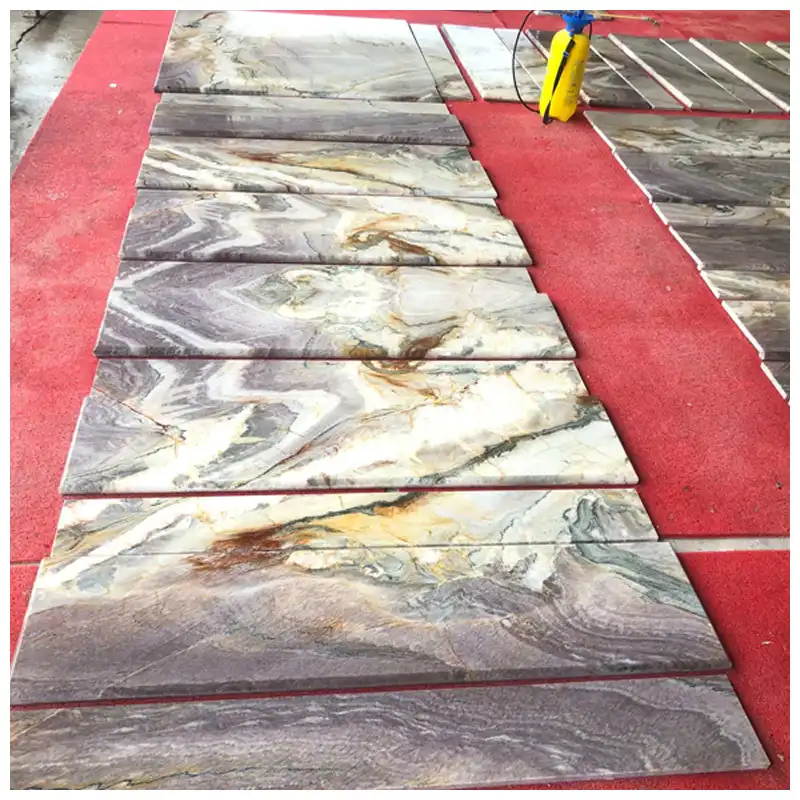


Aquarella Quartzite Tiles
Premium Aquarella quartzite tiles with dreamy watercolor-style flowing veining in purple, grey, gold and green tones. High-gloss polished finish, high-density quartzite delivers superior scratch and wear resistance for stair tread and floor applications. Factory full dry-lay service ensures continuous veining flow across stairs and flooring. Ideal for luxury villa staircases, whole-house flooring and feature walls.
Quartzite Item:Factory Supply Watercolor Vein Aquarella Quartzite Floor Tiles for High-End Villa Interior Projects
Quartzite Stone: Aquarella Quartzite, Aquarella Macaubas Quartzite
Slab Size: 2900x1600, 2400x1200, etc.
Sizes:12''x12'',24''x24'',18''x18'',24''x12''
Thickness: 20,30mm
Surface: Polished, Honed, and brushed
MOQ: 300 SQM
Quartzite Slabs And Countertop Factory: KA UNITED
Application: 60+ luxury exotic Quartzite Stones in KA UNITED Factory For Private Home, hotels, villas, apartments, and other commercial estate properties
Product Introduction
Quick Summary: Aquarella Quartzite Tiles are fabricated natural quartzite pieces characterized by lavender-grey mineral layers, creamy white areas, muted green veins and golden-brown accents. Supplied in polished rectangular and square formats with nominal thicknesses of 20 mm and 30 mm, they are suitable for luxury residential flooring, staircase components, hotel interiors and decorative wall cladding. Custom cutting allows stair treads, risers, landings and adjoining floor tiles to be specified within a coordinated stone package, while factory dry-lay arrangements help buyers assess pattern transitions before shipment. Surface finish, structural support and slip resistance must be matched to the intended installation.
Aquarella Quartzite Tiles for Luxury Villa Flooring, Architectural Staircases and Feature Walls
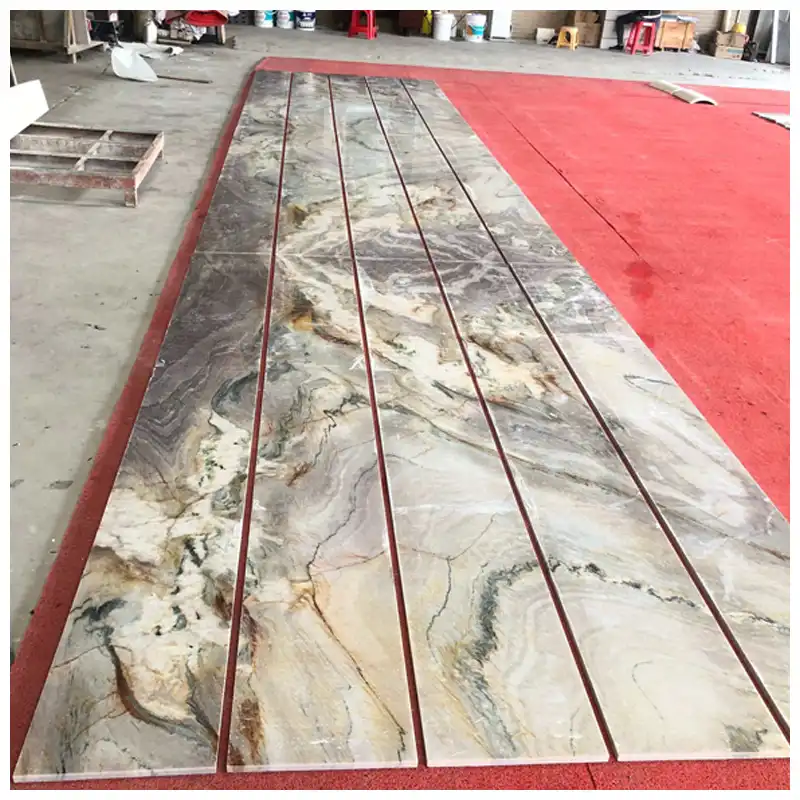
Aquarella quartzite brings a broad range of colors into a single natural stone surface. Its shifting grey, cream, green and golden-brown markings make it particularly useful in architectural spaces where the floor or staircase forms a substantial part of the interior composition.
Unlike raw slabs purchased for subsequent processing, these tiles are prepared in defined dimensions or fabricated around project cutting schedules. Buyers can specify rectangular floor modules, square tiles, individual stair components and matching wall pieces without treating every architectural surface as a separate material purchase.
In a multi-storey villa, Aquarella quartzite can connect an entrance hall with adjoining living areas, intermediate landings and the main staircase. In hospitality and commercial interiors, the stone is more likely to be concentrated in reception floors, prominent circulation zones, decorative walls or selected architectural features.
The scale of each application matters. Large floor fields reveal gradual changes in the stone's mineral pattern, whereas stair components and narrow wall panels expose individual bands of color. Appropriate cutting dimensions preserve these characteristics rather than reducing the material to unrelated decorative fragments.
Whole-House Flooring
Coordinated rectangular and square tile layouts for entrance halls, living rooms, corridors and adjoining residential spaces.
Architectural Staircases
Individually fabricated treads, risers and landing pieces that follow the dimensions of the staircase structure.
Decorative Wall Cladding
Selected stone panels for entrance walls, reception backgrounds, private lounges and prominent interior elevations.
Commercial Interiors
Architectural stone finishes for hotels, offices, bars and retail interiors, subject to traffic and installation requirements.
The Watercolor Mineral Pattern of Aquarella Macaubas Quartzite
Aquarella Macaubas is a Brazilian natural quartzite recognized for its complex mineral movement rather than a single dominant color. Broad lavender-grey and smoky purple areas are interrupted by lighter cream sections, fine dark lines and irregular green-grey formations. Golden-brown markings introduce warmer tones where these mineral zones meet.
The supplied stone photographs illustrate this variation particularly well. Some pieces contain relatively quiet grey layers, while adjacent pieces reveal much larger cream-colored areas surrounded by green and brown markings. The transitions are irregular, following the original mineral structure of the stone rather than a manufactured repeat pattern.
Polishing brings these differences into clearer focus. The lighter mineral areas reflect more ambient light, while darker purple-grey sections give the surface visual depth. Under warm interior lighting, brown and golden markings may become more pronounced; cooler lighting can emphasize the grey and green portions of the same piece.
For architects specifying Aquarella Macaubas Quartzite Tiles, the most useful approval sample is an image of the intended production material or an arranged group of finished tiles. A small hand sample may show only one color zone and cannot represent the full range of a large flooring or staircase installation.
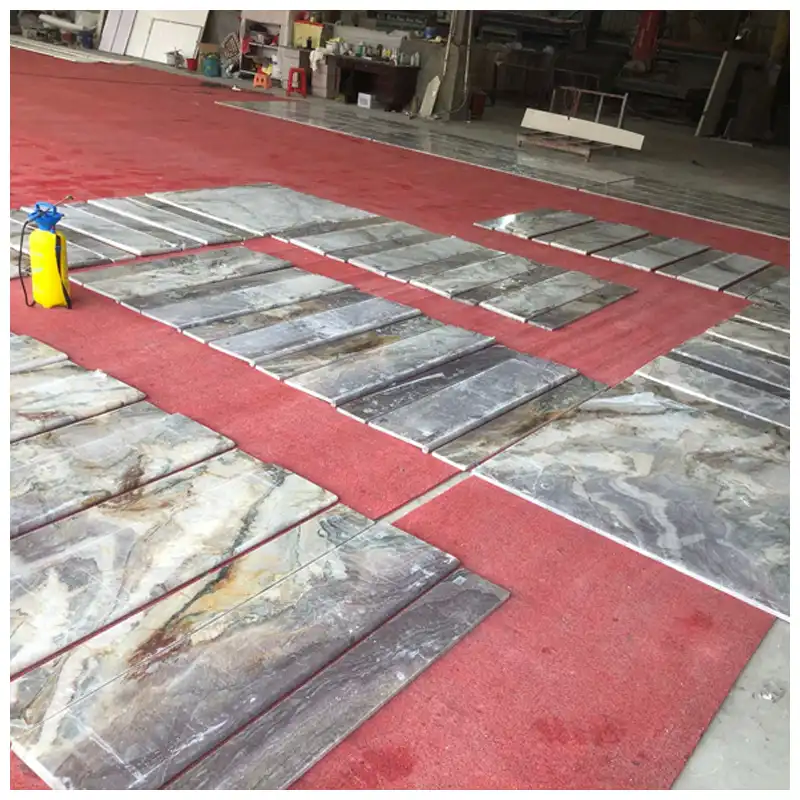
Aquarella Quartzite Tile Sizes, Thicknesses and Custom Fabrication Options
The standard tile selection includes both square and rectangular formats. These dimensions serve different architectural purposes, from regular floor grids to elongated stone elements used in corridors, wall elevations and individually designed staircases.
| Specification | Product Details |
|---|---|
| Product Name | Aquarella Quartzite Tiles |
| Alternative Material Name | Aquarella Macaubas Quartzite |
| Material Classification | Natural Quartzite |
| Origin Reference | Brazil; specific production block subject to confirmation |
| Natural Color Range | Lavender Grey, Cream White, Smoky Purple, Muted Green and Golden Brown |
| Rectangular Tile Sizes | 600 × 900 mm / 1200 × 300 mm |
| Square Tile Sizes | 600 × 600 mm / 300 × 300 mm |
| Nominal Thickness | 20 mm / 30 mm |
| Standard Surface Finish | Polished |
| Alternative Finishes | Honed or selected textured surfaces subject to processing and sample approval |
| Stair Components | Custom Treads, Risers, Landing Pieces and Coordinated Edge Details |
| Custom Architectural Pieces | Cut-to-Size Floor Panels, Wall Panels, Borders and Skirting |
| Edge Processing | Straight, Eased, Polished or Custom Profiles According to Approved Drawings |
| Layout Options | Directional Cutting, Sequential Layout, Selected Vein Matching and Bookmatch by Review |
| Dimensional Tolerance | According to Approved Fabrication Drawings and Agreed Inspection Criteria |
Choosing the Appropriate Tile Format
600 × 900 mm
A rectangular format that retains relatively broad areas of mineral movement. Useful for spacious floor fields and wall elevations where individual stone patterns should remain visible.
1200 × 300 mm
An elongated format for directional architectural layouts, narrow panels and selected stair components. Finished tread suitability depends on actual staircase dimensions.
600 × 600 mm
A regular square module for grid-based flooring plans, residential rooms and coordinated floor layouts with straightforward joint alignment.
300 × 300 mm
A compact module for smaller floor areas, selected decorative arrangements and spaces where larger pieces would require extensive perimeter cutting.
Custom Aquarella Quartzite Stair Treads, Risers and Landing Pieces
A natural stone staircase is assembled from components with different dimensions and exposed surfaces. The tread forms the horizontal walking surface, the riser covers the vertical face between steps, and the landing connects individual flights or adjoining floors. Each component must be cut for its actual position.
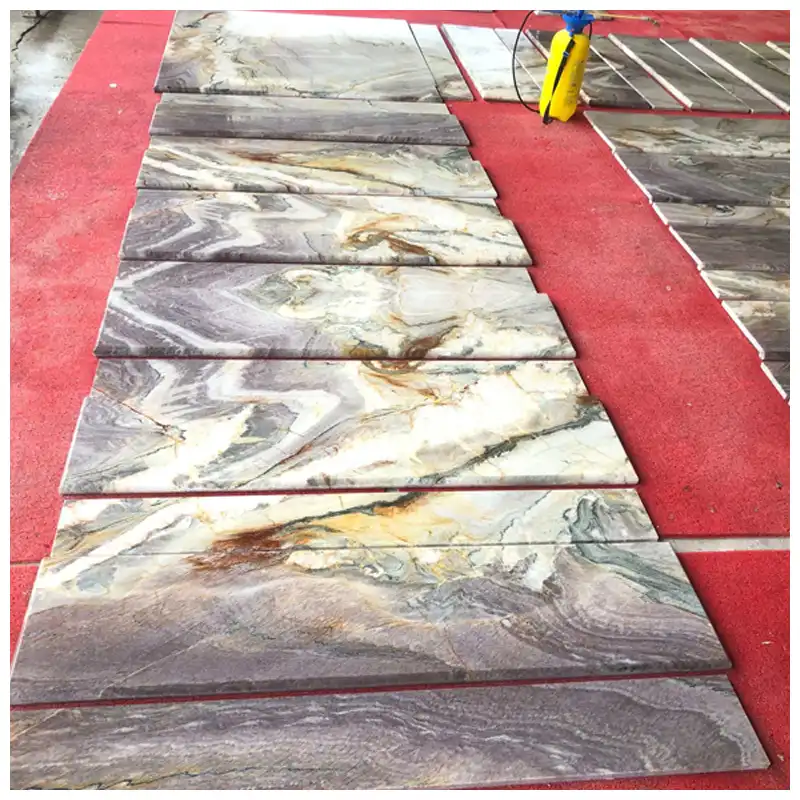
Full-Width Treads and Coordinated Vertical Faces
Aquarella Quartzite Stair Tiles can be fabricated as individual tread and riser pieces rather than assembled from several unrelated floor tiles. A full-width tread, where material dimensions permit, reduces the number of joints across the visible walking surface.
The direction of the stone pattern can follow the width of the staircase or develop along the direction of ascent. These arrangements produce different visual effects when viewed from the entrance hall or from the upper landing.
Risers require separate consideration because their exposed height is much smaller than the tread depth. Cutting all risers from a narrow band of similar mineral color may create a more deliberate rhythm than distributing strongly contrasting pieces throughout the staircase.
Corner stairs, winders and intermediate platforms should be included in the same cutting schedule, particularly when the stone pattern is expected to connect visually with adjoining floor surfaces.
Stair Nosing, Visible Thickness and Edge Fabrication
The exposed front edge is one of the most important details in a fabricated quartzite staircase. It receives regular foot contact and remains visible from the lower level, making both edge geometry and material condition important.
Aquarella Quartzite Steps Tiles can be reviewed with eased edges, polished front faces or other agreed nosing profiles. If the design requires a thicker-looking front fascia, the fabrication drawing must distinguish the actual stone section from any bonded or built-up edge construction.
The appropriate nosing projection depends on the supporting staircase, local dimensional requirements and selected edge profile. A projecting stone edge should not be treated as an unsupported decorative extension without considering its structural condition.
| Stair Component | Fabrication Consideration |
|---|---|
| Tread | Finished width, going depth, front projection, exposed edge and support condition |
| Riser | Finished height, visible face, thickness and connection to adjacent horizontal surfaces |
| Landing | Panel division, floor level, joint position and orientation of adjoining stone pieces |
| Winder Steps | Individual angular templates, finished dimensions and orientation within the staircase turn |
| Stair Nosing | Edge profile, projection, visible finish and applicable slip-resistance requirements |
| Skirting and Side Returns | Wall interface, finished height, corner treatment and relationship to the stair profile |
Aquarella Quartzite Floor Tiles for Continuous Residential and Commercial Interiors
The principal advantage of using Aquarella across several connected rooms is the ability to carry a recognizable natural stone palette through different architectural spaces. Individual tiles do not have to look identical for the overall floor to feel coherent.
For Aquarella Quartzite Floor Tiles, the placement of larger cream-colored sections and darker lavender-grey pieces influences the distribution of visual weight across a room. A bright group near a window can reinforce the natural light, while darker bands may establish a transition into a corridor or staircase.
Open-plan residences benefit from a floor grid established around architectural centerlines, major doorways and fixed interior elements. Starting the tile arrangement independently in every room can create narrow cuts at thresholds or interrupt the direction of the natural stone pattern.
Entrance Halls and Foyers
Larger uninterrupted pattern areas can establish a strong arrival surface, with panel divisions coordinated around entrance doors and principal sightlines.
Living and Dining Rooms
Square or rectangular modules can follow the room proportions, leaving the natural mineral pattern visible between furniture groupings.
Hotels and Commercial Spaces
Flooring selection must consider pedestrian traffic, entrance moisture, cleaning procedures, replacement access and verified surface performance.
Where a project uses the same stone on floors and stairs, the floor plan and staircase elevation should be coordinated before the fabrication schedule is finalized. This avoids allocating visually important slab areas to small perimeter cuts that will later be concealed by walls or furniture.
Aquarella Quartzite Wall Tiles and Directional Architectural Cladding
The visual character of Aquarella changes when the stone is installed vertically. On a wall, the viewer sees the mineral layers directly rather than at the shallow viewing angle typical of a polished floor.
Long horizontal panels can emphasize the layered appearance of the grey mineral zones. Vertical arrangements create a different composition, allowing cream-colored formations and darker veins to travel upward through the elevation.
Aquarella Quartzite Wall Tiles can be specified for entrance feature walls, hotel reception backgrounds, bar interiors, private lounges and selected bathroom elevations. Where a prominent wall incorporates large rectangular pieces, the panel grid should respond to the positions of doors, electrical outlets, lighting details and adjacent finishes.
Sequential Veining and Bookmatched Stone Panels
A sequential layout attempts to retain a progressive relationship between adjacent stone pieces. Bookmatching instead uses suitable paired surfaces to create a mirrored composition around a selected joint.
Not every Aquarella slab can produce an effective mirrored pattern. The result depends on consecutive slab availability, the orientation of the finished faces, usable stone dimensions and the location of the selected mineral formations. Tile-sized pieces may also produce a fragmented appearance if too many mirrored joints are introduced.
For wall cladding, the weight and size of the stone determine the appropriate fixing arrangement. Mechanical restraint, adhesive compatibility, substrate suitability and movement accommodation must be reviewed for the proposed system, particularly in high-level or exterior installations.
Aquarella Quartzite Technical Properties and Material Performance Reference
Natural quartzite is generally selected for its quartz-rich mineral structure and resistance to ordinary surface scratching. However, hardness alone does not determine the suitability of a finished tile for a particular floor, staircase or wall installation.
The following figures are indicative published material references associated with Aquarella quartzite. They are not certified laboratory results for the current KA UNITED production batch. Natural mineral composition, stone condition, specimen orientation and testing procedures can influence the actual measured properties.
| Physical Property | Indicative Reference | Engineering Relevance |
|---|---|---|
| Mohs Hardness | 6–7 | Indicative resistance to mineral scratching; individual mineral zones may behave differently. |
| Bulk Density | 2,650–2,750 kg/m³ | Relevant to tile handling, staircase loading and vertical cladding support. |
| Water Absorption | 0.10–0.50% | Supports evaluation of moisture uptake and suitable surface protection. |
| Compressive Strength | 130–220 MPa | General material resistance to compression; not a finished staircase load rating. |
| Flexural Strength | 14–16 MPa | Relevant to bending, panel support, projecting edges and vulnerable stone sections. |
| Abrasion Resistance | Project Test Required | Required when evaluating wear under repeated pedestrian traffic. |
| Slip Resistance | Finish-Specific Testing Required | Essential for staircases, wet areas, entrances and public circulation routes. |
Estimated Stone Weight at 20 mm and 30 mm Thickness
Using the indicative density range above, the approximate weight of the stone itself is shown below. These figures are useful for preliminary material handling and installation planning.
| Tile Format | 20 mm Approximate Weight | 30 mm Approximate Weight |
|---|---|---|
| Per Square Meter | 53–55 kg | 79.5–82.5 kg |
| 600 × 900 mm | 28.6–29.7 kg/piece | 42.9–44.6 kg/piece |
| 1200 × 300 mm | 19.1–19.8 kg/piece | 28.6–29.7 kg/piece |
| 600 × 600 mm | 19.1–19.8 kg/piece | 28.6–29.7 kg/piece |
| 300 × 300 mm | 4.8–5.0 kg/piece | 7.2–7.4 kg/piece |
Estimated weights exclude backing materials, adhesives, additional edge construction and packaging. Final structural calculations and shipment weights must use the actual finished components.
20 mm or 30 mm Aquarella Quartzite: Selecting Thickness for the Actual Installation
The choice between 20 mm and 30 mm quartzite is not simply a choice between a thinner and a stronger product. Thickness changes the finished floor buildup, component weight, edge appearance, available fabrication depth and relationship to adjoining construction.
20 mm Quartzite Tiles
A practical starting thickness for many fully supported interior floor and wall applications where the total installation depth and stone weight require control.
- Lower stone weight compared with 30 mm pieces of the same size.
- Reduced stone thickness within renovation floor buildup.
- Suitable for reviewing regular tile grids and supported cladding arrangements.
- Stair edges and other projecting details require separate fabrication assessment.
30 mm Quartzite Tiles and Stair Pieces
A thicker stone section may be preferred where a substantial exposed edge or additional machining depth forms part of the architectural design.
- Greater visible edge depth for selected stair tread profiles.
- Additional material for certain shaped edge details.
- Higher handling weight and permanent structural loading.
- Requires coordination with riser heights, floor levels and supporting construction.
Neither thickness should be interpreted as permission to install a stone tread across an unsupported span. The actual stone condition, support geometry, loading, edge details and required engineering verification determine whether a particular installation is acceptable.
Polished Aquarella Quartzite in Dry Interiors, Wet Areas and Exterior Applications
The polished finish is central to the appearance of the supplied Aquarella tiles. It reveals the contrast between lavender-grey layers and pale crystalline areas with a degree of reflection that is difficult to reproduce on heavily textured stone.
That same smoothness requires careful consideration in areas exposed to water. A quartzite tile can have relatively low water absorption without providing adequate resistance to slipping when its surface is wet. These are separate material and surface-performance characteristics.
| Installation Area | Finish and Application Review |
|---|---|
| Dry Residential Floors | Polished surfaces can retain strong natural color definition. Evaluate cleaning conditions, pedestrian use and applicable slip requirements. |
| Interior Staircases | Review walking-surface traction, nosing treatment, lighting, step visibility and stair safety requirements. |
| Bathrooms and Wet Areas | Distinguish decorative walls and dry vanity areas from shower floors or regularly wet walking surfaces. Confirm appropriate finish testing and waterproofing. |
| Hotels and Shopping Centers | Specify surface abrasion and slip performance according to actual traffic, entrance moisture and maintenance procedures. |
| Exterior Flooring | Review textured finish options, drainage, thermal exposure, weathering and freeze-thaw resistance where relevant. Polished material should not be assumed suitable by default. |
| Exterior Wall Cladding | Requires project-specific assessment of anchoring, stone soundness, wind loads, weather exposure and supporting construction. |
A honed or textured finish may be considered when lower reflection or different surface traction is required. Finish samples should be approved on the actual Aquarella material, since modifying the surface can change both its apparent color and the visibility of mineral markings.
Factory Dry-Lay Arrangement for Aquarella Quartzite Cut-to-Size Tiles

Dry-lay preparation is especially relevant to Aquarella because its color can change considerably within a single slab. Pieces cut from the same stone may contain very different proportions of cream, lavender-grey, green and brown.
The supplied workshop photographs show elongated stone components arranged beside one another and additional rectangular pieces positioned on a protected factory surface. These arrangements make the relationship between neighboring pieces visible before installation.
For Aquarella Quartzite Cut-to-Size Tiles, pre-arrangement can be organized around a specific floor zone, staircase flight or architectural elevation. The intention is to preserve a coherent visual sequence while accommodating the actual dimensions of every fabricated component.
Dry-lay does not mean that natural mineral lines will meet perfectly across every joint. Its value lies in identifying avoidable pattern interruptions and unsuitable color transitions while there is still an opportunity to adjust the allocation of finished pieces.
How a Coordinated Quartzite Layout Is Prepared
01. Allocate Material to the Architectural Drawing
Review the available slab patterns against the most visible floor panels, long stair treads and major wall sections. Reserve continuous mineral formations for components that need them most.
02. Establish Cutting Orientation
Determine which direction each component should follow before cutting. A rectangular piece rotated through 90 degrees may interrupt the geological layers even when its color is otherwise compatible.
03. Arrange the Fabricated Components
Position related pieces according to the cutting schedule or selected visual sequence. Inspect transitions between light and dark mineral zones and identify changes required for the agreed appearance.
04. Approve Pattern Distribution
Record the agreed arrangement with identifiable photographs. Review it from the intended viewing direction rather than assessing isolated tiles without their surrounding context.
05. Assign Installation Identification
Link each relevant piece to its position in the floor, staircase or wall layout so the approved arrangement can be referenced during installation.
Installation Interfaces and Long-Term Care of Natural Aquarella Quartzite
Fabricated stone tiles must accommodate the conditions of the supporting construction. A correctly cut piece can still develop problems if the substrate is uneven, the fixing system leaves unsuitable voids or adjacent construction restricts necessary movement.
Substrate Preparation and Stone Support
Before laying large rectangular tiles, installers should review substrate flatness, stability, moisture condition and the compatibility of the selected bedding or adhesive system with natural quartzite. Surface leveling should be addressed through the specified installation system rather than forcing individual stone pieces into position.
Stair treads require support appropriate to the completed geometry. Particular attention is needed around front nosings, side projections and changes in the underlying stair structure. The stone must not bear unexpectedly on isolated high points.
Joint Width and Architectural Movement
A coordinated vein pattern does not remove the need for installation joints. Joint width should follow the approved tile tolerances, installation specification and anticipated movement of the supporting structure.
Existing structural movement joints must be accommodated rather than concealed beneath uninterrupted stonework. At transitions between rooms, stair landings and wall interfaces, the joint treatment should allow the complete construction system to perform as intended.
Cleaning and Preserving the Polished Surface
The maintenance routine for Aquarella should focus on removing abrasive grit and preventing prolonged contact with unsuitable cleaning substances. Entrance mats, soft dust mops and natural-stone-compatible neutral cleaners can help maintain the polished appearance.
Where an impregnating sealer is appropriate, its compatibility should be checked on an inconspicuous sample. Sealing requirements depend on the actual absorption characteristics, surface finish and exposure conditions of the selected stone.
Avoid assuming that the commercial quartzite classification guarantees identical chemical resistance throughout every mineral vein. Aggressive descaling chemicals, abrasive pads and untested surface treatments can affect natural mineral areas, filled sections or the quality of the polished finish.
Finished Tile Inspection and Export Packing for Aquarella Quartzite Orders
For mixed-format architectural orders, inspection must cover more than the general appearance of the stone. Standard flooring tiles, custom staircase components and shaped wall panels have different dimensional and handling requirements.
| Inspection Stage | Product-Specific Review |
|---|---|
| Finished Dimensions | Check length, width, thickness, diagonals and relevant angular dimensions against the approved cutting schedule. |
| Surface Condition | Examine polish consistency, machining marks, visible surface damage and agreed natural stone acceptance criteria. |
| Exposed Edges | Inspect stair nosings, finished front faces, visible corners and custom profiles for dimensional and visual conformity. |
| Stone Soundness | Review fissures, repaired areas and vulnerable sections, particularly near projecting edges and narrow custom components. |
| Component Identification | Verify that piece numbers and packing references correspond to the approved drawings and arrangement records. |
| Crate Preparation | Check face separation, corner protection, restraint, handling instructions and suitability for the finished component dimensions. |
Long stair treads and narrow quartzite strips require packing arrangements appropriate to their geometry. Unsupported sections and exposed machined edges should be protected against concentrated loads and impact during lifting, transport and unloading.
Mixed-format orders can be grouped by floor level, staircase flight or installation zone. This makes it easier for the receiving contractor to locate the required components without repeatedly handling unrelated stone pieces.
Interior Design Reference: Aquarella Quartzite Across Villa Floors and Staircases
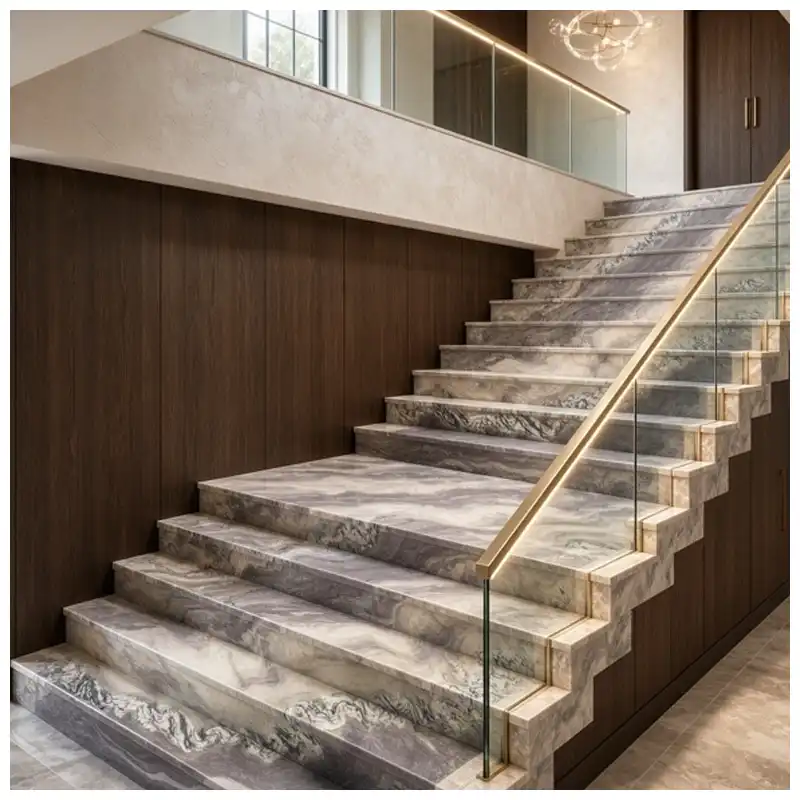
Aquarella works well in interiors where adjacent materials are visually quieter than the stone itself. Pale plaster walls, restrained architectural moldings and natural timber allow the changing mineral pattern to remain readable across larger surfaces.
Walnut, bronze-toned metal and warm neutral furnishings bring out the golden-brown markings. Cooler grey finishes and brushed metal fittings emphasize the lavender and green-grey portions of the stone.
A staircase using matching stone on horizontal and vertical faces can create a visually substantial architectural element. The final appearance depends on individual component proportions, lighting direction, joint placement and the approved material distribution. Design references illustrate these possibilities rather than guaranteeing an identical completed installation.
Aquarella Quartzite Tiles Compared with Four Related Natural Quartzite Tile Collections
The choice between exotic quartzite tiles often begins with color, but the scale of the mineral pattern and its behavior when divided into smaller architectural pieces can be equally important. Aquarella has a layered, multicolor identity that differs from quieter white-grey quartzites and stones with larger contrasting mineral formations.
| Quartzite Product | Visual Character | Architectural Direction | Primary Selection Consideration |
|---|---|---|---|
| Aquarella Quartzite Tiles | Lavender-grey layers, cream areas, muted green and golden-brown veins. | Multicolor flooring, staircases and coordinated cut-to-size interiors. | Directional cutting and distribution of contrasting mineral zones. |
| Calacatta Grey Quartzite Tiles | Grey and pale mineral tones with contrasting natural vein movement. | Neutral architectural floors and contemporary wall surfaces. | Balance between background color and the intensity of grey veining. |
| Cristallo Quartzite Tiles | Light crystalline appearance with varying natural mineral markings. | Bright decorative floors and distinctive interior wall installations. | Crystal distribution, visual clarity and consistency of the selected pieces. |
| Verde Patagonia Quartzite Tiles | Green-toned natural formations with contrasting mineral areas. | Expressive feature surfaces and selected luxury architectural installations. | Placement of large contrasting formations and suitability of the selected tile format. |
| Atlantic Quartzite Tiles | Natural quartzite with flowing mineral movement and batch-dependent color variation. | Coordinated stone flooring and architectural cladding. | Current material appearance, pattern orientation and available production formats. |
All five products require independent material and finish approval. Similar commercial classifications do not establish identical absorption, strength, abrasion resistance or installation suitability.
Recommended Natural Quartzite Tiles from KA UNITED
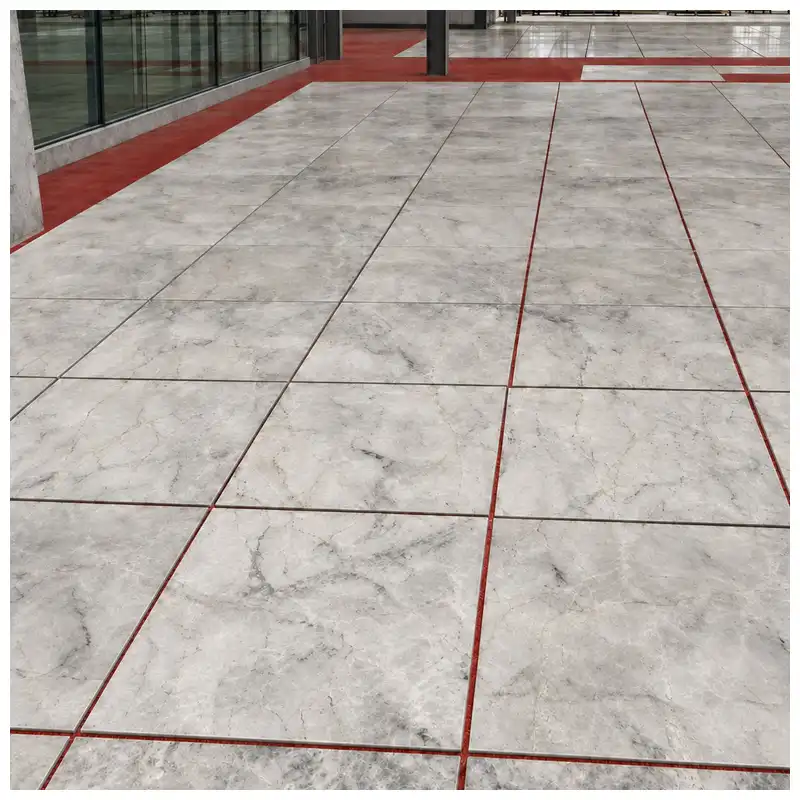
Calacatta Grey Quartzite Tiles
Natural grey quartzite tiles with contrasting mineral veins for contemporary residential flooring and coordinated architectural surfaces.
View Product
Cristallo Quartzite Tiles
Light crystalline quartzite tiles for visually bright architectural interiors, decorative floors and carefully selected wall layouts.
View Product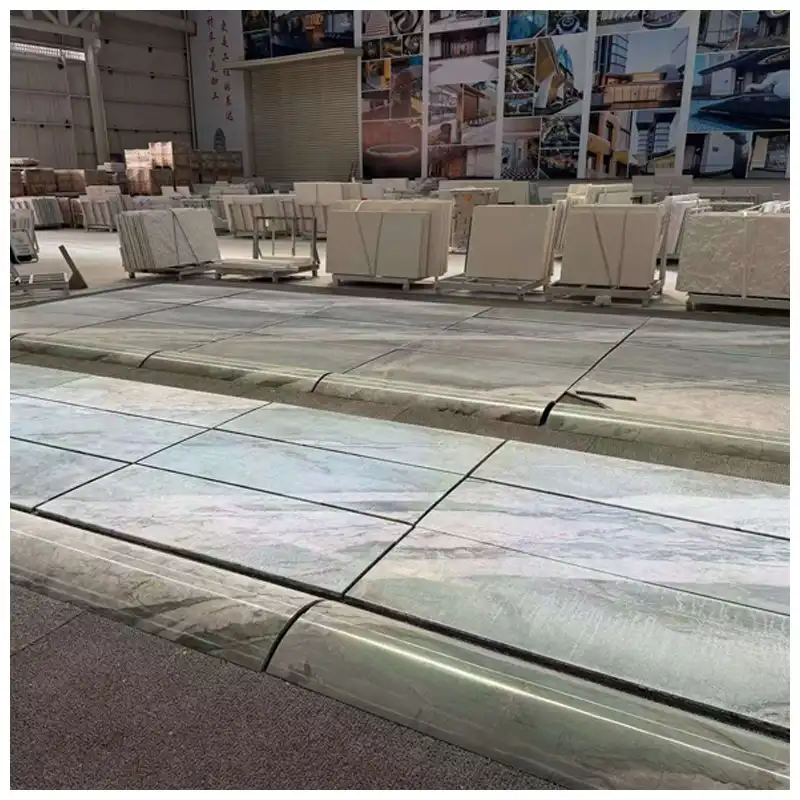
Verde Patagonia Quartzite Tiles
Green-toned quartzite with expressive mineral formations for feature surfaces and distinctive natural stone interiors.
View Product
Atlantic Quartzite Tiles
Natural quartzite tiles with flowing mineral patterns for coordinated flooring, decorative walls and custom architectural stonework.
View ProductFrequently Asked Questions About Aquarella Quartzite Tiles
1. What makes Aquarella Macaubas quartzite different from other natural quartzite tiles?
Aquarella Macaubas is distinguished by its combination of lavender-grey layers, creamy white mineral areas, muted green veins and golden-brown markings. Its broad color transitions create a more varied architectural pattern than relatively uniform quartzite collections. The appearance of each finished tile depends on its original position and cutting orientation within the slab.
2. Can Aquarella Quartzite Tiles be fabricated into full-width stair treads and matching risers?
Yes. Individual treads, risers and landing pieces can be fabricated according to approved staircase drawings, subject to available stone dimensions and material condition. The design must identify tread width, going depth, riser height, stone thickness, nosing profile and structural support requirements.
3. Can Aquarella quartzite floor tiles be matched continuously across different rooms?
A coordinated layout can be prepared using selected slabs, directional cutting and factory dry-lay arrangements. This helps establish visual continuity between adjoining rooms, corridors and stair landings. Exact mineral alignment across every joint cannot be guaranteed because natural stone patterns vary and material is removed during fabrication.
4. Is 20 mm or 30 mm Aquarella quartzite better for staircases and flooring?
The appropriate thickness depends on the supporting construction, finished floor level, exposed edge profile and component geometry. A 20 mm section may be suitable for many fully supported interior floors, while 30 mm can be considered for thicker exposed edges and selected stair details. Neither thickness independently establishes structural suitability.
5. Are polished Aquarella Quartzite Tiles suitable for bathrooms and exterior flooring?
Polished Aquarella quartzite can be considered for decorative bathroom walls and suitable dry interior areas. Wet walking surfaces and exterior flooring require additional assessment of slip resistance, drainage, weather exposure and installation conditions. A honed or textured finish may be more appropriate, subject to finish-specific testing.
6. What information is required to order custom Aquarella quartzite flooring and staircase components?
Provide the floor layout, tile dimensions, stone thickness, staircase plans and elevations, individual tread and riser dimensions, exposed edge profiles, intended surface finish and installation requirements. Any requested vein direction, bookmatch arrangement or factory dry-lay approval should be identified before the cutting schedule is finalized.
Finalize the Aquarella Quartzite Cutting Schedule Before Releasing Production
The most important procurement decision for a combined Aquarella floor and staircase package is how the available stone will be allocated across different component sizes. Long treads, prominent landing pieces and feature-wall panels generally require more selective use of the available mineral formations than ordinary perimeter tiles.
Before releasing the stone for cutting, establish a hierarchy of visible surfaces. Identify which panels must retain broad natural patterns, which areas can accept greater color variation and which components will require additional edge processing. This helps resolve competing material requirements within the same architectural package.
Replacement pieces should also be considered while the selected material remains available. Future stone batches may differ substantially in lavender intensity, cream-colored area and mineral direction, even when sold under the same Aquarella trade name.
Final Note: The architectural value of Aquarella Quartzite Tiles lies in the relationship between individual stone pieces. Approving the complete cutting schedule and material allocation together allows the flooring, staircase and wall components to retain their distinct natural patterns within a coherent finished installation.

Request Custom Aquarella Quartzite Tiles and Stair Components from KA UNITED
KA UNITED supplies natural Aquarella quartzite tiles and custom fabricated architectural stone components for residential developments, private villas, hospitality interiors and commercial construction projects.
Explore the available luxury natural stone collections or submit your Aquarella quartzite specification for material selection and fabrication review.
Project Information to Include in Your Inquiry
- Required standard tile formats or custom finished dimensions.
- Floor plans, staircase elevations and architectural cutting schedules.
- Stone thickness, surface finish and exposed edge profiles.
- Preferred mineral color range and requested vein orientation.
- Factory dry-lay requirements and project-specific acceptance criteria.
- Installation environment, project destination and delivery requirements.
Hot Tags: aquarella quartzite tiles, China aquarella quartzite tiles suppliers, factory, Azul Cielo Marble Slab, brittanicca luxury series quartz, Jacaranda Red Quartzite, Marbre Les Quatre Saisons, Palomino Stonewood Quartzite, White Macaubas Quartzite Slab
You Might Also Like


Send Inquiry
