


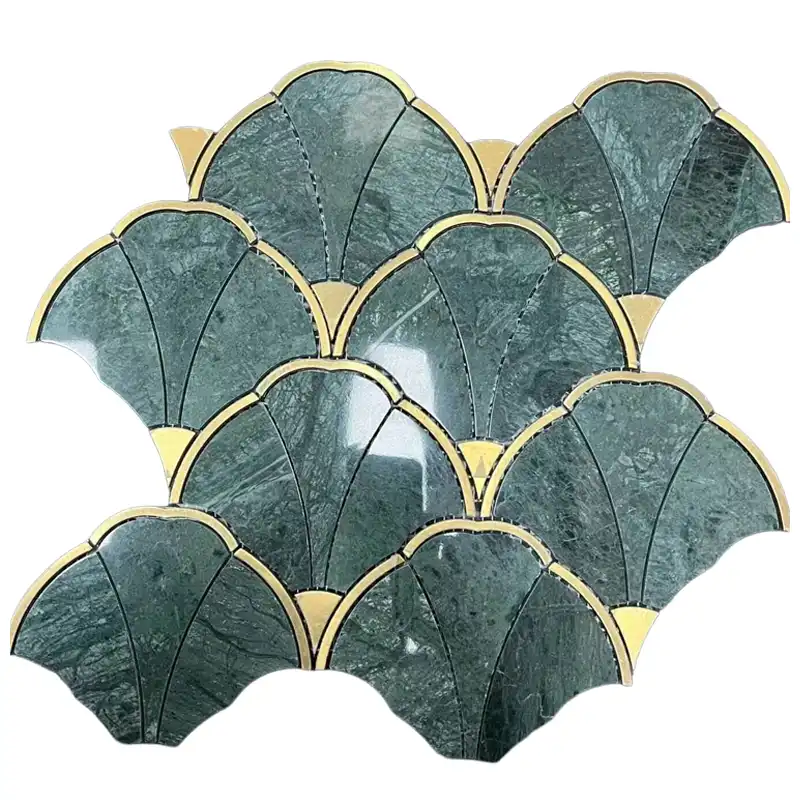

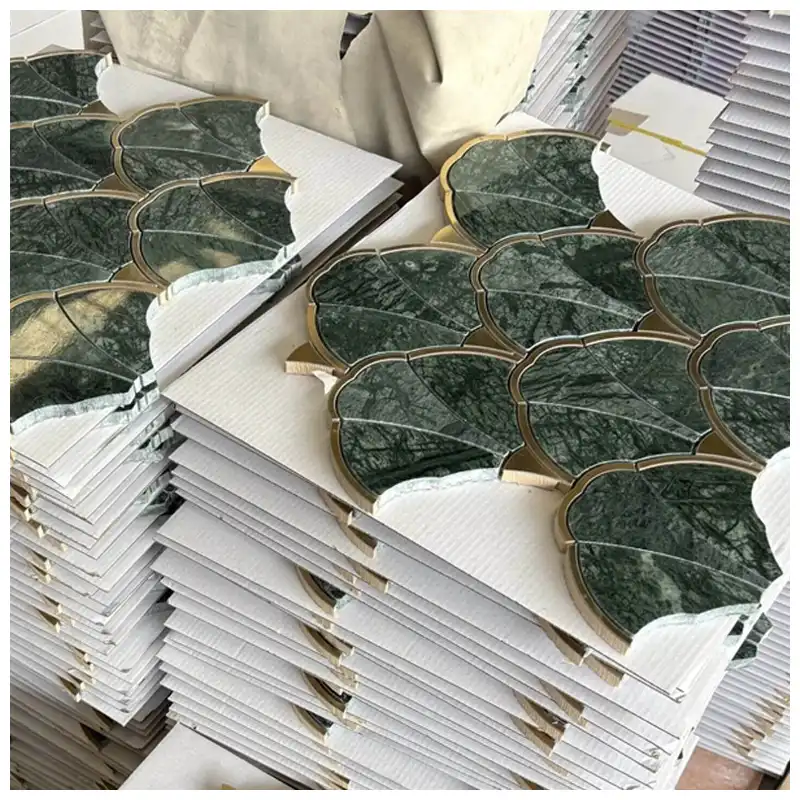

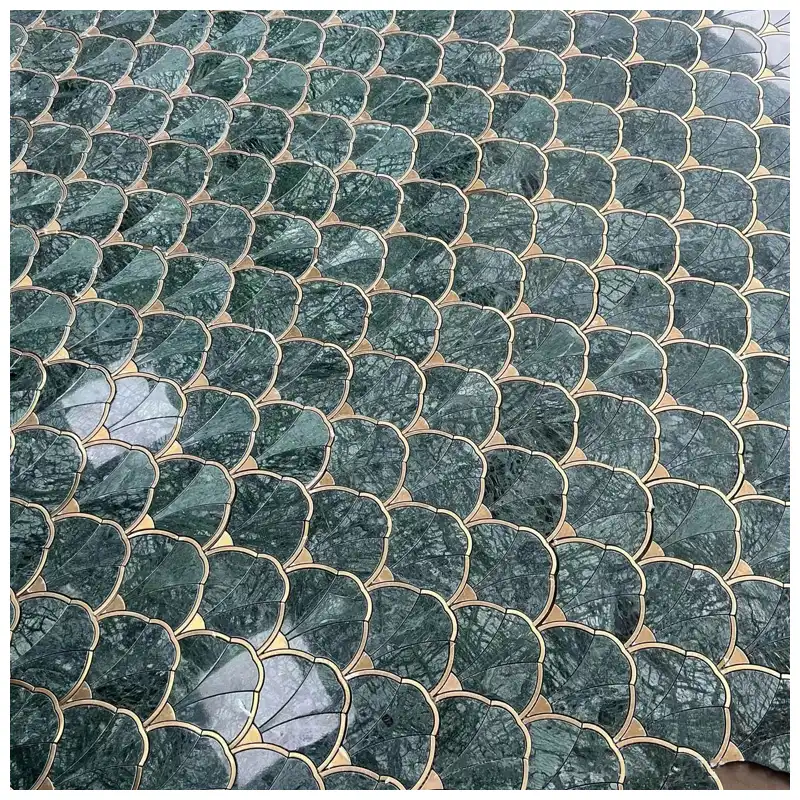
Quick Summary: Dark Green Marble Waterjet Mosaic Tiles feature overlapping ginkgo-inspired fan shapes cut from dark green natural stone, with gold-toned outlines and small metallic-looking accents at the pattern junctions. The polished marble displays irregular light green and grey mineral veins within each leaf. Available reference sheet sizes are 300 × 300 mm and 316 × 316 mm, with 9 mm and 10 mm thickness options. The pattern is intended for decorative interior walls, vanity backsplashes and selected floor accents. Buyers need to confirm the insert material, mesh assembly, sheet-edge continuity and installation suitability, particularly in moisture-exposed locations.
Dark Green Marble Waterjet Mosaic Tiles for Bathroom Walls, Vanity Backsplashes and Decorative Interior Floors
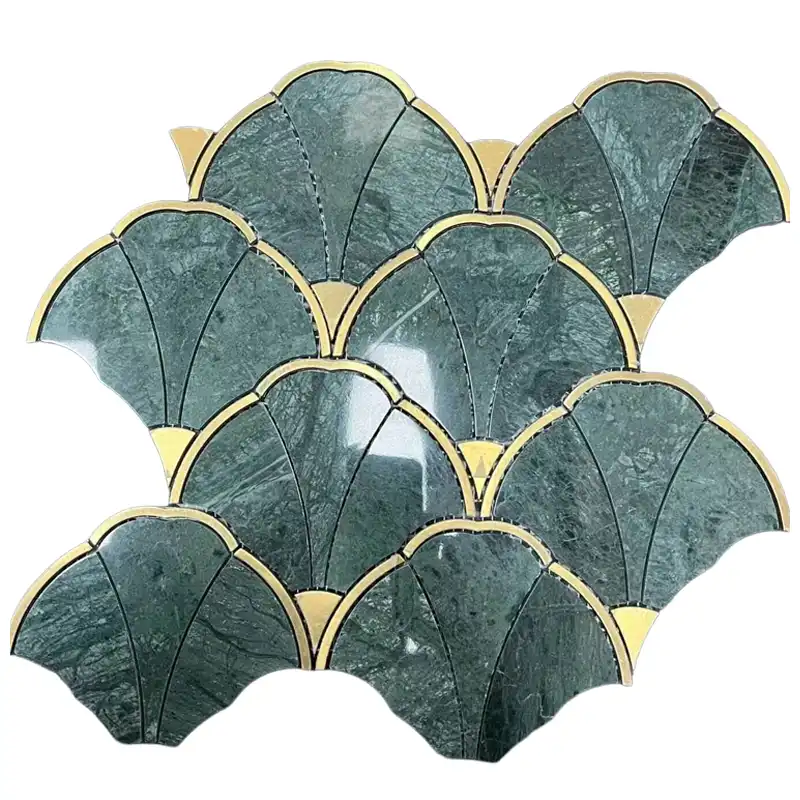
Full-pattern reference showing the overlapping leaf arrangement, natural green mineral variations and gold-colored joints.
This waterjet mosaic is built around the outline of a fan-shaped ginkgo leaf. Each dark green stone piece has a rounded outer edge, while a series of curved divisions gives the impression of separate leaf segments. Gold-colored detailing separates the pieces and emphasizes the repeated overlapping arrangement.
The finished pattern is suited to walls that are viewed at close range, including a vanity backsplash, powder-room feature, dressing-area wall or decorative entrance panel. Its closely spaced curves make the stonework more detailed than a conventional field of square marble tiles.
On a bathroom wall, the repeated fan edges create a strong geometric texture without requiring projecting three-dimensional stone. The visual depth comes mainly from the natural mineral pattern, polished reflections and contrasting outlines around the individual leaves.
A small decorative floor inset may also be considered, but floor use requires a separate assessment. The proposed polished stone, metallic detailing, assembled joints and substrate must meet the project's wear and slip-resistance requirements. A decorative wall specification cannot simply be transferred to a wet bathroom floor.
Bathroom Feature Walls
A repeating dark green botanical surface behind vanities, mirrors and selected dry-zone bathroom walls.
Architectural Accent Panels
Detailed leaf patterns for reception features, powder rooms and decorative residential wall sections.
Selected Floor Insets
Limited interior flooring details only where the finished assembly meets the specified surface requirements.
The Ginkgo Leaf Geometry: How the Curved Marble Pieces Form a Continuous Pattern
The main design feature is the relationship between one fan-shaped leaf and the next. Rows are offset rather than arranged as isolated flowers. The curved upper edges overlap visually, while narrow gold-colored boundaries preserve the shape of each green stone fan.
In the supplied photograph, some leaves appear wider or more prominent because of the natural veining and reflection on the polished stone. The underlying repeated geometry remains recognizable despite those differences. This combination of controlled cutting and unpredictable mineral detail prevents the pattern from appearing like a flat printed surface.
Fan Edges, Radial Lines and Leaf Overlap
A typical ginkgo leaf mosaic tile uses a rounded fan outline associated with the botanical leaf form. Here, curved radial divisions are visible within many pieces. Their spacing changes the way light travels across the polished surface and gives each leaf a segmented appearance.
The repeated fan edges also create a scalloped field. Unlike a simple fish-scale mosaic that relies only on one curved border, this design contains internal divisions and gold-colored junction details that must remain consistent from one sheet to another.
Why the Pattern Must Be Checked Across Several Sheets
A single sample can show a well-formed leaf but cannot demonstrate how the design repeats over a complete wall. The most revealing inspection is a multi-sheet arrangement, where the installer can check that the upper and lower fan rows maintain the intended staggered rhythm.
A green leaf pattern mosaic should appear continuous without obvious rectangular blocks revealing the edges of individual mesh sheets. That continuity depends on accurate perimeter geometry and the final joint arrangement, not simply on the appearance of the central leaves.
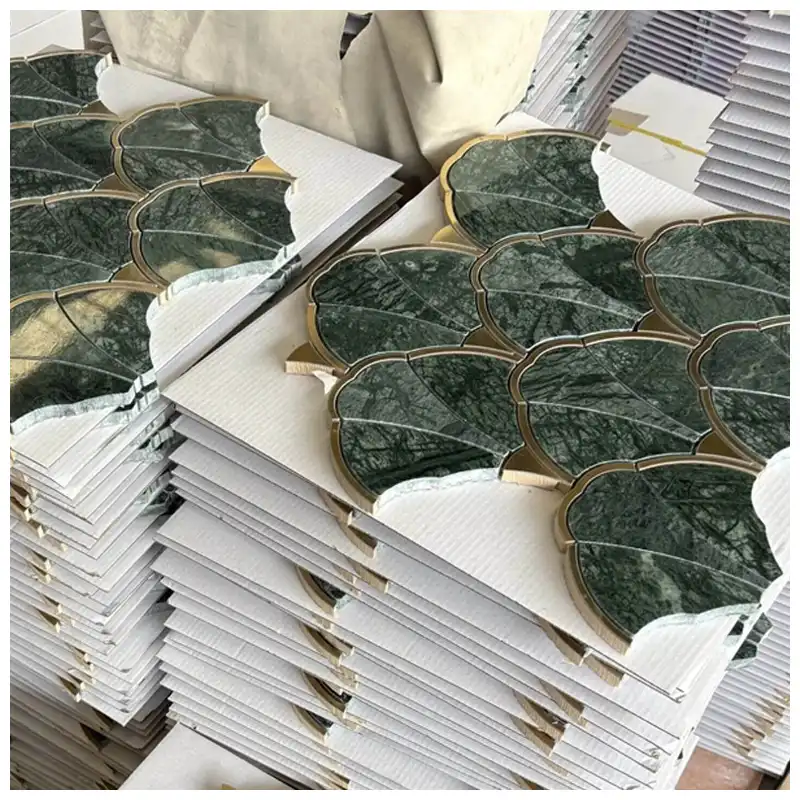
Close-up reference for the fan-shaped leaf segments, fine cutting edges and repeating junction details.
Indian Dark Green Marble, Verde Guatemala and the Actual Stone Selection
The dark forest-green marble used in this design has a dense visual network of pale green, grey and whitish mineral lines. Some leaves contain relatively open green sections; others show much heavier veining. The effect is especially noticeable because adjacent fan pieces expose the mineral pattern in different directions.
The material is described commercially as Indian Dark Green Marble. The names Verde Guatemala Marble mosaic tiles and Guatemala Green Marble Mosaic Tiles also occur in the market for related Indian green stone selections. Verde Guatemala is a trade name and does not, by itself, certify that the stone was quarried in Guatemala.
A further distinction concerns the underlying geology. Some stones sold under Indian Green or Verde Guatemala names are serpentinite-rich rather than conventional calcite marble. That difference can affect how the material responds to certain setting products, moisture and chemical treatments. Exact composition should be established from the selected source when the installation specification depends on it.
For a mosaic order, buying from the same commercial color family is not enough to guarantee a matching green background. Mineral concentration, polish and the orientation of individual cut pieces can all alter the assembled appearance. Approval should be based on representative completed sheets that include the intended metal-colored details.
Search catalogs may also contain abbreviated terms such as dian dark green marble mosaic. Such wording is a search variant, not a verified material grade or geological classification. The purchase specification should identify the approved stone selection, not rely on a shortened commercial phrase.
Gold-Toned Leaf Outlines: Brass Inlay, Grout Lines and Metal Finish Decisions
The photograph shows narrow warm-gold outlines around the green stone fans, with small triangular gold-colored areas at their junctions. These accents are visually important because they separate adjacent marble pieces even where the natural green veining is dense.
The supplied product description identifies the detailing as brass or metallic accents. However, the photograph alone cannot confirm whether every gold-colored line is a solid brass insert, a metal-coated strip, a decorative filler or a combination of different materials. A cross-section and approved physical sample should establish the actual construction.
Metal Composition
Confirm solid brass, plated metal or an alternative decorative material before finalizing the specification.
Surface Level
Review whether the decorative outlines sit flush with the marble and grout or project above the surface.
Finish Protection
Specify the required metal appearance and test its compatibility with expected cleaning and moisture exposure.
What Can Change the Appearance of the Gold Detail?
Uncoated brass may develop a patina, while some applied metallic finishes can change appearance when exposed to unsuitable cleaners. The exact behavior depends on the material and treatment. Where a bright gold color is required throughout the service life, the finish specification and proposed cleaning products need to be reviewed together.
The keyword Green Marble Mixed Brass Mosiac Tiles is sometimes used for this style of stone-and-metal composition. It describes the intended decorative category, but actual brass content must be confirmed for the product supplied.
In shower surrounds and other wet locations, the metallic detail introduces additional concerns beyond the stone itself. Corrosion resistance, finish stability, grout compatibility and drainage exposure need approval before the mosaic can be specified for prolonged moisture contact.
Waterjet Cutting and Mesh Assembly for the 300 mm and 316 mm Mosaic Sheets
Water Jet Green Marble Mosaic Tiles are produced by cutting individual marble components into the required shapes before assembling them into the repeated design. Waterjet processing is relevant here because the leaf outlines contain continuous curves, changes in radius and narrow transitions that are difficult to reproduce consistently with simple straight cutting.
| Specification | Product Reference and Approval Criteria |
|---|---|
| Product Type | Ginkgo Leaf Natural Stone Waterjet Mosaic |
| Stone Material | Indian Dark Green / Verde Guatemala Commercial Green Stone |
| Sheet Size A | 300 × 300 mm |
| Sheet Size B | 316 × 316 mm |
| Nominal Thickness | 9 mm / 10 mm |
| Finish | Polished Natural Stone |
| Decorative Inlay | Gold-Toned Accents; Actual Metal Composition and Finish to Be Confirmed |
| Assembly | Mesh-Mounted Sheet as Specified; Backing Material and Coverage Subject to Sample Approval |
| Customization | Pattern Scale, Stone Selection, Decorative Accent and Sheet Layout by Drawing |
| Relevant Inspection | Piece Fit, Sheet Edges, Surface Level, Backing Bond and Pattern Repeat |
Why the Nominal Sheet Size Is Not Enough for Layout Approval
The stated 300 × 300 mm and 316 × 316 mm dimensions describe the available sheet references. They do not establish the exact location of each fan edge or the exposed finished coverage after the sheets are joined. If the pattern uses interlocking sheet boundaries, a square overall measurement may not tell the installer where the visible repetition begins and ends.
For Water Jet Marble Mosaic Tiles with repeated curved pieces, the fabrication drawing should identify the leaf geometry and its relationship to the sheet perimeter. A suitable production sample needs to show at least one complete repeating unit across adjoining sheets.
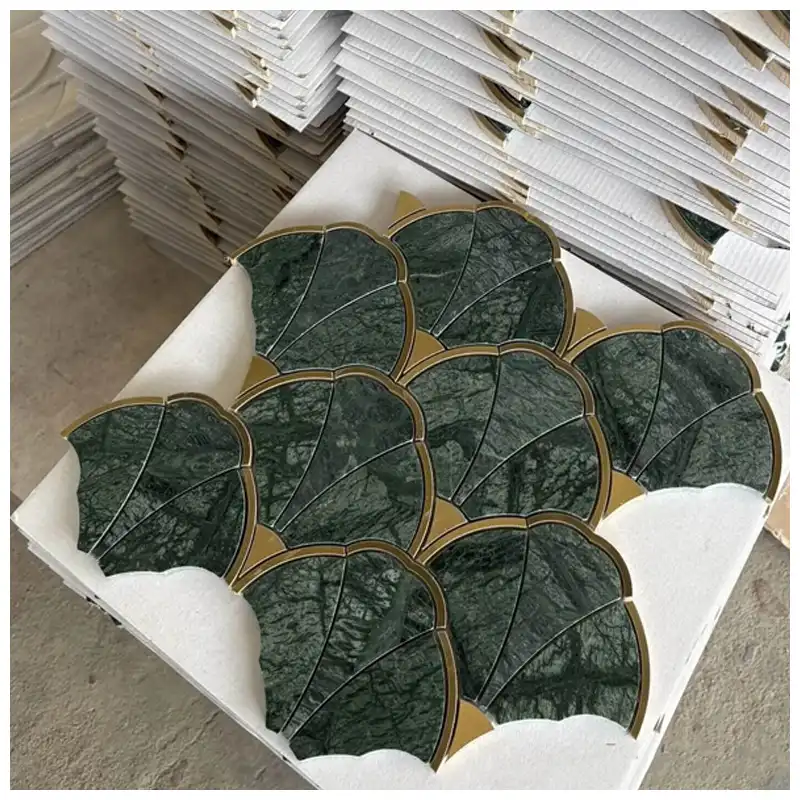
Sheet-construction reference for checking cut-piece geometry and the specified backing arrangement.
Mesh Orientation and Bonding
The mesh should hold the leaf pieces in their approved relative positions without preventing the installation adhesive from making the required contact with the stone. Excessive backing coverage or an unsuitable bonding material can affect adhesion, particularly where moisture-sensitive green stone is involved.
Sheet flexibility does not eliminate the need for a flat substrate or careful alignment. A flexible backing is intended to simplify handling of many small pieces; it cannot correct a distorted repeating pattern once the assembly has been fixed.
If project-specific dimensions or a different leaf scale are requested, the sample approval should cover the modified pattern itself. Changing the outer sheet size without reconsidering the fan repetition can produce awkward partial leaves at the edges.
Avoiding Visible Sheet Lines at Ginkgo Leaf Mosaic Joints
Large mosaic installations can reveal the outlines of individual sheets even when every leaf has been accurately cut. This happens when the gap between two sheets differs from the gaps inside the sheets, or when the staggered fan pattern is not correctly continued across their boundaries.
For this particular design, the gold-colored leaf outlines make the problem more visible. An unexpectedly wide line can interrupt several rows of fans at once. A displaced triangular accent may also break the repeated rhythm, even if the surrounding marble pieces remain close to their intended positions.
Inspect a Multi-Sheet Mock-Up
Place neighboring sheets together before final fixing and inspect the complete fan pattern at normal viewing distance. Check that the curved leaf rows continue without introducing a rectangular seam line. The joint width between sheets should visually correspond with the approved internal pattern.
Handle Corners and Perimeter Cuts Separately
Where a mosaic ends against a mirror, cabinet, door frame or architectural reveal, the installer may need to cut through a fan shape. The finishing detail should identify whether exposed partial leaves will be accepted, concealed by trim or replaced by a purpose-cut border.
This issue is particularly relevant to small vanity backsplashes. The available wall height may contain only a few complete rows, so the vertical starting position of the pattern can significantly change the finished appearance.
Control the Three-Way Junctions
The small gold-colored junctions between several leaves are focal points of the pattern. Their spacing, rotation and finished surface level should be included in the sample acceptance, not treated as incidental grout details.

Factory assembly and multi-sheet alignment reference, independent of the completed interior effect image.
Bathroom Installation: Moisture-Sensitive Green Stone, Gold Accents and Surface Safety
A decorative green marble mosaic has several material interfaces within one small sheet: natural stone, decorative gold-colored components, backing mesh, setting adhesive and grout. Each can respond differently to water and cleaning chemicals. The complete assembly therefore matters more than a general claim that polished marble is suitable for bathrooms.
Selecting a Compatible Installation System
Certain green stones sold as Verde Guatemala or Indian Green can be moisture-sensitive. Depending on the actual mineral composition, resin treatment and backing, a conventional water-rich setting method may be unsuitable. The adhesive manufacturer and installer should confirm compatibility with the selected green stone and the mesh assembly.
Where a product requires a specialized setting system, the choice must also account for the metallic inserts and the bonding material already used during mosaic assembly. A small mock-up can reveal unwanted movement, darkening, poor adhesion or surface changes before the entire wall is installed.
Separate Waterproofing from the Decorative Mosaic
Mosaic sheets and grout are not substitutes for a properly designed waterproofing system. Shower walls, wet vanity areas and other exposed locations need a substrate and membrane arrangement suited to the installation. The mosaic must be compatible with that system.
Polished stone and metallic detailing may also require different cleaning treatments. The chosen grout and cleaning process should not discolor or abrade the gold accents or create an unwanted reaction on the natural stone.
Floor Applications Need Their Own Approval
The presence of multiple grout joints does not automatically guarantee that a mosaic floor meets wet slip-resistance requirements. The completed surface includes polished stone and decorative inserts, so its traction must be evaluated as an assembly under the relevant use conditions.
For a small interior floor accent, the designer should establish expected traffic, cleaning, surface wear and acceptable metal-finish aging. Where the assembly cannot satisfy the required conditions, the product is better assigned to a decorative wall or another protected vertical surface.
Product-Specific Inspection and Packing for Leaf-Shaped Waterjet Mosaic Sheets
The principal quality checkpoints are the repeated curved edges and the positions of the gold-colored inserts. A sheet may have a consistent overall size but still display a visibly distorted leaf if one cut piece has shifted or if the wrong insert has been fitted at a junction.
Inspection should compare representative assembled sheets against the approved pattern drawing. Curved stone edges, narrow fan sections and metallic-looking triangular areas need to be checked for chips, unwanted gaps and inconsistent surface levels. The polished stone should also be examined for scratches or processing marks that alter the intended appearance.
For a multi-sheet order, sample checks should include pieces from more than one production group. The aim is to identify whether the green background, gold-colored finish and repeated sheet geometry remain within the agreed range. Exact stone veining cannot be identical across natural marble pieces.
Packing needs to protect the face of each assembled sheet from pressure on the narrow fan edges and exposed metallic details. Flat, stable support and suitable separation materials can reduce the risk of abrasion during movement. The packaging method should also prevent the flexible mesh from being distorted before installation.
Where a project has a selected color range or special border arrangement, the corresponding sheets should be identifiable upon receipt. The packing record should support inspection of the correct pattern and finish rather than relying on one generic description for every mosaic carton.
Interior Design Reference: Dark Green Ginkgo Leaf Mosaic as a Botanical Wall Feature

Interior application reference only. Use a verified installed-project photograph or an explicitly identified design rendering.
A dark green ginkgo mosaic can be coordinated with walnut cabinetry, warm white wall finishes, bronze-colored fittings or quieter natural stone surfaces. The curved leaf pattern already has considerable detail, so a restrained surrounding palette can prevent the feature from competing with multiple decorative textures.
For a powder room, the mosaic may cover a defined section behind a vanity mirror rather than every wall. The design can establish a clear edge where the pattern meets painted plaster, panel trim or another tile finish.
In a reception area, repeating rows of the botanical motif can create a recognizable backdrop. The visual effect depends on the scale of the installed field and the balance between polished green stone and gold-toned outlines.
Any illustrative rendering should be labeled as a design concept unless it is supported by actual project documentation. The product photograph demonstrates the mosaic itself, not a completed interior installation.
Dark Green Ginkgo Leaf Mosaic Compared with Four KA UNITED Decorative Mosaic Designs
These KA UNITED mosaics differ primarily in pattern geometry, material combination and the level of decoration that becomes visible across a finished surface. The comparison below concentrates on those observable design distinctions rather than assuming identical installation conditions or technical performance.
| Mosaic Product | Pattern and Material | Design Character | Selection Priority |
|---|---|---|---|
| Dark Green Ginkgo Leaf Mosaic | Forest-green fan-shaped stone pieces with warm gold-toned outlines | Overlapping botanical pattern with repeated scalloped rows | Leaf alignment, gold insert material and sheet-boundary continuity |
| Waterjet Floral Geometric Marble Mosaic | Rosa Aurora and Thassos marble with decorative brass accents | Lighter geometric floral arrangement | Flower repeat, contrasting stone shapes and decorative junctions |
| Thassos Carrara Marble Brass Waterjet Mosaic | White marble combinations with brass detailing | Bright, directional geometric mosaic | Metal positioning and white-stone pattern contrast |
| Thassos White Marble Berlinetta Mosaic | White Thassos and dark marble geometric composition | High-contrast black-and-white decorative pattern | Dark/light balance and complete motif repetition |
| White Marble Flower Mosaic | White marble floral shapes with gold-colored decorative details | Pale floral decoration rather than dark green foliage | Flower layout, accent details and finished panel borders |
Recommended Natural Marble Mosaic Tiles from KA UNITED
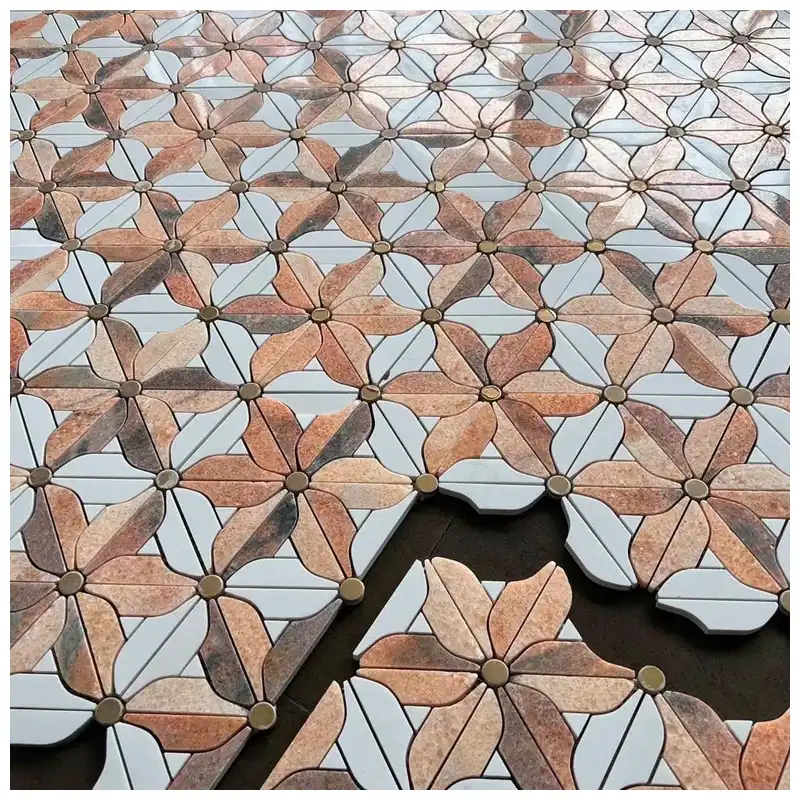
Waterjet Floral Geometric Marble Mosaic Tile
Light Rosa Aurora and Thassos floral geometry with brass details for patterned walls and decorative backsplash designs.
View Product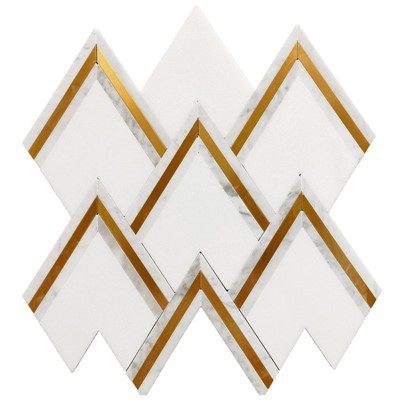
Thassos Carrara Marble Brass Waterjet Mosaic
White marble and brass geometric mosaic for interiors favoring a brighter stone palette and defined metallic detailing.
View Product
Thassos White Marble Berlinetta Mosaic Tile
Thassos white and dark marble pattern for bathrooms and backsplashes requiring a high-contrast geometric arrangement.
View Product
White Marble Flower Mosaic
White marble floral mosaic with gold-colored accents for lighter decorative wall and backsplash compositions.
View ProductFrequently Asked Questions About Dark Green Marble Ginkgo Leaf Mosaic Tiles
1. Are the gold-colored lines real brass or decorative grout?
The supplied specification describes brass or metallic accents, while the photograph confirms only their gold-colored appearance. The final order should identify the actual insert material, surface treatment and how the accents meet the marble and grout. An approved physical sample is needed before specifying solid brass throughout the pattern.
2. Why are 300 × 300 mm and 316 × 316 mm mosaic sheets offered?
Both dimensions are listed as sheet-size options for this product. The final choice should be checked against the approved leaf pattern and sheet-edge arrangement. The two formats should not be treated as interchangeable until the visible repetition, finished coverage and joint alignment have been confirmed.
3. How can the installer prevent visible square sheet outlines?
The installer should arrange neighboring sheets before fixing and compare the gaps along their edges with the internal leaf joints. The fan rows and gold-colored junctions must continue at the intended spacing. A multi-sheet mock-up is more reliable than judging one isolated sample.
4. Can this polished green marble and gold mosaic be used on shower floors?
Shower-floor use cannot be assumed from the decorative product photograph. The complete mosaic assembly needs approval for wet slip resistance, stone and metal exposure, setting-material compatibility, waterproofing and expected cleaning. If those requirements cannot be met, a decorative wall is the more appropriate location.
5. Is Verde Guatemala Marble always quarried in Guatemala?
No. Verde Guatemala is a commercial stone name also used for Indian green selections, including materials associated with Rajasthan. Quarry origin and mineral composition must be confirmed from the actual supplied stone when these details are required for the project specification.
Before Approving the Ginkgo Mosaic, Examine the Metal-to-Stone Junction Sample
The decisive sample for this product is not a loose green marble chip. It is a completed section containing several leaf shapes, their gold-colored outlines and at least one sheet boundary. This reveals whether the intended fan geometry and the metal-to-stone transitions can be reproduced in a larger installation.
The acceptance drawing should distinguish the cut stone pieces from the metallic inserts and grout. It should specify which surface is intended to be flush, how partial leaves are handled at the perimeter and which finish treatment is permitted on the completed assembly.
For bathroom projects, approval should also depend on the installation system and exposure conditions rather than the decorative appearance alone. A sample that meets the visual requirements may still need changes to its backing, fixing method or metal finish before use in a wet environment.
Final Note: The overlapping leaf pattern and its gold-colored junctions are the defining features of this green marble waterjet mosaic. A successful specification establishes the geometry, true insert material, backing arrangement and acceptable sheet-to-sheet fit before the finished surface is installed.

Request Dark Green Marble Ginkgo Leaf Mosaic Samples and Custom Waterjet Fabrication
KA UNITED can review the dark green ginkgo pattern for interior mosaic specifications that require coordinated waterjet-cut pieces, polished natural stone and decorative gold-colored accents. Requests for alternative stone combinations, adjusted fan proportions or different sheet formats should be supported by a reference drawing or approved sample.
Please identify the preferred sheet dimensions, nominal thickness, intended wall or floor location, required metal finish and relevant exposure conditions. Where the installation meets a cabinet, mirror, floor border or other architectural edge, include an elevation or setting-out drawing showing the finished boundary. This allows the ginkgo pattern repeat and insert details to be reviewed against the proposed design.


