Black Quartzite Kitchen Countertops: Slab Selection for Projects
Black Quartzite Countertops in Kitchens: Hardness, Finish, and Batch Checks on Dark Brazilian Slabs
Stand a dark natural slab next to an engineered quartz board of the same color and the two look like twins under showroom light. Set a hot pan down on both and the natural stone tolerates the contact while a resin-bound composite can scorch; leave lemon juice sitting on both and true quartzite wipes clean where a carbonate look-alike would dull. Because the color pulls the eye first, black quartzite countertops get chosen on appearance and are judged on behavior.
When a kitchen or bar program asks for a dark Brazilian material, I treat the request as a sourcing job with three unknowns: the rock type behind the series name, the finish the daily cleaning routine can live with, and whether every piece belongs to one bundle. Matrix Black is the commercial name KA UNITED gives to one grey-to-black Brazilian quartzite family we carry in slab form within the luxury stone program; the name describes the look, not the test results.
First, Confirm You Are Buying Quartzite, Not a Marketing Name
The first question in a dark stone order has nothing to do with color; it is about rock type. Quartzite begins as quartz-rich sandstone and recrystallizes under deep heat and pressure into interlocking quartz grains, which is why it behaves differently from the carbonate stones beside it on the rack. Hardness on the Mohs scale for true material of this kind typically lands near 7, above most granite and well above marble. An order for black quartzite countertops therefore starts with a material check rather than a color sample.

How formation changes what you can ask of the surface
Recrystallization fuses the sand grains into a dense silica body with no added binder. Heat that would soften a polymer resin does not bother quartzite, and kitchen acids have no calcite to attack, so scorching and etching drop off the risk list in true material. The trade-off shows up in the workshop, where fused quartz wears tooling fast and chips in a shop not set up for it; I ask who will fabricate before I quote.
Two yard checks settle most doubts
The acid test is the one I trust. Lemon juice left on a sample or offcut for ten to fifteen minutes wipes off with no dull ring if the stone is true quartzite; a carbonate rock etches where the drop sat, and no sealer stops that, because the damage is chemical, not porosity. A steel blade dragged across a hidden edge will not cut genuine quartzite; the blade works as a quick screen and the acid test as the verdict.
Paperwork that travels with the stone
Series names are not regulated, so I ask for a written material declaration naming the rock family and quarrying region, plus bundle photographs with slab numbers visible, repeated at loading and at delivery. The receiving check then compares against agreed material.
What the Kitchen Comparison Says: Quartzite vs Granite vs Engineered Quartz
A dark kitchen can be specified three ways, and all three look similar in a brochure. The difference is service behavior; the table collects typical published ranges for the three materials in kitchen programs. Slabs and brands vary, so treat the numbers as a comparison frame, not a certificate.
| Property | Natural quartzite (true) | Granite | Engineered quartz |
|---|---|---|---|
| What it is | Metamorphic sandstone recrystallized to fused quartz | Igneous rock: quartz, feldspar, mica | Crushed quartz aggregate, about 90-95%, in polymer resin (typical) |
| Mohs hardness (typical) | About 7 | 6 to 7 | About 6 to 7; resin matrix softer than aggregate |
| Household acids: lemon juice, vinegar | No etching in true quartzite | Generally resistant to brief contact | Resists household acids; strong solvents or very alkaline cleaners can attack resin |
| Hot cookware | Tolerated; trivets remain sensible | Tolerated; trivets remain sensible | Resin can scorch under direct high heat; trivets required |
| Water absorption, ASTM C97 (typical) | Very low, commonly under about 0.3% | Low, commonly about 0.2-0.5% | Near zero, about 0.01-0.05%, non-porous |
| Sealing | Periodic; judge by water-bead test | Periodic; dense dark stones less often | Not required |
| Slab-to-slab consistency | Natural; varies by block and bundle | Natural; varies by block | Uniform and repeatable by color |
| Scratches on a dark face | Visible on gloss, hidden by matte | Similar behavior | Micro-scratches can dull resin gloss over time |
The column that surprises buyers is heat. Hot cookware is a non-event on natural quartzite and granite, while engineered quartz can scorch under direct high heat because its resin binder is heat-sensitive. Put the same question to black quartzite countertops and the answer follows the rock, not the color.
When engineered quartz is the right call anyway
Uniform color is the composite's strongest argument. When a multi-unit program needs identical dark surfaces and the crew will not seal natural stone, an engineered quartz countertop range may serve the project better than any natural slab. When heat, acid, and material character matter more, I quote natural quartzite instead.
Dark natural stone still runs on a sealing schedule
Black quartzite and dense black granite such as Zimbabwe Black Granite are low-porosity stones, yet natural stone still benefits from an impregnating sealer. The water-bead test sets the timing: if water soaks in instead of beading, the sealer has worn, and dense dark stones commonly go longer between applications than light porous granites.
The Hard-Won Lesson: run the acid test before the cutting list
The dull-ring failure shows up in the trade often enough to design against. A dark top goes in as quartzite, the kitchen runs clean for weeks, then citrus or tomato sits at a seam and leaves a whitish ring that sealer does not fix and polishing cannot erase. Most such cases turn out to be a carbonate rock under a quartzite series name: it looked right, polished right, and etched like marble.
The Lesson: a commercial series name is a marketing label, not a material certificate. Test the actual slab before the cutting list is fixed.
What a Glossy Dark Surface Demands in a Working Kitchen
Most complaints about dark stone are really complaints about gloss. A high-shine black face reflects the room like a mirror, and it reflects every touch along with it, so maintenance expectations for black quartzite countertops should be agreed before the finish is chosen, not rediscovered after the first dinner service.
Fingerprints and smudges are the visible price of polish
Hand oils and skin contact show on a polished dark face within hours, far faster than on light stone where the same oil stays invisible. This is surface behavior rather than damage, and a soft cloth with a pH-neutral stone cleaner removes it completely. On gloss black, whether the cleaning team will wipe daily becomes visible inside the first week.

Water marks collect where taps and glasses live
Tap water left to dry leaves a mineral film that reads as grey spots on dark stone. Around a sink or bar station, wipe the surface dry after wet work and set cold glasses on a mat, since condensation rings are residue, not etching. On quartzite the film wipes off; on gloss black it stays visible until wiped.
Micro-scratches read louder on a mirror face
Abrasive scouring pads, grit under a heavy pan, or a dragged blade leave hairlines that a mirror finish catches across the room. Clean with a soft cloth and a stone-safe cleaner, keep vinegar and ammonia off the stone because they attack the sealer, and treat a gloss scratch as a fabricator's re-polishing job rather than a home buffing project.
Polished, Honed, or Leathered: Choose the Finish before Fabrication
On dark Brazilian quartzite the finish is a functional decision, because it decides how forgiving the black quartzite countertops will be for the people who wipe them every day. Changing it later means re-polishing an installed top, so the choice belongs at the quote stage, confirmed on a finished sample panel of the actual stone.
The same material family often runs beyond the counter: stair treads, island ends, and wall cladding in a villa program. Stairs take honed or leathered faces, while a polished face earns its place on a low-touch bar front or accent wall.

Polished: the deepest color and the most upkeep
Polishing brings out the richest black and the metallic grey movement that makes dark Brazilian quartzite distinctive, and it also makes the surface the most demanding to keep clean. It suits a showpiece island or formal bar where traffic is light and wiping is consistent.
Honed: matte calm that forgives reflections
A honed finish removes the mirror and leaves a smooth matte face that shows fingerprints and water film far less aggressively. It suits open kitchens where the counter stays in view all day and gloss would fight the pendant lighting.
Leathered: a textured face that hides the daily record
Leathered keeps a gentle texture that hides water spots and smudges better than any gloss and feels pleasant under the hand; on a working kitchen or wet bar it is usually the finish I recommend first.
Batch Matching and Arrival Checks on Dark Slab Programs
Light stones drift in tone and the change reads as natural variation; on dark stone the same drift reads as a mistake at the seam. When a program spreads black quartzite countertops across a kitchen, an island, and a bar in one open space, the slabs must be handled as one matched set from the first quote.
Undertone drift is the real batch risk on black
Two blocks from the same quarry, even two slabs from one series, can lean brown-black, blue-black, or grey-black, and vein density varies with them. A hero slab can photograph beautifully while the rest of the bundle drifts, so I approve the whole bundle, numbers visible, before any cutting list is fixed.
Cut adjacent surfaces from one numbered bundle
The cutting list should group every piece that will sit beside another: the counter, the island, the bar top, and the backsplash from the same numbered slabs where the layout allows, and I reserve spares inside that bundle while material is in production, because a later replacement from a new block will sit visibly out of family on a dark run.
Arrival checks before anything reaches the saw
At delivery I compare bundle numbers with the packing list, record thickness at agreed points, and walk each face in raking light. A fingernail that catches on a line marks a crack rather than a fissure, and cracked or chipped pieces are photographed before being touched. When a piece does not match the approval photographs, the sequence is fixed: photograph it, stop work on it, then send the image with the original receiving record to the supplier before cutting starts.
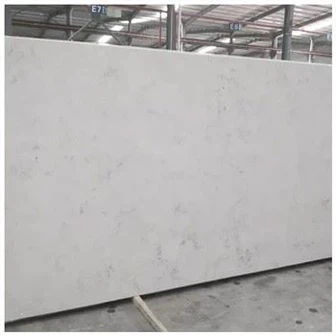
Factory-floor photographs in natural light, with slab numbers in frame, are my reference for that comparison; KA UNITED racks are photographed the same way, so approval image and delivered slab speak about the same stone.

Where Black Quartzite Selection Usually Slips in a Project
Approving a sample instead of the bundle
A polished sample shows one stone at its best but cannot show a bundle's tone range or the finish on your slab. Approve with bundle photographs and numbered slabs, and keep one reference image in the project folder for the receiving team.
Leaving the finish open until the slabs arrive
Finish is a fabrication step; a gloss face cannot become leather after cutting without starting over. Specify the finish with the purchase order, confirm it on a panel from the actual bundle, and write it into the drawing, because changing an installed top later means re-polishing or re-cutting.
Handing over care instructions after the first complaint
The care sheet belongs in the handover package rather than the complaint file: pH-neutral cleaner, wipe surfaces dry near water, trivets as a habit, and a sealer schedule driven by the water-bead test. On dark gloss, black quartzite countertops that arrive without a written routine produce callbacks that are really maintenance gaps.
Frequently Asked Questions about Dark Quartzite in Kitchen Programs
1. Are black quartzite countertops harder than granite and engineered quartz?
Typically yes. True quartzite sits near 7 on the Mohs scale, most granites land around 6 to 7, and engineered quartz reads about 6 to 7 because its resin matrix is softer than its aggregate. Cutting boards still stay on the specification sheet, since hardness protects no polish from abrasion.
2. Does lemon juice or vinegar etch dark quartzite?
Genuine quartzite is silica-based and does not etch when lemon juice or vinegar sits on it; a dull spot means the stone is carbonate material under a quartzite name. No sealer prevents that damage. Test an offcut with lemon juice before fabrication when the declaration is your only evidence.
3. Why do polished black quartzite countertops show water spots and fingerprints so quickly?
The marks are residue rather than damage: a polished dark face reflects light, so dried-water film and hand oils become visible at once where the same film is invisible on a matte surface. Wipe with a soft cloth and stone-safe cleaner and dry around the sink; honed or leathered finishes hide the same marks far longer.
4. Can I set a hot pan directly on black quartzite?
True quartzite tolerates hot cookware in normal kitchen use because it has no resin to scorch, the main difference from engineered quartz. I still specify trivets, which protect the sealer and avoid thermal stress at a seam.
5. What should I check when black quartzite countertops arrive for a project?
Photograph each piece with its bundle number visible, stop work on anything questionable, and compare the images with the approval photographs and receiving record before contacting the supplier. I also record thickness at agreed points, run a fingernail across any linear mark to separate a crack from a fissure, and check corners, backing, and polish.
Related Project Guides
Related guides on the countertop range, dark sibling materials, and cut-to-size quartzite programs.
Final Conclusion
The useful way to specify a dark kitchen is to treat black quartzite countertops as a use decision rather than a color decision. Verify the rock, pick the finish against the cleaning reality, tie every piece to one numbered bundle, and run the arrival checks before the saw starts; those four steps separate a program that performs from one that generates callbacks.
Here is what I would do: ask for the acid-test result, a finished sample panel, and numbered bundle photographs before fabrication, then let KA UNITED coordinate the stone, cutting, and matching kitchen cabinetry so the whole package is approved against one drawing and arrives as one planned set.
References
- Quartzite, Wikipedia.
- Dimension Stone Design Manual, Natural Stone Institute.
- Care and Maintenance of Natural Stone, Natural Stone Institute.
- ASTM C97/C97M, Standard Test Methods for Absorption and Bulk Specific Gravity of Dimension Stone, ASTM International.
- ASTM C616/C616M, Standard Specification for Quartz-Based Dimension Stone, ASTM International.
- ASTM C615/C615M, Standard Specification for Granite Dimension Stone, ASTM International.
- Kitchen & Bath Planning Guidelines, National Kitchen & Bath Association.