Cipollino Marble for Feature Walls: Vein Direction and Selection
Quick Summary: A cipollino marble wall is bought for its wavy green and white banding, but that pattern only exists when the slab is sawn the right way and the panels are mapped before cutting. This guide covers how the stone reads, the two slab faces of one block, bookmatch planning and slab quantities, cabinet pairings, and factory checks, plus honest alternatives when natural stone misses the budget. KA UNITED coordinates the feature wall slabs, vanity tops, and bathroom cabinets from one approved sample set so the room is approved together.
Cipollino Marble Feature Walls: Vein-Cut Slabs, Pattern Planning, and Pairing with Vanity Cabinets
When a hotel or residence spec calls for a green marble accent wall behind a double vanity, I ask to see two things before quoting cipollino marble: the actual slabs in stock and the direction they were sawn. A banded green stone photographs well from any angle; once it is on the wall it reads completely differently depending on the cut. The name alone settles nothing: Cipollino is a family label for several green wave stones that share an onion-like layered look, and one block sawn two ways gives two materials for the same room.
What Cipollino-Type Marble Looks Like: Banding, Ground, and the Names behind It
Reading the stone: green waves on a white-to-grey ground
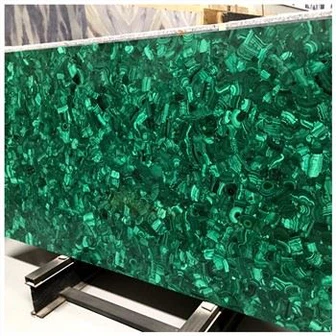
Stand two metres back from a slab and the wave motion takes over: bands of green and white fold and flow across the panel, divided by thin darker lines. The name comes from cipolla, onion, because the layering recalls the rings of a cut onion. This is a metamorphic marble; the green comes from chlorite and epidote minerals, the dividing lines are mica, and the banding is foliation rather than a painted surface.
What changes between suppliers is intensity. Some stock is pale sage and white, fine and quiet; other blocks show deep green waves on a warm grey ground, and the Rosso versions mix purple and red veins into the green so the wall shifts tone as you walk past it. Wide bold bands suit a feature wall; fine banding suits countertops and repeated hotel rooms.
What the names really mean, and why origin claims need a document
The classic stone that old references describe was quarried on the Greek island of Euboea near Karystos and shipped to Rome as marmor carystium for column shafts. Today the picture is broader. Cipollino Ondulato Verde is sold as an Italian marble from northern Italy, our Ondulato Rosso sheet describes the Apuan Alps area, and the Tuscan hills around Lucca and Garfagnana have their own documented cipollini varieties. So an Italian label tells you little by itself. If heritage provenance matters, ask for the quarry or current stock certificate in writing; otherwise approve against photographs of the actual batch under one fixed light.
| Commercial name | Typical ground and banding | Source area as published |
|---|---|---|
| Cipollino Ondulato Verde | Deep green ground, flowing white and grey wave bands | Italy, per supplier documentation |
| Cipollino Ondulato Rosso | Grey-green ground with purple, red, and green waves | Italy, Apuan Alps area per KA UNITED sheet |
| Cipollino Verde Apuano | White ground, parallel light-to-dark green bands | Apuan Alps, Tuscany |
| Cipollino of Versilia | White to very light green ground, fine dark green waves | Versilia, Lucca province |
| Cipollino '900 or Zebrino | White marble alternating with green-brown zebra stripes | Carrara area quarry |
| Cipollino Viola Isola Santa | Greenish ground with parallel violet bands | Versilia-Garfagnana border |
Vein Direction on a Banded Green Stone: Two Slabs from One Block
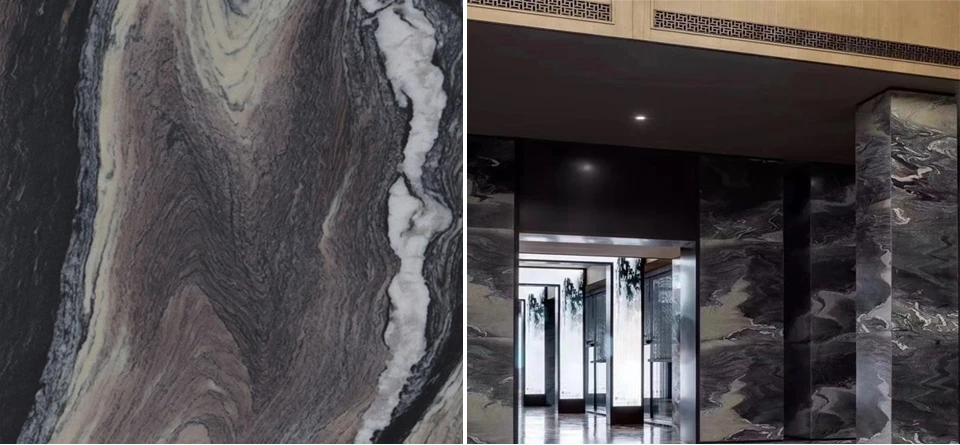
Because the green color sits in folded layers, every slab is a flat slice through those layers, and the angle of the saw decides what the surface shows. Trade catalogs use the words vein cut and cross cut loosely, sometimes in opposite senses, so I specify by geometry and ask for photos. The two faces below are the real choice.
Sawn across the folded layers: the wavy banded face
Sawn perpendicular to the layers, the slab shows the bands edge-on as continuous parallel waves running across the whole panel. This is the classic Cipollino face and the one photographed for most feature walls. It carries a strong direction: it lengthens a room, but it punishes seams, because a band that stops dead at a panel joint reads as a defect rather than a joint.
Sawn with the layers: the clouded face
Sawn close to parallel with the layers, the same block shows broad mottled fields of green and white with no fixed direction. This face is calmer, hides seam alignment far better, and is often the right pick for a vanity top or table when the wall behind it carries the wavy pattern. Same block, same minerals, different material for the room.
| How the block is sawn | Face you get | Where it earns its place |
|---|---|---|
| Perpendicular to the layers | Continuous wavy parallel bands, strong direction | Feature walls, bookmatch runs, tall panels |
| Parallel to the layers | Clouded mottled patches, no direction | Vanity tops, tables, quieter surfaces |
Some suppliers call the banded face vein cut because the lines flow, while others call it cross cut because the saw crosses the bedding. Order by geometry and full-slab photos, never by the label, because a small hand sample cannot show cut direction at all.
Planning a Cipollino Marble Feature Wall: Bookmatch, Panels, and Slab Quantities
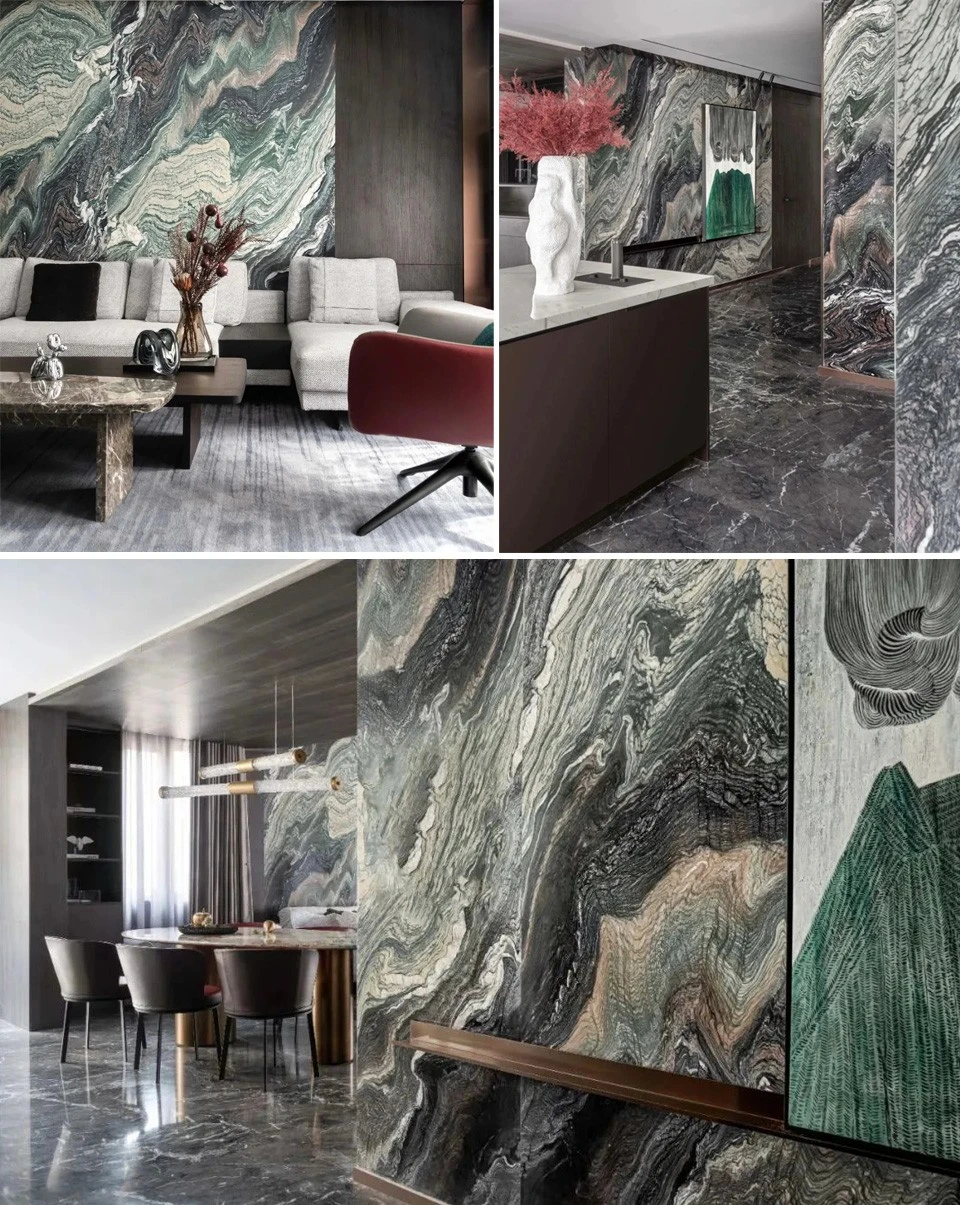
Every green wall order fails the same way: the buyer approves one slab photo, the factory cuts, and the bands meet at the joints wrong. The layout language must be fixed before any panel is cut, and it must be written as a numbered cut map.
Choose the layout language before you choose panels
Three layout systems cover almost every wall. Bookmatch mirrors the pattern around the central joint, which suits a wall centered behind a double vanity or tub. Continuous flow runs the bands in one direction panel to panel, which suits long corridors and full wall runs. Random or balanced placement suits small accents and powder rooms where the stone is a detail rather than a surface. Each system changes how many slabs you need and how much waste you accept.
The arithmetic of a full-height wall
Run the numbers before the quotation, using our common stock as an example. A wall 3.6 metres wide and 2.4 metres high takes six full-height panels of 600 millimetres, about 8.6 square metres net. Our jumbo slabs of this stone run roughly 3000 by 1600 millimetres, near 4.8 square metres each, in 20 or 30 millimetre thickness, and each slab cuts two panels of 2400 by 600. Three slabs cover the wall face, and the 600 by 1600 strip left on each slab is close to a single-basin vanity top blank. Add one matched spare slab from the same block and the order becomes four slabs. Directional stone is quoted by the slab, not by the square metre, and purchased area runs well above net because every panel must come from the pre-selected zone of its slab.
Panel formats, numbering, and the spare policy
For interior walls I prefer large formats over tiles because every joint is a place where a band can misalign. Thin veneer panels of 10 to 12 millimetres, mesh backed, keep weight down and are fixed like large-format tile; standard 18 to 20 millimetre slabs carry more weight and need a full adhesive bed plus mechanical anchoring. Number every panel against the cut map and record which slab and zone each wall position comes from. Green marble is replaced only with matched stone, so hold spare panels cut from the same block and note their numbers in the handover documents.
Pairing Cipollino Marble with Vanity Cabinets, Metals, and Light
Let the wall be the only green in the room
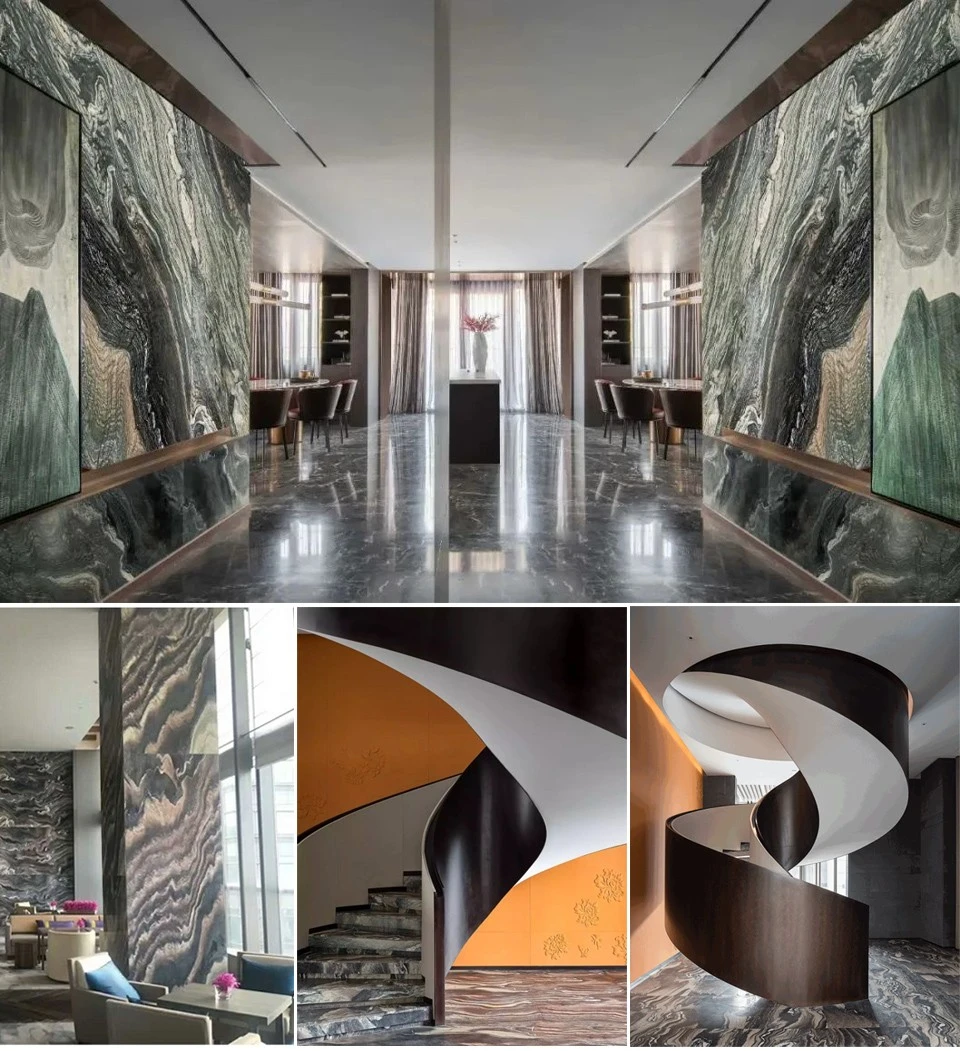
A green veined wall works when everything else stays neutral. Warm oak, light greige, and off-white cabinet finishes sit quietly beside it; deep walnut adds weight without competing. What looks wrong fast is a second green element: green paint, green towels as decor, a green-tinted mirror frame. The stone carries the color budget, so the cabinet line below it should be simple, with flat panels or light shaker fronts rather than heavy ornament.
Warm metal against cool green
Brass, aged bronze, and unlacquered brass fittings are the usual companions to green marble, and matte black is the modern alternative when the room should feel sharper. Polished chrome tends to read cold next to a deep green ground. Match the metal finish across faucet, mirror frame, and cabinet hardware; three near-golds look like a mistake.
Light and the vanity top rule
Judge the stone under the light the hotel will actually install. Warm lamps around 2700 to 3000K keep the green rich; cool light flattens it toward grey. Cut the vanity top from the same blocks as the wall, even when the top uses the calmer sawn face, because a top half a tone away from its own wall is the most common punch-list item on green marble bathrooms. Build a sample board with the wall panel, the top edge, the cabinet door, and the faucet finish, and approve the set under one lamp.
Handling a Soft Stone: Filling, Backing, and Installation Checks
Marble is softer than it looks, and foliation adds fragility
Calcite-based marble sits around 3 on the Mohs scale, so it scratches, etches with acid cleaners, and chips at edges far more readily than granite or quartzite. The foliation that gives cipollino its pattern adds a second weakness: thin mica planes can open into fissures, which is why commercial slabs of this stone are resin filled and often carry fiberglass mesh on the back before they leave the factory. Through-cracks are a rejection, while filled micro-fissures are normal and should match the ground tone when the work is done properly.
Finish is a maintenance decision, not only a look
Polished marble deepens the green and shows the wave pattern at its fullest, which suits feature walls in dry zones. Honed removes the glare, hides water spotting, and is the safer finish where the stone meets steam and splash. Brushed finish takes advantage of the stone's mineral mix: the softer marble wears down and harder mineral nodules stand slightly proud, giving an aged surface that does not need to be perfect under mirror light. Decide the finish before quoting, because honing and brushing change how the sealer behaves.
Installation and factory checks that protect the pattern
Standard 18 to 20 millimetre wall panels need a full adhesive bed plus the mechanical anchoring the manufacturer specifies, per accepted stone anchoring practice; thin veneer panels set with polymer-modified adhesive over a flat, primed substrate. Seal the finished wall with a penetrating impregnator and keep joints to one or two millimetres, color matched to the lightest ground, with movement joints at perimeters. At the factory, approve the batch under one fixed light, confirm the filler color against the ground, check thickness and flatness so lippage never becomes an argument on site, and photograph each numbered group of panels before packing. These checks are where a green marble wall is won or lost, which is why our line holds the wall panels with their matching vanity tops until the whole set is approved.

Budget-Conscious Projects: Green-Tone Engineered Alternatives
Engineered quartz when the program needs consistency
Green engineered quartz in emerald, moss, and grey-green grounds with white waves is the standard substitute for budget-driven rooms. It resists etching and scratching, needs no sealing, and every slab matches the next, which matters when a hotel chain repeats the same bathroom in a hundred rooms. The trade-off is real: the pattern repeats rather than flowing uniquely, and the surface lacks the depth of natural stone. Where marble wins is on one signature wall that the guest will photograph.
What I ask before swapping materials
Before I substitute a quartz or porcelain surface for a green veined wall, I check three things: the room light, because engineered greens read differently under warm lamps than natural ones; the edge and detail treatment, since printed stone shows its nature at returns and miters; and the maintenance regime, because marble fails only when the housekeeping chemicals are wrong. If the design intent is a continuous banded wall, both materials can deliver it; the decision is durability budget versus one-of-a-kind character.
Frequently Asked Questions about Cipollino Marble Feature Walls
How much cipollino marble should I order for a bookmatched feature wall?
Plan at least two matched slabs per 1.6 metres of wall width for full-height panels, plus vanity top stock and one spare pair from the same block. Purchased area runs well above net on any directional stone, because each panel must come from a pre-selected zone of its slab.
Is cipollino marble a practical material for a bathroom feature wall?
Yes, in dry-to-moderate bathroom zones, with a penetrating sealer applied after installation and gentle pH-neutral cleaning. Walls take less abuse than countertops. In high-traffic guest bathrooms where housekeeping uses aggressive chemicals, engineered quartz is the safer call, so decide that before quoting.
How do vein-cut and cross-cut cipollino marble slabs differ in appearance?
The two names describe how the block was sawn relative to its layers. Sawn across the folded layers the slab shows continuous wavy bands, the classic wall face; sawn with the layers it shows clouded mottled fields. Catalogs use the labels in opposite senses, so specify the geometry and approve full-slab photos, not the word.
Should cipollino marble walls be polished or honed?
Polished deepens the green and shows the banding at full strength, best for dry feature walls. Honed removes glare and hides water spotting where the wall meets steam and splash. Decide before the quotation: the finish changes sealer behavior and the maintenance routine.
What cabinets and finishes pair best with cipollino marble?
Keep the room neutral: warm oak, light greige, or off-white cabinets with brass, aged bronze, or matte black fittings. Let the green wall carry the color, judge everything under warm 2700 to 3000K light, and cut the vanity top from the same blocks as the wall.
Related Project Guides
Final Conclusion
Green banded marble is bought as an image and installed as an engineering problem, and every decision that protects the image happens before cutting: the sawn face of the slab, the layout language, the slab count, and the factory checks. A wall of cipollino marble rewards the buyer who locks the pattern into a numbered cut map and punishes the one who approves a single pretty sample and lets the crates decide. KA UNITED coordinates the wall stone, vanity tops, and bathroom cabinets from one approved sample set, so the green of the marble and the tone of the wood are decided together before the first panel ships.
References
- Cipollino marble, Wikipedia (Karystos quarry history; chlorite and epidote banding)
- Cipollino Ondulato Verde product documentation, Acemar Marbles, Italy
- Cipollini Marbles from Toscana (Italy), Litos Online, 2003 (family varieties; across-the-bed cutting)
- Marble Countertops: Cross Cut vs Vein Cut, MSI Surfaces
- Dimension Stone Design Manual, Natural Stone Institute (marble properties, sealing, anchoring)
- ASTM C503, Standard Specification for Marble Dimension Stone, ASTM International
- ASTM C1242, Standard Guide for Selection of Design and Installation of Dimension Stone Anchoring Systems, ASTM International
- TCNA Handbook for Ceramic, Glass, and Stone Tile Installation, Tile Council of North America