Azul Macaubas Quartzite: Blue Slab Selection for Projects
Quick Summary: Azul macaubas quartzite is a metamorphic blue quartzite from Bahia, Brazil, and no two slabs carry the same blue. Specifying it means deciding three things before cutting: whether the material is true quartzite or a blue granite sold under a similar label, which numbered slabs hold the blue the client approved, and which cabinet tones keep that blue visible. KA UNITED reviews the slab lot, the cutting layout, and the matching cabinets on one file.
Azul Macaubas Quartzite: Sourcing True Blue Slabs, Matching Veins, and Pairing Them with White and Wood Cabinets
A client sends me a magazine photo of a blue island and asks for the same stone next quarter; the caption usually says Azul Macaubas. The yard holds a family of quartzite blocks, some deep navy over grey-white, others pale, and that spread decides whether island, perimeter, and splash wall read as one material or three.
The checks below are the ones I run before an azul macaubas quartzite order reaches the saw. Each has a pass condition you can apply in the yard or on approval photos.

What Azul Macaubas Quartzite Is and How to Read Its Blue
Azul Macaubas is sold as a quartzite, and that label is usually accurate: quartz-rich sandstone recrystallized under heat and pressure into a dense rock of interlocking quartz grains. The eye sees a grey-to-white base carrying blue bands from pale sky tone to near-indigo, with white veining and occasional beige or golden flashes. Most slabs carry more white and grey than a catalog hero photo.
The origin line: Bahia, around the town of Macaúbas
The material is quarried in the interior of Bahia state in northeastern Brazil, around the town of Macaúbas, written Macaubas on most export documents. Quarry areas in the same belt differ in character, so origin is only a first filter.
The blue varies because the mineral does
The color is commonly traced to dumortierite inclusions that concentrate unevenly inside each block, so one block may cut slabs with continuous royal-blue bands while a block a few meters away cuts pale material with thin streaks. That spread is not a defect; it is why approval happens on whole slabs, not sample tiles.
Read the lot, not the single hero slab
When a project specifies azul macaubas quartzite, I ask for the full available lot photographed face-on, then check three things: how much of each slab is actually blue, how consistent the background tone is, and whether vein direction suits the cutout plan. A lot running 30 to 50 percent blue per slab gives a calm coastal look; one dominated by deep indigo is a different budget.

Why Whole Blue Slabs Cost More
Blue is rare in natural stone, and continuous blue across a whole slab is rarer still. In most Macaubas blocks the strongest color sits in zones, so clean, fully blue slabs are a small part of each block, and the premium pays for that yield.
Quartzite vs Blue Granite vs Larvikite: Rock Family First
Most blue-stone confusion comes from names that describe color instead of geology. Azul Macaubas is a true quartzite; Azul Bahia granite is a sodalite-bearing syenite sold under the granite label; Blue Pearl granite is quarried in Norway and is technically a larvikite. Rock family decides hardness, acid behavior, and maintenance.
Source note: rock families and origins follow Natural Stone Institute classification notes and published supplier data; Mohs ratings are qualitative and typical, not lot certificates. Sodalite acid sensitivity and larvikite labradorescence are documented in the references. Verify absorption and hardness reports for the actual lot before committing the drawing.
Hardness and acid decide the room
Quartzite built from interlocking quartz sits around 7 on the Mohs scale, so it shrugs off scratching and handles lemon juice, vinegar, and wine without the dull etch that troubles calcite materials. Azul Bahia, with sodalite near 6 to 6.5, is harder than marble but softer, and its sodalite zones react to acid and some cleaners. In a kitchen where citrus is daily, the quartzite is the lower-risk spec.
Fissures are part of the material, so plan for them
Natural quartzite can carry fine fissure lines that close under normal loads but open during careless cutting or over an unsupported span; processing typically stabilizes them with resin, and mesh backing is common. A fissure is not an automatic reject, but I record where each line sits so no cutout or seam lands on it, flagging open lines in raking light before fabrication.
The Hard-Won Lesson: approve the group, not the crop
The pattern I watch for in the shop: a project approves one deep-blue slab photo, releases the cutting list, and the lot arrives with one dark island piece and three pale perimeter pieces never shown side by side. The mismatch shows at the seam where two faces meant to read as one surface sit a tone apart.
The Lesson: approve numbered whole slabs together, in the finish that will be fabricated, with the acceptable color range written down.
Countertop, Island, or Feature Wall: Where the Blue Goes
Azul Macaubas pays for itself when it is the loudest material in the room, so the engineering question I ask is which surface carries that role: counter, island, or wall panel.
Islands and perimeter counters: spend the blue share like a budget
Give the strongest slabs to the island and calmer slabs to the perimeter run, so the room gets one focal point. Where island and perimeter meet, both pieces should come from the same block group with a similar blue share, or the joint reads as a hard color step.
Because KA UNITED ships stone and cabinetry together, I see pairing failures before they reach the wall. Three cabinet directions handle azul macaubas quartzite well, and I steer clients away from two others.
White cabinets: the default that makes blue read blue
White fronts, painted, laminate, or thermofoil, give the blue the strongest contrast and let a mixed lot pass, because white does not echo the grey undertones of weaker slabs. For warmth, use white uppers with a wood island base rather than cream-tinted white, which makes the blue look dirty.
Light gray cabinets: the architectural middle ground
Light gray sits between white and blue without competing and forgives the grey background most Macaubas lots carry. My rule: keep the gray cool and lighter than the lightest blue zone in the slab, or counter and cabinet merge into one grey-blue mass.
Wood cabinets: warm contrast, gated on blue share
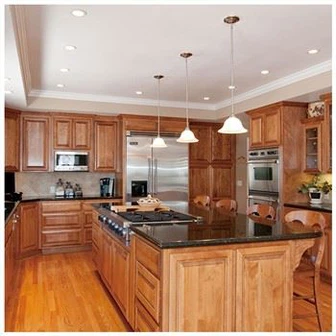
Walnut and oak bring warmth that plays well against blue, but the balance depends on how much blue the slabs carry. Deep navy slabs take rich wood tones; pale slabs under heavy wood lose the stone entirely. My rule: strong blue lot, wood is safe; pale lot, keep wood to the island or lower cabinets, and pair the wood sample with the slab under kitchen light.
Two combinations I avoid
Navy cabinets under a navy slab swallow the counter into the base, and dark charcoal fronts pull the blue toward black. Both work only in high-light monochrome rooms; for most projects, white, cool light gray, or warm wood is the safer contract.
Batch Locking and Arrival Checks before Cutting
Blue stones punish loose procurement more than beige ones, because the eye registers a half-tone shift instantly. Batch locking keeps every project piece inside one material population.
Lock the batch in the order file
Record the supplier, declared quarry area, block or batch reference, thickness, finish, and approved slab numbers; receiving compares that file against the delivery. For phased orders, reserve phase-two slabs at the same time, because a later reorder under the same name can come from a different block.
Arrival acceptance before anyone cuts
When crates arrive, I check every bundle label against the packing list and approval photos before the saw starts, dry-lay adjacent pieces to match veins and blue share at seams, and inspect each face in raking light for fissures or damage absent from the approval record.
If a slab disagrees with the record, three fixed steps
Stop work on the piece, photograph it with its slab number in the frame, hold all cutting and installation, then send the photos with the original approval and receiving records to the supplier before anything is fabricated. Photos taken before handling protect both sides.

Budget Paths: Engineered Quartz and Lower-Grade Lots
Not every project needs the natural stone. When budget or color requirements do not line up with current lots, I present the alternative honestly instead of forcing a mismatch.
Deep-blue engineered quartz when repeatability matters
Engineered quartz gives a uniform navy or repeatable pattern at a more predictable price and wins where many surfaces must match exactly, such as hotel bathroom runs. The trade-offs are real: the resin binder dislikes direct heat and strong solvents, and the pattern is designed rather than grown, so it lacks the depth of a natural blue band. For a hero island where color depth is the point, natural stone is usually worth it.
Lower-grade lots and coordinated tiles
A lower-grade lot with more white and grey still makes a calm, handsome kitchen and holds the color family on budget. Coordinating field tiles extend the look to backsplashes and floors, but they should come from the same production run as the slabs. Compare one tile against the approved slab before ordering.
1. Is azul macaubas quartzite the same stone as Azul Bahia granite?
No. Azul Macaubas is a metamorphic quartzite from Bahia, Brazil, with blue bands over a grey-white base and hardness around 7. Azul Bahia is a sodalite-bearing stone sold as granite, more saturated in royal blue and acid-sensitive. They suit the same rooms but behave differently in daily use.
2. Does azul macaubas quartzite stain or etch in a kitchen?
As a quartz-based stone it resists the acids that etch marble, so lemon, vinegar, and wine are not the risk they would be on calcite. Open or badly filled fissure lines can trap moisture and stains, which is why slab inspection matters. Use a pH-neutral stone cleaner and wipe spills promptly.
3. Why does every azul macaubas quartzite slab look different?
The blue comes from mineral inclusions that concentrate unevenly inside each block, so slabs from the same block can differ in blue share, background tone, and vein density. Approve numbered whole slabs in the actual finish, never a catalog image or a small sample.
4. Can I use this blue stone across a full kitchen, not just an island?
Both work, but layout matters more than square footage: a full kitchen needs enough strong slabs from one batch to keep the run consistent, with seams on calmer pieces. An island-only application lets one or two hero slabs carry the design and is easier when budget or lot is limited.
5. Which cabinets pair best with an azul macaubas quartzite countertop?
White, cool light gray, and warm wood tones are the reliable directions. Keep gray lighter than the lightest blue zone, use strong wood only when the lot carries deep blue, and avoid navy or charcoal fronts that swallow the counter. Check the finish sample against the slab under the room lighting.
Related Project Guides
Guides and programs that sit beside the blue slab decision, from the product range to the cabinet package that carries it.
Final Conclusion
Azul macaubas quartzite earns its place when the buying method matches the material: confirm the rock family, choose whole slabs for blue share rather than a hero photo, plan lighting and seams, pair the stone with cabinets that hold the contrast, and lock the batch so every piece comes from one population. Get those steps right and the blue reads as one continuous surface; skip them and the mismatch shows at every seam. KA UNITED keeps the slab approval, layout review, and matching cabinetry on one project file.
References
- Quartzite, Wikipedia.
- Dimension Stone Design Manual, Natural Stone Institute.
- ASTM C616/C616M, Standard Specification for Quartz-Based Dimension Stone, ASTM International.
- ASTM C615/C615M, Standard Specification for Granite Dimension Stone, ASTM International.
- ASTM C97/C97M, Standard Test Methods for Absorption and Bulk Specific Gravity of Dimension Stone, ASTM International.
- Kitchen & Bath Planning Guidelines, National Kitchen & Bath Association.
- Brazilian dimension stone trade and terminology notes, ABIROCHAS.
- Published Azul Macaubas, Azul Bahia, and Blue Pearl supplier datasheets (typical Mohs, absorption, and density ranges vary by lot).