FAQ: Everything You Need to Know Before Order Blue Bahia Granite
Why I Wrote This Ordering FAQ
I have spent years helping architects, contractors, distributors, and homeowners source natural stone, and I can tell you that the questions people ask before ordering are remarkably consistent. Everyone wants to know whether the stone is real, whether it will hold up, what it will cost to land it, and how to keep it looking good once it is installed. Blue Bahia Granite attracts more of these questions than almost any other material we handle, simply because it is rare, expensive, and easy to mislabel.
What follows is the FAQ I wish every buyer would read before committing to an order. It is written in plain language and covers the ground in the order that matters: origin first, then the technical numbers, then grading, fabrication, pricing, care, and shipping. If you read nothing else before ordering, read the section on verifying authenticity and the section on sealing. Those two topics account for most of the disappointment I see in the market.
I want to be clear about one thing at the start. This is not a sales pitch. It is a reference you can use to compare suppliers, check slabs, and ask better questions. Where I think a particular choice is safer, I say so plainly, and where I think you should test something yourself, I tell you to test it rather than trust my word.
Where Genuine Blue Bahia Comes From
What is the actual geological origin of the stone?
Genuine Blue Bahia Granite is a Brazilian blue stone tied to restricted extraction zones within the Bahia Shield, and most of the material I have worked with is connected to the region near Itaju do Colônia in Bahia. Depending on the market you buy in, you may see it listed as Blue Azul Bahia Granite, Azul Bahia Blue Granite, Bahia Azul Granite, Blue Azul Granite, Granite Azul Bahia, Brazilian Blue Granite, or Brazilian Exotic Granite. These are all the same family of stone, and the naming differences are mostly a matter of geography rather than geology.
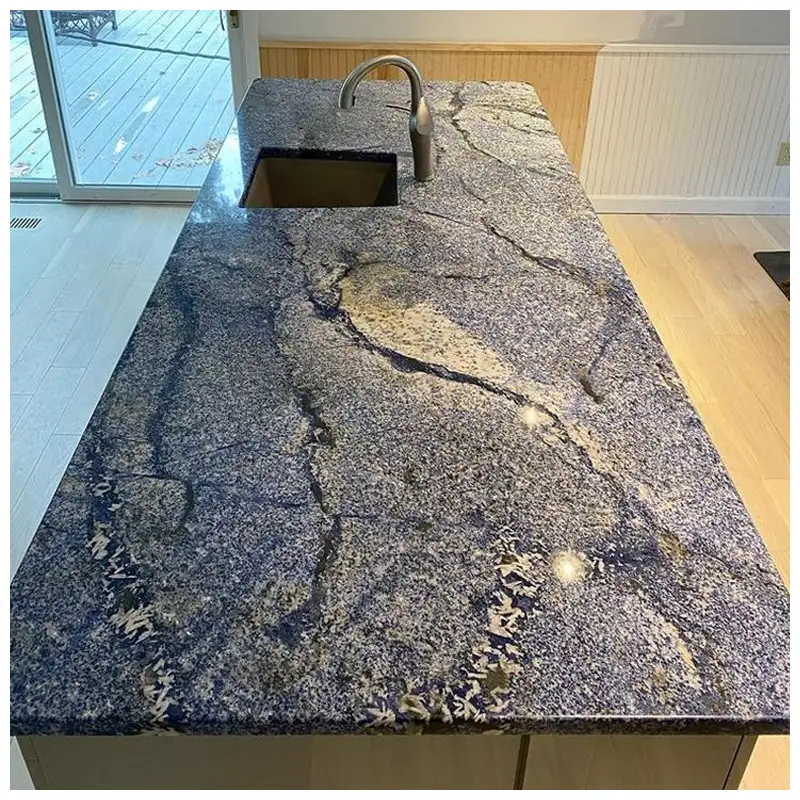
The reason the origin matters so much is that the stone's value sits in three things: an authentic blue mineral composition, genuine geological rarity, and verified slab quality. The rock formed through ancient tectonic activity in alkaline plutonic environments, which produced a mineral layout very different from the grey or beige granites most people are used to. The best slabs show a saturated royal-blue field, white crystalline movement, and dark mineral contrast, all under a polish that gives the surface a gem-like depth.
That rarity is the whole reason Blue Bahia is not priced like a standard black or grey granite. It is also the reason counterfeit material finds its way into the market. I have seen suppliers use the name Blue Bahia for dyed stone, for low-grade blue material, for blue quartzite, for engineered surfaces, and even for unrelated blue marbles. Before you order, ask for real slab photos, bundle identification, close-up mineral images, origin information, polish inspection, and supplier documentation. If a supplier will not provide these, treat that as a signal, not an inconvenience.
Which minerals give Azul Bahia its blue color?
The signature blue comes primarily from sodalite, a rare blue silicate mineral. Sodalite is what separates a genuine Blue Bahia from a stone that merely looks blue in a photograph. The white veining and crystalline movement you see across the surface is generally feldspathic material, most commonly microcline feldspar, while the dark grey to black clusters are usually biotite or related mafic minerals.
What makes a slab beautiful is how these three elements sit together. Sodalite builds the deep blue field. Microcline feldspar creates the white structure and movement. Biotite and its darker relatives add shadow and depth. The best slabs balance all three, with enough blue to feel rare, enough white to create motion, and enough dark contrast to anchor the surface without overwhelming it. When I evaluate a slab, I am looking at mineral distribution as much as color, because mineral quality affects both the look and the structural stability of the piece. Heavy fissures, excessive dark clustering, and unstable white zones all reduce value, and no amount of clever photography fixes that.
The Numbers You Should Ask For
Blue Bahia is bought for its looks, but I always encourage buyers to review the engineering data before confirming a project order. This matters most for countertops, vanity tops, bar tops, floor tiles, wall panels, and staircase elements, where the stone has to earn its keep structurally. Below is a reference table I share with clients. Keep in mind these are reference ranges, not guarantees, and the exact numbers shift with the mineral zone and the individual block.
| Performance Item | Premium Azul Bahia Granite Reference | Premium Quartzite Reference | Luxury Blue Marble Reference | Buyer Interpretation |
|---|---|---|---|---|
| Mohs Hardness | Approx. 5.5–6.5 depending on mineral zone | Approx. 6.5–7 where quartz-rich | Approx. 3–4 for many calcite-based marbles | Blue Bahia is generally more durable than many blue marbles, though polished surfaces still need scratch protection. |
| Water Absorption Rate | Approx. 0.08%–0.20% target range for selected dense material | Usually low, but varies by fissure structure | Often higher and more variable | Low absorption supports use in bathrooms, bars, kitchens, and high-traffic commercial interiors. |
| Compressive Strength | Often specified above 131 MPa reference for granite dimension stone | Often strong, depending on foliation and fissure behavior | Usually lower than dense granite and quartzite | Useful for evaluating heavy counters, large slabs, wall panels, and shipping safety. |
| Flexural Strength | Project-specific testing recommended; generally stronger than many blue marbles | Often strong but affected by natural layers | More vulnerable to bending stress and edge damage | Important for transit, lifting, thin panels, cutouts, and large-format installation. |
| Density | Approx. 2.56–2.75 g/cm³ project reference range | Often high where quartz-rich | Variable and often lower than dense granite | Higher density helps stability but requires careful packing, lifting, and substrate support. |
That water absorption range of roughly 0.08% to 0.20% is the number I point to most often, because it is what makes the stone practical in a busy bar or a hotel bathroom when it is sealed and installed correctly. Low absorption means fewer subsurface moisture traps, less staining, and less liquid penetration than you would get from a more porous decorative stone. If you are weighing this material against a man-made alternative, our quartz countertops page explains the other end of the spectrum, and the kitchen countertop material guide walks through how natural and engineered options compare side by side.
Is Blue Bahia a highly porous stone?
No, not when you select dense premium slabs and finish them properly. But I would not call it stain-proof either. Sodalite-rich zones, feldspar movement, resin-filled fissures, and natural micro-porosity can all absorb liquids at slightly different rates across the same slab, which is why a good sealer is still worth applying for countertops, vanity tops, and bars. A serious factory will usually apply initial treatments such as resin consolidation, mesh backing where needed, micro-fissure filling, and high-mesh mirror polishing to stabilize the slab before it ships. Those steps do not erase the stone's character; they make it safer to fabricate and install. Ask your supplier whether resin treatment is visible, whether the polish is consistent, and whether the slab was inspected for fissure behavior before it left the factory.
Grading, Matching, and Why One Block Matters
How is Azul Bahia graded?
Grading is based on color depth, blue continuity, white movement, black mineral distribution, slab size, structural stability, polish quality, and overall visual harmony. The most expensive slabs are not just blue; they show a strong, balanced blue identity that is hard to find in large usable blocks. Broadly, I group the material into three tiers. Extra Grade shows deep, continuous royal blue with clean crystalline movement and limited disruptive black clusters, and it is the tier reserved for luxury islands, executive desks, hotel lobbies, and book-matched walls. Standard Grade carries a balanced blue with visible white veining and moderate black contrast, which suits commercial walls, luxury bathrooms, and countertops. Commercial Grade has more black biotite, more grey feldspar, and more visible fissure or pattern interruption, and it is best used for accent walls, tiles, and smaller cut-to-size formats.

One thing I always warn buyers about is that grading vocabulary is not standardized. One supplier's premium may be another supplier's standard grade. The safest approach is to review the actual slabs rather than trust catalog names. Compare full-slab photos, close-up mineral details, edge quality, polish depth, and batch consistency before you commit.
Why does sourcing from a single block matter?
Natural stone varies by extraction zone, block, cutting direction, and mineral distribution, and this variation is especially visible in Blue Bahia. Two slabs cut from different blocks can look like two different stones, with one reading as deep royal blue and the other as grey-blue or black-heavy. Under strong lighting, the mismatch only becomes more obvious. For book-matched walls, vein-matched counters, long reception desks, hotel bathroom sequences, and multi-room villa installations, single-block or single-lot sourcing is the difference between a cohesive result and a patchy one. If you are planning a large project, ask your supplier to review slab sequence, color grouping, and layout logic before shipping.
Blue Bahia vs. Blue Marble and Onyx
The most useful comparison I can give you is not about color; it is about chemistry. Many blue marbles are calcite-based or dolomitic, which makes them vulnerable to acid etching from lemon juice, vinegar, wine, alcohol, and commercial cleaning chemicals. Blue Bahia is generally more resistant in normal interior use, although it still needs pH-neutral cleaning and proper sealing. In a busy hospitality bar, this difference shows up quickly. A blue marble bar top can develop dull spots within months of exposure to citrus cocktails and cleaning sprays, while Blue Bahia holds up better when sealed and maintained.
Onyx is a different story again. Blue onyx can look spectacular, especially backlit, but it is much softer and more fragile than dense Blue Bahia. I would reserve onyx for decorative, low-impact vertical surfaces and protected interiors, and I would not put it under a heavy bar or a public-facing vanity. If you need blue color with practical durability, Blue Bahia slabs are the more stable choice. The point I always make is that the correct comparison is not maintenance-free granite versus fragile marble; it is that a blue exotic granite gives you a stronger structural and chemical foundation than most blue marbles, while still asking for professional care.
Fabrication and Installation
What installation mistakes cause discoloration?
Most discoloration and shadowing I see comes from installation choices, not from the stone. Standard dark epoxies, grey thin-set, oil-rich adhesives, and low-quality fillers can create dark shadows under the lighter crystalline zones, especially in polished or illuminated installations. For premium Blue Bahia, use pure white, non-staining, stone-compatible adhesives, and make sure the substrate is dry, stable, clean, and correctly leveled. Wet substrates push moisture into the stone and cause dark patches, yellowing, or efflorescence. In bathroom walls, spa areas, and exterior-adjacent interiors, confirm waterproofing and vapor control before the first slab goes up. The practical rule is short: white adhesives, dry substrate, proper drying time, and a compatibility test before full installation.
Can it be fabricated with waterfall drops and custom edges?
Yes. Blue Bahia can be fabricated with custom edge profiles, waterfall drops, mitered edges, bar tops, vanity tops, reception counters, stair treads, wall panels, and furniture components. The catch is that this is valuable stone, and it can carry natural fissure zones, so fabrication requires skilled cutting, correct tooling, and careful handling. Water-jet machinery, bridge saws, CNC equipment, and proper diamond tooling all help, and mitered joints need precise cutting and reinforcement to reduce edge chipping. For countertops, plan sink cutouts and cooktop openings carefully, because sharp inside corners become stress points. If you are still deciding between natural stone and engineered surfaces for a kitchen, the material guide I linked earlier is a good place to start.
Pricing and Sourcing Direct
The square-meter cost of Azul Bahia in 2026 is driven by rarity, block yield, extraction limits, blue saturation, slab size, usable area, resin treatment, polish quality, thickness, finish, fabrication complexity, packing, freight, and destination market. Extra Grade deep royal-blue slabs cost substantially more than commercial-grade slabs with heavy black clusters or grey feldspar areas, and that gap comes down to sorting yield. Not every extracted block produces high-value slabs; some carry excessive fissures, uneven color, or limited size, which means the usable premium yield is a small fraction of the total extracted volume. That is the single biggest driver of price pressure in this material.
Shipping then shapes the landed cost. Maritime freight rates, container availability, port congestion, fuel, insurance, customs, inland delivery, and crate weight all matter, which is why I always tell buyers to calculate landed cost rather than compare factory quotes. A lower quotation is not better if the packing is weak, the inspection is incomplete, or the supplier cannot support replacement and documentation. Ordering through a direct exporter can remove mid-tier broker margins and, more importantly, put you in direct contact with the production and export side, so you can discuss slab selection, cutting plans, packing standards, and inspection requirements in one conversation.
Sealing and Daily Care
How often should the stone be sealed?
In residential kitchens, I suggest checking sealing performance about every 12 months. In high-use commercial areas such as hotel bars, restaurant counters, and public vanities, check every 3 to 6 months. Actual frequency depends on finish, cleaning products, spill exposure, traffic, sealer quality, and maintenance discipline. I prefer a high-quality fluorocarbon-based impregnating sealer over traditional silicon-based topical sealers, which can yellow under UV light or form an uneven film that dulls the crisp blue tone. An impregnating sealer penetrates the micro-pores without building a thick coating, but always test a small area first to make sure the sealer does not darken the slab or leave haze.
What cleaning products are safe?
Stick to pH-neutral stone cleaners, warm water, and soft microfiber cloths. Mild dish soap diluted in water is fine occasionally, as long as you rinse and dry afterward. Avoid vinegar, lemon cleaner, bathroom descaler, ammonia glass cleaner, bleach-heavy products, abrasive powders, scouring pads, rust removers, and acidic commercial agents. I have seen more polished surfaces damaged by years of the wrong daily cleaner than by any single spill. Use cutting boards, coasters, and felt pads, and do not drag metal or ceramic objects across the surface.
Packing, Shipping, and Quality Checks
Premium Blue Bahia should travel in heavy-duty export packing built for dense, high-value stone. For slabs, that means fumigated wooden A-frames reinforced with strong internal bracing; for cut-to-size pieces, crates with foam protection, separators, corner guards, and moisture protection. Polished faces should be separated with polyethylene foam to prevent friction scratches. Wood packaging should meet ISPM-15 standards, which helps avoid customs delays in many European, American, and Middle Eastern ports, and crates should carry the required treatment markings.

Before the container is loaded, verify quality digitally. Ask for high-definition slab mapping, close-up photos, videos, bundle numbering, color grading, thickness checks, polish review, edge inspection, resin evaluation, and dry-lay videos where relevant. For large projects, third-party inspection before shipment is worth the cost. All of this should connect to cargo insurance, packing records, loading documents, commercial invoices, and packing lists, because if a claim becomes necessary after arrival, pre-shipment records are what make the case winnable. A dependable supplier makes the whole process traceable, and for rare stone, trust should rest on photos, documents, and measurements rather than product descriptions alone.
Frequently Asked Questions
Is Blue Bahia granite porous?
Blue Bahia is not generally considered highly porous when you select dense premium slabs and finish them correctly, but it should still be sealed for countertops, vanity tops, bars, and commercial surfaces. Its absorption rate sits in a low range compared with many softer decorative stones, yet natural micro-fissures and different mineral zones can absorb liquids at different speeds. The safe approach is to test the exact slab, apply a quality impregnating sealer, and clean with pH-neutral products.
What mineral gives Azul Bahia its blue color?
The vibrant blue comes mainly from sodalite, a rare blue silicate mineral. White crystalline movement is typically microcline feldspar, while black or dark grey clusters usually come from biotite or related mafic minerals. The balance between blue sodalite, white feldspar, and dark contrast determines the slab's grade, depth, and value, which is why full-slab photos matter more than a small sample.
How do you verify an authentic Azul Bahia slab?
Request real full-slab photos, close-up mineral images, bundle numbers, supplier documentation, origin information, and videos under natural light. Genuine high-grade slabs show natural sodalite-rich blue, crystalline white movement, dark contrast, and a polished depth that dyed or artificial substitutes cannot fully replicate. For large orders, also ask for slab mapping, thickness checks, resin inspection, dry-lay review, and pre-shipment photos.
Is Azul Bahia Granite suitable for kitchen countertops and bar tops?
Yes, when the slabs are properly selected, fabricated, sealed, and installed. It generally offers stronger durability than many blue marbles and more structural confidence than translucent onyx, but it should still be protected from harsh acidic cleaners, abrasive pads, and poor installation adhesives. Before fabrication, confirm slab thickness, cutout details, edge profile, support structure, and the sealing plan.
Where can I buy Blue Bahia Granite slabs for an international project?
Source from a professional manufacturer, supplier, or exporter that can provide real slab photos, grading information, inspection support, packing standards, and logistics documentation. KA UNITED supports overseas importers, contractors, distributors, hotel developers, design studios, and fabricators with slab selection, tiles, countertops, custom fabrication, export packing, and container shipping coordination.
Final Conclusion
Ordering Blue Bahia Granite is about more than choosing a beautiful blue stone from a photograph. The order that goes smoothly is the one where origin, grade, mineral composition, slab sequence, finish, resin quality, packing, logistics, installation, and maintenance were all confirmed before the container was loaded. Work through the checklist, request the slab photos and documents, and treat the material as the long-term architectural asset it is. That discipline, more than any single tip, is what protects a project and its budget, and it is the standard I bring to every order at KA UNITED.