Top 2026 Kitchen Design Trends Featuring Taj Mahal Quartzite
Top 2026 Kitchen Design Trends Featuring Taj Mahal Quartzite
I spend most of my working week standing in front of stone slabs, and over the last year I have watched a quiet change take hold in how kitchens are being specified. The 2026 kitchen is no longer chasing a single loud trend. It is being built around restraint, texture, and material intelligence, and Taj Mahal Quartzite has become the stone that carries all three. The material brings warmth without visual weight and genuine strength without looking industrial, which is a rare combination in a market where most buyers still assume they have to choose between beauty and durability.
My job at KA UNITED puts me in the middle of that decision every day. Buyers come to me asking for a countertop, but what they are really describing is a kitchen identity that has to flow across an island, a backsplash, a floor, and sometimes a wall or a piece of furniture. Taj Mahal Quartzite is one of the few materials that can do that without breaking stride, and that is why the slab, the tile, and the countertop version of it have all moved into the same design conversation over the past twelve months.
The Quiet Luxury Shift Behind the 2026 Kitchen
Why warm minimalism now beats sterile white
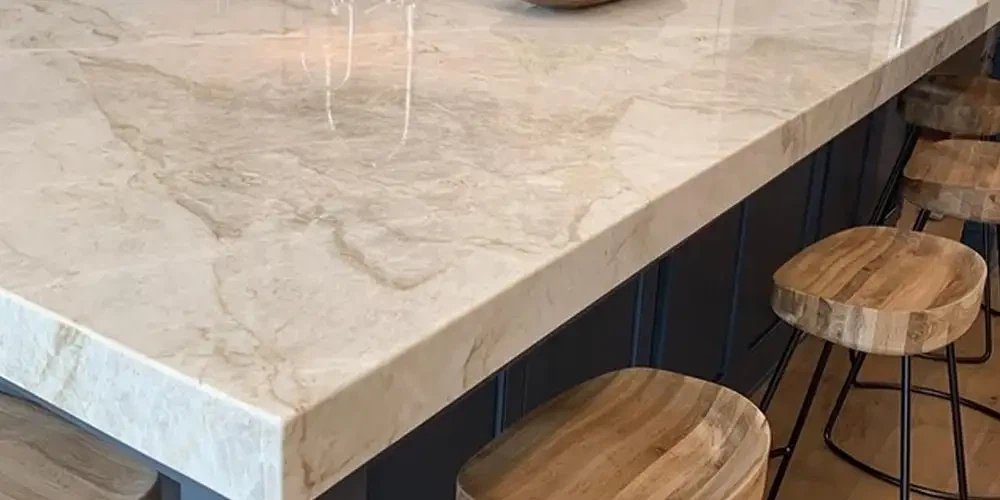
The dominant aesthetic of the 2026 kitchen is warm minimalism, and it is a direct reaction against the cold, all-white rooms that dominated the previous decade. Homeowners are no longer asking for a space that looks clean in a photograph. They are asking for a room that feels calm and settled when you walk into it at seven in the morning. That means layered neutrals, natural texture, and surfaces that reflect light quietly instead of glaring back at you.
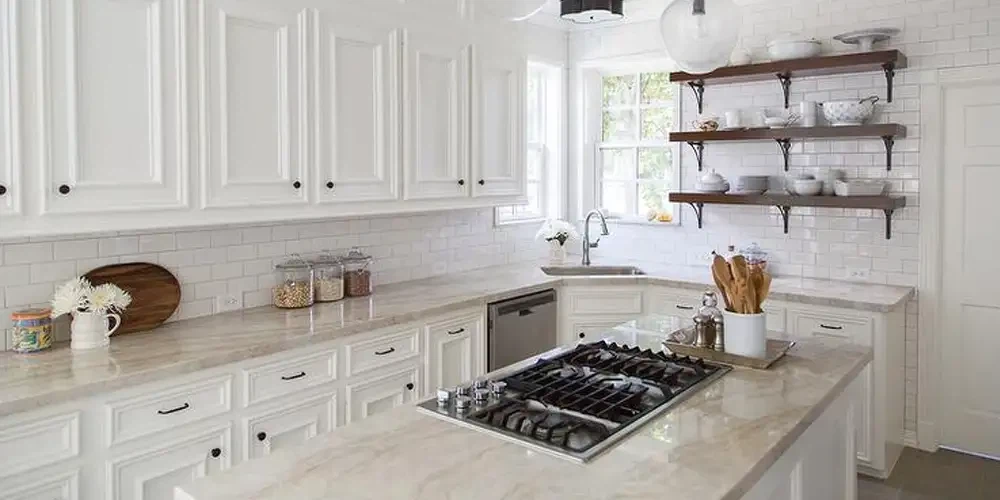
This is exactly the environment where Taj Mahal Quartzite works best. Its beige-cream body brings warmth into the room, while the crystalline depth keeps the surface from reading as flat or plain. It supports a kitchen that feels mature and quietly expensive without becoming dramatic or over-decorated. Warm minimalism only works when every element looks intentional, and the countertop is usually the element that carries the room. A stone with too much movement overwhelms the design. A stone with too little character feels generic. Taj Mahal sits in the useful middle.
The role of natural texture
In 2026, buyers want materials that feel grounded and sensory rather than printed and perfect. Quartzite answers that desire because it offers what I call tactile realism. The eye can read the mineral body, the hand can feel the finish, and the room registers the stone as authentic rather than manufactured. That is a meaningful difference for homeowners who have grown tired of engineered surfaces that look the same from three feet away.
The trend also reflects a broader move away from visual noise. Busy, cluttered kitchens are giving way to rooms that feel restful and lightly sculptural. When the island, the backsplash, and the surrounding cabinetry all speak the same tonal language, the room reads as both more expensive and more liveable at the same time. That balance is hard to fake, and it is one of the reasons quartzite keeps showing up in 2026 kitchen countertop trends.
Taj Mahal Quartzite as the neutral anchor
Taj Mahal Quartzite is especially strong as a neutral anchor because it supports both contrast and tone-on-tone layering. It can make a creamy palette feel richer, a dark cabinet plan feel more balanced, and a wood-based kitchen feel more organic. A good design team does not just ask what color the countertop is. It asks what the countertop allows the rest of the room to do. Taj Mahal gives the cabinetry and the hardware more room to breathe, and that flexibility is why the stone appears in so many different kitchen styles without looking out of place in any of them.
Where the Stone Comes From: The Brazilian Shield
Ceará and Bahia, and why geology matters
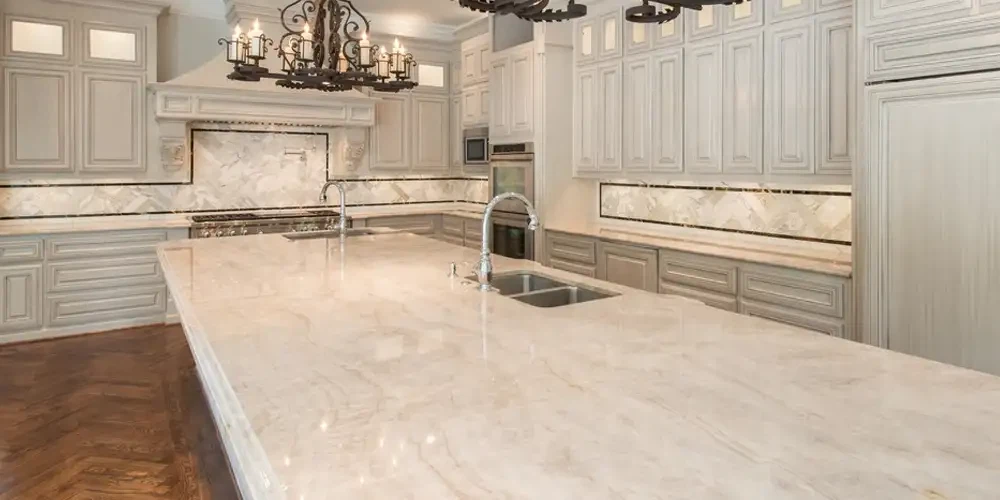
The beauty of Taj Mahal Quartzite starts in Brazil, where the mineral history of the Ceará and Bahia regions produced blocks with strong quartz purity and elegant tonal behavior. The stone formed through metamorphic pressure and heat that transformed sandstone into a much denser, more crystalline quartzite body. That geological process is what gives the material its soft translucency on the surface and its hard technical backbone underneath.
The result is a stone that feels warm in color but serious in performance, and it is one of the reasons buyers often classify it as a beige exotic quartzite rather than a simple beige stone. The quartz content is what delivers the crystalline clarity and the resilience. When you understand that origin, you start to understand why the stone costs what it does and why two slabs from two different blocks can behave very differently even when they look similar.
What true quartzite actually means
Not every stone sold as quartzite behaves like true quartzite. Some softer trade materials borrow the quartzite label without carrying the same hardness or the same low absorption. That is why working with a supplier who understands block grading matters. A serious operation selects higher-grade material for projects where visual consistency and performance both count, and it is willing to explain how one block face was chosen over another and how the slab family will behave once it is cut.
That explanation matters when the order includes a large island, a coordinated backsplash, or matching wall features. The chain from quarry to slab is where the real value of the stone is created, and a supplier who cannot walk you through it is probably not the supplier you want handling a large-format kitchen package.
Block-to-slab consistency
Buyers planning a full kitchen need predictable results from slab to slab, because a kitchen is rarely built from a single piece. A large island and a matched backsplash demand continuity that only shows up when the block selection and the cutting were done deliberately. This is the practical difference between buying stone and buying a material system, and it is the difference that separates a premium quartzite distributor from a reseller who is simply moving boxes.
The Numbers That Explain the 2026 Preference
I keep a short technical table in my head for Taj Mahal Quartzite, because it frames nearly every sourcing conversation I have. These are practical reference ranges rather than guarantees, and actual values shift with the block, the slab, the finish, and the testing method. For a major project, always ask for project-specific test data before you commit. The direction of the differences, though, is what matters most.
| Physical Property | Taj Mahal Quartzite | Premium Granite | Calacatta Marble |
|---|---|---|---|
| Mohs Hardness | 7.0 – 7.5 | 6.0 – 6.5 | 3.0 |
| Water Absorption | 0.02% – 0.08% | 0.15% | 0.20% – 0.50% |
| Acid Sensitivity | Zero (non-etching) | Low | Very high |
| Density (kg/m³) | 2,650 – 2,680 | 2,630 | 2,710 |
| Flexural Strength | High | Moderate | Low |
| Heat Response | Excellent | Good | Poor to moderate |
The number I care about most is the absorption rate. A range of 0.02% to 0.08% is why a premium quartzite supplier can recommend the stone for heavy-use kitchens, especially in open-plan homes where spills, steam, and high heat are part of everyday life. That technical stability is one reason quartzite factory sourcing stays attractive to developers and contractors who want a lower-risk luxury surface. In plain terms, the stone gives the look people expect from marble, but it behaves more like a high-performance natural mineral. That is why so many buyers now compare Taj Mahal Quartzite against Calacatta marble instead of simply asking whether quartzite is attractive.
Big Slabs and the Continuous-Surface Look
The monolithic island
One of the defining 2026 kitchen design trends is the monolithic island, where a large slab is installed as a waterfall piece to create a single sculptural object rather than a conventional work surface. This is where Taj Mahal Quartzite becomes especially powerful. The stone's calm movement and soft warmth make the island feel architectural rather than decorative, and the wider the slab, the fewer visible joints you have to live with.
Achieving that continuous grain flow from the countertop down through a waterfall edge requires exceptionally large slabs. That is why we import more than 300 containers of high-quality raw blocks from Brazil every year, and why we deliberately select jumbo-size blocks that yield slabs exceeding 3,000 millimeters in length. That scale lets designers execute the large 2026-style islands with a clean run of stone and a minimum of mid-surface joints, preserving the stone's natural rhythmic movement.
Vein-cut versus cross-cut
Vein-cut and cross-cut surfaces create very different visual effects, and the choice should reflect the cabinet style and the geometry of the room. Vein-cut slabs produce a directional sense of movement that works well in modern, linear kitchens. Cross-cut slabs soften that movement into a cloudier, more diffuse appearance. When a kitchen uses flat-panel cabinets and thin brass pulls, vein-cut can sharpen the look. When the room uses shaker cabinets and warm wood, cross-cut can feel softer and more relaxed. This is a conversation you need to have before the order is finalized, because it changes how the entire room reads.
Honed and leathered finishes
The textured-finish movement is strong in 2026. Honed and leathered quartzite are overtaking high-gloss in many high-end kitchens because they feel more tactile and less reflective, and they reduce glare while helping the stone sit more naturally alongside timber, linen, and matte hardware. Taj Mahal Quartzite performs beautifully in a honed or leathered finish, which is another reason it reads as a warm, low-noise surface in kitchens that prioritize calmness over shine.
Quartzite Against Marble and Granite
The practical marble alternative
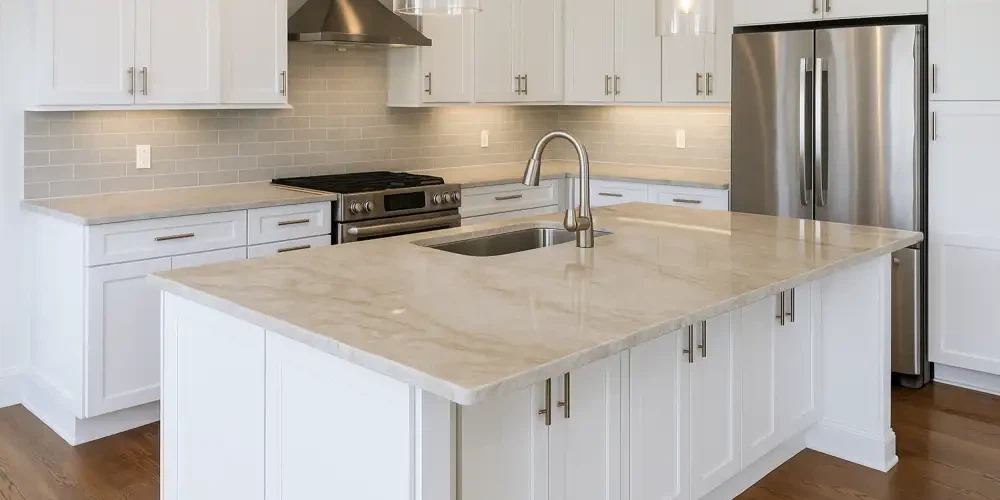
For many buyers, Taj Mahal Quartzite is the preferred alternative to more delicate Italian marbles. It offers a similar white-marble aesthetic with far less maintenance pressure and a much stronger surface profile, and that matters in kitchens where acids, oils, wine, and heat are part of daily use. The difference is not purely technical either. It affects how the room ages over time. Marble can develop etching and surface fatigue after years of contact with citrus and wine, while quartzite tends to retain a cleaner, more resilient look.
What real daily wear does
Wine and lemon juice can leave visible marks on marble in a matter of minutes. Quartzite handles those exposures much more effectively, particularly when it is sealed properly, and its resistance to thermal shock makes it a better fit for serious cooking than many softer stones. That is the difference between a surface you have to protect and a surface you can actually use.
The white look without the maintenance load
Many clients want the white or creamy marble look but do not want the upkeep that comes with it. A knowledgeable supplier solves that by specifying the correct grade, finish, and fabrication route, which gives the kitchen the softness and elegance buyers want while leaving the homeowner with a surface that is far more forgiving day to day. If you are weighing these options, our kitchen countertop material guide lays out how quartzite compares to quartz and other worktop materials on the points that actually matter in a working kitchen.
Beyond the Countertop: Integrated 2026 Features
Integrated sinks
One of the strongest luxury features of 2026 is the integrated sink, carved or fabricated to match the countertop system so the whole surface reads as a single plane. Taj Mahal Quartzite countertops can be paired with sinks made from the same material family, and the result feels custom, quiet, and expensive. The same idea extends naturally into bathroom and wet-zone design, where a coordinated vanity top carries the material language from the kitchen into the rest of the home.
Book-matched backsplashes
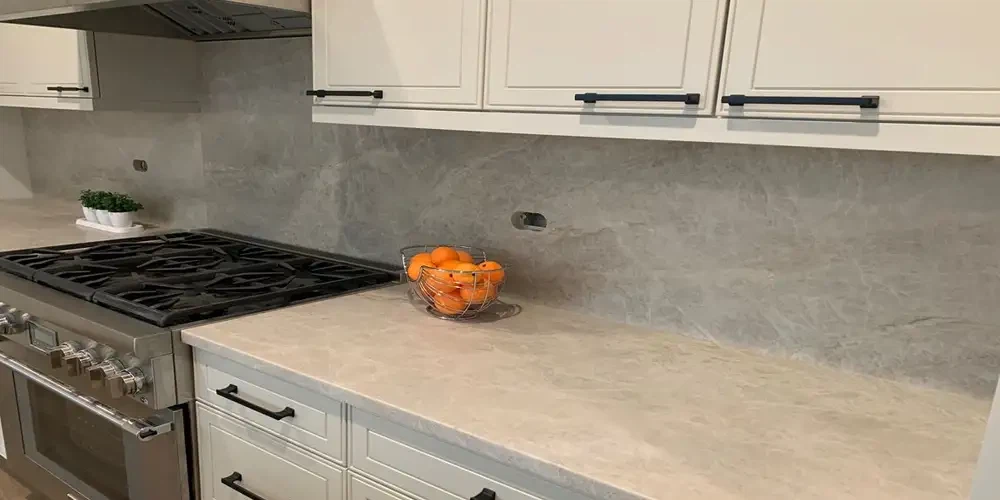
Book-matched backsplashes are now one of the clearest forms of stone art in a modern kitchen, turning the wall behind the range into a focal point rather than a background surface. When executed well, the result is soft, bright, and highly refined, but the pattern alignment and the cut direction determine whether the backsplash reads as polished luxury or just expensive tile. This is where experienced fabrication matters more than the stone itself.
Backlit panels
Taj Mahal is not an onyx, but its translucent qualities can still be enhanced with careful backlighting in the right applications, especially in evening bar areas, niche walls, and decorative panels. The effect is a subtle glow rather than a dramatic lit wall, which suits the stone's calm nature. For projects that want full-surface continuity, wall cladding tiles and floor tiles can be coordinated in the same room so the entire space feels unified.
Installation and Engineering Standards
The substrate requirement
Quartzite is dense and heavy, which means the cabinetry and the wall systems have to be prepared correctly before installation begins. The substrate has to support the weight of the stone without allowing deflection or movement, and this is especially important for large islands, long backsplash runs, and full-height cladding. A responsible distributor should explain those support requirements before the material ships, because a stone that is beautiful but badly supported will eventually fail somewhere, and that failure always costs more than the preparation would have.
Adhesives and shadowing
Shadowing is a common concern with light natural stone. To prevent it, installers should use white, moisture-neutral setting materials that will not bleed through the slab and show through the finished face. This is a critical part of the process for light-colored quartzite, and it is the kind of detail that separates a clean installation from one that looks fine on day one and wrong six months later.
Mitered monolith edges
Mitered edges are one of the signature details of 2026 luxury kitchens, because they make a relatively thin stone appear thick and monolithic and give the island more visual weight. The edge profile has to be cut precisely and aligned carefully, or the illusion breaks the moment you look at the corner. I have learned to treat the miter as a fabrication test: if a shop cannot show you a clean mitered corner, I would not trust it with a waterfall island.
Pricing, Sourcing, and Long-Term Value
What actually drives the price
The price of Brazilian quartzite slabs in 2026 is shaped by block quality, slab size, finish, yield, freight, demand, and project scale. Cleaner, more consistent slabs cost more because they waste less material during cutting and produce a better final result, and buyers should think in terms of landed project value rather than a simple cost per square meter. A cheaper block can easily become an expensive one the moment several slabs crack or fail grading after cutting.
Factory-direct sourcing
A direct exporter can reduce both lead times and costs by removing unnecessary distribution layers, which is especially useful in large residential and hospitality projects where timing matters. Factory-direct sourcing usually gives the buyer better control over grading, packaging, and shipment scheduling, and it is one of the reasons we run a direct Brazil-to-Shuitou pipeline rather than buying through middlemen.
Investment and lifecycle value
In luxury real estate, Taj Mahal Quartzite can support appraisal value because it signals long-term quality and considered taste. Buyers can tell the difference between a fast remodel and a carefully specified stone interior, and a kitchen finished in quartzite usually reads as more durable and more expensive than one finished in more common materials. Quartzite is often treated as a 50-year material, while many man-made surfaces are replaced far sooner, and that lifespan difference is one of the strongest financial arguments for the stone.
Sustainability and Maintenance
Clean quarry sourcing
The 2026 clean-quarry expectation is part of a broader demand for traceable, responsible sourcing. Buyers increasingly want to know where the stone came from, how it was handled, and whether the extraction and processing chain met labor and environmental expectations, and a serious supplier should be able to answer those questions directly rather than waving them off.
LEED v5, WELL, and low-VOC
Natural stone supports high-performance building narratives because of its long life cycle and low-VOC profile. Quartzite is especially attractive because it is not resin-heavy and can be specified as a durable, low-replacement material, which matters in projects pursuing LEED v5 or WELL-oriented outcomes. At the wholesale level, buyers are also comparing the footprint of natural stone against engineered quartz, which often carries more resin and higher manufacturing complexity. Natural quartzite offers a longer lifespan and fewer replacement cycles, which can support a lower long-term material burden.
Sealing, daily care, and a 50-year horizon
Maintenance should stay simple. A pH-neutral cleaner, a soft cloth, and sensible spill cleanup are all a busy kitchen really needs, and modern nano-impregnating sealers extend protection over time without turning care into a ritual. I tell clients to think of sealing as a 15-year conversation rather than an annual chore: seal at installation, then test the surface periodically with water beads and reapply only when the protection starts to fade. A surface that lasts longer and ages more gracefully usually delivers better life-cycle cost, and that is the quiet advantage of a stone like this one.
Frequently Asked Questions
Is Taj Mahal Quartzite more expensive than granite in 2026?
Usually yes, especially at the cleaner grades. Taj Mahal Quartzite often costs more than many standard granites because it is rarer, more highly desired in luxury kitchens, and more demanding to quarry and process. The price difference is also shaped by block quality, slab size, finish, freight, and project scale, so it is worth asking for a specific quote rather than assuming a fixed premium.
Does Taj Mahal Quartzite need to be sealed?
Yes, but not heavily. Even though quartzite has very low absorption, sealing helps preserve the finish and reduce long-term stain risk. A modern schedule usually includes an initial sealing followed by periodic water-bead testing, so the owner knows when the protection needs refreshing. It is a manageable routine rather than a constant burden.
Can I use Taj Mahal Quartzite outdoors?
In many cases, yes. Quartzite has strong UV stability and handles sunlight better than many stones, but outdoor use still depends on the finish, the climate, the installation method, and the freeze-thaw environment. A qualified supplier should evaluate the specific outdoor application before approving the specification.
How does Taj Mahal Quartzite compare to marble for kitchens?
It gives a similar refined look while performing much better under daily use. Quartzite resists heat and acid more effectively, shows less etching, and generally offers a better life-cycle profile. For a homeowner who wants a marble-like aesthetic without the maintenance load, quartzite is usually the more practical choice.
What colors work best with Taj Mahal Quartzite in a 2026 kitchen?
The strongest palettes include cream-on-cream, warm oak, walnut, sage green, navy, charcoal, and soft greige. The best colors are the ones that let the stone's beige-gold body stay visible while supporting the tone of the room. Designers are using color to frame the quartzite rather than compete with it.
Final Conclusion
Taj Mahal Quartzite has earned its place as one of the defining surfaces of 2026 luxury kitchen design because it delivers a rare mix of warmth, refinement, strength, and adaptability. It works as a countertop, a backsplash, a feature wall, a floor, and an integrated feature without losing its calm identity, and that flexibility is exactly what today's high-end kitchens need. The material's real value is not just visual; it is architectural. It helps the room feel coherent, durable, and quietly expensive, whether the project uses a monolithic island, a book-matched backsplash, or a spa-like floor-to-wall layout. For buyers, the takeaway is simple: choose the stone with the numbers and the origin to back up the look, and you get a kitchen that holds up as well as it photographs. That is the standard I work to every day at KA UNITED.