



Black White Marble Checkerboard Tiles
Premium black white checkerboard marble tiles, precisely cut from Nero Marquina black marble and Bianco Carrara white marble. Polished glossy finish, classic chessboard pattern, suitable for high-end interior flooring and wall cladding. Ideal for villas, hotels, lobbies and upscale residential spaces.
Item: Factory Supply Pre-Patterned Black White Marble Floor Tiles for Luxury Residential & Commercial Projects
Material: Nero Marquina Marble, Bianco Carrara Marble
Tile Size: 600x600,600x300, 300x300 mm, etc.
Thickness: 20,30mm
Surface: Polished, Honed, Brushed
MOQ: 100 SQM
Grey Marble Factory: KA UNITED
Application: Marble Tiles For Indoor and Outdoor Floor, Wall and other Commercial Projects
Product Introduction
Quick Summary: Black White Marble Checkerboard Tiles are a two-stone flooring collection made from Nero Marquina black marble and Bianco Carrara white marble. Alternating square tiles create a clear geometric pattern while retaining the natural veins and tonal variation of both marbles. Available in 300 × 300 mm and 600 × 600 mm formats with an 18 mm nominal thickness, the tiles can be specified for residential entrances, interior corridors, decorative floors and selected commercial spaces. Pattern geometry, material thickness, substrate preparation and slip-resistance requirements should be confirmed before project installation, particularly where a polished finish is requested.
Black White Marble Checkerboard Tiles for Villa Floors, Hotel Interiors and Decorative Wall Designs
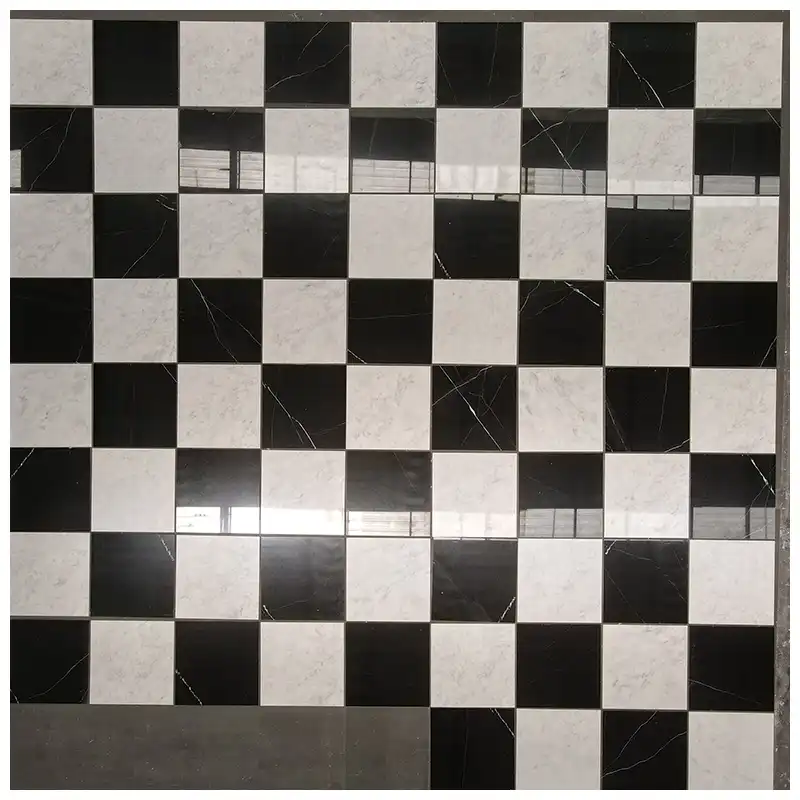
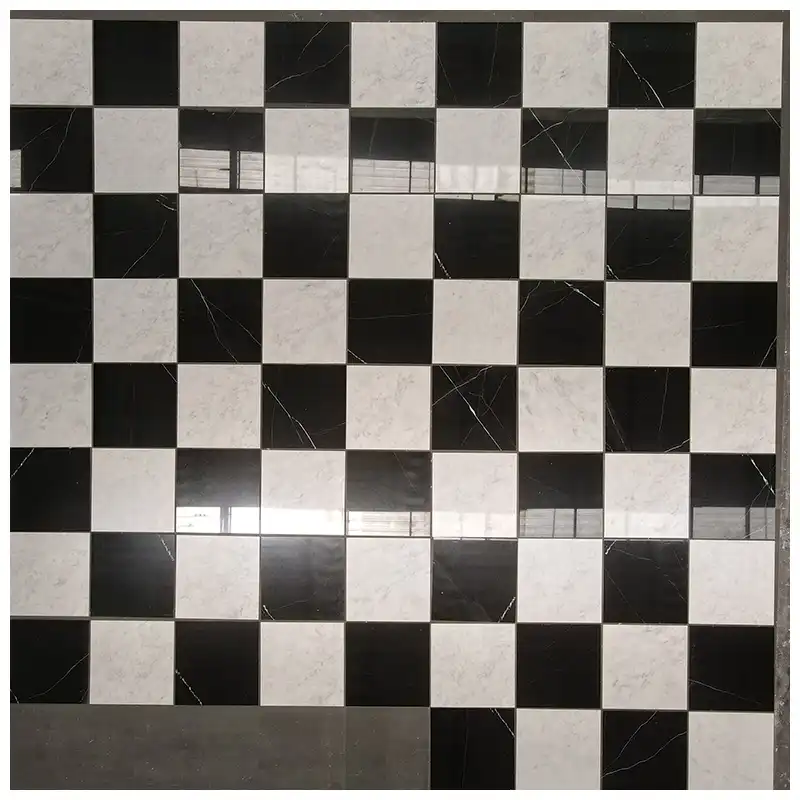
Nero Marquina and Bianco Carrara form an alternating square marble pattern.
A checkerboard stone floor has a distinctly architectural character. Every square participates in the overall composition, so the floor reads as an ordered pattern rather than a collection of individually decorative tiles. Black and white marble brings natural mineral variation into that geometry without weakening the contrast between the two colors.
Marble Checkerboard Floor Tiles can be incorporated into private villa foyers, mansion hallways, apartment entrances, hotel reception areas and boutique commercial interiors. The same square format may also be used as decorative wall cladding, particularly for entrance walls, hospitality feature areas and coordinated floor-to-wall schemes.
Unlike a stone medallion built around a central illustration, checkerboard flooring is modular. The square pattern can continue across a large open room, stop at a border or turn to another direction at a threshold.
Designers can choose a conventional grid aligned with the room or rotate the grid diagonally. The selection changes the appearance of the installation and the amount of perimeter cutting required, but not the fundamental two-material identity of the product.
Where Checkerboard Marble Tiles Work Best
Residential Foyers and Hallways
A clear black-and-white grid can organize the approach from the entrance to adjoining living spaces, with borders positioned around doorways and circulation paths.
Hotels and Boutique Commercial Spaces
Suitable for selected interior reception zones, corridors and decorative floor areas where the marble finish meets the project's wear, cleaning and slip-resistance criteria.
Architectural Wall Cladding
The alternating stone colors can extend onto feature walls, lift surrounds or decorative interior panels, subject to an appropriate wall fixing system.
For a large hotel or retail installation, the design must also account for floor maintenance, entrance moisture, anticipated foot traffic and transitions to other flooring materials. A glossy marble floor should not be assumed suitable for every public circulation area solely because it appears attractive in photographs.
Two Natural Marbles Behind the Black and White Checkerboard Pattern
The checkerboard effect depends on the deliberate contrast between two separate natural stones. Both are marbles, but their colors and veining behave differently. Material selection should account for those differences rather than treating the tiles as uniformly colored manufactured products.
Nero Marquina: Deep Black with Fine White Veins
Nero Marquina is recognized by its black background and white mineral veining. Individual tiles may contain a nearly uninterrupted black field, a few narrow white veins or more visible branching lines. Under a polished finish, the dark background becomes particularly reflective.
In a checkerboard installation, some variation in the black tiles is desirable because it identifies the surface as natural stone. Excessive differences in background tone, however, can disturb a highly controlled architectural grid. Buyers may specify an agreed appearance range when selecting the batch.
Bianco Carrara: White-Grey Marble with Soft Veining
Bianco Carrara provides the light-colored half of the composition. Its pale white to light grey ground typically carries irregular grey mineral veins, cloudy patches and changes in overall tone.
Some Carrara tiles appear predominantly white while others display more grey movement. For a regular checkerboard, the objective is a cohesive range of light tiles, not a claim that every natural marble square will look identical.
Together, these Black and White Marble Tiles create a more varied surface than a printed imitation. Their natural character remains visible inside a disciplined geometric format.
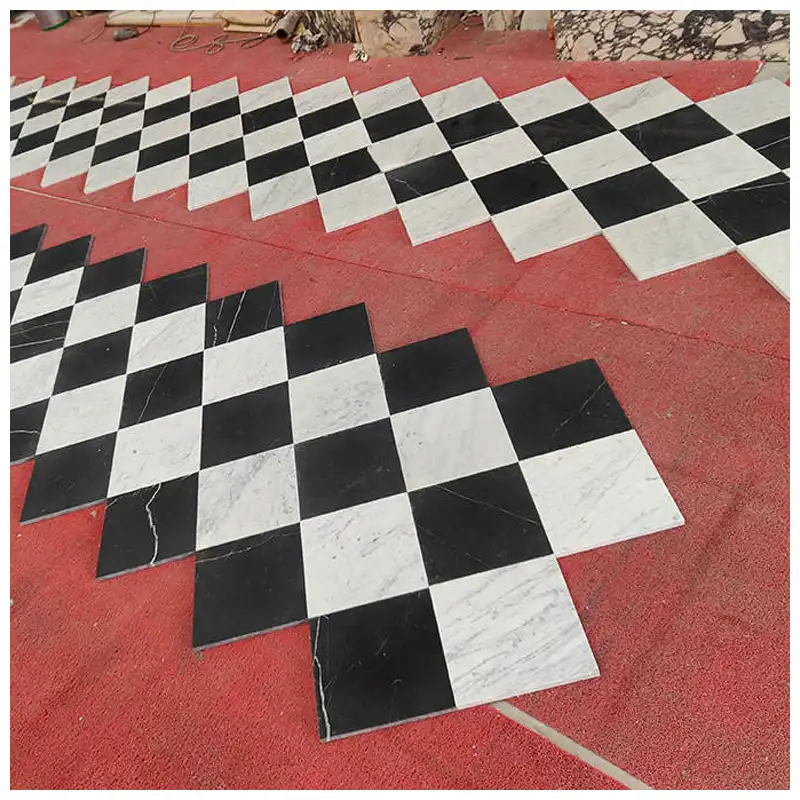
The two marbles retain different natural veining within the repeated square geometry.
Checkerboard Marble Tile Sizes, Thickness and Surface Finishes
The product is specified in square formats of 300 × 300 mm and 600 × 600 mm, with an 18 mm nominal thickness. Both sizes follow the same alternating color principle, but they produce substantially different visual scales across a floor.
| Black White Marble Checkerboard Tiles - Product Specifications | |
|---|---|
| Product Type | Natural Marble Floor and Wall Tiles |
| Black Marble | Nero Marquina Marble |
| White Marble | Bianco Carrara Marble |
| Tile Size A | 300 × 300 mm |
| Tile Size B | 600 × 600 mm |
| Nominal Thickness | 18 mm |
| Primary Finish | Polished |
| Alternative Finish | Honed, Subject to Confirmation |
| Pattern Layout | Alternating Square Checkerboard |
| Optional Layout | Diagonal Grid, Borders, Cut-to-Size Perimeter Pieces |
| Applications | Interior Floors, Entryways, Corridors, Feature Walls and Decorative Commercial Spaces |
300 × 300 mm: Smaller Repeated Squares
This format creates a tighter checkerboard rhythm, with more visible joints across a given floor area. It can work well in compact entrances, smaller residential rooms and decorative panels where a large square would dominate the available surface.
600 × 600 mm: Larger Architectural Grid
The larger format creates broader black and white fields with fewer pattern repetitions. It is useful where the design calls for a pronounced large-scale checkerboard, provided the subfloor, handling arrangements and installation tolerances are appropriate.
Polished versus Honed Marble
A polished finish reflects overhead lighting and emphasizes the black-and-white contrast. It can also reveal scratches, dull patches and acid etching more clearly, particularly across the dark Nero Marquina tiles.
A honed finish has lower reflectivity and may be preferred where glare or the visibility of everyday surface wear is a concern. However, a honed finish does not automatically establish a particular slip-resistance classification.
For a commercial floor or a potentially wet entrance, finish selection should follow the required project test method and safety criteria. The finished sample, not the general finish name, is the appropriate basis for approval.
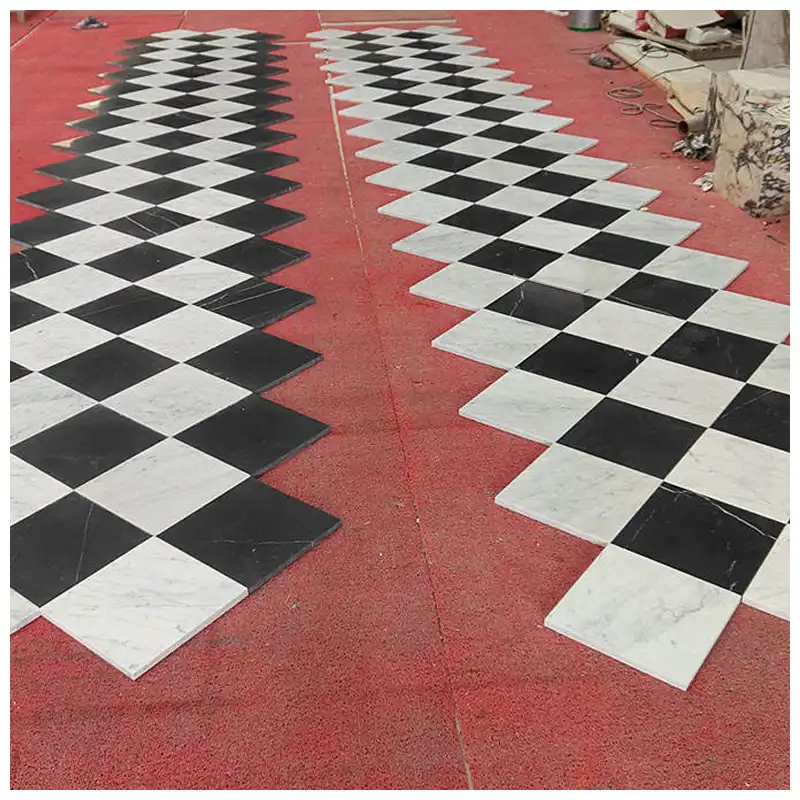
Square tile geometry and finished edges should be checked before project cutting is finalized.
Thickness and Finished Floor Levels
Both stone colors must arrive within the agreed thickness and dimensional tolerances. Otherwise, differences at adjoining edges can produce visible lippage across a pattern whose joints are intended to appear straight and regular.
The nominal 18 mm tile thickness does not represent the entire finished floor build-up. Adhesive or mortar thickness, preparation layers, waterproofing where required and substrate flatness must be considered separately.
The installation drawing should also establish transitions to doors, adjacent tile or timber flooring, stair edges and any recessed floor features before the tile order is processed.
Checkerboard Marble Flooring Layouts: Straight Grid, Diagonal Pattern and Borders
A checkerboard consists of alternating squares with opposite colors along every shared edge. Although the principle is simple, a large installation can appear unbalanced if the starting point, room centerline or perimeter cuts are not planned carefully.
The familiar chess pattern marble floor may be assembled in different orientations. Architects should select the arrangement using a dimensioned floor plan rather than deciding only from a small sample board.
Straight Checkerboard Grid
Tile edges follow the principal room axes. This can simplify alignment with walls, door openings and adjacent architectural elements.
Diagonal Checkerboard Grid
The same squares rotate relative to the room walls. This produces a diamond-like visual direction and usually changes the number and shape of perimeter pieces.
Bordered Marble Floor
A contrasting stone border can define the checkerboard field and create a controlled transition at room edges, thresholds and adjoining surfaces.
Perimeter Cuts and Pattern Balance
The architect should determine whether the floor is centered around the room, a doorway or another dominant feature. Small triangular or narrow cut pieces can weaken the visual edge of a diagonal pattern and may require adjustments to the starting point.
The design should also specify which color appears at the principal entrances and where the pattern must remain aligned through adjacent spaces. A checkerboard that changes phase unexpectedly across a doorway can appear visually disconnected.
The phrase checkerboard marble tile generally describes the alternating square format, while geometric marble flooring tiles also includes diamonds, inlays and more complex stone compositions. This product is based on regular square pieces; decorative waterjet patterns form a separate product category.
If a project combines different square sizes, the architect must develop a separate modular layout. Simply mixing 300 mm and 600 mm tiles does not retain a uniform traditional checkerboard without additional pattern decisions.
Factory Dry-Lay Inspection for Black and White Marble Tile Orders
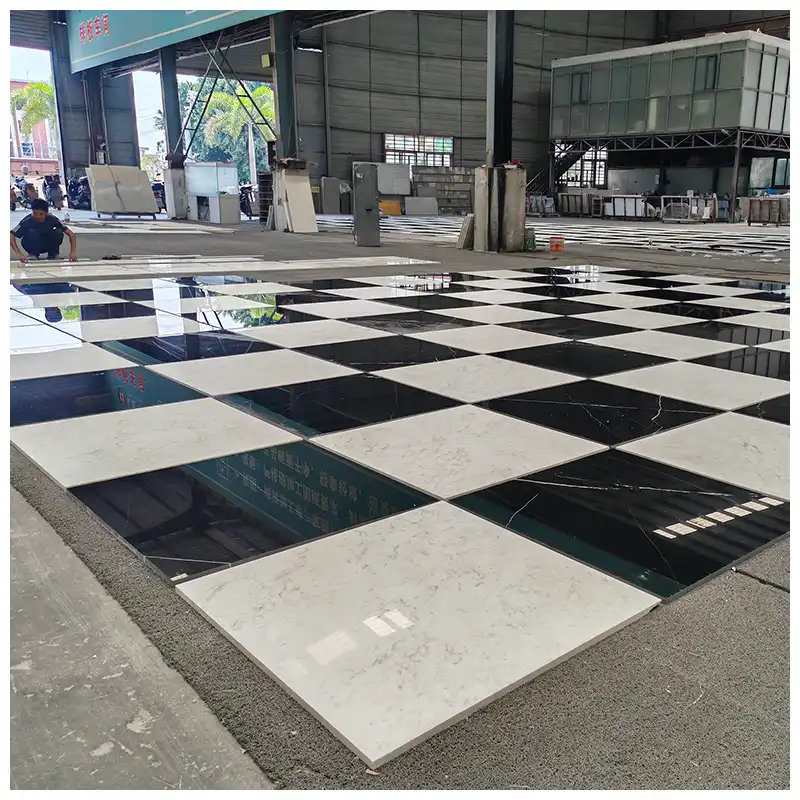
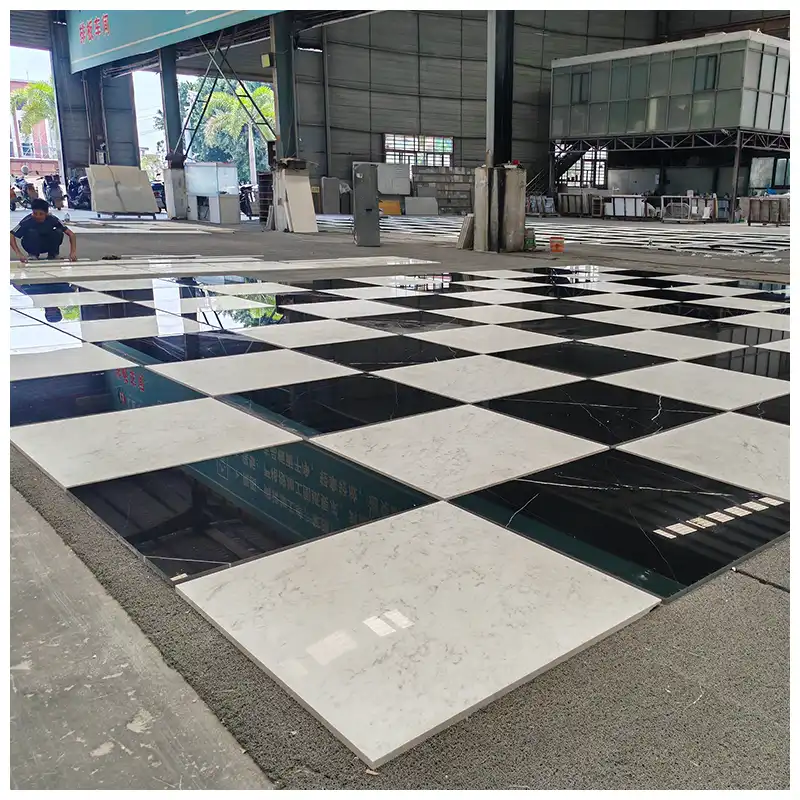
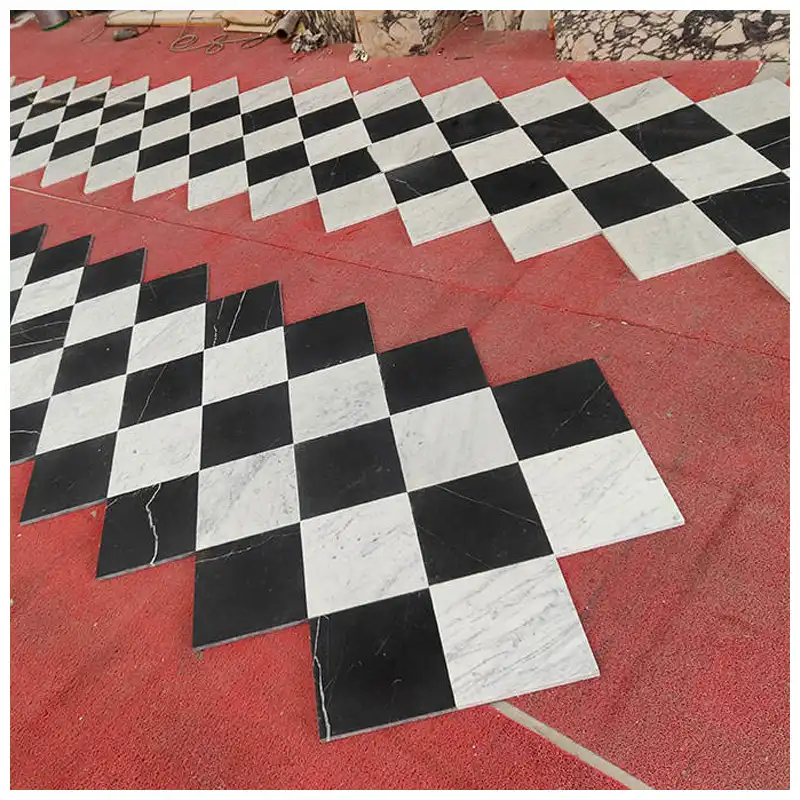
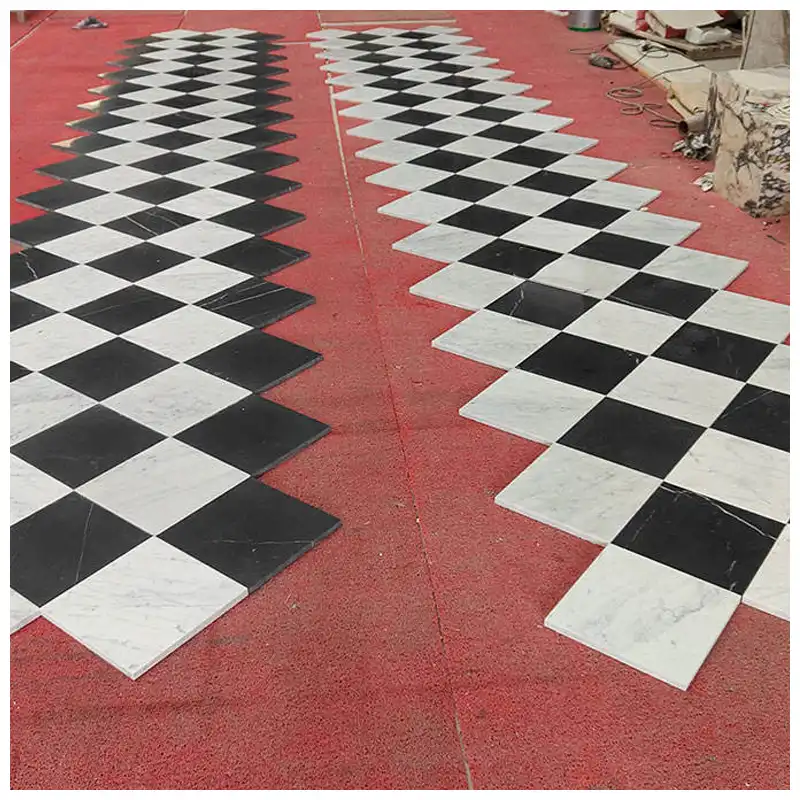
Factory pre-layout showing the alternating tile sequence before installation.
The supplied factory photographs show polished black and white marble tiles arranged in a repeated square pattern on the workshop floor. This is a useful stage for reviewing the appearance of the checkerboard before the stone is packed for site delivery.
For this particular product, factory dry-lay inspection is less about matching continuous veins and more about confirming the alternating color sequence, overall tile dimensions, surface appearance and pattern alignment.
Nero Marquina pieces with unusually prominent white veins may need to be distributed deliberately. Likewise, lighter and darker Bianco Carrara tiles should be reviewed so that natural tonal changes do not concentrate unexpectedly in one area.
For multi-room projects, it can be useful to identify distinct layout zones and group the corresponding material. These arrangements assist site coordination but do not replace proper installation control or dimensional checking.
What the Factory Layout Should Check
The critical checks are the correct black-to-white sequence, square sizing, edge integrity, acceptable tonal variation and the relationship between the actual tile layout and approved project drawings.
When borders and cut pieces are included, their dimensions and orientation should be reviewed separately. Special perimeter sections must align with the primary checkerboard grid and the finished room measurements.
Factory pre-layout helps identify problems before dispatch. It cannot guarantee a flawless finished floor because substrate movement, adhesive installation, field measurements and site conditions remain outside the scope of a workshop dry-lay.
Installation Requirements for Natural Marble Checkerboard Floors and Walls
This product uses two distinct natural marbles. Although they share the same nominal tile dimensions, their individual pieces can differ in surface appearance, absorption behavior and natural stone characteristics. The setting system must be selected for the actual stones and the application environment.
Substrate Preparation and Joint Alignment
A flat, structurally suitable substrate is particularly important beneath a square marble pattern. Repeated straight joints make lippage, irregular grout lines and small dimensional errors readily visible.
Installers should confirm the approved setting bed, tile coverage, grout joint width and finished floor levels. Existing structural movement joints must be respected and continued through the stone assembly as required by the project design.
Stone-Safe Adhesives and Grout
The setting material should be compatible with both marble types. The installer may need to evaluate whether a light-colored adhesive or mortar is appropriate beneath the Bianco Carrara tiles to reduce the risk of unwanted discoloration or visible shadowing.
Grout color also changes the final visual effect. A narrow grey joint may emphasize the square grid without competing strongly with either marble color, while a contrasting grout will make individual tile boundaries more pronounced.
Grout selection should account for the possibility of scratching polished marble and for the stone's sensitivity to certain cleaning chemicals.
Wall Installation and Architectural Interfaces
Where the product is used as wall cladding, substrate capacity, fixing method, edge support and the height of the installation must be reviewed. Large-format stone wall tiles may require additional fixing considerations depending on local requirements.
Wet areas and external exposures involve separate waterproofing, drainage, safety and weathering requirements. Interior polished marble specifications should not automatically be extended to outdoor paving or wet commercial floors.
Marble Performance, Slip Resistance and Surface Maintenance
Both Nero Marquina and Bianco Carrara are natural marbles. Their polished surfaces require appropriate cleaning, protection and realistic expectations for wear. Marble is not an impervious or acid-proof flooring material.
For project specification, the following properties should be assessed using material-specific documentation and the intended test methods. No batch-specific laboratory results have been supplied for this checkerboard collection.
| Technical Property | Current Information | Project Relevance |
|---|---|---|
| Bulk Density | Material-specific test values not supplied | Finished floor dead load and wall support |
| Water Absorption | Verify for the selected black and white marbles | Moisture exposure, setting compatibility and sealing |
| Flexural Strength | Batch-specific results not supplied | Panel handling and stone substrate support |
| Abrasion Resistance | Project verification required for commercial flooring | Expected traffic, finish wear and long-term appearance |
| Slip Resistance | Must be established for the selected finish and conditions | Floor safety in dry, damp and potentially wet areas |
| Acid Sensitivity | Natural marble requires acid-sensitive surface care | Cleaning products, spill response and maintenance |
Maintenance of Black and White Polished Marble
Routine cleaning should use a suitable pH-neutral natural stone cleaner. Abrasive powders, acidic descalers and strong chemical cleaners may scratch or etch marble surfaces.
Black polished marble can show scratches, fine scuffs and dull etch marks more visibly than lighter stone. The white Carrara pieces may show staining, localized discoloration or changes in appearance depending on the exposure and treatment.
An appropriate impregnating sealer may help reduce liquid absorption, but sealing does not prevent acid etching or guarantee that all spills will leave no marks.
In commercial spaces, an entrance matting system and a realistic cleaning schedule can help manage tracked-in grit and moisture. The marble surface should be reviewed periodically so maintenance practices can be adjusted before localized damage becomes widespread.
Manufacturing Inspection, Tile Sorting and Export Packing
The finished checkerboard depends on accurate cutting of both marble types. During quality inspection, the black and white tiles should be checked separately for dimension, nominal thickness, squareness, polished finish, corner condition and unacceptable surface defects.
Natural fissures, mineral veins and small visual differences are part of marble selection. However, pieces with damaged corners, unsuitable repairs or dimensional discrepancies should not be approved simply because the natural pattern permits variation.
Where project drawings define particular zones, the material may be sorted and identified by room or installation area. The corresponding checkerboard layout should remain clear to the receiving contractor so the intended color sequence is maintained.
For export packing, polished faces require separation and surface protection. Crates must provide sufficient support and restraint to reduce edge impact, corner damage and movement during transport.
If the project includes cut border pieces or specially marked modules, those components should be clearly identified and protected separately from regular square tiles.
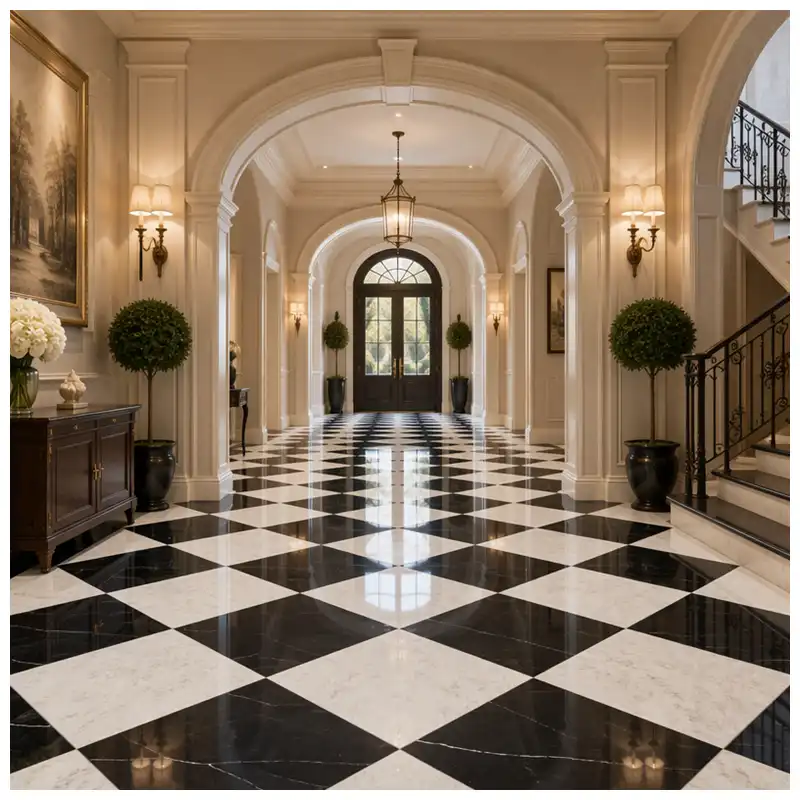
Project material review focuses on color distribution, edge quality and consistency of the square modules.
Interior Design Reference: Black and White Marble Checkerboard Flooring
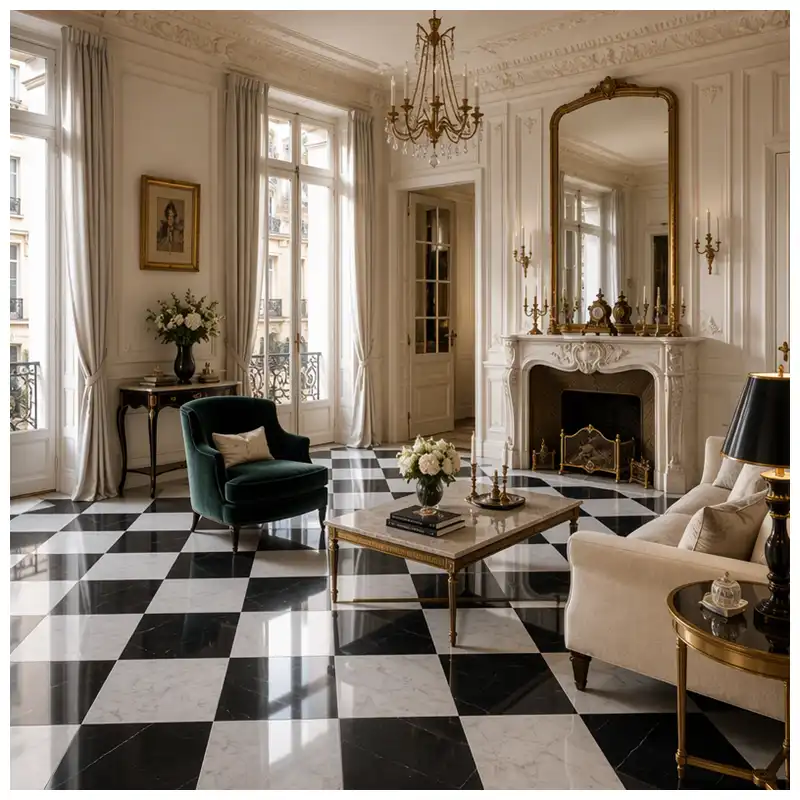
Checkerboard marble can be incorporated into residential and commercial interior floor compositions.
In a traditional residential entrance, the checkerboard can be framed by a plain stone border, with the square grid centered on the main doorway. This arrangement retains the original geometric character without requiring elaborate decorative inlays.
A modern interior may instead use an uninterrupted grid, allowing the contrasting black and white squares to define the floor independently of furniture or wall finishes.
For hotels and commercial interiors, the pattern can be restricted to reception areas or other selected architectural zones rather than extended across every circulation space. This allows the floor specification to respond to differences in moisture, traffic and maintenance requirements.
Compare Checkerboard Marble Tiles with Other KA UNITED Stone Tile Designs
Buyers considering a black white marble floor tile collection may also evaluate single-color marble surfaces or a more elaborate geometric design. The main differences are pattern complexity, material appearance and how the installation is planned.
| Stone Tile Product | Visual Character | Main Selection Difference |
|---|---|---|
| Black White Marble Checkerboard Tiles | Alternating natural black and white squares | Regular repeating checkerboard; two-material color and grid control |
| Pietra Grigio Marble Tiles | Deep grey marble with fine light veining | A more continuous grey surface without a two-color pattern |
| Ottoman Beige Marble Tiles | Warm cream-beige natural marble | Light neutral interiors requiring a less graphic floor appearance |
| Marble Travertine Geometric Tiles | Pale marble and beige travertine geometric composition | Custom floor pattern with a central decorative arrangement |
| Black White Marble Waterjet Tiles | Black and white curved floral geometry | Waterjet-cut decorative motifs rather than simple square modules |
Recommended Marble Floor Tiles from KA UNITED
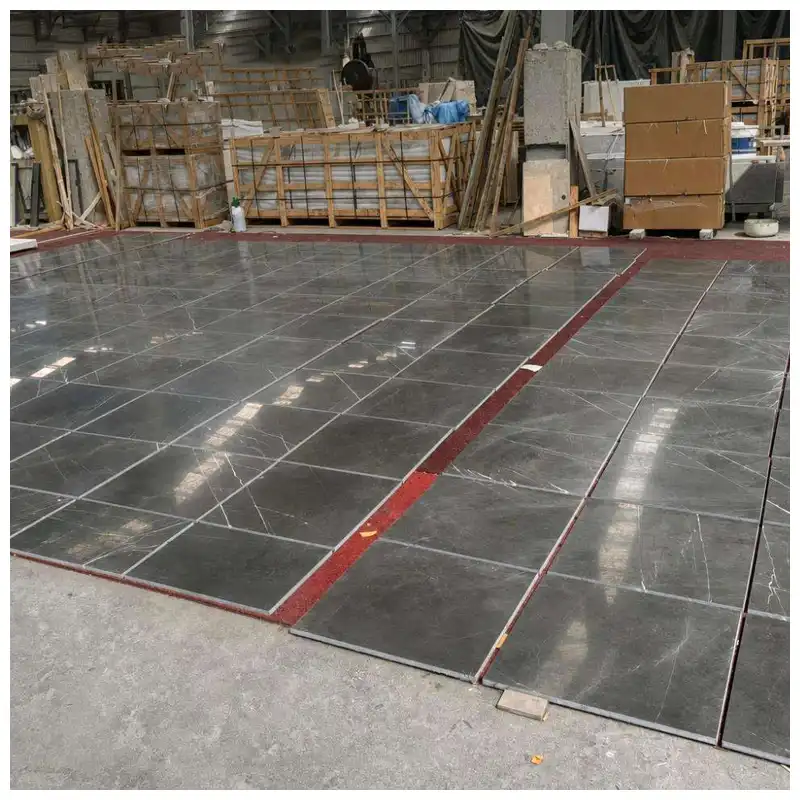
Pietra Grigio Marble Tiles
Deep grey marble with restrained white veins for contemporary interior floors, walls and coordinated cut-to-size projects.
View Product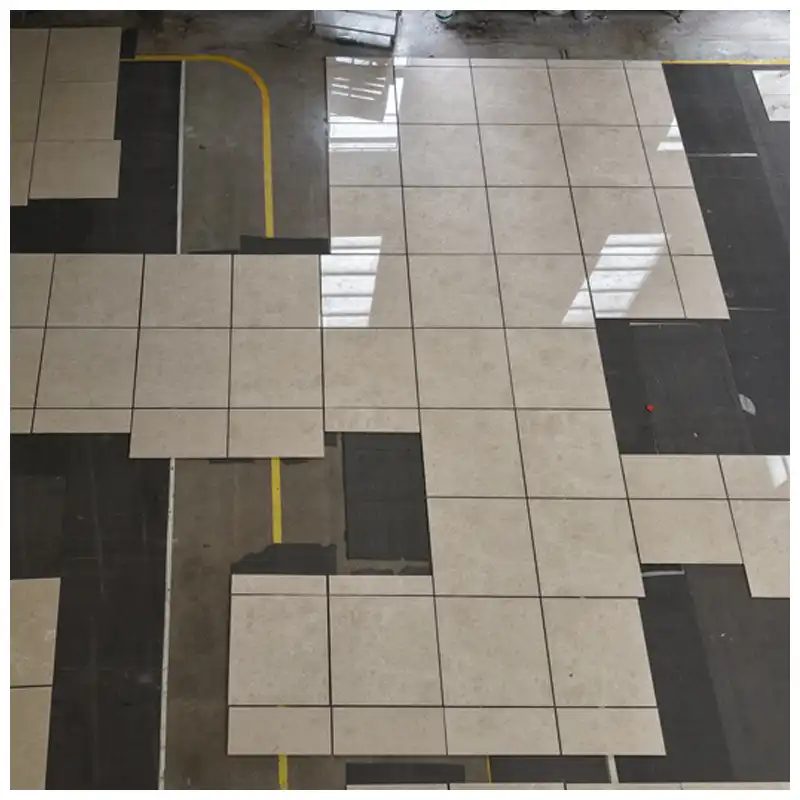
Ottoman Beige Marble Tiles
Cream-beige marble with soft natural movement for lighter residential floors and coordinated interior wall finishes.
View Product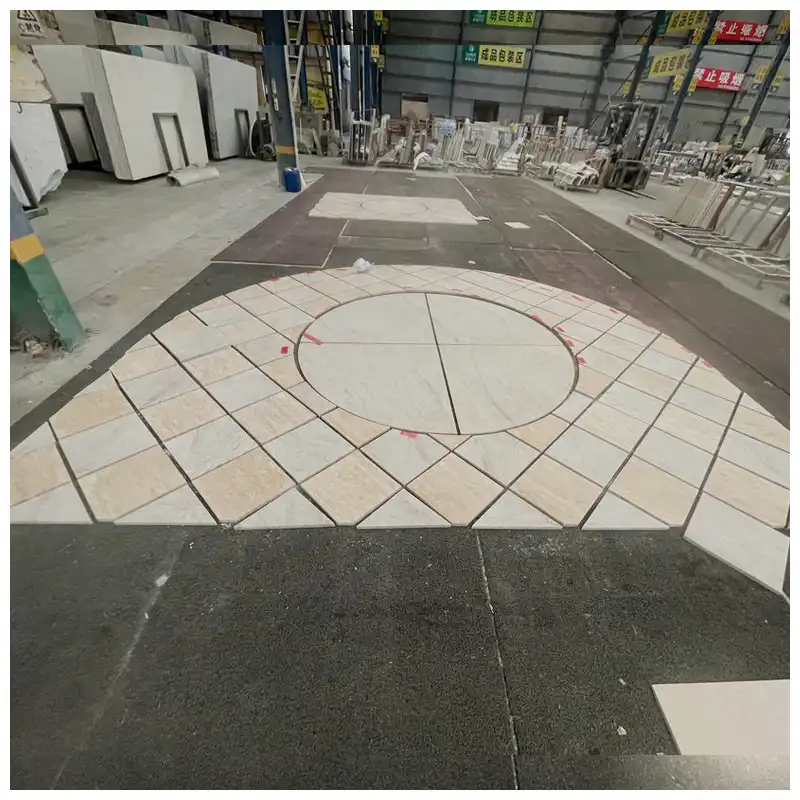
Marble Travertine Geometric Tiles
Carrara marble and beige travertine form a custom geometric floor composition with a circular focal center.
View Product
Black White Marble Waterjet Tiles
Contrasting Nero Marquina and white marble form repeating waterjet floral geometry for decorative floor installations.
View ProductFrequently Asked Questions About Black White Marble Checkerboard Tiles
1. Are these checkerboard tiles made from natural marble or manufactured stone?
They are made from two natural marbles: Nero Marquina for the black squares and Bianco Carrara for the white squares. Each tile retains natural mineral veining and some tonal variation, rather than repeating an identical printed design.
2. Which checkerboard tile size works better for a villa entrance?
The 300 × 300 mm format creates a tighter pattern with more repeated squares, while 600 × 600 mm creates a larger and more pronounced grid. The final choice depends on entrance dimensions, door positioning, border design and the desired pattern scale.
3. Can polished black and white marble be installed in hotel lobbies?
Polished marble may be considered for selected hotel interiors, but it is not automatically suitable for every public floor. Slip resistance, anticipated traffic, moisture exposure, maintenance and applicable building requirements must be evaluated before the finish is approved.
4. Can the checkerboard layout be rotated diagonally or combined with stone borders?
Yes. A straight square grid can be adapted into a diagonal arrangement or framed with custom stone borders. Perimeter cutting, starting points and the alternating color sequence should be established on approved project drawings before fabrication.
5. What does factory dry-lay inspection check for checkerboard marble tiles?
Factory dry-lay inspection can help review the alternating black-and-white pattern, tile alignment, material color distribution and special border components. It does not replace site measurements, substrate preparation or professional installation.
6. Does sealing prevent scratches and acid etching on these marble tiles?
No. A suitable impregnating sealer may help reduce liquid absorption, but it does not make natural marble scratch-proof or acid-proof. Both stones require appropriate cleaning products, prompt spill removal and routine surface maintenance.
7. Can these checkerboard marble tiles be used for decorative wall cladding?
Yes, they can be considered for interior decorative wall cladding when the substrate and fixing system are appropriate for natural stone. Larger or elevated installations require project-specific assessment of support, movement joints and fixing requirements.
Final Buyer Decision: Approve the Checkerboard Layout and Both Marble Batches
Before placing a project order, establish the exact floor area, the selected square format and the pattern starting point. A dimensioned plan should distinguish regular black and white pieces from perimeter cuts, border sections and any special transition elements.
Approve Nero Marquina and Bianco Carrara separately. Their natural veining and tonal differences should remain within an agreed visual range so that the completed checkerboard has a coherent appearance without pretending that every marble tile is identical.
The installation team should also confirm the specified finish, substrate condition, floor build-up and any safety requirements before receiving the material. For large installations, a numbered pattern plan can help maintain the intended arrangement through delivery and construction.
Practical Takeaway: The quality of a marble checkerboard floor depends on more than the contrast between black and white. Select compatible tile batches, approve the grid geometry, control dimensional tolerances and choose a finish that meets the intended installation conditions before the floor is laid.
Request Black White Marble Checkerboard Tiles for Your Interior Flooring Project
KA UNITED can review Black White Marble Checkerboard Tiles requirements for residential entrances, hotel interiors, decorative flooring and custom stone wall designs. Project layouts can be developed around the specified tile format, room geometry and the selected black-and-white marble combination.
For a quotation, provide the tile size, required finish, total installation area, architectural drawings and destination. Where the design includes a diagonal pattern, stone border or special perimeter cuts, submit the corresponding floor layout so the material and fabrication requirements can be assessed together.
Hot Tags: black white marble checkerboard tiles, China black white marble checkerboard tiles suppliers, factory, emperador marble, faux marble slab, italian marble, marble and stone, textured marble tile, white marble slab
You Might Also Like


Send Inquiry
