



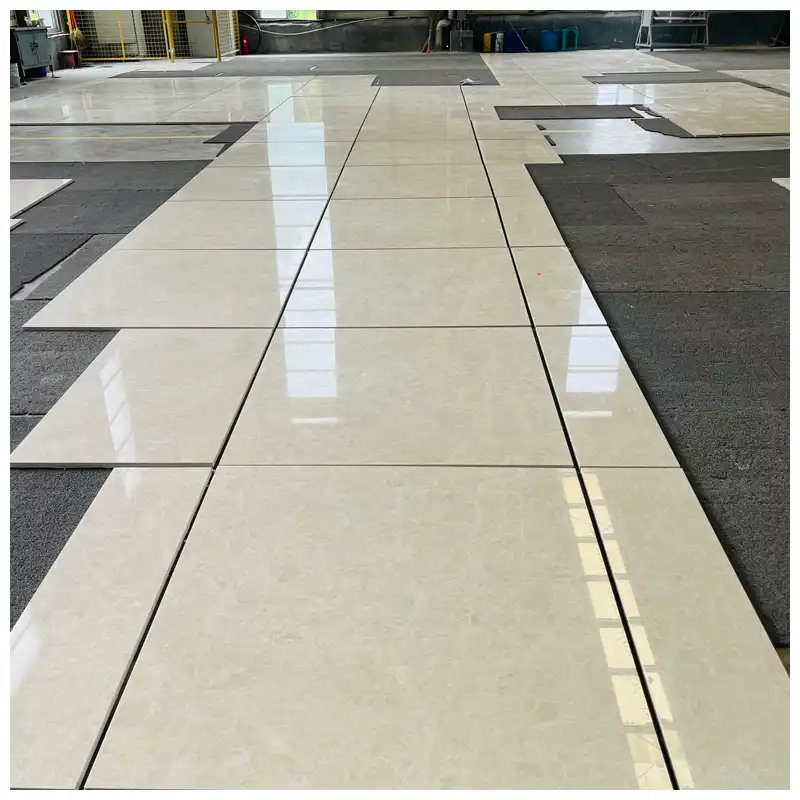
Ottoman Beige Marble Tiles
Premium Ottoman Beige marble tiles for luxury villa floor and wall applications. Warm creamy beige base with subtle fine veining, high-gloss polished finish. Factory full dry-lay inspection ensures consistent color tone for seamless whole-house installation. Reliable density and wear resistance for long-term residential use.
Luxury Marble: Custom Cut Ottoman Beige Marble Tiles Uniform Tone for Whole-House Villa Interiors
Natural Marble: Ottoman Beige Marble, Ultraman Beige Marble
Marble Factory: KA UNITED
Marble Slab Size: 2400upx600, 2400upx800, 2500upx1200up, etc.
Marble Tiles: 24''x24'', 12''x24'', 12''x12'', 18''x18''
Thickness: 20,30mm
Surface: Polished, Honed, Brushed
MOQ: 300 SQM
Application: KA UNITED Supplies A full Range of natural Marbles For Floor, Wall Tiles, Kitchen and Bathroom Countertops, and other Commercial Projects
Product Introduction
Quick Summary: Ottoman Beige Marble Tiles are natural Turkish marble tiles with a warm cream-beige base, fine mineral veining and soft cloudy variations. Supplied in 300 × 300, 600 × 600 and 900 × 900 mm reference formats, with 10, 18 and 20 mm thickness options, they are suited to appropriately specified residential floors, hotel interiors, entrance halls and wall cladding. The polished finish reveals the stone's natural color depth, while cut-to-size processing accommodates architectural layouts. For larger projects, actual stone selection, surface performance and the approved installation method are essential to achieving a consistent finished appearance.
Ottoman Beige Marble Tiles for Villa Floors, Hotel Interiors and Architectural Wall Cladding
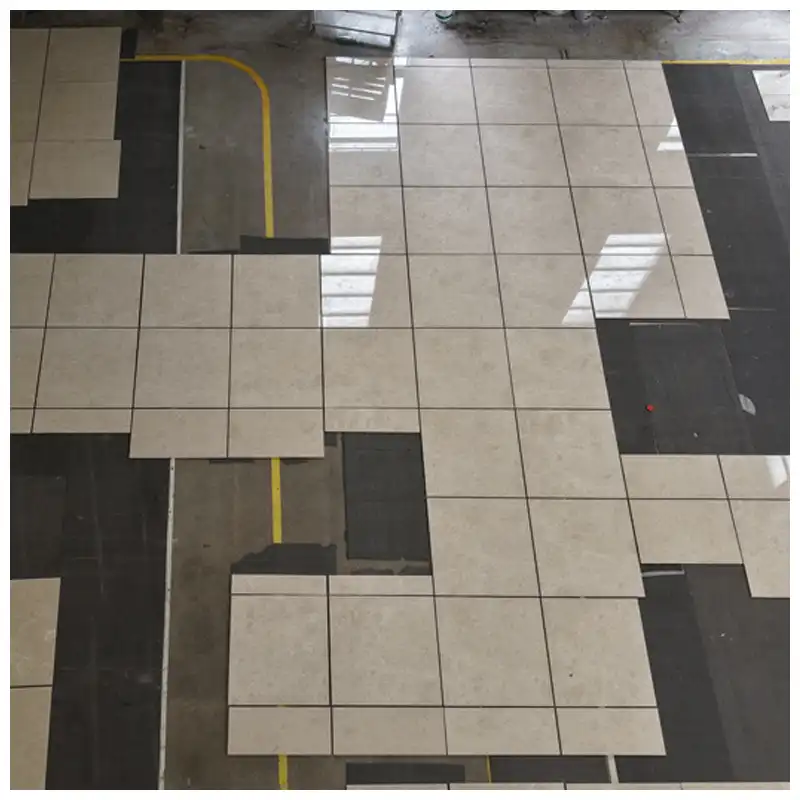
Ottoman Beige natural marble tiles with a warm, light-beige surface and polished finish.
Natural beige marble remains a practical architectural choice when the design calls for a continuous light-toned stone surface rather than a strongly veined feature material. Ottoman Beige has enough natural movement to avoid an artificial uniform appearance, yet its restrained colors allow it to cover extensive floor and wall areas without dominating the interior.
In residential construction, Ottoman Beige Marble Floor Tiles can be incorporated into living rooms, entrance halls, hallways and other interior spaces where the selected finish meets the intended floor conditions. A coordinated marble wall cladding tile specification can extend the same palette onto interior feature walls, columns and circulation areas.
For commercial design, the material can be evaluated for hotel guest areas, reception spaces, residential development common areas, boutique retail interiors and other professionally specified locations. The design may use one consistent tile size or a coordinated selection of formats.
The primary value of the material lies in its natural beige color family, available modular sizes and ability to connect separate architectural surfaces. Floor traffic, moisture exposure and mounting conditions still need independent technical assessment.
Ottoman Beige Marble Color, Natural Veining and Material Selection
Ottoman Beige is a natural marble associated with the Turkish stone industry, particularly the Isparta region. In international stone trading, the material may also appear under the names Ottoman Marble, Ultraman Beige or related regional selections. These names can cover different quarry blocks and commercial grades, so a product name alone should not replace approval of the actual stone.
The appearance is generally a cream to light-beige background with pale ivory areas, soft grey-beige mineral lines and understated cloud-like movements. Rather than forming long, dramatic veins, much of the variation is dispersed across the surface. This creates visual texture at close range while allowing a more continuous impression across a larger installation.
Buyers researching Ottoman Marble Tiles and Ultraman Beige Marble Tiles should compare the physical samples or production photographs rather than relying exclusively on trade names. Stone sold under similar names may differ in background warmth, vein density, small mineral markings and the amount of visible color contrast.
For a spacious interior, the most important selection issue is the acceptable range of beige tones. One tile may have a warmer cream background while another from the same general stone type appears slightly greyer. These differences are natural, but they become more noticeable under strong overhead lighting or when adjacent tiles are deliberately contrasted.
The required visual range should be established from representative material, especially for floors continuing through several rooms. In wall applications, the final orientation and lighting can change how mineral details are perceived. Consistent stone selection matters more than assuming that every tile will have identical veining.
Ottoman Beige Marble Tile Sizes, Thicknesses and Specification Options
The three reference tile formats address different layout requirements. Smaller modules allow more flexibility around corners and architectural interruptions, while larger pieces reduce the number of visible tile joints across broad surfaces. The correct selection depends on room dimensions, substrate conditions and the installation design.
| Product | Ottoman Beige Marble Tiles |
| Material Type | Natural Marble |
| Stone Origin | Turkey |
| Reference Format A | 300 × 300 mm (approximately 12 × 12 inches) |
| Reference Format B | 600 × 600 mm (approximately 24 × 24 inches) |
| Reference Format C | 900 × 900 mm (approximately 35.4 × 35.4 inches) |
| Nominal Thickness | 10 / 18 / 20 mm |
| Main Surface | Polished |
| Other Surface Options | Honed / Brushed, subject to production confirmation |
| Manufacturing Format | Regular modular tiles and architectural cut-to-size pieces |
| Primary Uses | Interior flooring and wall cladding, subject to technical approval |
| Custom Processing | Drawing-based cutting, border pieces and installation-specific details |
The 300 × 300 mm format can accommodate smaller rooms and layouts with numerous boundaries. The 600 × 600 mm size is a useful reference for conventional modular floor arrangements, while 900 × 900 mm pieces create a broader stone face with fewer interruptions from grout lines.
Thickness selection must reflect the intended application and installation system. A 10 mm tile cannot automatically substitute for an 18 mm or 20 mm stone element where different mechanical or support requirements apply. Large-format pieces also require appropriate handling and substrate flatness.
Polished, Honed and Brushed Ottoman Beige Marble Surface Selection
A polished marble tile has a reflective surface that reveals the depth of natural beige tones and fine veins. In rooms with generous natural light, polished Ottoman Beige can appear lighter and more luminous, while reflections from ceiling lighting may become prominent on extensive floors.
Polishing is the primary finish for the product described here. It is suitable for applications where the reflective stone appearance is an important part of the design and where the specified floor or wall conditions permit its use.
A honed surface produces a more subdued reflection, allowing the color and natural variation of the marble to remain visible without the same mirror-like effect. Brushed finishing changes the tactile character and may soften visual reflections further. Availability, final texture and achievable finish consistency require confirmation with the actual material.
For flooring, finish selection cannot be based on appearance alone. A honed or brushed surface is not automatically certified slip-resistant, and polished stone should not be presumed appropriate for wet entrances, shower floors or other areas requiring specific traction performance.
The architect should define the intended environment before approving a finish. Floor safety, cleaning requirements and expectations for long-term surface wear all affect that decision.

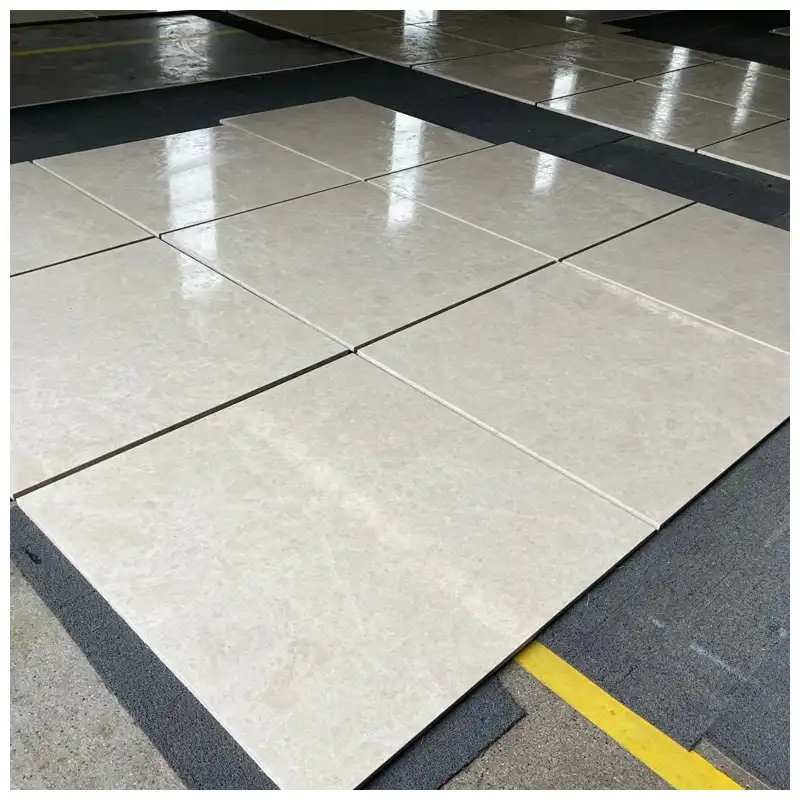
Close-up reference for Ottoman Beige marble color variation, polished surface and natural mineral details.
Beige Marble Cut-to-Size Tiles for Floors, Borders and Architectural Wall Details
Regular modular tiles are only one available fabrication direction. Beige Marble Cut-to-Size Tiles can also be considered for construction drawings involving special floor boundaries, wall panels, architectural columns and coordinated stone details.
A project may require full tiles in open floor areas and narrower pieces around structural columns, door recesses or wall edges. For rectangular rooms, the setting-out plan should balance the size of perimeter cuts and reduce conspicuously narrow strips in visible areas.
Wall cladding involves different dimensions and interface details. Panel heights, corner returns, openings, substrate construction and the proposed fixing method must be included in the architectural specification. Stone thickness and fixing requirements are evaluated against the actual panel size and installation height.
Depending on the approved production drawings, additional pieces may include stone skirting, simple borders, thresholds or wall returns. These are customization possibilities rather than guaranteed standard components within every order.
Cutting accuracy should be assessed against the agreed tolerance, including edge straightness, thickness calibration, squareness and visible edge condition. Large-format stone may require adjustments to the cutting plan based on the size and condition of the selected raw slabs.
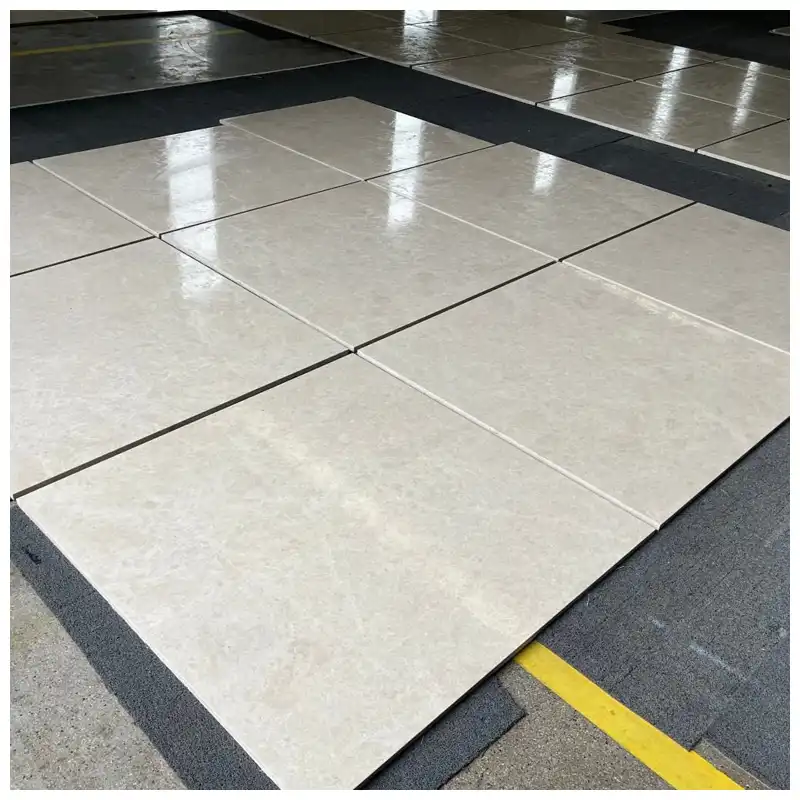
Reference position for finished marble tile edges, thickness calibration and cut-to-size processing.
Choosing a Beige Marble Tile Layout for Continuous Interior Floors
The warm beige color of Ottoman marble is suited to coordinated floor surfaces where the architectural layout, rather than individual dramatic veins, establishes the main visual rhythm.
A conventional straight-grid arrangement emphasizes order and dimensional regularity. Alternating tile directions may introduce more movement, but the result depends on whether the actual stone has directional mineral features or a largely cloudy pattern.
When selecting Beige Marble Floor Tiles for several connected rooms, the proposed joint grid should be checked against doorways and corridor axes. Inconsistent setting-out can create awkward transitions even where the material color is well coordinated.
Light marble also changes appearance under different lighting conditions. Daylight from a window may reveal minor vein differences that are less evident under warm artificial lighting. Viewing samples in the intended environment can help establish an acceptable material range.
For a large floor, the laying plan should specify the principal tile direction, joint width, perimeter cuts and movement-joint locations before fabrication begins. The goal is controlled layout, not an unrealistic promise of completely invisible joints or identical natural stone faces.
Representative Ottoman Beige Marble Technical Properties and Project Verification
Ottoman Beige is a calcareous natural marble. Its material behavior differs from harder silicate stones such as granite and quartzite, particularly in resistance to acidic substances and certain forms of surface wear. Published trade specifications provide the following representative reference ranges for Ottoman Beige marble, but they are not certified test results for the current KA UNITED production lot.
| Material Property | Representative Reference | Specification Relevance |
|---|---|---|
| Density | Approximately 2,680–2,720 kg/m³ | Indicative stone weight and handling calculations |
| Water Absorption by Weight | Approximately 0.15–0.35% | Moisture-related material assessment |
| Compressive Strength | Approximately 85–125 MPa | Material characterization; not a substitute for floor-system engineering |
| Flexural Strength | Approximately 9–16 MPa | Review of stone bending behavior for applicable components |
| Mohs Hardness | Approximately 3–4 | Indicative scratch and surface-wear considerations |
Technical qualification: These figures are representative published ranges for the commercial stone type, not batch-specific acceptance values. Quarry variation, stone selection, sampling and test methods may affect the measured results. Current test reports should be requested when the project specification requires verified performance.
No certified slip-resistance value or project-specific abrasion result is available in the supplied material. Floor suitability must therefore be confirmed separately for the expected traffic level, moisture conditions, finish and installation system. Stone density or compressive strength alone does not establish safe floor performance.
Installing Ottoman Beige Marble on Floors and Interior Walls
Floor Substrate and Stone Setting
The substrate must be suitable for the selected tile dimensions, thickness and installation method. Flatness is particularly important for larger marble pieces because local substrate irregularities can contribute to excessive adhesive-bed variation and tile lippage.
Setting materials should be suitable for natural marble, with attention to potential moisture-related discoloration and compatibility with the selected stone. The final adhesive or mortar specification depends on the actual substrate, floor environment and applicable installation standards.
Joints must be planned rather than eliminated. Structural movement joints, perimeter accommodation and required changes in floor construction should remain functional even where a continuous marble appearance is desired.
Wall Cladding and Vertical Installation
Interior wall panels require an approved mounting system that accounts for stone dimensions, support conditions, wall construction and installation height. Large or heavy-format panels may require mechanical support or an engineered system beyond ordinary adhesive installation.
Where Beige Marble Tiles are specified for bathrooms or other moisture-exposed locations, waterproofing belongs to the approved wall or floor assembly. A polished stone face or penetrating sealer should not be treated as a replacement for a required waterproofing system.
Factory Dry-Lay Preparation for Large Ottoman Beige Marble Tile Orders
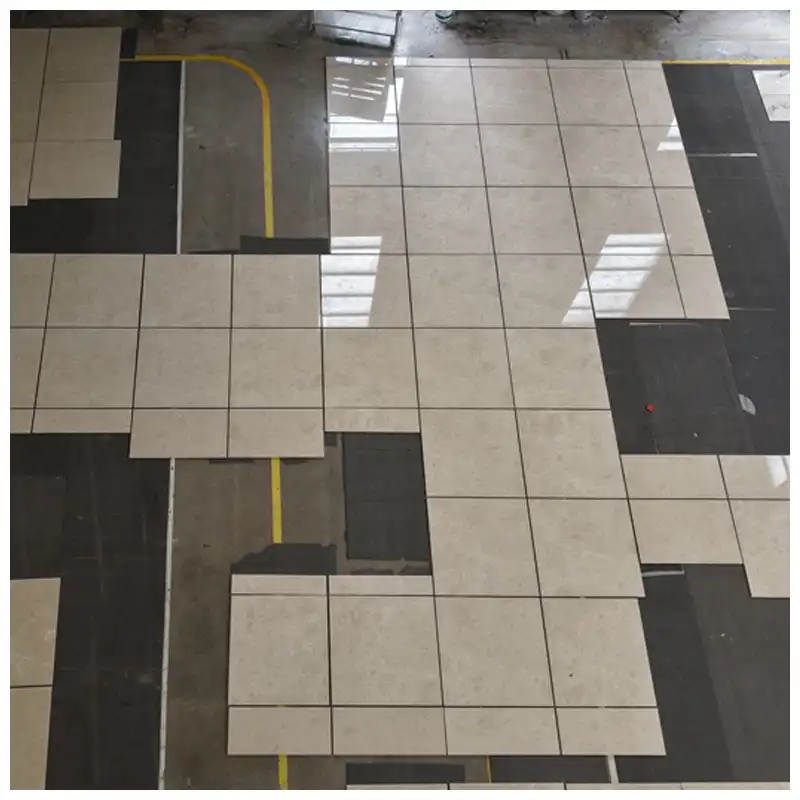
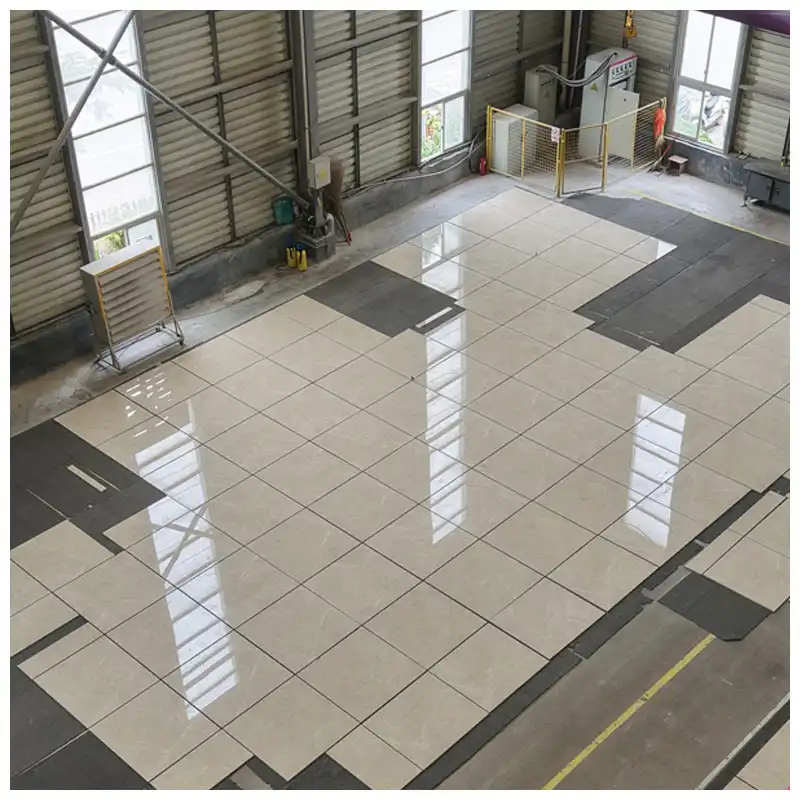
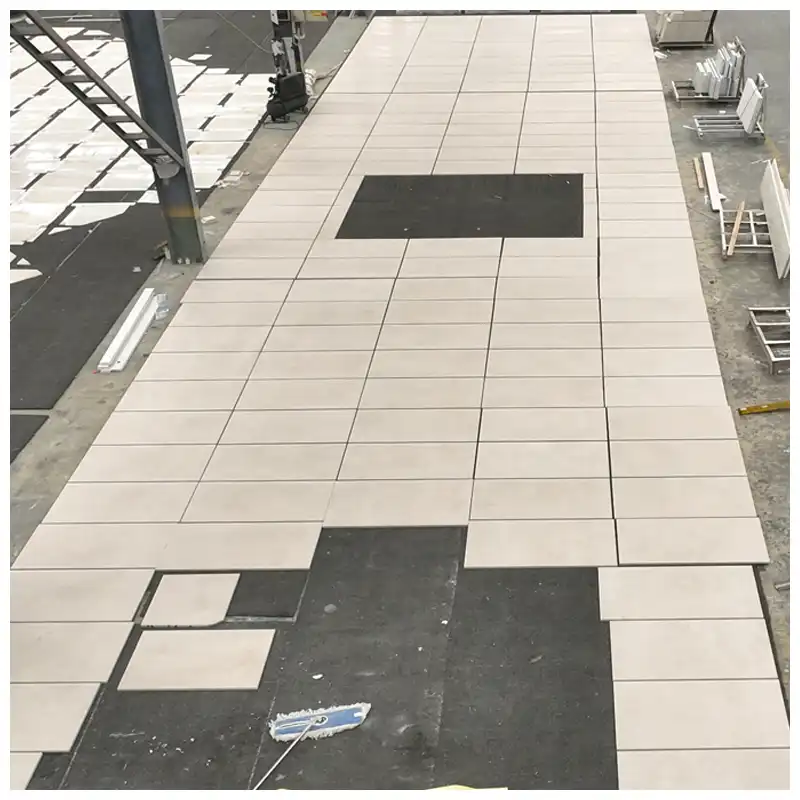
The supplied factory photographs show polished beige marble tiles arranged across a workshop floor before shipment. This type of dry-lay preparation makes it possible to inspect the distribution of stone tones and evaluate the intended modular arrangement before permanent installation.
A wide dry-laid area helps reveal whether a group of tiles appears noticeably darker or lighter than the surrounding material. Individual pieces may look similar during isolated inspection, but their tonal relationship can become clearer when arranged side by side.
Where required by the project, approved tile groups can be identified against a layout schedule. This may help the installation contractor follow the intended color distribution and locate pieces assigned to specific rooms or floor sections.
Factory dry laying should not be confused with final installation. The photographs document a pre-shipment arrangement, not a fully bonded floor. The process also does not guarantee zero natural variation, eliminate every possible site cut or replace field measurements.
For multi-room residential projects, a clear schedule connecting tile batches, room references and packing identification is more useful than simply stating that every piece has been inspected.

Factory dry-lay reference showing polished Ottoman Beige marble floor tiles arranged for visual selection and layout inspection.
Cleaning, Sealing and Long-Term Care of Beige Marble Surfaces
Ottoman Beige marble contains acid-sensitive minerals. Acidic cleaners, vinegar, lemon-based products and unsuitable scale removers can etch a polished surface. Depending on exposure, etching may appear as dull marks or a localized change in gloss rather than a conventional absorbed stain.
For routine care, loose grit should be removed before wet cleaning. A cleaner appropriate for calcareous natural stone and non-abrasive tools will generally be preferable to aggressive chemicals or abrasive scrubbing materials.
A compatible penetrating sealer may help reduce absorption-related staining, but it does not make marble stain-proof, acid-proof or waterproof. Sealer suitability and reapplication intervals depend on the selected product and actual usage conditions.
In regularly occupied residential and hospitality interiors, entry mats, appropriate cleaning procedures and prompt removal of spills can reduce avoidable wear. The maintenance plan should account for the marble's actual finish and the expected level of use.
Dimensional Inspection, Color Grouping and Export Protection
For modular marble tiles, factory inspection should consider the characteristics that affect both visual appearance and installation. These include tile dimensions, thickness variation, flatness, visible edge damage, surface finishing and acceptable natural color differences.
Large pieces need particular attention at the corners and edges, where impact damage may affect the finished joint. The condition of polished surfaces should be reviewed under suitable lighting rather than only from a distance.
When color grouping is part of the approved project specification, packing identification should remain consistent with the material selection and cutting schedule. This prevents the intended visual arrangement from becoming disconnected from the shipment documentation.
Protective separators, stable support and appropriate crating should be selected according to actual tile dimensions and shipment conditions. Details of the packing system and any project-specific inspection documents should be established during order confirmation.
Ottoman Beige Marble Flooring in Spacious Residential Interiors
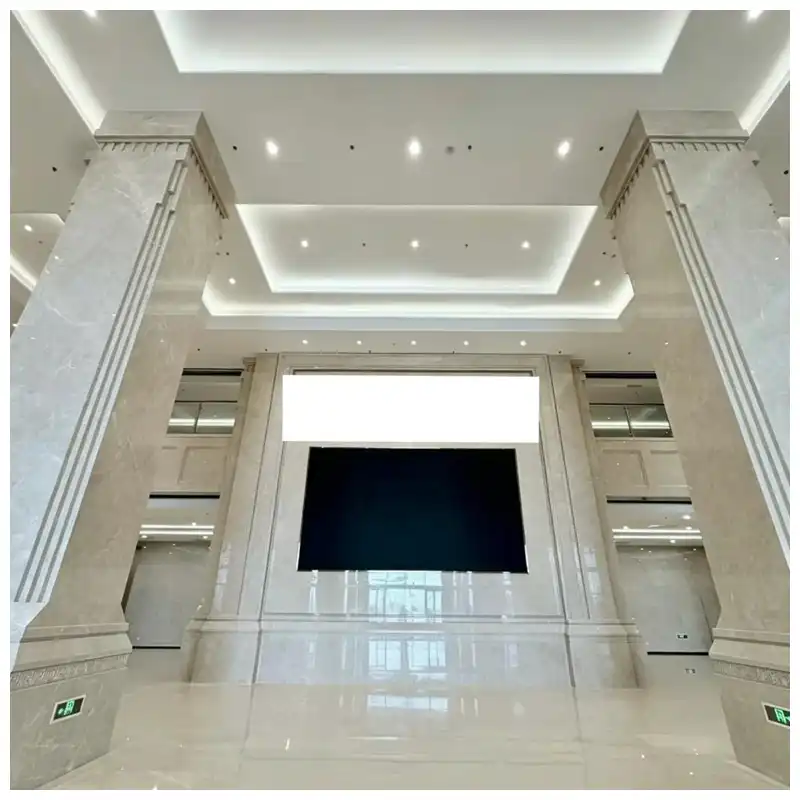
Interior application reference showing a light-beige polished stone floor coordinated with large architectural columns and wall surfaces.
The supplied interior photograph illustrates how light-beige polished stone can read across a spacious interior containing tall columns and broad wall surfaces. Instead of relying on a strong decorative pattern, the floor forms a relatively neutral architectural background.
Large rooms can benefit from a measured tile grid and an approved beige-tone range, particularly where the floor is visible across long sightlines. Reflection from ceiling lighting also affects the visual impression of polished marble.
This image is an application reference, not a specification of every possible Ottoman Beige installation. The same material can be considered for smaller residential rooms or selected wall surfaces where the dimensions, installation conditions and intended finish are appropriate.
For buyers, the useful lesson is the relationship between color, scale and light. The photographed room does not determine the full range of applications for the product or replace the need to approve the actual material.
Ottoman Beige Marble Compared with Four Other Natural Stone Tile Collections
The following materials present different design directions and installation priorities. Ottoman Beige favors a relatively continuous warm-neutral surface, while the four alternatives provide stronger veining, crystalline detail, contrasting geometric patterns or directional mineral bands.
| Comparison | Ottoman Beige Marble | Calacatta Grey Quartzite | Cristallo Quartzite | Black White Waterjet Marble | Palissandro White Marble |
|---|---|---|---|---|---|
| Appearance | Cream-beige, subtle cloudy mineral movement | Grey-white natural veining | Crystalline grey-white stone with warm mineral veins | Black-and-white geometric floral contrast | Cream-white with linear beige-grey bands |
| Product Form | Regular marble floor and wall tiles | Natural quartzite tiles | Crystalline quartzite tiles and panels | Multi-piece waterjet marble pattern | Linear-pattern natural marble tiles |
| Installation Type | Modular floors and interior wall cladding | Modular floor and wall installation | Wall panels and technically approved flooring | Decorative geometric floor assembly | Directional modular floors and walls |
| Ideal Design Use | Warm-neutral interiors and continuous stone surfaces | Cool grey architectural interiors | Crystalline feature treatments and selective backlighting | Entrance medallions and decorative focal floors | Linear visual movement across large surfaces |
| Customization | Sizes, thickness, finish and border pieces | Tile dimensions, finish and orientation | Crystal selection, sizing and lighting coordination | Pattern geometry and individual stone shapes | Dimensions, band direction and color selection |
| Positioning | Understated warm beige natural marble | Marble-like grey natural quartzite | Decorative crystalline quartzite | Pattern-led marble floor decoration | Directional cream-white marble |
Popular Natural Stone Floor and Wall Tiles from KA UNITED
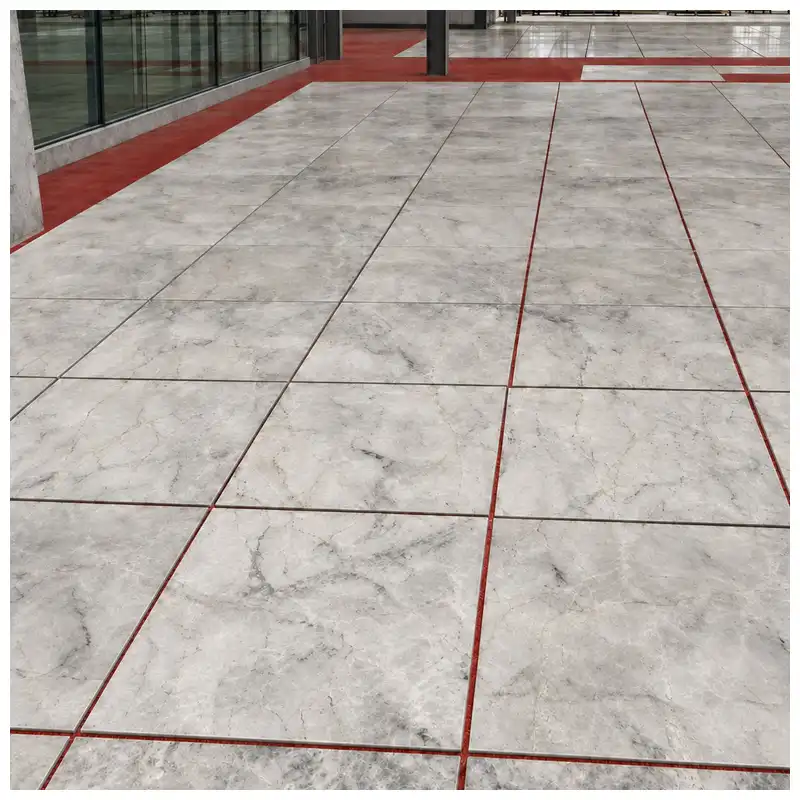
Calacatta Grey Quartzite Tiles
Grey-white quartzite tiles with natural veining for coordinated flooring, architectural walls and contemporary interior schemes.
View Product
Cristallo Quartzite Tiles
White crystalline quartzite for decorative wall treatments, selective backlit features and technically approved interior floors.
View Product
Black White Marble Waterjet Tiles
Contrasting natural marble pieces form repeating geometric floral designs for decorative entrances and formal lobby floors.
View Product
Palissandro White Marble Tiles
Cream-white marble with directional beige-grey bands for bright architectural walls and coordinated commercial interior floors.
View ProductFrequently Asked Questions About Ottoman Beige Marble Tiles
1. What is the difference between Ottoman Beige Marble and Ultraman Beige Marble?
Ottoman Beige and Ultraman Beige are commonly used trade names for related Turkish beige marble selections. The exact appearance can vary between quarry blocks and commercial grades. Buyers should confirm the actual stone photographs and physical samples rather than assuming every supplier uses these names for an identical selection.
2. Which Ottoman Beige Marble tile sizes are available?
The stated reference sizes are 300 × 300, 600 × 600 and 900 × 900 mm, with nominal thickness options of 10, 18 and 20 mm. Project-specific dimensions and the availability of particular size-thickness combinations should be confirmed before production.
3. Can polished Ottoman Beige Marble Tiles be used on bathroom floors?
A polished marble surface should not be assumed suitable for wet walking areas. Bathroom floor applications require review of the actual finish, tested slip performance, waterproofing system and applicable local requirements. A different finish may be considered where the project needs additional traction.
4. How can color variation be managed in a large marble flooring project?
The buyer should approve a representative stone color range before fabrication. Factory dry laying and grouping can help review the distribution of beige tones, while approved layout references and packing identification can guide installation. Natural color and veining differences cannot be completely eliminated.
5. Is Ottoman Beige Marble resistant to acidic cleaning chemicals?
No. Ottoman Beige is a calcareous marble and can be etched by acidic substances. Routine cleaning should use products suitable for natural marble. A penetrating sealer may reduce some staining risks, but it does not prevent acid etching.
6. What information is needed for custom Ottoman Beige Marble floor or wall tiles?
Buyers should provide architectural drawings, required tile dimensions, thickness, finish, installation area, intended environment and delivery destination. Projects involving wall panels, special borders or wet areas should also specify the relevant fixing, waterproofing and performance requirements.
Approving Ottoman Beige Marble for Your Interior Floor and Wall Specification
For a residential or commercial project using Ottoman Beige marble, material approval should begin with the actual stone selection. A satisfactory sample must establish the expected beige background, natural vein range and surface appearance before the full tile schedule is finalized.
The next decision is technical: tile size and thickness must match the intended floor or wall construction, and the selected surface must meet the applicable requirements for traffic, moisture exposure and maintenance. Published representative stone properties are useful for preliminary evaluation but cannot replace required project-specific reports.
Once the material and installation requirements are settled, the approved cutting drawings, dimensional tolerances and component references can be coordinated with the fabrication order. This allows the product selection to move from an appearance preference to a defined architectural specification.

Request Ottoman Beige Marble Tiles for Your Floor and Wall Project
KA UNITED can review Ottoman Beige Marble Tiles requirements for residential floors, hotel interiors, architectural walls and coordinated stone installations. The selected beige tone, surface finish and tile format should be established according to the intended interior design and technical conditions.
To prepare a quotation, provide your requested tile sizes, thickness, surface finish, architectural drawings, application area and delivery destination. Include any special cutting details, material selection requirements or performance criteria relevant to the project.
Hot Tags: ottoman beige marble tiles, China ottoman beige marble tiles suppliers, factory
You Might Also Like



Send Inquiry
