How To Buy Natural Stone?
How to Buy Natural Stone: Start With the Journey, Not the Color
Most people walk into a stone yard, or scroll through a supplier's gallery, and pick the slab that looks best in a photo. I understand the impulse. I did the same thing years ago. Natural stone is not a product off a shelf though. It is a material that changes from one block to the next, one slab to the next, one shipment to the next. If you buy on color alone, you are buying whatever happened to be photographed well that day, and you find out about the rest when the crate arrives.
The way to buy natural stone well is to understand the route it travels before it reaches you. Quarry, block, saw, slab, inspection, batch, layout, fabrication, packing, transport. Every stage adds cost and risk, and every stage hands you something to check. How to buy natural stone without regret is mostly a question of which stages you check before you sign. I want to walk that route in the order a real export order moves, because that is where the surprises actually live, and it is the part most buying guides skip.
For interior decoration, the two stones you will meet most often are granite and marble, and they are not interchangeable. Marble is calcite-based, softer, and sensitive to acid, so it belongs indoors on walls, floors, windowsills, and vanity tops. Granite is harder and denser, which is why it carries a kitchen countertop or a stair tread. Polished granite gives you a mirror finish for tabletops and walls, while flamed or bush-hammered granite gives you grip for outdoor steps. That split matters before you even think about color.
Choose the Block Before You Choose the Color
Every slab starts as a raw block pulled from a quarry, and the block decides almost everything downstream. Its size sets the biggest slab you can cut. Its fracture lines set how many slabs survive. Its color banding sets whether a batch will ever match. When a supplier quotes you a price, part of that price is the block they selected, and a cheap block can hide fractures that only show up after the saw.
That is why I tell buyers to ask where the material is quarried and how the blocks are picked. A careful processor walks the block before the first cut and reads it: visible fissures, color drift, mineral pockets, likely yield. You cannot do this from your kitchen, but you can ask for it. If a supplier cannot tell you anything about the block beyond a color name, that tells you something about how much control they actually have.
Block selection also decides whether your project fits on one slab. A long kitchen island wants a slab wide enough to run without a seam, and if the block is too small, you get a joint where you wanted a clean sweep. Ask for the slab dimensions up front and check them against your layout before you fall in love with a stone. A color you like is only useful if the block can give you the size you actually need.
Inspect the Slab, Not Just the Photo
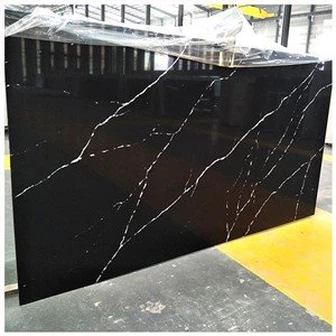
Photos lie about stone more than any other material I know. A camera flattens tone, hides fissures, and can make a cloudy slab look crisp. Before you commit to a slab, you need eyes on it, or at least a set of photos taken the way a factory actually inspects: full surface, close-up on any repair, backlit if it is translucent, and under daylight rather than showroom spot.
When you do get a slab in front of you, check the obvious defects first: cracks, chips, color lines, spots, pits, warpage, stains. Stand back about 1.5 meters under natural light and check whether the color and pattern read consistent across the whole surface. Then look closer at the grain. A good granite shows even grain and fine texture, while poor granite shows uneven grain size. A good marble shows fine surface, even luster, and no repair marks, while a low-grade slab shows fillers and dull patches. I keep a fuller list of these checks in our article on how to quickly identify stone quality, which is worth reading before you buy.
There is one test I run on every sample I can get my hands on. Put a drop of ink or dark liquid on the back of the slab. If it spreads and soaks in fast, the stone is porous and loose, with high water absorption and lower compressive strength. If the drop sits on the surface, the structure is dense. It is a two-minute check that tells you more about the material than the polished face ever will.
Batch Consistency: Two Slabs From the Same Quarry Are Not the Same Slab
A single countertop rarely comes from one slab. A kitchen island plus a perimeter run can need three, four, five slabs, and they all have to read as one surface. That is where batch consistency decides whether the job looks deliberate or patched together. Stone from the same quarry, even the same block, shifts in tone and veining as you move through it.
When you buy, ask which slabs will come from the same bundle or batch, and ask for photos of the exact slabs rather than a representative one. This matters most for white and light stones, where a slight tone shift between two slabs sits next to each other at a seam and reads as a mistake. For a large run I always ask the supplier to send the batch photos together so I can see whether the set will actually hang together. The questions I go through with buyers before they commit are collected in our pre-order FAQ, which lists what to confirm with a supplier first.
White stones deserve an extra warning. Under warm bathroom light, a slab that looked bright white in the warehouse can read cream, and two slabs from different batches drift in opposite directions. If the job is a vanity top or a bathroom wall, ask to see the batch photos under a light closer to the room's actual temperature. Light is the variable that catches people, and a mismatched white vanity is the first thing a client notices in the morning.
Vein Matching and Dry-Lay: Making the Seams Look Planned
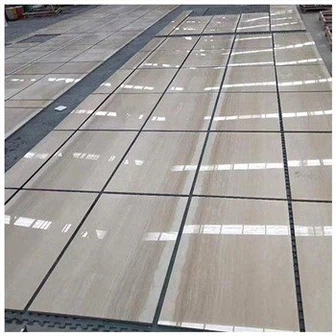
The most expensive part of a natural stone job is often not the stone itself, it is the layout. Veins do not stop politely at the edge of a slab. They run at an angle, and if two slabs meet at a seam with veins pointing in opposite directions, the joint jumps out at you. A dry-lay, where the fabricator lays the slabs out on the floor in install order, is how that flow gets planned before a single cut.
Bookmatching takes this further: two slabs cut from the same block and opened like a book so the veins mirror each other across a seam or a full wall. It looks striking, but it costs more and needs slabs with clean, continuous veining to work. If the veining is muddy, bookmatching just doubles the visual noise. This is a decision you make at selection, not at installation, so ask to see the dry-lay photos for your exact slabs before the saw starts.
Tolerance: Where the Gaps and Lippage Come From
Every stone has a tolerance, the small allowed difference in thickness, squareness, and flatness from one slab to the next. Careful suppliers keep this tight. Sloppy ones do not, and you find out at install when one countertop sits a millimeter higher than the next at the seam. That step is called lippage, and it is the fastest way to make an expensive job look cheap.
Thickness matters for more than looks. A slab that varies across its surface flexes differently when it is carried and cut, and thin spots chip at the edges. When you buy, ask about thickness tolerance and edge flatness. If you are having pieces fabricated, ask for a cutting plan that maps which part of each slab becomes which countertop. A supplier who cannot give you tolerances is asking you to take the variance blind.
Cutouts are where tolerance gets personal. A sink or cooktop opening is cut after the slab is measured, and a slab that is not square or flat throws that measurement off, so the faucet holes or the cooktop rim sit slightly wrong. I ask fabricators to template the finished pieces from the actual slab rather than from a drawing, and I check the cutout positions before the piece goes on the truck.
Packing: The Wood Crate Is Part of the Product
Stone spends days or weeks in transit, and most of the damage I have seen did not happen in the quarry or the factory. It happened in the crate. A good export pack stands slabs on edge inside a timber crate, separates each face with foam or a soft spacer, braces the corners, and marks the outside so handlers know which way is up and where to lift. A bad pack lays slabs flat, lets them rattle, and turns a sea crossing into a grinder.
For international orders, the wood itself has to follow ISPM-15 treatment rules so the crate does not get held at customs. Ask to see loading photos of your actual bundle before it ships. This is where you don't cheap out: a held container is a delayed project, and the fix costs more than the crate ever did.
The crate is not the only thing that has to be right. The outside should carry shipping marks that match the packing list, and the packing list should match the invoice, so customs and the buyer's receiving team are reading the same thing. When those documents drift apart, containers get flagged and projects wait. It is boring paperwork, but it is the kind of boring that keeps a kitchen on schedule.
Transport: A-Frame Racking and the Container
Inside the container, slabs are racked on A-frame supports, leaning at a shallow angle so the weight presses down through the frame instead of onto the slab edge. That angle is the difference between a slab that arrives flat and one that arrives cracked from a hard bump at sea. The slabs need to be strapped so they cannot slide, and the frame has to be wedged or nailed to the container floor.
I keep coming back to the journey because it is where the risk hides. A slab is heavy, brittle in the wrong direction, and unforgiving of a sudden stop. When you understand how it travels, you understand why some suppliers cost more: they are paying for the frame, the crate, the blocking, and the labor to do it right. The ones who cut that corner pass the cost to you in the form of a cracked slab that nobody wants to pay to replace.
Here is the whole route in one view. It is the checklist I keep in my head for any natural stone order, and it matches the stages we just walked through.
| Stage | What to check | What goes wrong if you skip it |
|---|---|---|
| Quarry block | Fissures, color banding, block size, likely yield | Slabs crack on the saw, the batch never matches |
| Slab inspection | Cracks, chips, repair marks, tone under daylight, ink test | Defects show up only after fabrication |
| Batch match | Tone and veining across every slab in the order | Seams look patched, light stones drift in tone |
| Vein layout and dry-lay | Vein direction across joints, bookmatch continuity | Seams point the wrong way, layout looks random |
| Tolerance | Thickness variance, squareness, edge flatness | Lippage at seams, chipped thin edges |
| Packing | Crate construction, slab separation, corner bracing, shipping marks | Chips and cracks in transit |
| Transport | A-frame angle, strapping, blocking to container floor | Slab racking and damage on arrival |
Frequently Asked Questions
What is the difference between granite and marble when I am buying for a home?
Granite is denser and harder, which is why it takes kitchen counters, stair treads, and outdoor paving. Polished granite suits tabletops and walls, while flamed or bush-hammered granite gives outdoor steps their grip. Marble is calcite-based, softer, and reactive to acid, so it belongs indoors on walls, floors, windowsills, and vanity tops. The choice is not really about beauty. It is about where the stone will live and what it will meet every day.
How do I check the quality of a stone slab before I pay?
Look at the full slab under natural light from about 1.5 meters and check for cracks, chips, color lines, spots, pits, warpage, and stains. Then check the grain: even and fine on good granite, uniform luster with no repair marks on good marble. Drop ink or dark liquid on the back and watch whether it soaks in fast. A porous slab has high water absorption and lower compressive strength. I covered these checks step by step in our article on identifying stone quality, which you can find linked earlier in this guide.
Should I ask for the radionuclide test report?
Yes, for granite especially. Some granite, often red, brown, or green tones and pieces with large red spots, can register higher natural radionuclide levels than others. Ask the supplier for the product's test report and check the origin, the radionuclide category, and any limits on where the stone may be used. If the report is missing or unclear, send a sample to a third-party lab before you install it in a home.
Why do slabs from the same quarry look different, and how do I avoid a mismatch?
Tone and veining shift as you move through a block, so two slabs from the same quarry can sit side by side and still not match. Order from one batch, ask for photos of the exact slabs you are buying, and request a dry-lay plan that shows which slab becomes which countertop. For light stones, ask the supplier to photograph the batch together so you can judge the tone as a set rather than one slab at a time.
What packing and transport details should I confirm for an export order?
Ask that slabs be packed on edge in a timber crate with a soft spacer between faces and bracing at the corners. Confirm the wood follows ISPM-15 treatment for international shipping. Inside the container, slabs should ride on A-frame racks, strapped and blocked to the floor. Ask for loading photos of your bundle before it sails. These details are cheap to get right and expensive to skip.
Final Conclusion
Buying natural stone is a small exercise in following a material backward. The color is the last thing you should decide and the first thing most people do. The block, the slab inspection, the batch, the vein layout, the tolerance, the crate, and the A-frame all come first, and each one changes what actually shows up at your door. That, to me, is how to buy natural stone without buying a problem. Get those checks right and the stone earns its price for decades. Skip them and you are paying a premium for a color that hides the problems you never asked about. That is the whole reason I would rather walk a buyer through the route than hand them a pretty photo, and it is exactly the kind of end-to-end attention to detail that KA UNITED is built around.