Why Sourcing Taj Mahal Quartzite Slabs from China Offers the Best ROI?
Quick Summary
From Brazil to China to You: Decoding the ROI of Sourcing Taj Mahal Quartzite Slabs for Luxury Developments
The ROI case for Taj Mahal Quartzite Slabs is not built on price alone. It is built on how the global stone supply chain actually works in 2026. The strongest value typically appears when Brazilian blocks are processed in China, where factories have mature stone infrastructure, dense export ecosystems, and strong technical fabrication capabilities. That combination matters because premium buyers do not just need a beautiful slab. They need repeatable quality, predictable lead times, and a project result that stays within budget.
KA UNITED works with buyers who think in terms of return on investment, not just material acquisition. When the end goal is a luxury kitchen, hotel lobby, villa package, or commercial fit-out, the sourcing question becomes strategic. The key issue is whether the buyer should buy locally from a distributor or source directly from a Taj Mahal Quartzite Slabs manufacturer or direct exotic stone exporter in China. In many cases, the China route wins because it turns raw block quality into a finished project advantage.
Buyers who want to review product-level references can start with Taj Mahal Quartzite, Taj Mahal Quartzite Slab, and Taj Mahal Quartzite Countertops. Those product families help illustrate how sourcing decisions influence the final project outcome.
1. The Global Supply Chain: Why the Brazil-China Pipeline Exists
1.1 Why China is the primary processing destination
The Brazil-China pipeline exists because China has become the world's major stone processing and finishing hub for many premium natural materials, including Taj Mahal Quartzite Slabs. Raw Brazilian blocks are shipped to China because factories there offer strong processing capacity, dense logistics networks, and a wide ecosystem of saws, polishers, resin lines, and project packaging systems. In practical terms, that means more efficient conversion of raw block into export-ready slabs.
The result is not only lower cost. It is also better coordination. A buyer working with a premium quartzite supplier in China can often get a more organized chain from block evaluation to slab packing to final shipping. That matters in luxury procurement where timing and consistency are almost as important as price.
1.2 Industrial clustering in Shuitou and Yunfu
Shuitou and Yunfu are not just cities. They are stone industry ecosystems. The advantage of industrial clustering is that specialized services sit close to each other. A slab can be cut, resin-reinforced, polished, inspected, packed, and loaded with fewer delays because all the supporting trades are nearby. This increases speed and usually improves project control.
For buyers comparing a Chinese stone factory vs. local distributor cost analysis, this clustering often explains why factory-direct Chinese pricing can be materially better. Local distributors may add convenience, but they often cannot match the scale or technical depth of a large processing hub. That difference becomes especially visible in wholesale Taj Mahal Quartzite Slabs for commercial developments.
1.3 How direct exporters optimize the chain
A strong direct exotic stone exporter is not just a seller. It is a supply-chain coordinator. The exporter helps optimize the 2026 process by managing grade selection, export documentation, packing discipline, freight timing, and project-specific order sequences. That is why many buyers choose a direct channel rather than buying through multiple layers of markup.
For buyers who want source-level product evidence, Taj Mahal Granite Slab remains visible in some catalog routes, but the quartzite family is the real focus for high-end procurement.
2. Technical Specification Matrix: Ensuring 2026 Standard Compliance
The following table explains why Taj Mahal Quartzite Slabs are valued so highly in 2026 and why factory direct supply matters.
| Physical Property | Taj Mahal Quartzite (Grade A) | Requirement (ASTM) |
|---|---|---|
| Water Absorption Rate | 0.02% – 0.08% | < 0.10% (Superior) |
| Mohs Hardness | 7.0 – 7.5 | > 6.0 |
| Density | 2,650 – 2,680 kg/m³ | High Stability |
| Compressive Strength | 185 – 210 MPa | ASTM C170 |
| Acid Resistance | 100% Non-Etching | Chemical Inert |
These metrics explain why wholesale Taj Mahal Quartzite Slabs are not commodity stone. They are premium material with a high technical floor. The water absorption rate and hardness profile are especially important because they influence how the slab behaves in kitchens, lobbies, vanity systems, and outdoor-adjacent zones.
From a performance standpoint, the stone is well suited to high-use environments. That is why it supports custom quartzite fabrication services so effectively. The fabricator can cut, edge, and install the slab with confidence because the underlying stone is stable enough for premium applications.
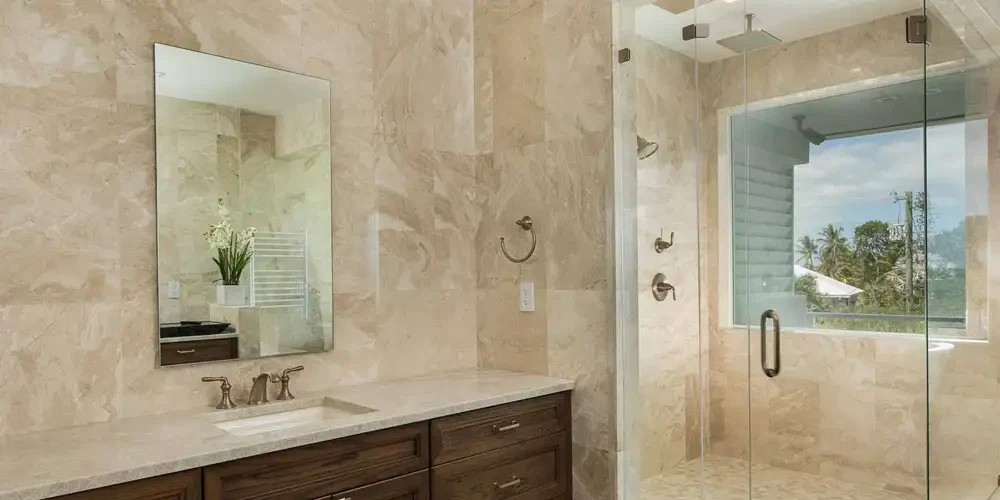
Buyers who need finished product examples can also review Taj Mahal Quartzite Vanity Top and Taj Mahal Quartzite Wash Basin. These product pages show how the technical profile translates into furniture and bathroom use.
3. The ROI of Advanced Fabrication: Technology over Labor
3.1 Italian machinery in China
One of the biggest hidden advantages of sourcing Taj Mahal Quartzite Slabs from China is the access to advanced machinery. Many Chinese stone factories use Italian lines such as Breton and Simas equipment, which improves precision slicing, polishing consistency, and production repeatability. This technology reduces waste and supports more accurate dimensional work.
The combination of high-end machinery and experienced operators is a major reason a Taj Mahal Quartzite Slabs factory in China can offer stronger ROI than a fragmented local supply chain.
3.2 Precision slicing and jumbo slab yield
Precision slicing matters because quartzite is expensive to waste. Better cutting systems create more jumbo slabs from each block and reduce unnecessary breakage. When the factory can extract more usable area from the same block, the customer's effective cost per square meter improves. This is one of the strongest economic arguments for factory-direct sourcing.
In practice, that means more consistent availability for large projects and less risk that the buyer must settle for inferior material. For bulk stone export from China, this is a serious advantage.
3.3 Pre-cut project pieces
Another source of ROI is custom quartzite fabrication services. When a factory can deliver pre-cut project components, the buyer saves labor hours, site waste, and coordination effort. That is especially useful for developers and contractors who need integrated sinks, waterfall edges, wall panels, and matched vanity systems.
Buyers who want to compare slab and tile programs can also review Taj Mahal Quartzite Tiles and Taj Mahal Quartzite Low Plinth Tables.
ROI Factors: Sourcing From China vs. Traditional Channels
| Sourcing Metric | Local Distributors | China Direct (KA UNITED) |
|---|---|---|
| Inventory Access | Limited (Local Stock) | Unlimited (3,000sqm+ Ready) |
| Custom Fabrication | High Surcharge | Factory-Direct CNC Cost |
| Quality Grading | Mixed Batches | Strict "A-Grade" Selection |
| Lead Time (Bulk) | Dependent on Imports | Immediate Dispatch (In-Stock) |
*Analysis based on 2026 global stone logistics and premium project procurement data.

4. Pattern Grading and Aesthetic ROI
4.1 The color spectrum
Taj Mahal is a stone of controlled warmth. In the market, the most desirable faces often sit in the Pearl, Champagne, and Gold-veined spectrum. The cleaner and more consistent the background, the higher the premium. A slab with soft movement and calm tonal balance usually performs better in luxury interiors than one with noisy variation.
This is where a premium quartzite supplier in China can outperform local boutiques. The supplier may have deeper inventory and broader access to matching slab families, which means better pairing for large rooms or repeated units.
4.2 Book-matching and digital mapping
Symmetry matters in large interiors. A premium supplier should use digital slab mapping to plan book-matching across feature walls, kitchen islands, and full-height panels. The more accurate the mapping, the better the final luxury effect. This is one of the reasons buyers value direct manufacturing channels over random retail stock.
For design examples, buyers can review Taj Mahal Quartzite Slab and Taj Mahal Quartzite Countertops. These formats show how pattern consistency affects premium appearance.
4.3 Inventory depth versus boutique sourcing
A wholesale Brazilian quartzite supplier often has better inventory depth than a local boutique because it is buying and processing at higher volume. That depth matters when the project needs matching lots or several slabs with similar color behavior. Local distributors may be convenient, but they cannot always offer the same level of continuity.
This is especially important for developers who need repeatable results across multiple kitchens or suites.
5. Quartzite vs. Marble: The Long-Term Maintenance ROI
5.1 Lifecycle analysis
One of the strongest ROI arguments for quartzite is maintenance. Compared with marble, Taj Mahal Quartzite can reduce long-term maintenance liabilities substantially because it resists etching and staining far better. For many developers, the maintenance delta over 10 years is more meaningful than the initial purchase delta.
In practical terms, the stone's hardness and low absorption reduce the need for frequent rescue work. That is why high-end hospitality and luxury home developers often prefer quartzite for heavy-use areas.
5.2 Resale value 2026
Natural stone continues to support resale value because buyers view it as premium and authentic. But not all natural stone is equal. Quartzite often ages more gracefully than marble because it shows less etching and less maintenance fatigue. That is important in high-end property appraisals, where visual condition and perceived longevity matter.
This is one reason Luxury Quartzite often outperforms more fragile stones in the eyes of future buyers.
5.3 High-traffic zones
The hospitality industry has been shifting toward quartzite for high-traffic zones because the stone can maintain a polished, premium look under more demanding use. That is why bulk stone export from China increasingly focuses on quartzite rather than softer stones. The ROI is stronger when the material survives repeated contact without frequent restoration.
For bathroom and interior examples, buyers can compare Taj Mahal Quartzite Vanity Top and Taj Mahal Quartzite Wash Basin.
The "World's Warehouse" Effect
Sourcing from our Shuitou Luxury Stone Warehouse provides an unmatched ROI due to logistics consolidation. In this global hub, KA UNITED maintains a high-turnover inventory of Taj Mahal Quartzite (18mm & 20mm), allowing for:
- Instant Inspection: High-definition slab photos and video inspections of over 3,000 square meters of current stock.
- Mixed Container Shipping: Combine Taj Mahal slabs with other exotic stones or cut-to-size products in a single shipment to maximize freight efficiency.
6. Comparative Pricing: China vs. The World 2026
6.1 Labor dynamics
Fabrication labor is a major component of final cost. In China, industrial clustering helps reduce labor inefficiency because the machinery, manpower, and logistics are all connected in one ecosystem. By contrast, North American and European fabrication often involves higher labor rates and less concentrated supply. That difference is a key reason many buyers seek a premium quartzite supplier in China.
The pricing benefit does not come from cutting corners. It comes from scale, technical maturity, and supply-chain density.

6.2 Economies of scale
A high-volume Taj Mahal Quartzite Slabs manufacturer can often offer 20–30% lower unit prices because the plant is optimized for repetition, throughput, and slab utilization. Higher volumes usually mean lower waste and better machine utilization, which creates better economics for the buyer.
6.3 Logistics and landed cost
Shipping surcharges still matter in 2026, but the ROI can remain strong if the buyer works with a supplier that knows how to manage packing, freight timing, and customs paperwork. The true price comparison is not ex-factory only. It is landed cost plus fabrication savings plus long-term maintenance savings.
For product planning, buyers may also review Taj Mahal Quartzite and Taj Mahal Quartzite Slab to understand format and sourcing context.
7. Installation Engineering: Professional Advice for 2026 Projects
7.1 Substrate preparation
Quartzite is dense enough to require proper substrate design. Cabinets, wall systems, and support structures must be prepared for the weight of the material. That matters especially when the project includes large islands, full-height cladding, or integrated furniture pieces.
Installation failures usually begin below the stone, not in the stone itself. That is why contractors and project managers must verify the structure before setting Taj Mahal Quartzite Slabs.
7.2 Adhesive science
Bleed-through can ruin a light quartzite installation. To avoid it, installers should use the correct 2026 chemical binders-white, moisture-neutral, non-staining epoxies. The adhesive should support the stone without leaving shadows or discoloration at the seam lines.
7.3 Edge-profile mapping
If the project includes mitered details or waterfall edges, the fabricator must map the edge profile carefully. That is the only way to keep vein continuity and avoid abrupt visual breaks. This is where custom quartzite fabrication services create real value. They turn an expensive slab into a coherent architectural object rather than just a cut surface.
Buyers interested in furniture and bathroom applications can also review Taj Mahal Quartzite Vanity Top and Taj Mahal Quartzite Low Plinth Tables.
8. ESG and Regulatory Compliance: The Green ROI
8.1 Silica safety and wet processing
In 2026, wet-processing mandates are increasingly important in quartz-rich stone shops. A responsible Taj Mahal Quartzite Slabs factory should have procedures in place for dust suppression, worker protection, and safe cutting. This is not only a compliance issue. It is also a quality issue because wet processing often produces cleaner cuts and better finishing control.
8.2 Water recycling systems
Buyers increasingly look for environmental credibility. A premium quartzite supplier in China with water-recycling systems and slurry management can support ESG targets and make the project easier to defend in public or corporate settings. This is especially relevant for commercial clients with sustainability requirements.
8.3 Traceability and digital IDs
Digital ID tags help verify where a block came from and whether the sourcing path was responsibly managed. That traceability matters for high-end buyers who want confidence in both origin and ethics. A strong direct exotic stone exporter should be able to support this documentation process from block to slab to shipment.
For application-level references, buyers can compare Taj Mahal Quartzite Tiles and Taj Mahal Quartzite Countertops.
9. Managing Risk in 2026 Procurement
9.1 Third-party inspections
For large orders, third-party inspection is not optional. SGS or Intertek audits help confirm slab quality, packing accuracy, and compliance before shipment. This matters in bulk stone export from China because even a strong factory can make mistakes if the order is not independently checked.
9.2 Remote selection with 8K and VR
High-resolution photography and VR have become essential procurement tools. Buyers can inspect slab tone, movement, and grain behavior remotely before approving a shipment. This reduces risk and helps the importer choose the exact lot that best suits the project.
In a luxury project, the ability to review slab families before they ship can save weeks of correction work later.
9.3 Customs and tariff documentation
A competent direct exotic stone exporter also helps manage customs and tariff paperwork. This can reduce delays and keep the project on schedule. In many cases, this is where the real savings happen-not just in material price but in avoided administrative friction.

10. Case Study: The 2026 Luxury Hotel ROI Model
10.1 Scenario: 2,000 SQM hotel lobby
Imagine a 5-star hotel lobby requiring 2,000 square meters of premium surface material. The developer needs a stone that feels luxurious, resists heavy traffic, and can be sourced with enough consistency to cover the entire project. This is exactly where wholesale Taj Mahal Quartzite Slabs from China can outperform a fragmented local buying strategy.
10.2 Financial breakdown
The savings appear in several places: lower unit fabrication cost, higher slab yield, better packaging, fewer delays, and lower long-term maintenance. The project also benefits from better matching across the lobby, corridors, and adjacent suites. A single supplier ecosystem reduces mismatch risk and improves scheduling.
10.3 Staying under budget
In this kind of project, the Taj Mahal Quartzite Slabs manufacturer is not just a vendor. It is the key to staying under budget because it controls the raw block input, the processing line, and the final shipment sequence. That direct control can make a large difference in the final tender outcome.
For product references, buyers can also review Taj Mahal Quartzite Slab and Taj Mahal Quartzite.
11. High-Intent Procurement FAQ
Why is Taj Mahal Quartzite cheaper in China?
Taj Mahal Quartzite Slabs are often cheaper in China because the country has dense industrial processing hubs, efficient factory clustering, and mature logistics networks. When Brazilian blocks are shipped to China for cutting and finishing, the buyer can benefit from scale, lower fabrication inefficiency, and a more integrated supply chain. The price advantage is usually not about lower quality. It is about industrial efficiency.
Is the quality of wholesale Taj Mahal Quartzite Slabs from China consistent?
It can be highly consistent when the factory has strong block selection, digital mapping, resin stabilization, and quality inspection systems. Buyers should verify the supplier's slab photos, grading criteria, and packing discipline. A good factory will provide consistency because repeatable quality is necessary to win project business.
What are the 2026 shipping times for bulk stone export from China?
Shipping times depend on order size, freight routes, customs processing, and production queue. In general, large orders should be planned on a project timeline rather than a retail timeline. Buyers should expect that the best results come from early ordering, clear specifications, and a supplier that can coordinate export documents efficiently.
How do I find a verified Taj Mahal Quartzite Slabs factory?
A verified factory should provide real block or slab photos, inspection reports, packaging examples, and clear export history. The buyer should also ask how the factory handles grading, resin reinforcement, and slab mapping. If the supplier cannot explain those points clearly, the buyer should continue searching.
For broader learning, buyers can also review the related article cards below.
Maximizing Your Investment with the Original Pioneer
The true Return on Investment (ROI) in the luxury stone industry is not found on a price tag-it is found in the reliability of the supply chain and the purity of the material. KA UNITED holds a distinguished position as one of China's first stone enterprises to import Taj Mahal Quartzite, giving us decades of deep-rooted relationships with Brazil's premier quarries.
Our operational strength is measurable: we import over 300 containers (20'GP) of high-grade Taj Mahal raw blocks annually. This direct "Brazil-to-China" bridge eliminates multiple layers of middleman markups, passing the savings and the quality control directly to our clients. For projects requiring immediate execution, our Shuitou Luxury Stone Warehouse maintains a permanent stock of over 3,000 square meters of 18mm and 20mm full slabs, each hand-selected for visual excellence.
The KA UNITED ROI Guarantee:
Direct Import Heritage + 300+ Annual Containers + 3,000sqm Ready-to-Ship Inventory.
Secure the best value for your 2026 luxury development.
Download Our Stock List & Direct Pricing Guide
Related Taj Mahla Quartzite Blogs
2026 The Ultimate Guide To Taj Mahal Quartzite
Primary reference for grading, origin, and market positioning.
Is Taj Mahal Quartzite Value to Buy?
ROI and value analysis for premium procurement.
Why Choose Taj Mahal Quartzite
Selection logic and buyer guidance.
60 Pcs Taj Mahal Quartzite Blocks One the Way
Block shipment and scale context.
Art Flow Luxury Stone Taj Mahal Quartzite
Design inspiration for visual applications.
Top 5 FAQs of Taj Mahal Quartzite
Quick answers for procurement teams.
Taj Mahal Quartzite vs Macaubas Fantasy 2026: Which Brazilian Quartzite is Better?
Comparison reading for luxury stone buyers.
Taj Mahal Quartzite vs Granite vs Marble 2026: Why Quartzite Wins for Durability?
Durability-focused comparison guide.
Taj Mahal Quartzite vs Engineered Quartz 2026: Ultimate Durability Test & Comparison
Companion guide for surface comparison.
How to Grade Taj Mahal Quartzite Blocks: A Guide from Direct Brazilian Importers
Block selection and importer guidance.
Taj Mahal Quartzite Fabrication Guide 2026: Cutting, Polishing & Edging Solutions
Fabrication advice for contractors and installers.
Best Kitchen Cabinet Colors to Pair with Taj Mahal Quartzite Countertops 2026
Design support for kitchen planning and color coordination.
Taj Mahal Quartzite Beyond Countertops: Backsplashes, Feature Walls & Floors 2026
Broader use cases beyond the kitchen island.
Top 2026 Kitchen Design Trends Featuring Taj Mahal Quartzite Countertops
Trend analysis for modern luxury kitchens.
The Complete Guide to Sealing & Cleaning Taj Mahal Quartzite (2026 Expert Tips)
Care and maintenance strategies for long-term performance.
Semantic Closure Content Block
Why does sourcing Taj Mahal Quartzite Slabs from China offer strong ROI?
Because China combines factory scale, technical processing, logistics density, and export coordination in a way that many local markets cannot match. The buyer gains not just a lower fabrication cost, but also better slab yield, more consistent grading, and stronger project control. For premium buyers, ROI is created through the whole chain, not only by the initial slab quote.
How should buyers think about the Brazil-China pipeline?
Buyers should see it as a value-creation system. Brazilian blocks provide the geology. Chinese factories provide the processing capacity. Exporters and suppliers coordinate the final output. When those pieces work together, the project gets better slabs, better pricing, and better delivery reliability. That is why the pipeline continues to dominate in 2026.
What should a project team consider before placing a bulk order?
The team should consider grading, slab size, matching requirements, finish type, fabrication scope, packaging quality, and shipping timing. Large orders fail when they are treated like simple stock purchases. They succeed when the supplier is evaluated as part of the project team.
Option: when should a developer choose factory-direct sourcing?
Factory-direct sourcing is best when the project needs price discipline, consistency, and technical support across many slabs or many units. It is especially useful for hotels, villas, commercial towers, and custom interiors. A good factory can reduce waste and improve overall project economics.
Consideration: what makes a reliable importer or exporter valuable?
A reliable importer or exporter manages block quality, factory communication, inspection, logistics, and paperwork without creating friction. In premium stone work, this role is decisive because the material is expensive and the margin for error is small. KA UNITED operates in this kind of project-oriented sourcing model, where procurement is judged by final outcome rather than just unit price.
FAQ
1. Why is Taj Mahal Quartzite cheaper in China than in the US?
Taj Mahal Quartzite Slabs are often cheaper in China because the country has concentrated stone-processing hubs, large-scale factories, and highly efficient production and export infrastructure. The cost difference is usually driven by labor efficiency, machine utilization, slab yield, and factory volume rather than lower stone quality. For buyers, the key advantage is that China can turn raw Brazilian material into finished export-ready slabs with lower unit cost and better scheduling control.
2. Is Chinese-processed quartzite high quality?
Yes, when the factory is well equipped and the process is disciplined. Chinese-processed quartzite can be very high quality because the industry has access to advanced cutting lines, resin systems, polishing equipment, and experienced production teams. The final quality depends on block selection, grading, inspection, and packaging. A good factory does not just process the stone; it manages the technical chain so the slab arrives ready for fabrication.
3. How do I verify a Taj Mahal Quartzite factory in 2026?
Verify the factory by asking for real slab photos, block origin records, inspection reports, packaging examples, and proof of export history. You should also ask how the factory handles grading, resin reinforcement, slab mapping, and third-party audits. If the supplier cannot explain those steps clearly, the buyer should be cautious. A genuine factory should be able to show process transparency, not just product pictures.
4. What are the 2026 shipping times for bulk stone export from China?
Shipping times vary by destination, order size, and customs complexity, but large stone orders should always be planned on a project timeline rather than a retail timeline. The best results come from early specification, early deposit, and a supplier that has strong freight coordination. For bulk stone export from China, the real risk is usually not production alone; it is production plus packing plus freight plus customs.
5. Who should buy wholesale Taj Mahal Quartzite Slabs from China?
Developers, contractors, fabricators, distributors, and serious homeowners with larger projects should consider wholesale Taj Mahal Quartzite Slabs from China when they need strong value, consistent grading, and export-ready supply. Factory-direct sourcing is especially attractive for hotels, villas, high-end residential projects, and commercial interiors where the buyer needs both quality and budget control. For many projects, it is the most balanced route between technical performance and ROI.
References
- ASTM International. ASTM C97/C97M Standard Test Methods for Absorption and Bulk Specific Gravity of Dimension Stone. ASTM International.
- ASTM International. ASTM C170/C170M Standard Test Method for Compressive Strength of Dimension Stone. ASTM International.
- Natural Stone Institute. Dimension Stone Design Manual. Natural Stone Institute.
- Natural Stone Institute. Stone Care and Cleaning Guidance. Natural Stone Institute.
- U.S. Geological Survey. Mineral Commodity Summaries: Stone (Dimension Stone). USGS.
- Stone Federation Great Britain. Natural Stone Specification and Maintenance Guidance. Stone Federation GB.
- Tile Council of North America. Installation Guidance for Natural Stone Surfaces. TCNA.
- Stone World Editorial Team. Natural Stone Fabrication and Installation Resources. Stone World.
For the ultimate guide on material properties and grading, revisit: 2026 The Ultimate Guide To Taj Mahal Quartzite.