Bathroom Vanity Drawer Slides: Load Rating, Extension, Soft-Close, And Sink Clearance
Bathroom Vanity Drawer Slides: Load Rating, Extension, Soft-Close, and Sink Clearance
A drawer can look generous on an elevation and lose half its useful depth once the trap, the supply lines, and the sink cutout are added. The slide is the hidden part that decides whether the drawer still opens, holds its load, and returns to the same reveal every time. I treat bathroom vanity drawer slides as an envelope problem: the box, the slide, the plumbing, and the sink all have to agree before the cabinet is released.
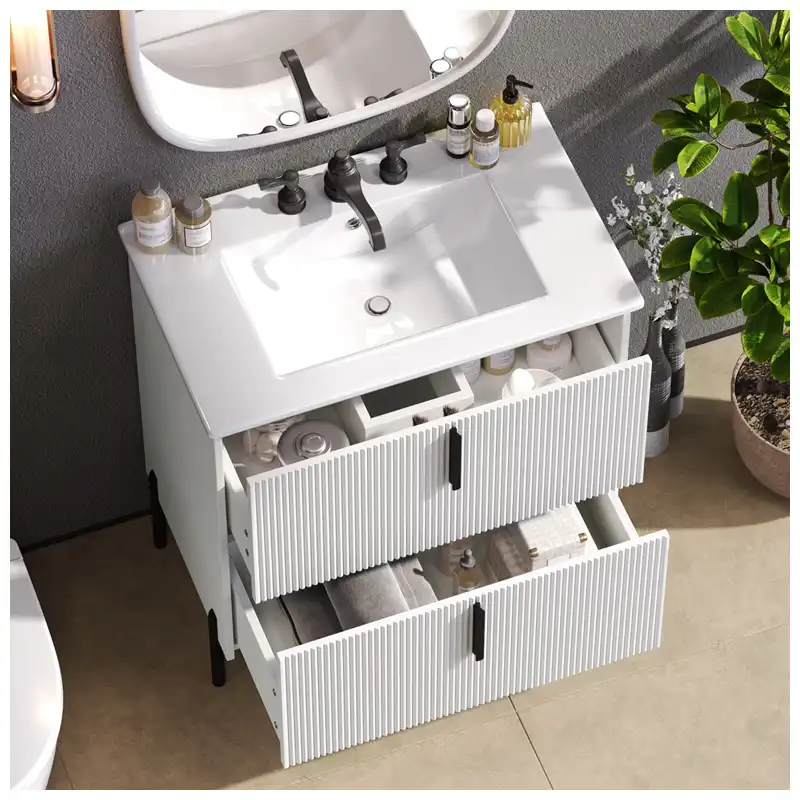
The first number people quote is the load rating, and it is the easiest one to misread. A slide rated for a hundred pounds sounds safe until you ask what the drawer will actually hold, how far it extends, and how many times a day it cycles in a busy bathroom.
Load Rating: What the Number Means and What It Skips
A load rating is usually a manufacturer's figure for a pair of slides under a specified mounting condition, not a promise that any drawer box will carry that weight forever. Towels, a hair dryer, and bottled products can add up faster than the spec sheet suggests, and a slide that is rated high but mounted on a thin cabinet side can still sag. I read the rating as a starting point, then test the drawer with the real contents.
The table below separates the common slide choices by how they behave in a bathroom, with the load figure as one line of evidence rather than the whole story.
| Slide type | Typical rating | Extension | Best in a bathroom |
|---|---|---|---|
| Side-mount ball bearing | 75 to 110 lb | Full or partial | Shallow drawers, low cost |
| Undermount, full extension | 100 lb or more | Full | Deep drawers, hidden hardware |
| Soft-close undermount | 100 lb or more | Full | Repeated use, quiet close |
| Standard roller | 50 to 75 lb | Partial | Light use only |
The ranges in the table are illustrative for residential and hotel vanity use; capacity depends on the specific manufacturer, slide length, and installation, so the model's published data sheet is the record that matters, and the test should be done with the actual drawer box, not a bare slide on a bench.
The cycle count matters as much as the load. A hotel bathroom drawer opens and closes many times a day, and a soft-close damper that feels fine on day one can degrade under repeated use if it is undersized for the duty. Cabinet hardware is graded by cycle testing under ANSI/BHMA A156.9, so I ask for the tested cycle figure and how the drawer will be used before I accept a rating.
The published rating applies under the manufacturer's stated mounting and load-distribution conditions, and the lab tests behind ANSI/BHMA A156.9 assess cabinet hardware rather than a complete cabinet system. A drawer that is overloaded or loaded unevenly can sag at the front, and bathroom vanity drawer slides can then carry a twisting load the rating never covered, so the specification needs a realistic contents list that matches what a guest or housekeeper will actually store.
Full Extension, Partial, and the Reach You Actually Get
Full-extension slides pull the drawer all the way out so the back of the box is reachable. Partial-extension slides stop the drawer short, leaving a few inches hidden at the back. For a deep vanity drawer holding towels or bottles, the difference is whether the item at the back can be reached without pulling the whole drawer off its runners.
I match the extension to the room routine. A housekeeper restocking amenities or a guest reaching a stored hair dryer wants the back of the drawer. A shallow tray drawer for small items does not need full extension. The extension type also changes the slide's depth inside the cabinet, which feeds back into the drawer box depth.
Soft-close on a drawer is a damper that catches the box in the last stretch, and it can add a little depth behind the drawer. The required depth varies substantially by slide system, so I take the exact figure from the selected system's data sheet rather than assuming the box stays where a standard slide left it.
Extension also changes the reach for maintenance. A full-extension slide lets a technician pull the drawer far enough to see the back and the release, while a partial slide hides the last few inches and the fixings with them. For bathroom vanity drawer slides under a sink, that reach difference decides whether a loose bracket can be found without removing the whole cabinet.
The Sink and Trap Own the Drawer Envelope
The sink is where bathroom vanity drawer slides run out of room. Wherever the drawer envelope would cross the bowl, the trap, or the supply lines, the box has to be shaped around them, and a layout that avoids the plumbing makes the shaping unnecessary. A U-shaped drawer wraps around the trap from below, and a notched drawer keeps a full front while cutting the back to clear the plumbing. Both need real dimensions on the drawing, not a generic notch added after production. I mark a working air gap around the trap and the supply lines on that drawing, sized from the sink, the trap, the rough-in, and the slide-maker's drawings, not guessed on site.
I overlay the drawer box on the sink template and the plumbing rough-in before the cabinet is cut. The question is not just whether the drawer opens, but whether it opens to full travel without the trap touching the box or the slide. A drawer that clears the trap empty can still catch a flexible hose when it is loaded and the box flexes.
Service access is the second half. A drawer has running clearance while it moves and service clearance for the plumber to reach the trap later. The release clips on undermount slides often sit at the front of the box, and a sink that overhangs the drawer can block them. A drawer that moves freely can still be impossible to remove for maintenance.
The Hard-Won Lesson: The drawer clears empty, then catches loaded
A drawer can pass a shop test with nothing in it, then stick once the towels go in and the box flexes against a flexible hose. The slide is not defective. The envelope was drawn without the load and without the plumbing's real position, so the first guest who fills the drawer finds the fault.
The Lesson: Test the drawer loaded, over the actual trap, before the stone top hides the whole envelope.
Drawer Box Construction: What the Slide Screws Into
The slide is only as good as the box it mounts to. A dovetailed solid-wood or plywood box holds its screws and stays square under load, while a thin stapled box can rack and let the slide bind. The bottom panel and the front fixing matter too, because a drawer that flexes at the front catches the slide and loses its smooth travel.
I check the drawer box and the slide together, because the load rating assumes a box that holds its shape. A high-rated slide on a weak box sags the same way a weak slide on a strong box does. For a bathroom, the box also has to survive the humidity, so the material and the edge sealing belong in the same decision as the slide finish.
Mounting is the other half. Bathroom vanity drawer slides carry their load into the cabinet side of the bathroom vanity cabinet through its specified runner fixings and any rear bracket used by that installation, so the side panel thickness and the screw position decide how much of the rating is real. A slide screwed near a machined edge or into a void will pull loose from the wood long before the steel shows any wear, which is why I keep the mounting detail beside the load figure on the schedule.
The same envelope decides the drawer's front reveal. When the box is notched around the trap, the front has to stay full and flat, because a visible notch on the front reads as a repair. The slide and the notch geometry are drawn together so the front stays clean and the back clears the plumbing.
Undermount, Side-Mount, and the Corrosion Question
Undermount slides hide under the drawer box and give a clean look with full extension. Side-mount slides fix to the drawer sides and the cabinet sides, and they are cheaper and simpler to fit. The choice is not only about looks: undermount slides keep the hardware out of the visible side, while side-mount slides expose their rails when the drawer is open.
Corrosion follows the same rules as any bathroom hardware. Zinc plating gives basic protection, stainless steel and better coatings suit a steamy room, and the real weak points are the screw holes and cut edges where the plating is broken. The drawer box material matters too, because a slide screwed into a swollen or stripped drawer side will lose its grip long before the steel fails.
I keep the slide finish and the room condition in the same decision, and I note the slide model and load class in the handover file so a replacement slide matches what was originally fitted. The bathroom vanity cabinet hardware guide carries the package-level replacement logic, while this decision stays on the drawer itself.
Soft-Close on a Drawer: the Damper That Catches the Box
Drawer soft-close works the same way as door soft-close but under a different load, because a drawer carries weight through its whole travel. A hydraulic damper catches the box in the last stretch and decelerates it, while a simple silicone bumper mainly cushions contact rather than controlling the whole closing stroke. The difference shows when a loaded drawer is pushed hard and the damper has to stop real momentum.
I test the damper with the drawer loaded, because an empty drawer closes differently from one holding towels and bottles. A damper that struggles under load is pushed past its catch point every day, and the drawer slams with the contents bouncing. The soft-close on bathroom vanity drawer slides has to be rated for the loaded drawer, not the empty one.
The damper decision is separate from the load decision, even though they ride on the same slide. A slide can carry its rated load and still slam if the damper is undersized, or close softly and still sag if the box is weak. I keep the two checks apart so a good soft-close action does not hide a load problem, or the reverse.
Releasing a Drawer You Cannot See Under the Sink
Bathroom vanity drawer slides need a release plan, not just a running plan. On many undermount slides, the box lifts off or presses a clip to come free, and that action needs finger room at the front. When the vanity top overhangs the drawer or the sink blocks the front, the drawer can run fine and still be unremovable for plumbing work.
I confirm the release action in the mock-up with the top and sink in place, because that is the only time the real clearance exists. A drawer that releases in the shop and traps the plumber in the finished room is a package failure, not a hardware failure.
When a drawer sticks or sags after delivery, the first step is evidence. Photograph the drawer open and loaded, note where it catches, then compare the slide, box, and plumbing against the approved drawing before forcing anything. A documented adjustment is fine; a drawer box cut around unknown plumbing on site is usually a sign the envelope was never drawn.
Undermount slides also change what a technician can reach. Many side-mount slides expose their adjustment screws with the drawer open, and some undermount systems carry front-mounted adjustment and release devices, while others expect the drawer to come out for the same work. The answer is model-specific, so I record which style of bathroom vanity drawer slides was fitted, and how it adjusts, so maintenance knows what they can reach before they start.
Questions We Hear Before Release
1. What should the team confirm first about bathroom vanity drawer slides?
Confirm the load rating, the extension, and the drawer box clearance against the sink, trap, and supply lines before the cabinet is released.
2. What load rating does a bathroom vanity drawer need?
It depends on the contents and the use. A range of roughly 75 to 110 pounds is common for residential vanity drawers, but the real test is the drawer loaded with its actual contents.
3. What is the difference between full and partial extension?
Full extension pulls the drawer out so the back of the box is reachable, while partial extension stops short and hides a few inches at the back.
4. Why does the sink change the drawer design?
When the drawer envelope would cross the bowl, trap, or supply lines, the box is usually shaped around them, as a U-shape or a notch, with real dimensions on the drawing; a layout that avoids the plumbing needs no shaping.
5. What should happen when a drawer sticks or sags after delivery?
Photograph the drawer open and loaded, note where it catches, then check the installed slide, box, and plumbing against the approved drawing before adjusting or cutting anything.
Quick-Reference Checklist for Drawer Slides
- Confirm the load rating against the drawer's actual contents and daily cycles.
- Match the extension type to what a guest or housekeeper needs to reach.
- Overlay the drawer box on the sink template and plumbing rough-in.
- Verify the release action with the top and sink in place in the mock-up.
- Record the slide model and load class in the handover file.
Final Conclusion
A drawer slide is worth reading carefully because it is the part that turns a storage promise into a working drawer. I would rather test one drawer loaded over the real trap than approve a rating from a catalogue and inherit a floor of sticking drawers. KA UNITED keeps bathroom vanity drawer slides tied to the drawer box, the sink position, and the room that will pull them open every day.
References
- ANSI/KCMA A161.1 Performance and Construction Standard for Kitchen and Vanity Cabinets, Kitchen Cabinet Manufacturers Association.
- ANSI/BHMA A156.9 American National Standard for Cabinet Hardware, Builders Hardware Manufacturers Association.
- Kitchen and Bath Planning Guidelines, National Kitchen & Bath Association (NKBA).
- Architectural Woodwork Standards, Architectural Woodwork Institute.